Showing posts with label lugs. Show all posts

Thursday, January 20, 2011

Lugwork Preferences

[image via hbuckles]

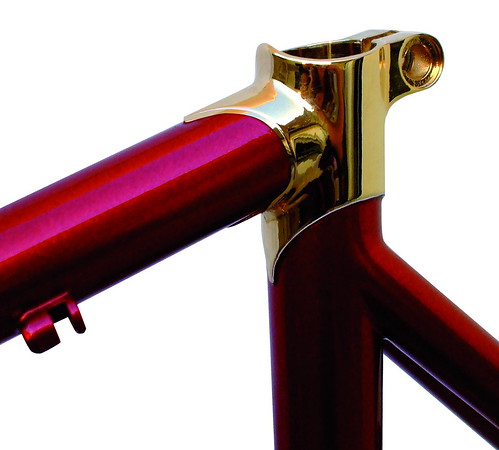
While I've come to appreciate some non-luggged methods of frame construction and have even discovered a bike that I truly think looks better without lugs (the truss frame), overall my infatuation with lugwork shows no signs of subsiding. I can go into a meditative trance whilst following the seemingly chaotic yet magically harmonious outlines of a Nervex lug (above) and I can experience a dizzying sense of exhilaration at the sight of a particularly intriguing seat cluster (below).

[image via Ciclo Di Cuoio]

Granted, it's kind of insane to feel so strongly about lugwork - but also perfectly normal for someone involved in art and design. After all, if designers and artists did not feel an obsessive emotional attachment to forms, colours and textures, what would motivate them to create new work? I don't see myself as a hands-on framebuilder, but I think that my dream "bike job" would be to work with a framebuilder as a designer - not only of overall frame specs, but of the lugwork itself. Some framebuilders make proprietary lugs from scratch, while others take pre-fab lugs and alter them beyond recognition - so it's possible to find someone to work with in that context. Some day.

[image via Mercian Cycles]

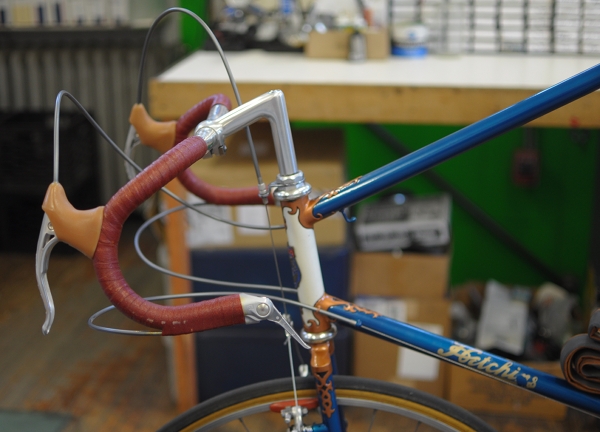
But back to lugs... As with everything, those who are into lugwork tend to have their preferences. For instance, for some it's "the fancier, the better," and their "holy grail" is the type of truly elaborate lugwork you might see on Hetchins frames. Some like their lugs chromed, or painted a contrasting colour to the frame.  Some prefer "pointy" lugs, while others prefer "rounded" ones. Many customers ordering custom frames ask for something personal or symbolic to be carved into at least some of the lugs, like a shamrock or a star of David. And others still might favour a particular manufacturer, preferring the distinct looks of Nervex lugs, Capella lugs, or Mercian's Vincitore lugs (above).

[image via Joel Greenblatt]

To my eye, lugwork looks best when it complements - but does not overwhelm - the overall form and "personality" of the bicycle frame. For that reason, I am actually not a fan of some of the fancier lugwork out there - to the extent that if someone were to give me a Hetchins with one of the elaborate lug patterns, I would sell it; it really does nothing for me aesthetically. To me, a bicycle frame is ultimately about the form of the frame itself, and I think that overly ornate lugwork competes with that. If the eye is continuously drawn to the joints of the tubes, that interferes with being able to take in the overall aesthetic - which is not something I'd want to happen if I were designing a bicycle. For the same reason, it does not appeal to me when lugwork contrasts dramatically with the main frame colour: For instance, chromed or white lugs on a black or a deep red frame. Close up, the effect is beautiful, but it just does not work for me as an overall design when looking at the complete bike as a whole.

[image via Gregory Townsend]

I do have my favourite design elements, such as double-plate fork crowns (above), elegant seat clusters, and main lugs with a filigreed look to them. But inasmuch as possible, I prefer for these elements to be noticeable only upon close inspection, so that when looking at the bicycle as a whole, the overall form is what dominates. Oh, and when it comes to utilitarian transportation bikes? The "jagged broken pipe" look of the old Raleigh Sports lugwork is just fine with me - the simpler the better.

What are your preferences? - if you like lugs at all, that is! Do you have a "dream lugwork" in mind if you had the choice, or would you leave it up to the framebuilder?

Saturday, December 11, 2010

The Best Time to Visit Your Bike Shop

Even though we live close to one another and normally cross paths on our own turf, this weekend I bumped into "cycler" from Biking in Heels 10 miles away - at Harris Cyclery. We'd both taken on projects that ended up throwing us curveballs, and now here we were. Even if you work on your bike yourself, it's good to find a trustworthy bike shop you can turn to just in case - and better still, a specific mechanic whose opinion and work you trust. The fact that I travel 10 miles to see Jim even though there are plenty of bike shops walking distance from my house, speaks for itself.

And if you are going to visit your local shop with a "project bike," there is no better time than the winter months. In the off season, bicycle shops tend to be less crowded, which means that they will be able to work on your bike sooner and will have more time to answer your questions. They are also more likely to have the components and accessories you want in stock, since things don't sell out as quickly as in the summer.

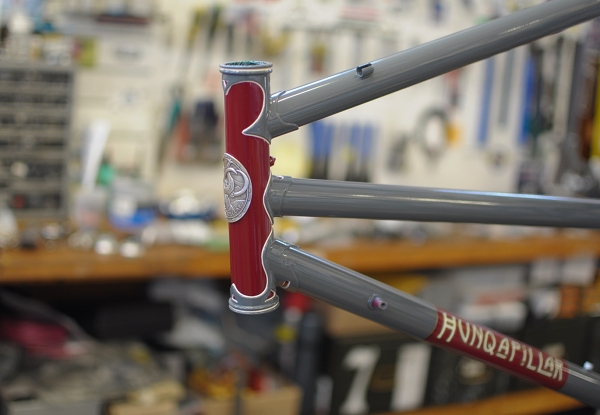
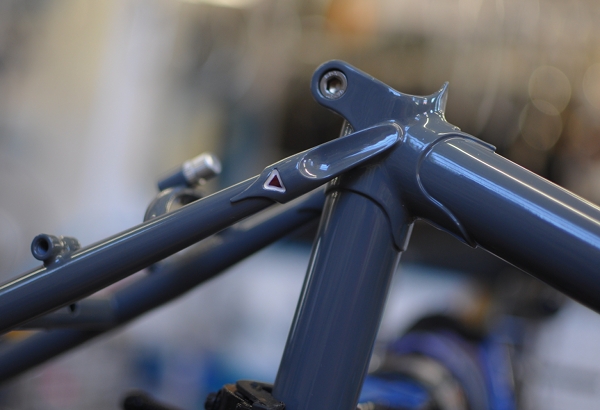
Some new floor models are likely to be available as well, since the shop will actually have time to build them up. This is the first time I've seen the Rivendell Hunqapillar - the version with the diagonal "middle tube." The design is definitely not for me and I cannot help but wonder how many people buying this bike will actually be using it in a way that necessitates this construction. But I do appreciate seeing the monster in person. The wooly mammoth headbadge and the decals are nicely done, as is the lugwork.

Never seen a seat cluster with a "socketed" seat stay like this before. Any idea what the purpose of this design is, assuming that it is more than aesthetic?

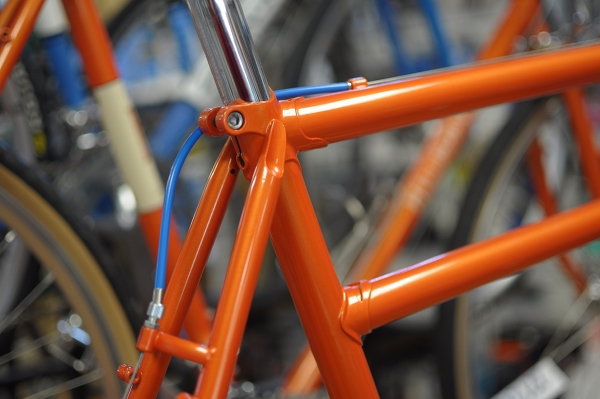
Between the Hunqapillar, the flock of other Rivendells, the vintage Hetchins, and other exotic specimens, it felt as if lugwork was declaring war on modern bikes and taking over the shop. My own modestly lugged bicycle seemed like an underachiever in comparison - though he held himself proudly and was quite happy to have the mechanic's attention.

Winter is also the time when bike shops hold end-of-the year sales, where good deals can be found if you are in the market for a new bike. And for those manufacturers whose models do not change year to year, winter is often the last chance to get a bike at the current price tag, before prices go up in the Spring. If you hang around long enough, you might also learn about non-advertised deals, including second hand bikes. Some of the most interesting vintage bicycles never make it to the likes of Craig's List or e-bay, but are sold via word of mouth. Bicycle shops can act as hubs for those types of connections. If you are looking for a particular bike, try asking your bike shop about it - they might just know of a customer, or a friend, who is trying to sell theirs. 

The winter months are infamously slow for the bicycle industry - but as a customer, you can take advantage of that in a way that benefits everyone: You get more personal attention, faster turn-around, and better deals - and the bike shop gets winter business. It's win-win!

Monday, November 1, 2010

Lugged Non-Steel?

[image via the IF Blog]

I have been curious about bicycles that are lugged, but not made of steel. The first ones I noticed were the lugged carbon fiber frames made by our local Independent Fabrications. I have seen a couple of these in person, and they are beautifully done. The picture above is a detail from the XS model. The lugs are painted titanium, over a clear-coated carbon fiber frame.

[image via the IF Blog]

Here is a detail shot of a cyclocross model where both the lugs and the frame are carbon fiber.

[image via the IF Blog]

And here is a Corvid model frame, from a bicycle built for Boston Celtic Ray Allen - the carbon lugs painted a metallic Celtics green. The lugs on the Independent Fabrications bikes are molded to incorporate the stylised crowns in the company's logo, so the look is especially striking. 

[image via Alchemy Bicycles]

Though I have never seen their frames in person, Alchemy Bicycles seems to be doing something similar - carbon fiber frames with aluminum lugwork. 

[image via Bruce Gordon]

And Bruce Gordon takes it one step further by making his titanium-lugged carbon fiber frames look like true classics. 

Reading the manufacturers' descriptions of the construction, I am wondering how IF and Alchemy integrate the lugs with the frame. I am nowhere close to knowledgeable when it comes to these manufacturing techniques, but don't the lugs run the risk of making the infamously brittle carbon fiber even more so? Is a lugged carbon frame "safe"? And is there any purpose, other than decorative, to lugging these frames? After all, I had thought that the very benefit of carbon fiber construction, was that it enabled the frame to be built in a single mold.

[image via aj_the_first]

But carbon fiber is not the only non-steel material being used in lugged bicycle construction. The above detail is from a wooden Porteur made by a small frame builder.

[image via aj_the_first]

The lug sleeves here are parts of actual lugged tubing, the lugwork rather elaborately done. Have a look at the flickr pictures that show his process - it's fascinating.


And a lugged faceted frame, made by Sylvan Cycles out of composite wood. The faceted tubing reminds me of this vintage lugged aluminum Caminade bicycle I wrote about earlier. It must feel interesting to ride a faceted bike. I have never heard of Sylvan Cycles before, but apparently they are made in Massachusetts. Amazing how many interesting local builders there are in our vicinity. 

[image via antbikemike]

And speaking of local builders and wooden tubing, I still can't get over the antique wooden showbike by ANT

[image via antbikemike]

The lugsleeves are copper-plated steel and they were designed to attain the aged look - which makes this bicycle seem wonderfully "alive" to me. 

But, same as with carbon fiber, I am wondering whether these wooden bicycles are truly ridable, and what effect the lugwork has on them structurally. Does it improve things, or is it mainly there for the "wow" factor? I would love to try a lugged wooden bicycle or a lugged carbon fiber bicycle some time, and would be interested to hear from those who have ridden one. These construction methods do not receive a great deal of attention, but they are certainly intriguing - and beautiful.

Tuesday, August 10, 2010

The Seat Cluster: a Starburst of Lugwork

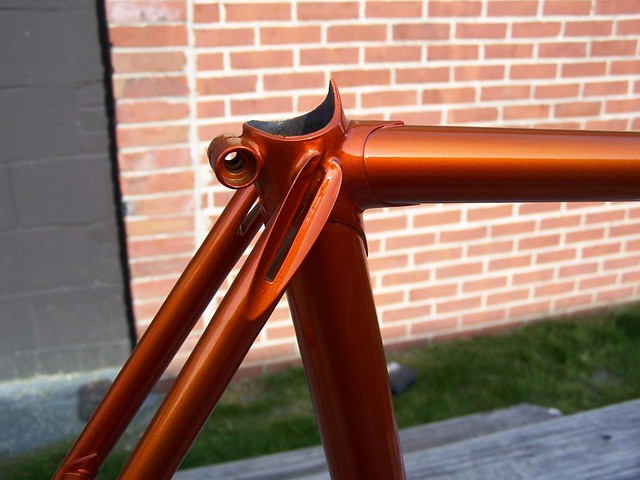
One of my favourite parts of a bicycle frame's anatomy is what's called the "seat cluster" - the joint where the seat tube, the top tube, and the rear stays of the bicycle meet. If done nicely, the seat cluster can look like a beautiful starburst of lugwork, and that is what I love about it.  On the picture above is the very classic seat cluster on the Waja trackbike I rode in Vienna earlier this summer. 

A similarly classic seat cluster on the Rivendell Sam Hillborne

[image via Franklyn W]

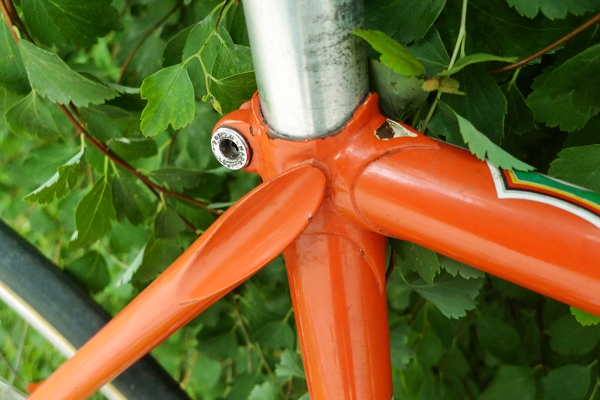
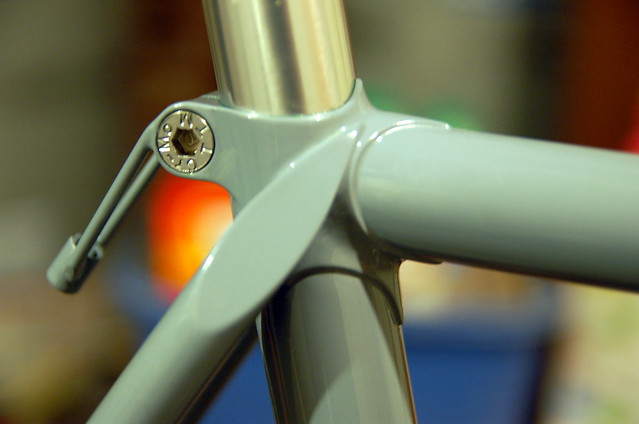
And another example from an Ebisu bicycle.  You can see how the individuality of the cut of the lugwork interacts with the colour of the paint to create subtle variations in form and shade. The stay caps (those narrow diagonal pieces that taper to meet the main lug) can be rounded or pointy, flat or concave, stubby or elongated.

[image via cycleczar]

They can even wrap all the way around the main seat lug, like on this Toei bicycle,  so that the pointy tips meet. This is called a "wrap around seat cluster" design.


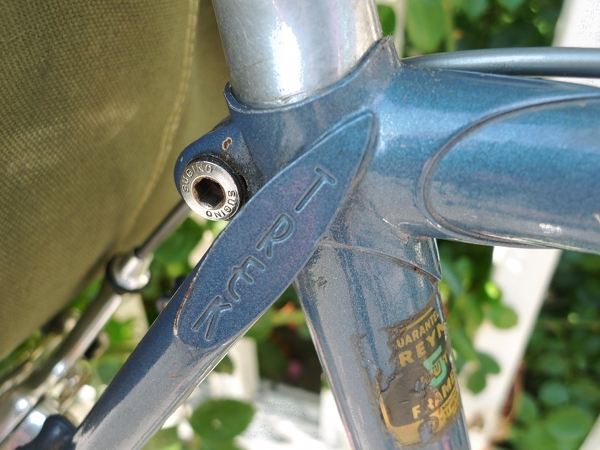
The stay caps also make for a good surface to embellish with an engraving of the manufacturer's name, like on this vintage Trek 610.

[image via Dancing Weapon]

Or with hand-painted flourishes, like on this Bob Jackson.

[image via Royal H.]

They can also be carved, if so desired, like on this early Royal H. frame.

[image via ribalrid]

While I prefer classic seat clusters, there are also many designs that deviate into all sorts of creative directions.  On this Bates B.A.R. bicycle, the seat stay caps look like sharpened pencils and meet the main lug at the bottom.

[image via somervillain]

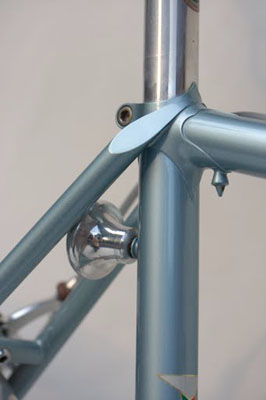
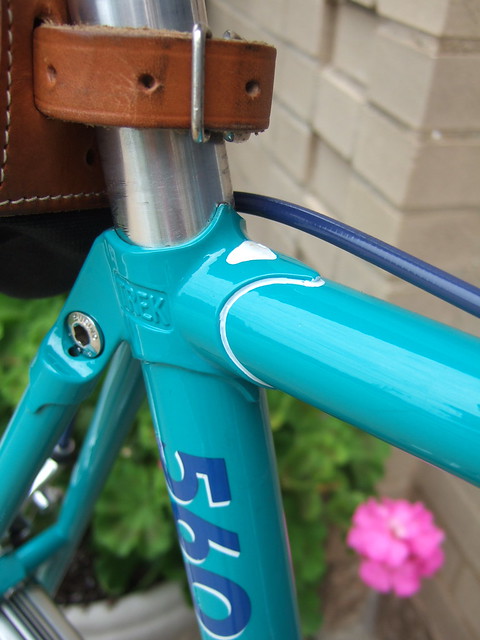
On this vintage Trek 560, the seat cluster is one big lug, and the seat stays are held by lugged sockets at the back.

[image via Kevin Saunders]

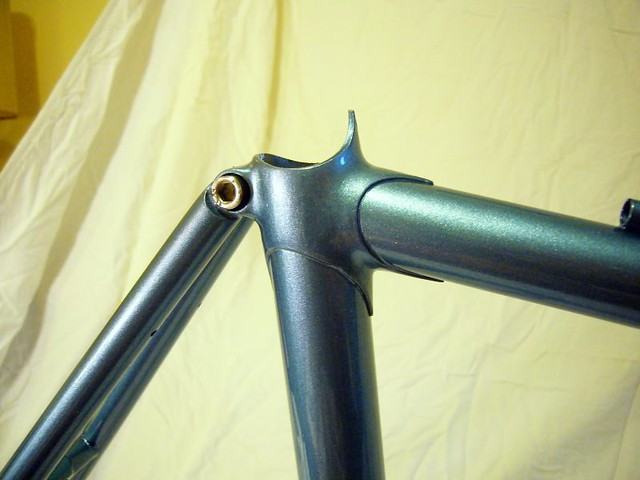
And then there are seat clusters where the stays connect to the tube directly, below the lug, like on this Formigli frame. (My understanding is that both this and the method used by Trek above is done to create tighter clearances?)

[image via Royal H.]

A similar approach to "fastback stays" by Royal H., with the seat stays attached at the rear.

When it comes to lugwork, there is no shortage of details to get obsessed about, and the topic can provide hours of impassioned discussion to those who feel strongly about one design over another. Crazy? Maybe so, but also beautiful... like the seat cluster on my Royal H. frame that will (hopefully very soon now) emerge as a fully built bicycle.