Showing posts with label frame building. Show all posts

Wednesday, January 26, 2011

Who's Afraid of Toe Overlap?

The idea of "toe overlap" or "toe clip overlap" (TCO) is one of those hot button topics that can cause metaphorical bloodshed in online discussions among bicycle enthusiasts. Still, I would like to have a go at it, as I think my perspective reflects the type of cyclist who does not typically take part in these debates. I would also like to discuss the topic from both sides of the argument, encouraging readers to form their own opinions. In short, here are my 2 cents:

What is toe overlap?
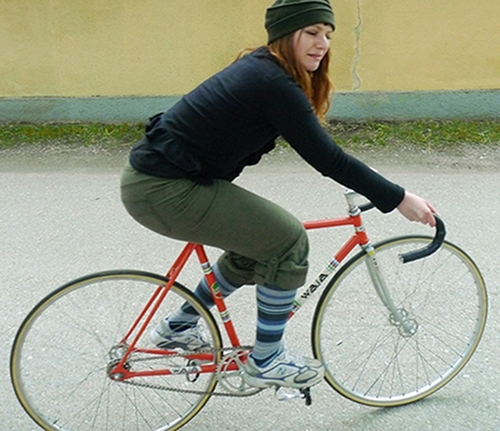
On some bicycles, it is possible to hit the front wheel with your toe when turning at slow speeds. This interference (or overlap) between your toe and the wheel can make you fall. Toe overlap is especially common on bicycles with small frame sizes and large wheels. If you picture what happens to the wheels of a bike as the frame gets smaller (as the top tube gets shorter, the wheels move closer together), it makes sense why that is so. 

Is toe overlap a problem? 
I don't think there is an answer to this question that rings true for everyone, but I will try to cover multiple sides of the argument.

An argument for "no": Chances are that you already have a bike with toe overlap and simply haven't noticed. Try it: make a slow, sharp U-turn on a quiet street or in a parking lot, and pay attention to whether your toe can potentially hit the wheel as you are making the turn. The overlap is more drastic on some bikes than on others, but most smaller-frame production bicycles have it to some degree. The reason many cyclists remain blissfully unaware of it, is that we rarely cycle at speeds slow enough for the wheel to turn so sharply as to cause the overlap. So while the overlap is a theoretical possibility, it is not usually a threat.

An argument for "yes": Cyclists do occasionally make turns slow enough to cause toe overlap. Instances when that might happen include the aforementioned U-turns, as well as slow turns in urban traffic. In addition, beginner cyclists tend to go slower than experienced cyclists - making them more vulnerable to toe overlap.

An argument for "no": Some in the bicycle industry will argue that toe overlap is not so much a "problem" as a reality, and it is the cyclist's responsibility to learn to deal with it. Even on bikes with dramatic toe overlap, and even when those bikes are fixed gear (i.e. coasting through a turn is not an option), there is a way to time your pedal strokes so that your toe does not hit the turned wheel. There are formulas and instructions for this. Over time, it becomes "second nature."

An argument for "yes": What is "second nature" to some, may not be to others, even over time. There are some experienced cyclists who've had bad falls as a result of toe overlap. The bottom line is, that if your bike has toe overlap, and if you actually manage to hit the front wheel with your toe as a result (or get your toe jammed in there, which also happens), you could have a bad fall while trying to execute a turn. Therefore, at least in theory, a bike with toe overlap is more accident prone, than a bike without. Some would argue that this in itself makes it a "problem" and not just a "feature" of the bike.

What can be done to avoid toe overlap on small size bikes?
In theory, a few things can be done by the framebuilder or manufacturer to create small size frames without toe overlap. The problem is, that all of these changes have consequences that can be perceived as drawbacks. For example:

Smaller wheel size: Toe overlap can usually be eliminated on a small frame by fitting the bike with proportionally smaller wheels. For instance: 650B instead of the typical 700C on a roadbike, or 26" instead of the typical 28" on a roadster-type bicycle. The reason this is seldom done on production bikes, is that it is more costly for a manufacturer to design different sized frames around different wheels. Additionally, cyclists themselves tend to have an aversion to smaller wheels, due to a commonly held belief that larger wheels are faster. This makes smaller wheeled bikes less popular, despite their no-TCO advantage.

Changes in frame geometry: Toe overlap can also be eliminated by a number of changes to frame geometry. The simplest method is to make the the top tube a bit longer and the seat tube a bit steeper, which will create more space between the front wheel and the crankset without changing the way a bicycle handles too much. However, a longer top tube means that you will either be too stretched out on the bike, or will need a super-short stem. And a steep seat tube means that you may either be uncomfortable with the aggressive angle, or will need to find a seat post with considerable set-back. If you prefer a relaxed seat tube angle and a reasonable top tube length, then the other options are more complicated, as they involve messing with the bicycle's handling: Making the head tube slacker and increasing the fork rake will reduce toe overlap as well, but it could make the bicycle less responsive, which many cyclists would find undesirable. I don't want to turn this into a lesson in frame geometry, but suffice to say that some would prefer to deal with the toe overlap, rather than make either of these changes to their bike.
Conclusions?
It is hard to find a definitive answer to the questions of whether toe overlap is a problem, and of how to eliminate it. Different frame builders, bicycle fitters, and other industry spokespersons will tell you different things, and they may all sound perfectly convincing and reasonable while you are listening to them... until you hear the other guy's argument for the opposite, and it will sound equally convincing and reasonable.

My personal view is that toe overlap is a problem if you consider it a problem. And if you do, then I don't think it's right for anybody in the bicycle industry to try and persuade you otherwise in order to sell you a bike. Ultimately, it should be up to the cyclist to decide and for the framebuilder, or salesperson, to accommodate.

Monday, January 24, 2011

Getting a Custom Bicycle, Part II: Choosing a Framebuilder

[Mike Flanigan of ANT Bikes, Holliston, MA]

Last year, I began what was meant to be a series of posts about ordering a custom bicycle frame. Overwhelmed by the topic, I stopped after the first one. But with an additional year of experience under my belt, with the deep winter chill we're having, and with an increasing number of readers ordering custom bicycles, this seems like a good time to resurrect the series. To start from the beginning, please read "Getting a Custom Bicycle, Part I: Why?" But if you already know that you want a custom frame and are hunting around for a framebuilder, I offer some ideas on finding the right one:

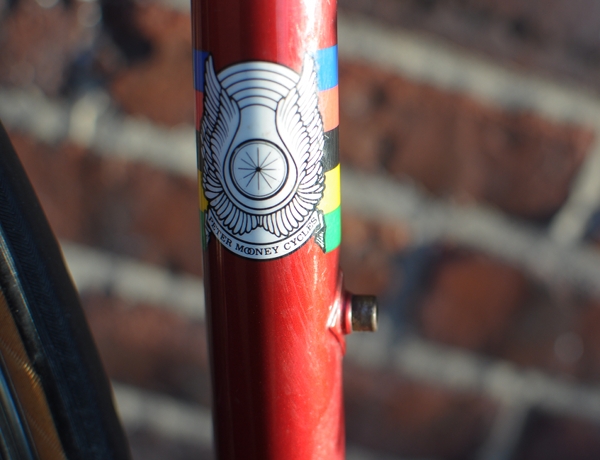
[Insignia on a Peter Mooney bike, Belmont, MA]

1. Avoid the "Who is the best?" mentality
To start with, I would like to note that I do not believe there exists such a creature as "the best" framebuilder. I have my obvious favourites, but that's all they are: my favourites. It does not matter how many Handmade Bicycle Show awards a framebuilder has won and how many blogs feature them. That stuff says very little about whether they are right for you, and I am afraid that those who rely on the big name/ new hottest thing factor in selecting the person who will build their frame, are setting themselves up for disappointment. There are many different types of bicycles and different types of cyclists out there. To me, what it's really about is finding a good three-way match between yourself, the framebuilder, and the type of bike you are looking for. So, when I receive emails asking me whom I believe to be "the best" framebuilder, all I can say is that's just not the way I would approach it.

[Bryan Hollingsworth of Royal H. Cycles, Somerville, MA]

2. Decide what kind of bike you want first
While I am not saying that you need to know all the minute details in advance, I think it is good to at least have a solid idea of what type of bicycle you want: racing vs mountain vs commuter, diamond vs step-through vs mixte, lugged steel vs welded vs carbon fiber, and so forth. Those are fundamental categories that ideally would be already formed in your mind before you seek out framebuilders. If you ask a builder, you may be surprised to learn how common it is for a customer who initially asked for one type of bike, to grow unsure about their choice over time, or to change their mind dramatically. When that happens, it will most likely create glitches in the framebuilding process - some of which may be resolvable, while others may not. But more importantly, it can mean that the framebuilder you chose initially may no longer even be the right person to make your bicycle. Which brings me to the next point...

[Armando Quiros of Quiros Custom Frames, Natick, MA]

2. Pick the best (hu)man for the job
Most framebuilders specialise in a particular type of frame (racing, touring, transportation...) or a particular type of construction (lugged, welded, fillet brazed...). And even the ones who can make "any kind of bike you want" are, more often than not, better at one type than at another, and have more experience in one type than another. If you are looking specifically for a lugged bicycle, it makes sense to pick a framebuilder who specialises in lugged steel and not in TIG-welding. If you are looking for a sturdy, step-through transportation bicycle, it makes sense to go to someone who has done plenty of them before and is familiar with all the challenges they entail - not to someone who mainly builds racing bikes. This is why it's helpful to take the time to do some research on the various framebuilders you are considering.

One thing to keep in mind, is that even knowing that you want a "touring bike" or a "transportation bike" is not enough, as these terms are subjective and different framebuilders have different understandings of what they mean. To some, a "transportation bike" means a diamond frame fixed gear bicycle, with some fenders and 28mm tires instead of the "normal" 20mm. To others, it means a step-through frame, upright handlebars, a basket, and enormous balloon tires. Don't take it for granted that your vision of these things will correspond to the framebuilder's vision. Get to know the framebuilder's design philosophy and aesthetic first.

In that context, I would also not be shy about contacting previous customers if you see that they have the type of bike you want (for example, if you find their flickr pictures when searching for a particular framebuilder). People usually love to discuss their custom bikes and will probably be pleased to hear from you. Contacting them may help you determine whether their bike is typical of the framebuilder's work, and how pleased they are with the result. This type of feedback, especially from multiple customers, can be as helpful as the information on the framebuilder's website.

[Marty and Brad of Geekhouse Bikes, Boston, MA]

3. Listen to your instincts
Just as with jobs, universities, and potential romantic partners, a framebuilder can appear to be the perfect one for you "on paper," but in reality things might not work out between the two of you. Of course, the opposite can also be true: Going by their reputation or description, you would not think the framebuilder is a good match for you, but upon personal interaction it just "feels right." Either way, I am a believer in listening to your instincts. If you get a "bad vibe" from the framebuilder or if you feel like you are having trouble communicating with them, I would see that as a red flag - even if you had already decided that they were "perfect." You need to feel comfortable with the framebuilder and to feel wanted as a customer, in order for everything to work out in your best interest. If it doesn't seem right, start over and look for someone else (before you place an order, of course).

As usual, boiling something down to a handful of key points results in an oversimplification of the topic, and that is definitely what I've done here. Finding the right person to build your custom frame is not easy - especially if you are looking for something like a classic transportation bike, or a true randonneuring bike - which are still fairly rare offerings. Hopefully, these points can serve as a starting point for your own research into which framebuilder is right for you. There are many excellent ones around.
Thursday, January 20, 2011

Lugwork Preferences

[image via hbuckles]

While I've come to appreciate some non-luggged methods of frame construction and have even discovered a bike that I truly think looks better without lugs (the truss frame), overall my infatuation with lugwork shows no signs of subsiding. I can go into a meditative trance whilst following the seemingly chaotic yet magically harmonious outlines of a Nervex lug (above) and I can experience a dizzying sense of exhilaration at the sight of a particularly intriguing seat cluster (below).

[image via Ciclo Di Cuoio]

Granted, it's kind of insane to feel so strongly about lugwork - but also perfectly normal for someone involved in art and design. After all, if designers and artists did not feel an obsessive emotional attachment to forms, colours and textures, what would motivate them to create new work? I don't see myself as a hands-on framebuilder, but I think that my dream "bike job" would be to work with a framebuilder as a designer - not only of overall frame specs, but of the lugwork itself. Some framebuilders make proprietary lugs from scratch, while others take pre-fab lugs and alter them beyond recognition - so it's possible to find someone to work with in that context. Some day.

[image via Mercian Cycles]

But back to lugs... As with everything, those who are into lugwork tend to have their preferences. For instance, for some it's "the fancier, the better," and their "holy grail" is the type of truly elaborate lugwork you might see on Hetchins frames. Some like their lugs chromed, or painted a contrasting colour to the frame.  Some prefer "pointy" lugs, while others prefer "rounded" ones. Many customers ordering custom frames ask for something personal or symbolic to be carved into at least some of the lugs, like a shamrock or a star of David. And others still might favour a particular manufacturer, preferring the distinct looks of Nervex lugs, Capella lugs, or Mercian's Vincitore lugs (above).

[image via Joel Greenblatt]

To my eye, lugwork looks best when it complements - but does not overwhelm - the overall form and "personality" of the bicycle frame. For that reason, I am actually not a fan of some of the fancier lugwork out there - to the extent that if someone were to give me a Hetchins with one of the elaborate lug patterns, I would sell it; it really does nothing for me aesthetically. To me, a bicycle frame is ultimately about the form of the frame itself, and I think that overly ornate lugwork competes with that. If the eye is continuously drawn to the joints of the tubes, that interferes with being able to take in the overall aesthetic - which is not something I'd want to happen if I were designing a bicycle. For the same reason, it does not appeal to me when lugwork contrasts dramatically with the main frame colour: For instance, chromed or white lugs on a black or a deep red frame. Close up, the effect is beautiful, but it just does not work for me as an overall design when looking at the complete bike as a whole.

[image via Gregory Townsend]

I do have my favourite design elements, such as double-plate fork crowns (above), elegant seat clusters, and main lugs with a filigreed look to them. But inasmuch as possible, I prefer for these elements to be noticeable only upon close inspection, so that when looking at the bicycle as a whole, the overall form is what dominates. Oh, and when it comes to utilitarian transportation bikes? The "jagged broken pipe" look of the old Raleigh Sports lugwork is just fine with me - the simpler the better.

What are your preferences? - if you like lugs at all, that is! Do you have a "dream lugwork" in mind if you had the choice, or would you leave it up to the framebuilder?

Wednesday, January 12, 2011

Domesticating the Transportation Bicycle?

[Bowery Lane bicycle, made in Brooklyn; image via bowerylanebicycles]

When a skirt-wearing woman is photographed astride a step-through bicycle, she is inevitably described as riding a "European bike." Transportation bicycles in North America are to a large extent synonymous with European bicycles, and the cause is understandable: Most classic bikes currently on the market are indeed imported from the EU. But ultimately, how good is this association for the fate of transportation cycling in North America? Tom Bowden taps into this idea in How to Talk About Cycling to a Conservative, where he suggests to "refrain from gushing praise of European cycling culture, e.g. the Dutch, the Danes, or whoever. Conservatives are not inclined to emulate pre-colonial imperialist has-beens - at least not consciously." Funny, but true. And in my view not limited to conservatives. The US "as a whole" (inasmuch as there can be such a thing) prefers to be a cultural trendsetter, not a follower. Is it realistic to believe that bicycles are immune to that? 

[vintage Schwinn, made in Chicago; image via eva.lu]

A separate issue is that of cultural affiliation. Does a European bicycle really mean anything to the majority of the North American population? Are images of Amsterdam, romantic as they may be, really of personal significance? I don't see how they could be. Images of a glowing midwestern girl riding a '50s Schwinn through the noisy streets of Chicago, or a carefree Californian on a beach cruiser, are likely to be more relatable. And that brings me to yet another point: the US has its own upright bicycle manufacturing tradition. From Victor Bicycles and Iver Johnson in Boston, to Worksman Cycles in New York and the aforementioned Schwinn in Chicago, the history is there and the cultural associations are there. Can new American manufacturers emerge from these historical roots?

[ANT basket bike; made in Holliston, MA]

Please don't misunderstand: Obviously, I love European bicycles. English Roadsters, Dutch bikes, French mixtes, Italian city bikes - I am crazy about them all. But in addition, it would be exciting to see the US revamp its own distinct cultural specimen. To some extent, Mike Flanigan of ANT does this nicely - but he is a custom framebuilder and not a manufacturer. Perhaps over time, someone will step up to the plate and we shall see the classic (lady's!) transportation bicycle domesticated.

Friday, December 17, 2010

Second Chances for Custom Bikes?

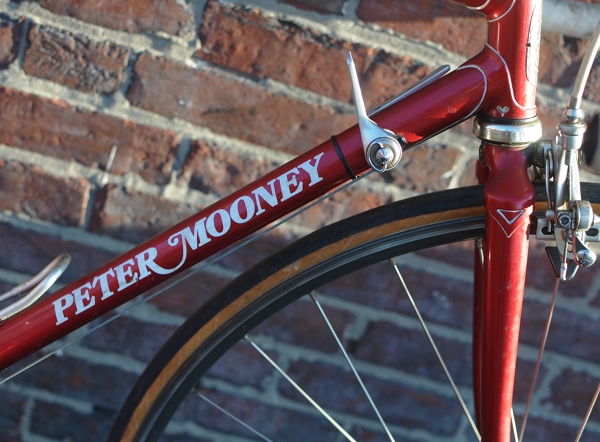
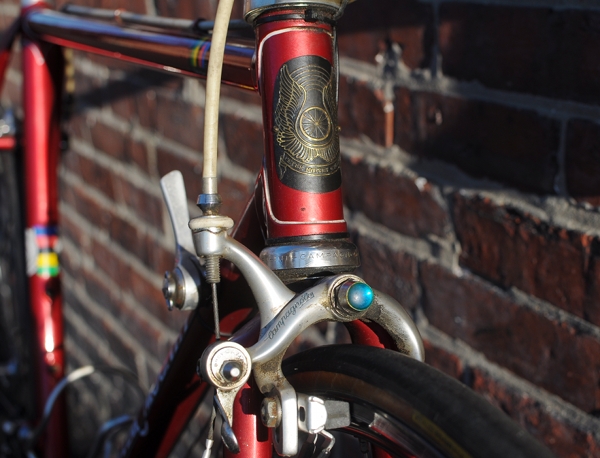
As a (somewhat) reasonable person, I recognise that sometimes a deal is just not for me, no matter how good it is. But I can still feel disappointed, can't I?  Peter Mooney is a famed local framebuilder who has been making custom bicycles since the 1970s, including his own lugwork. I love his frames and very much hope to have one of my own some day. And for a brief, dazzling moment, it seemed that such a day might come much, much sooner than I expected.

As usual, these things have a way of finding me when I am not looking, and in this case the "thing" was a second hand Peter Mooney bicycle. As soon as I learned of the bike's existence and availability, I was ready to bargain and prepared to sell or trade my other vintage roadbikes in order to get it. Going by the description, it seemed that the frame was my size - so it was only a matter of seeing it in person and test riding it.

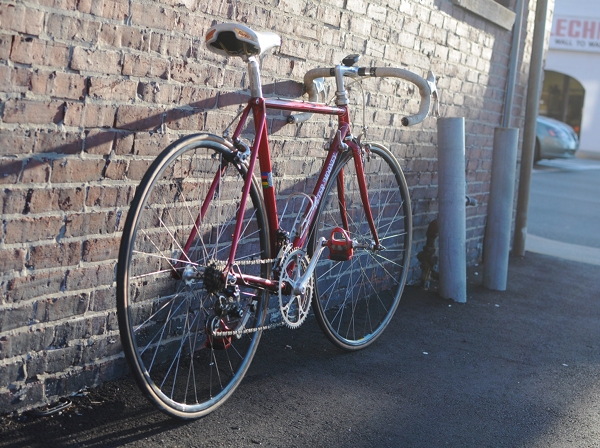
But the stars were not aligned in my favour. Although the bicycle does not look all that small in the pictures (compare it to my Moser), it felt very small once I tried to ride it. The size is 50cm (center of the bottom bracket to toptube), which is only 2cm smaller than the size I normally ride - so maybe there was something additional in the proportions that didn't feel right to me. Not sure what it could be, because the top tube actually seems long-ish, and the stem is long as well. Does anything unusual jump out at you, looking at this frame? 

And I guess that is just the thing with a custom-built frame: It was custom-built for someone else, which is bound to make second-hand purchases tricky. And the fact that it was built for someone else (judging by the components, most likely in the mid-1980s?) also makes me wonder what is the story of this bicycle - why did the previous owner give it up? 

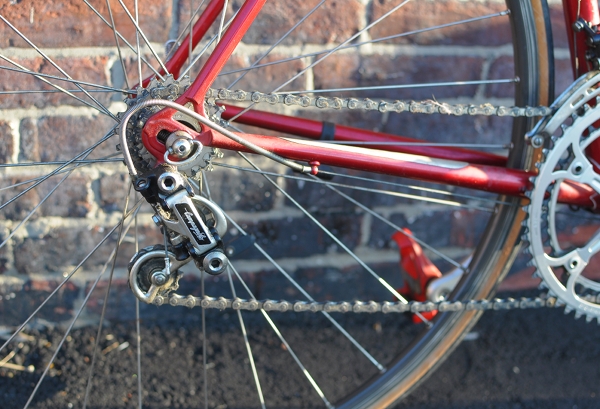
The bicycle certainly has nice components - Campagnolo everything. And though it was clearly ridden, it looks to have been well maintained.

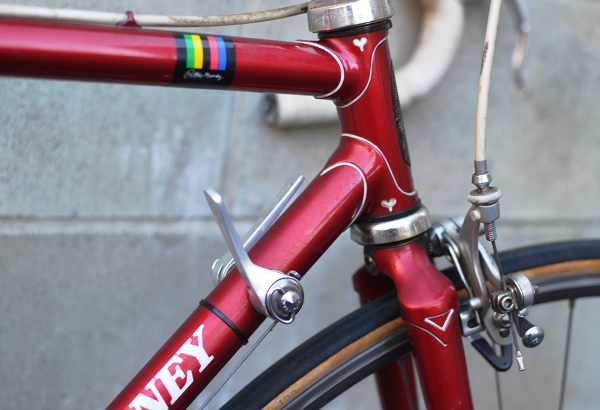
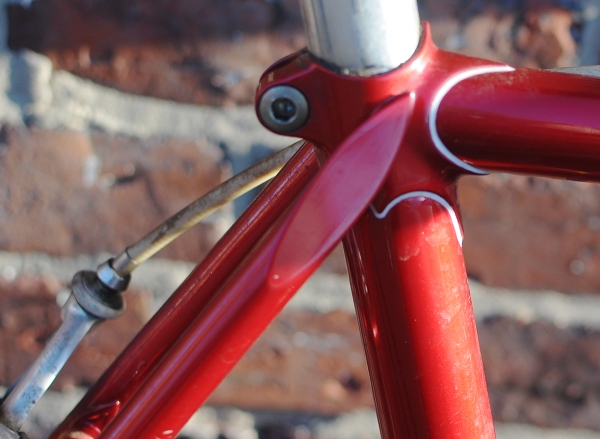
The elegant seat cluster with the white outlining is my favourite part of the lugwork. I hope the original owner appreciated it as well. 

Who knows, maybe some years from now I will have a Peter Mooney bicycle of my own - in my size, in my favourite colour, and maybe even with custom lugwork (let's just say that I already have sketches for the lugwork!). But with this particular bike, I am glad that I was able to resist. It's a bad idea to get a bicycle that doesn't fit you, no matter how good of a deal it is. 

If you are between 5'3" and 5'6" and are interested in this bicycle - it is in the custody of Vin at Old Roads, whose contact information you can find here. For the right person, it is a rare chance to own a bicycle by one of the great framebuilders. But what are your thoughts on getting a custom bike second-hand? I imagine that the more unique the original owner's anatomy, the more difficult it would be to find a new home. I wonder how many custom bikes get second chances, and what are the circumstances under which they switch owners.

Thursday, December 2, 2010

A Visit with Geekhouse Bikes

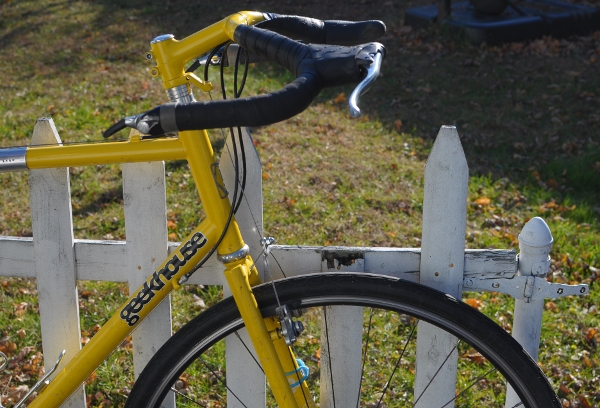
Today I had the pleasure of visiting Geekhouse Bikes in Allston, Mass. A region of greater Boston that's just across the river from Cambridge, Allston is notorious for how dangerous it is to cycle there and I was fully prepared for a journey fraught with peril. Instead, I found myself pedaling along a bike lane followed by a series of quiet streets - at the end of which was Geekhouse, nestled picturesquely between a white picket fence and a rusty chainlink fence,  amidst rows of family homes with tidy back yards offset by a sinister-looking warehouse in the distance.

When I saw this out front, there was no doubt that I had come to the right place.

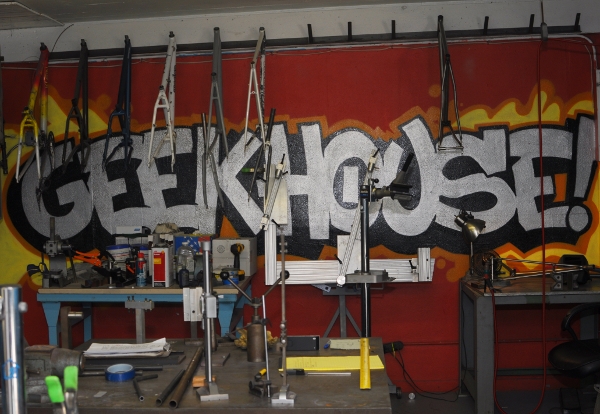
Geekhouse is a small shop that has been producing their distinct custom bikes since 2002.

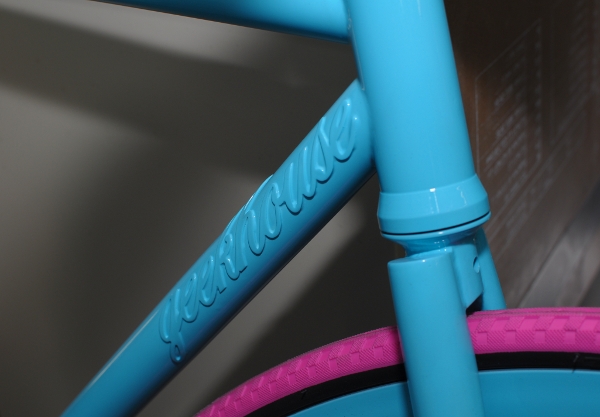
TIG-welded steel, clean lines, and candy-coloured powdercoat, make their handiwork easy to spot on the streets of Boston and beyond. The powdercoat is done in-house by the Geekhouse subsidiary, Sugarcoat.

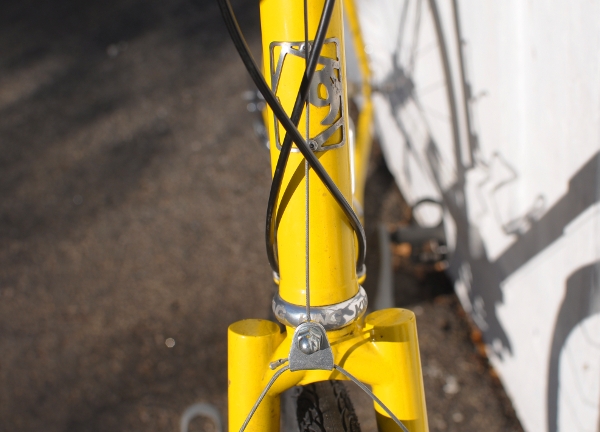
While I generally prefer lugged steel construction, there is something about the "New England bad boy" look of the segmented fork on a neatly TIG-welded frame that makes me feel all funny inside. Now imagine a workshop chalk full of these forks, in candy colours... I did my best to keep calm.

The main man behind Geekhouse is Marty Walsh, who learned TIG-welding while apprenticing for Mike Flanigan of ANT and began making his own frames shortly thereafter. His work embraced the influence of ANT and the Fat Chance legacy, while developing a trademark aesthetic unmistakably his own.

As Geekhouse grew, Marty was joined by Brad in the framebuilding department

and by Gregory in the running-of-the-business department.

The sense of comradery between the three boys is endearing, and entertaining to watch.

They clearly have a good time working together, which makes for a comfortable and lighthearted atmosphere in the shop.

But getting back to bicycles - One development I find exciting, is that Geekhouse has recently made a number of beautiful custom frames for women, reflecting the increasing number of female cyclists who are opting for handmade bikes. Unfortunately none of these frames were at the shop during my visit, but here is a glimpse as photographed by others:

[image via Geekhousebikes]

This "Woodville" model is a contemporary take on the loop frame. And notice the "wooden" rims.

[image via Geekhousebikes

And a fairly classic straight step-through bicycle re-imagined in Geekhouse style.

[image by urbanvelo via Geekhousebikes]

But of course, a "woman's bike" does not have to be a step-through, especially when it comes to road and touring bikes. The bicycle above (shown at NAHBS and mentioned here earlier) was made for Bianca, who rode it cross-country for Autism, from Boston to San Francisco.

[image by urbanvelo via Geekhousebikes]

To me this bicycle is just stunning; definitely my favourite Geekhouse bike. And if the owner rode it from Boston to San Francisco, I take it that it has got to be comfortable.

[image via Geekhousebikes]

What I think makes this a remarkable bicycle, is the combination of all the practical, functional elements - the built-in mounts, the racks, the lights, the sturdy geometry - and the hyper femininity of the colourscheme. The lilac and pale turquoise are unexpectedly gorgeous together. They make the bicycle look very light, almost ethereal. I would not have thought this design up myself, but I love it - and I think it works on a TIG-welded frame better than it would on a lugged one, as combining lugs with such vivid colours would have been overkill. This is also why I think the bright colourschemes of the lugless Brompton work so well, and why I love the TIG-welded truss frame by ANT: Sometimes, just sometimes the clean joints afforded by the lack of lugwork are more fitting to the overall personality of a bicycle.

The personality of Geekhouse bikes is certainly distinct, and I look forward to a possible test ride... hopefully something with a delicious segmented fork!

Tuesday, November 30, 2010

What Our Hands Can Do

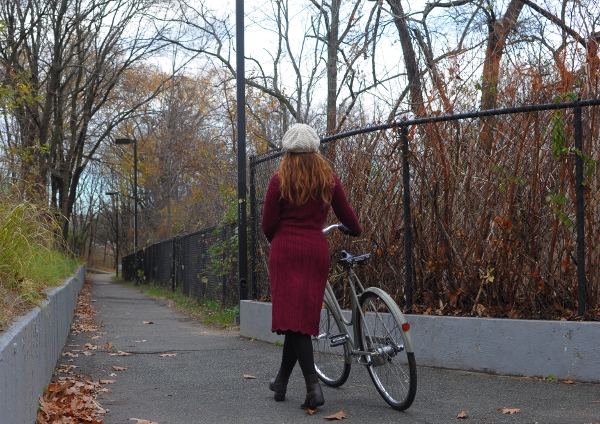
Looking over these photos from the Friday after Thanksgiving, I noticed something interesting: Almost everything pictured here is hand-made. The dress I am wearing was made by my mother. The hat and scarf were made by me. Even the bicycle was hand-made by an Italian frame builder for Bella Ciao. This combination was not intentional, but once I noticed it, I found it striking. 

My mother knitted this elaborate wool dress for herself in the early 1980s and wore it all through her 20s and 30s, after which point she gave it to me. The dress suited her much better, but that has not stopped me from wearing it since I were a teenager. It only occurred to me recently how remarkable it is for a dress like this to survive being worn for three decades by two different women - neither of whom are at all gentle with their clothing. And yet here it is, still looking fresh and current. The tailoring, the textural variation, and the attention to detail are incredible by today's standards - and my mother made tons of this stuff when I was a child, while being a busy career woman, too. (I remember seeing her knit while speaking on the phone and reading a book about mathematics at the same time... )

While my own attempts at knitting are fairly pedestrian compared to my mother's past projects, they do have one feature in common: longevity. I knitted this scarf back in grad school, and 8 years later it remains alive and well, while countless store-bought ones have since fallen apart. My friends, for whom I've made clothing as far back as high school, give me the same feedback - some of them still wear the things I made in the mid-'90s. Noticing this was a big reason why I started to knit and sew again this year: I am not that great at it, but the stuff I make lasts and fits me better than store-bought.

Over this past year I have done something a little nuts: I've sold or given away most of my clothing - stuff that I had collected and saved for more than 10 years. When I was younger, I was into edgy fashion and quirky designers, but lately that interest has all but faded - replaced by a curiosity regarding how far I can go making things on my own. Aside from knitting, I have been cutting up some of my remaining old clothing and handsewing "new" clothes out of it. Hopefully I will get a sewing machine for the holidays, which will allow me to take things further. In the past I have dabbled in making my own fountain pens as well. And eventually - maybe, just maybe, I would like to try my hand at building bicycle frames - or at least designing them à la Grant Petersen.

While my framebuilding days are not yet on the horizon, I do have enormous respect for bicycles hand-made by others, and an insatiable curiosity about the process. Whether independent framebuilders such as JP Weigle, Peter Mooney, Royal H. and ANT, or small manufacturers such as Mercian, Rivendell, Velo Orange and even Pashley and Bella Ciao - I am impressed by the sheer amount of work and consideration it takes to get the design, the construction, and the finishing just right. The more I learn about the process, the more overwhelming it seems. In a world of homogenous, mass-produced goods, it is amazing to witness what our minds and our hands are capable of creating.

Thursday, November 18, 2010

Mixte vs Mixte: What's the Difference?

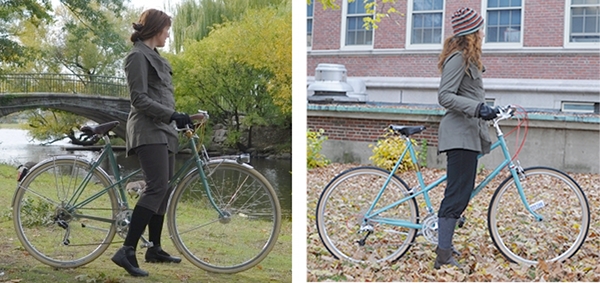
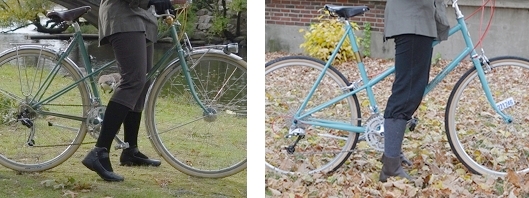
Mixte-frame bicycles have become popular again over the past couple of years, with many women buying them, or considering buying them. But what kind of bicycle is it that they are looking for? Mixtes can differ from one another considerably, both in looks and in ride quality: You cannot assume that because you have ridden one, you know them all. Just to give you an example, I have prepared a side-by-side comparison between my custom Royal H. mixte and the Rivendell Betty Foy. It takes some time to train your eye to differentiate between bicycles that may seem similar at first glance. But see whether you can get a sense of the differences just by looking at the pictures. 

To break it down, I will describe the most obvious and significant differences between these mixtes' geometries. And as an aside to the experts out there: If you are cringing at my explanations, please keep in mind that I am trying to make this as visual as possible, as opposed to as technical as possible!

Overall proportions
Take a close look at the overall "body types" of the two bicycles. Despite their being the same size in relation to me, my custom mixte has a "short and fat" look to her, whereas the Betty Foy looks "tall and skinny". That is because my mixte is dominated by the round forms of the large wheels, whereas the Betty is dominated by the angular forms of the large frame. The Betty Foy has smaller wheels, so the frame automatically needs to be larger in order for the overall bicycle to be the same size as mine. This also explains why my mixte frame is 52cm and the Betty Foy frame is 58cm - yet when the bicycles are assembled they are both my size.

The "short and fat" vs "tall and skinny" difference between the two bikes is accentuated by the position of the handlebars. The handlebars on the Betty Foy are set higher, with some stem showing - which further elongates Betty's "body."  The handlebars on my mixte are pushed almost all the way down - which accentuates the round look. Both bicycles were designed to be set up with the handlebars in these respective positions.

If you look at the vintage René Herse mixtes in this post from last year, as well as at some modern bicycles that emulate them, you will notice that they all have similar proportions to my custom mixte. Not a coincidence, because that is the look I was going for. The Rivendell Betty Foy, on the other hand, is a more contemporary take on the mixte and does not conform to this traditional design. Other modern framebuilders have taken a similar approach - playing with proportions to create their own versions.

Wheelbase 
"Wheelbase" is the distance between the center of the front and the rear wheel of a bicycle. But to get a more concrete idea of what that means, look at the space between the wheels. On my custom mixte (left) you can see that the wheels are fairly close together, while on the Betty Foy (right) there is an enormous amount of space between the wheels.

Another easy difference to spot is the length of the chainstays. The chainstays are those skinny tubes on the frame that run parallel to the ground along the rear wheel. If you look closely, on the Betty Foy these are considerably longer than on my mixte.

Angles
The angles of a frame are actually directly related to the wheelbase, but I am not going to go into this here and will discuss angles separately.

Even without measuring, you can see in the side by side pictures, that both the seat tube and the head tube on the Betty Foy are more relaxed (they lean further back) than on my custom mixte. The difference in angles is actually very small (1 degree difference in the seat tubes and 2 degree difference in the head tubes), which makes it all the more interesting that it is visually apparent. Even a small difference can be important.

Step-over height
Not related to any of the previous factors, but worth mentioning, is that the Betty Foy top tube is lower than my mixte's twin lateral stays. On the Betty this was achieved by virtue of not continuing the top tube in a straight line after the seat post, but angling it a bit. This angle produces a similar effect to creating a "swoop" or slight loop in the frame's top tube. It is still not as easy to step over as a step-through, but it is lower than other mixtes out there.

Ride quality
If you have managed to read this far and not fall asleep or close your browser window, you are probably wondering how these features affect ride quality. After all, it is useful to be able to look at a bike and have an idea of how it rides compared to other bikes.

Speaking very generally and summarily, bicycles with a longer wheelbase and more relaxed angles tend to feel more comfortable and stable, whereas bicycles with a shorter wheelbase and steeper angles tend to feel more aggressive and maneuverable. Of all these qualities, comfort is the most subjective - and also depends on other factors (such as tubing material and tires) that are independent of geometry. I would say that my custom mixte is equally comfortable to the Betty Foy - which means that the builder must have done something to enhance comfort despite the steeper angles and shorter wheelbase. As for the other factors, my mixte is indeed aggressive in comparison to Betty, with a ride quality that feels more "zesty." Both bicycles are fast and stable, but mine is quicker to accelerate and a tad more responsive, whereas Betty is more even-tempered.

Either of those qualities can be considered a virtue, depending on the cyclist's needs: A mixte like the Betty Foy is a better idea if you are looking for a relaxed, even-paced ride, whereas a mixte like mine will be more enjoyable if you want something more racy. And it helps to recognise which is which by looking at them.

Sunday, November 14, 2010

Mesmerising Metallics - and the Colours That Go with Them

[early Raleigh in unpainted steel, image via A. Weed]

I love the look of silvery-metalic bicycles: stainless steel, clear-coated steel, chromed, nickel-plated, silver paint, even titanium. And though I do not own such a bicycle myself, it is nice to live vicariously through others. One of my readers, Jim P. , is getting a stainless steel bicycle from Royal H. Cycles that will be ready in a couple of months. 

[stainless steel Gerhard Marshall bike at DBC, image via Lovely Bicycle]

Jim's bicycle will be fitted with an internally geared hub and upright handlebars. It will be a sportier and more personalised alternative to his main bicycle - a Workcycles "Secret Agent" Dutch bike. 

[chromed Raleigh Sports, image via lernerbikes]

While waiting for his frame to be finished, Jim is trying to decide about colour. The frame will mostly be stainless steel, but he is considering a secondary colour - for some panels, Royal H. insignia, and lug outlining - and has asked me for advice. After thinking about it, I realised that it is actually quite difficult to decide what goes with stainless steel, or any silvery frame.

[Co-Habitant's silver Motobecane, image via Lovely Bicycle]

One direction to take, would be to go for low contrast. For instance, the Co-Habitant's vintage Motobecane Super Mirage has black insignia and decals that blend in with the frame colour. I have also seen beige, navy blue, white, and coppery-gold used in the same manner: to break up the sea of steel, silver, or chrome without attracting attention to the secondary colour.

[chromed Rene Herse, image by Mike Kone via J. Ferguson]

Or one could go in the entirely opposite direction, and choose a colour that creates a strong contrast. Red seems to be a popular choice when going this route, like on the Rene Herse above.

[chromed Alex Singer randonneur, image via cyclezine]

or on this Alex Singer

[chromed Waterford bicycle, image via velospacee]

or on this modern Waterford, which I believe was built as an homage to the vintage Schwinn Paramount (though could somebody please explain that saddle?...).  I have also seen the high-contrast look achieved with a lemony yellow (on a vintage Panasonic touring bike), and I think orange and pink can work pretty nicely as well - for those who like those colours, of course.

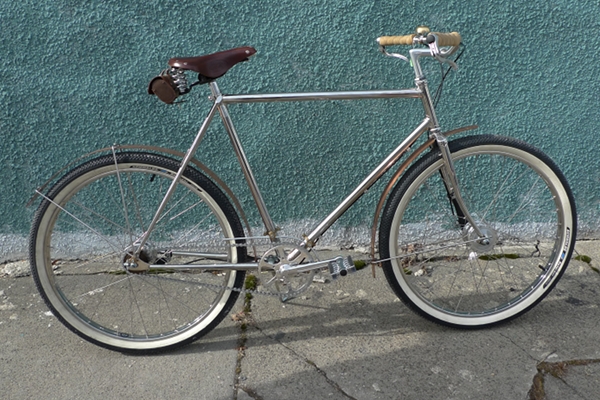
[nickel-plated bicycle; via Steve on Bike]

One colour Jim was considering was turquoise, or blue-green. I was not able to find any examples of this colour integrated with the frame, but you can sort of tell how it would look next to the stainless steel based on the picture above. Personally, I think this would be a great choice. It would not provide quite as much contrast as red, yellow, orange or pink, but it wouldn't blend in with the frame either. It would be an interesting and unexpected combination, and would evoke a shimmery seascape - which would be fitting, as Jim P. lives near the water. If it were me, I might also choose violet - which would offer a similar degree of contrast as the turquoise, but in a slightly warmer tone. And I would definitely keep the secondary colour to a minimum - maybe some narrow strips on the seat tube and downtube instead of full panels.

[chromed Peugeot PX10 via fixomatosis]

Of course if Jim is feeling indecisive, he can go with a little bit of everything and choose the rainbow look - which, if done in moderation, I in all seriousness think could look nice.

[silver Royal H. track bike, image by Eric Baumann]

Generally speaking, what do you think of stainless steel as a frame material? - in of itself, as well as in comparison to chromed frames, nickel-plated frames, titanium, and "plain old" silver paint?  Personally, I think stainless is a great idea, especially for those who live near salt water, or who cycle through the winter. And the finish looks fantastic to me. But I was surprised that I was not able to find any good images of stainless steel bikes on the internet. I have seen a few in person, but apparently not many builders are showing them off online. Bob Brown does have a few here, but I can't find one of a fully built up bike without a carbon fork. There are also a few by Bilenky, such as this one, but I am a little confused by the wiring and the components these bicycles are fitted with. Feel free to point me to any others, if I have missed them. Of course, when Jim's bicycle is finished I will take loads of pictures, so the internet should have no shortage of stainless steel "bike porn" after that point!