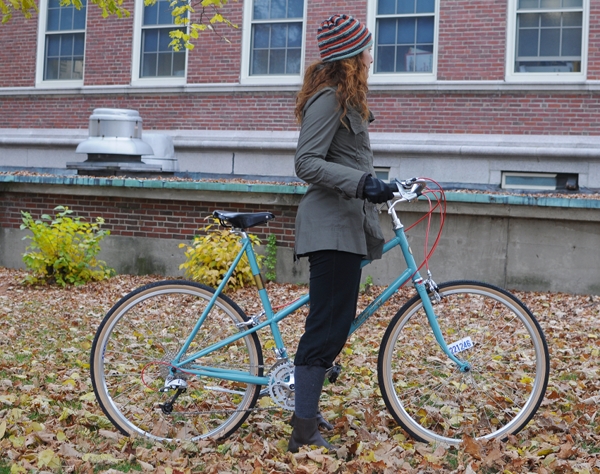
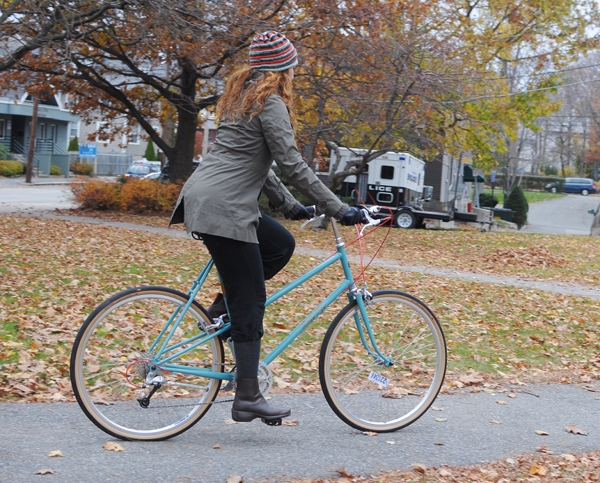
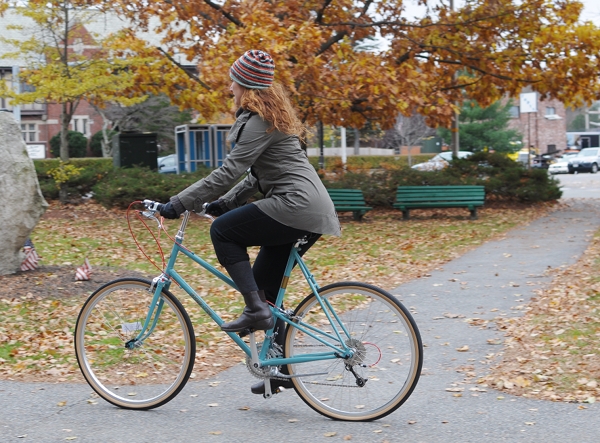
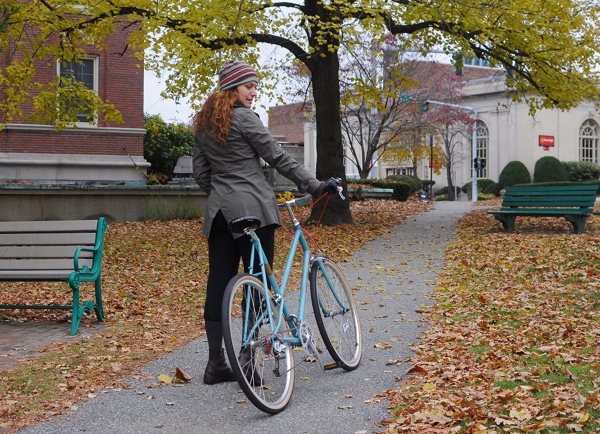
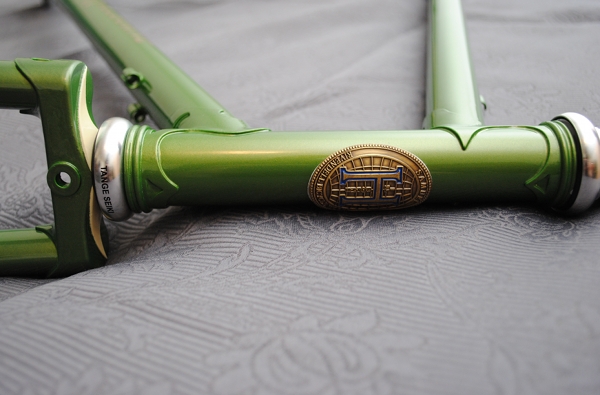
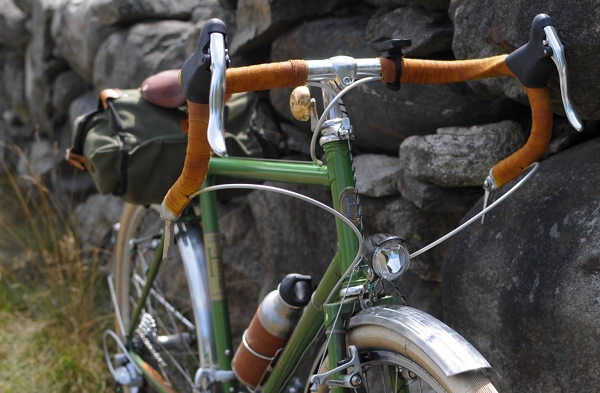
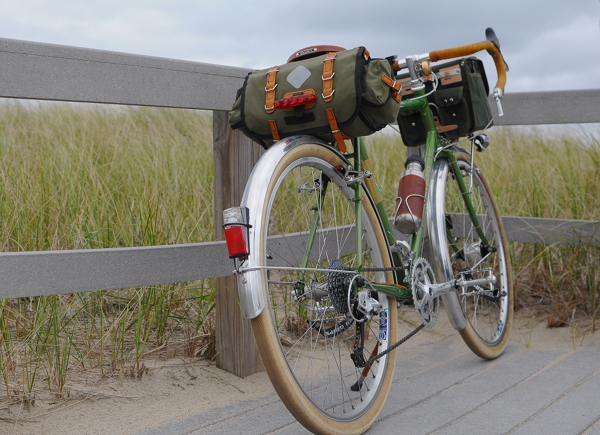
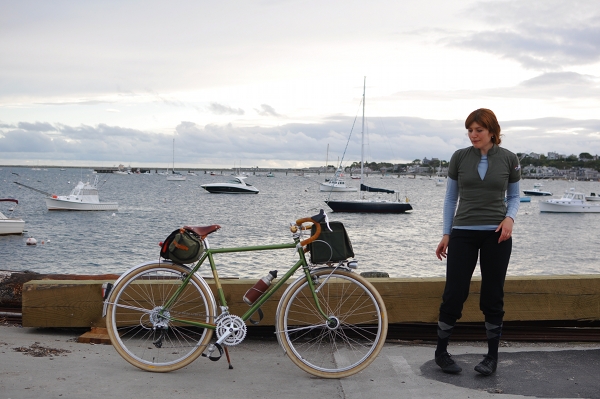
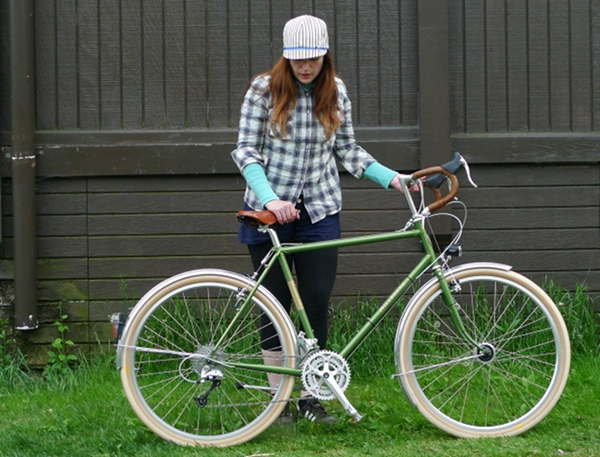
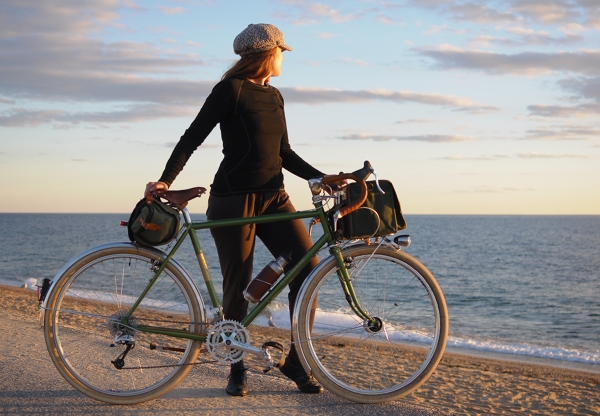
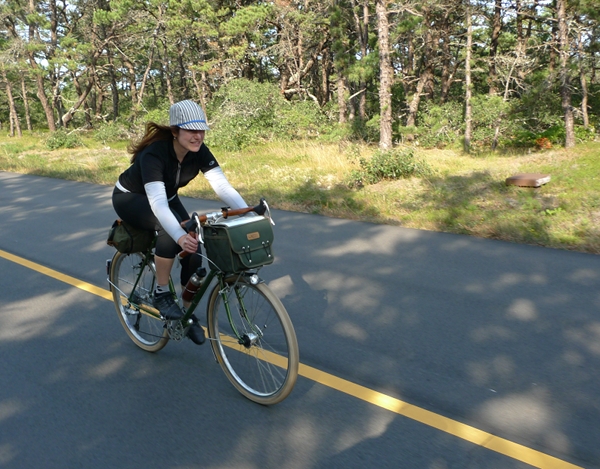
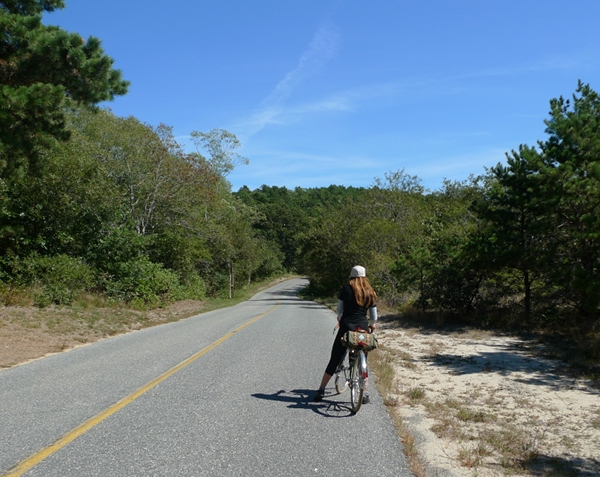
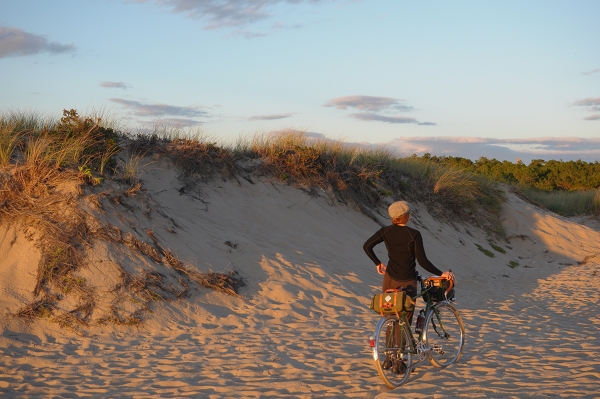
For some time now, I have been searching for "cycling pants" to be worn on a roadbike that look sufficiently like trousers. Regular trousers have seams in the crotch that start to hurt me after cycling for more than 15 minutes in a forward-leaning position. And women's trousers specifically tend to be quite form-fitting, which makes it uncomfortable to swing a leg over the diamond frame, as well as to pedal. I explored several possibilities for trousers that would work, but everything was either too sporty or had too much of a "cycling culture" look. I wanted something conservative and subtle. The "Stealth Pantaloons" from Clever Cycles seemed to fit the bill, and being my sponsors they graciously allowed me to try the pants before deciding whether to buy them. The pants ended up being just what I needed, and I have since purchased them.
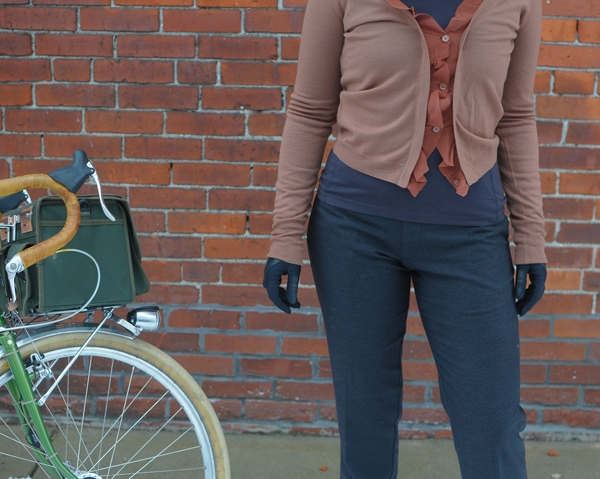
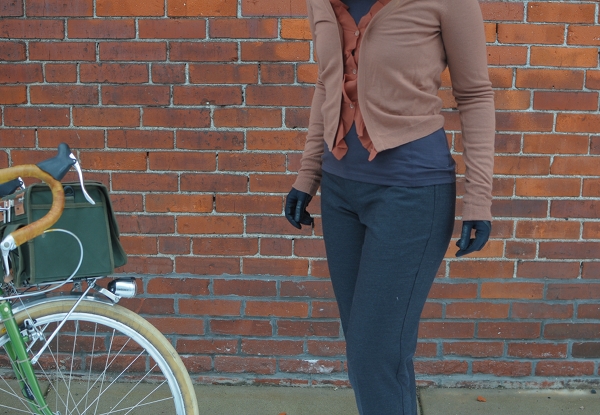
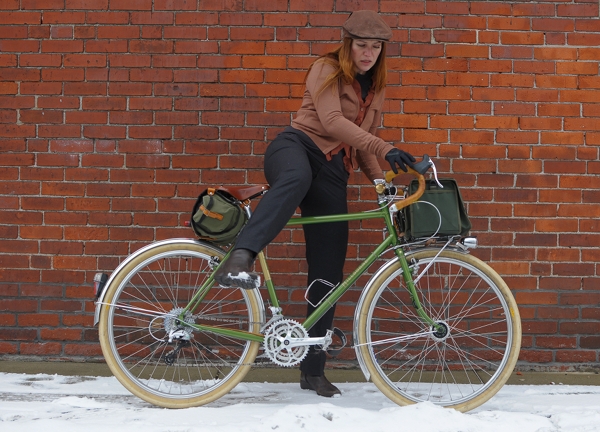
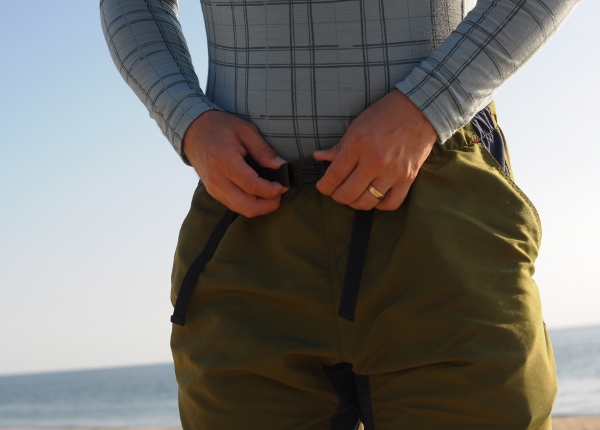
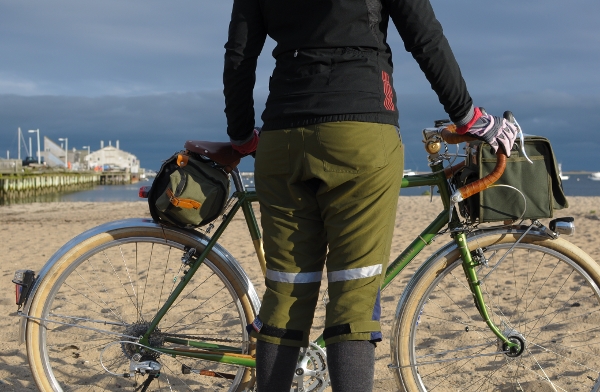
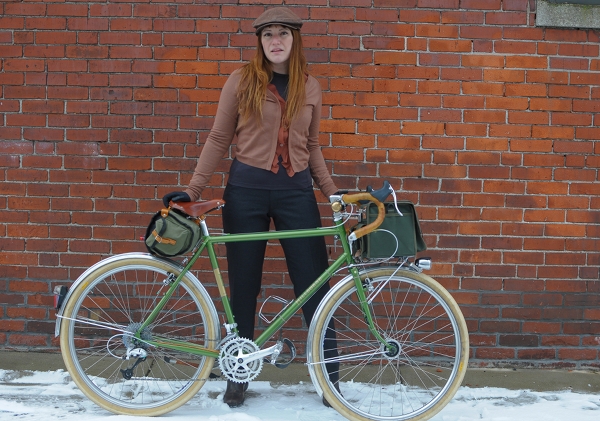
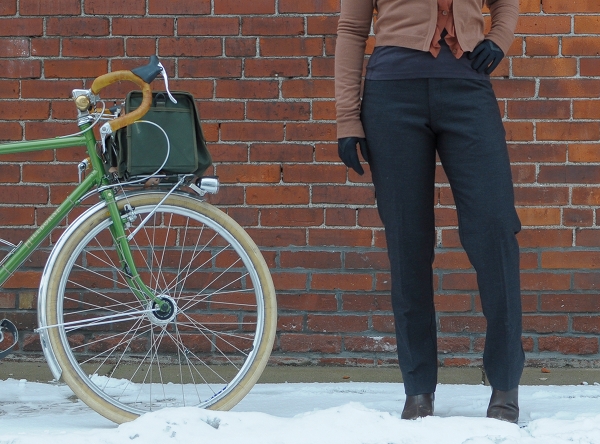
Upon superficial examination, the Clever Cycles "Stealth Pantaloons" look like regular trousers in every way. They are made of a lightweight wool and have a classic, straight cut to them that tapers slightly towards the ankles.
The cut is unisex, and after reading my MUSA knickers review Clever Cycles warned me that I might find some aspects of these not ideal for the female figure either. However, I found the "Stealth Pantaloons" to be reasonably flattering. For instance, compare the above picture to this. Not even in the same category.
I am 5'7" and wear a US women's size 4. I got the Stealth Pantaloons in size 30. They look form-fitting in the pictures, but in fact they are fairly loose in the abdomen, inner thighs, and below the waistband in the back - similarly to the Rivendell MUSAs. What's not similar, is that the wool fabric falls and drapes in a way where this is not noticeable. As a result, I can wear these pants with leggings underneath or without, and the fit will be flattering either way. The versatility is good for when the temperatures fall below freezing.
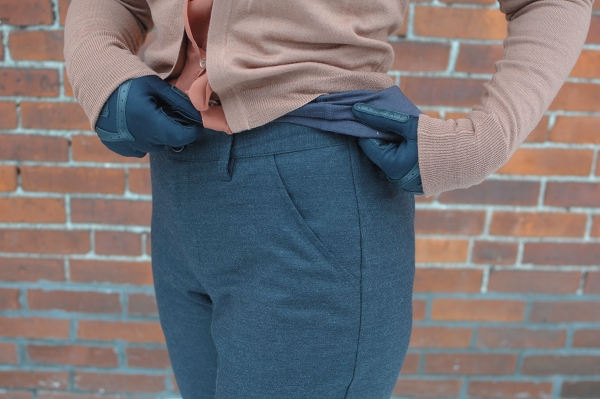
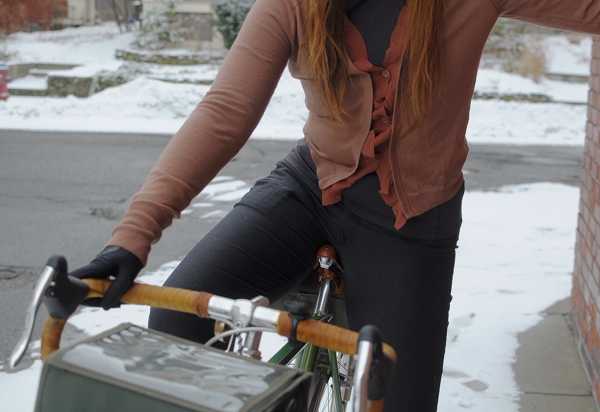
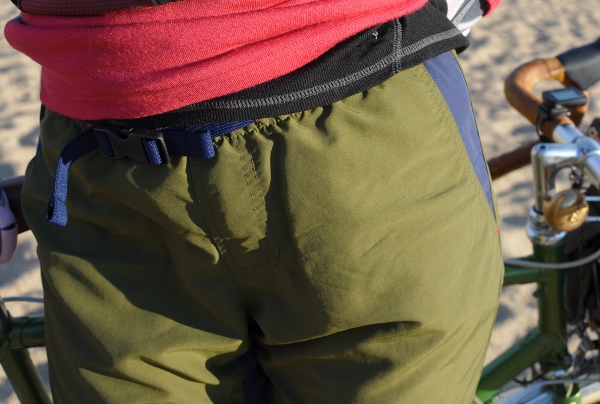
I believe the waistband is supposed to hit about mid-waist. However, due to the elasticised area in the back (picture below), I find this to be adjustable: I can wear the pants both high on my waist and low on my hips by simply pulling them up or pushing them down. Here they are shown relatively high on the wait.
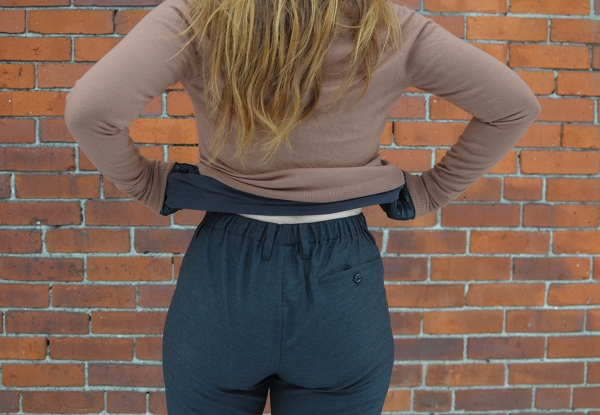
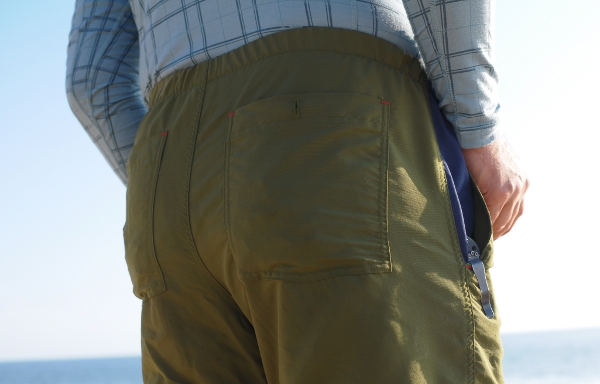
And here is the elasticised waist in the rear. This is the only aspect of the "Stealth Pantaloons" that is potentially unflattering to the female figure and it all depends on how you are built. The feature is useful in that it makes the fit versatile and prevents the waistband from digging into tummy fat when cycling in a leaned-forward position. However, it also detracts from the formal look of the trousers, and makes the fabric bunch up under the waistband. For me both of these problems are solved by the fact that I do not like to wear tucked-in blouses: My top covers up the elasticised area and the bunching underneath. If you like to wear your tops tucked in, beware. However, even with the elastic and the bunching, the look suits me better than this.
In addition to the elasticised feature, there is something about the fit of the "Stealth Pantaloons" that allows for unconstrained movement. I can mount a diamond frame while wearing without feeling any pulling at the seams. Same with pedaling or pretty much any motion. This is not typical of form-fitting women's trousers.
Another cycling-specific feature is the flat seam construction. The "Stealth Pantaloons" do not have a gusseted crotch. However, the seams are flat and do not cut into my "soft tissue" (crotch-related problems on a roadbike are an ongoing theme for me!) when I lean forward on the saddle. I have not gone on long rides with these yet, but I can usually feel seams right away once I am on the saddle, whereas these I cannot feel.
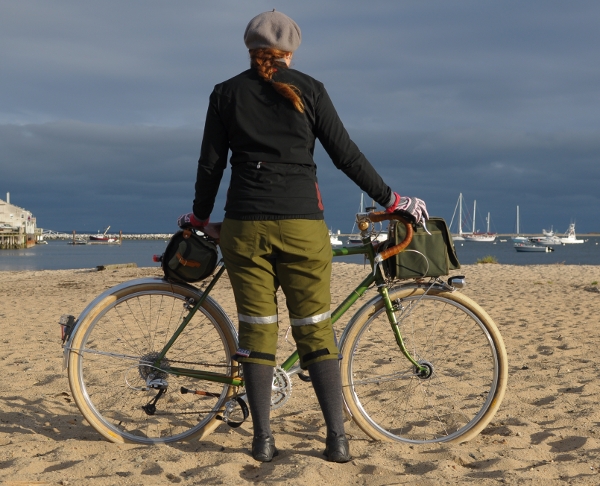
There is no bunching in the rear while on a bike, which is good. As a woman with a smallish waist and an obscenely voluminous behind, I find it difficult to find even regular trousers that offer a flattering fit, let alone cycling-specific pants. The "Stealth Pantaloons" fit me better than I had imagined they would after the very cautious description I was given by Clever Cycles. My experience may or may not be applicable to you, but I am happy. They are comfortable on and off the bike, they are all-wool, and they are a neutral colour. They can be worn with shoes, tucked into tall boots, or pushed up the calves like knickers. I am also told that they are fairly stain-resisant, though I have not yet tried this out. Oh, and today I was trying on a jacket in a clothing store and two women complimented the pants as they walked by. I am pleased with the purchase and might get another pair in black a few months from now.
Showing posts with label Rivendell. Show all posts
Saturday, January 8, 2011
Saturday, December 11, 2010
The Best Time to Visit Your Bike Shop
Even though we live close to one another and normally cross paths on our own turf, this weekend I bumped into "cycler" from Biking in Heels 10 miles away - at Harris Cyclery. We'd both taken on projects that ended up throwing us curveballs, and now here we were. Even if you work on your bike yourself, it's good to find a trustworthy bike shop you can turn to just in case - and better still, a specific mechanic whose opinion and work you trust. The fact that I travel 10 miles to see Jim even though there are plenty of bike shops walking distance from my house, speaks for itself.
And if you are going to visit your local shop with a "project bike," there is no better time than the winter months. In the off season, bicycle shops tend to be less crowded, which means that they will be able to work on your bike sooner and will have more time to answer your questions. They are also more likely to have the components and accessories you want in stock, since things don't sell out as quickly as in the summer.
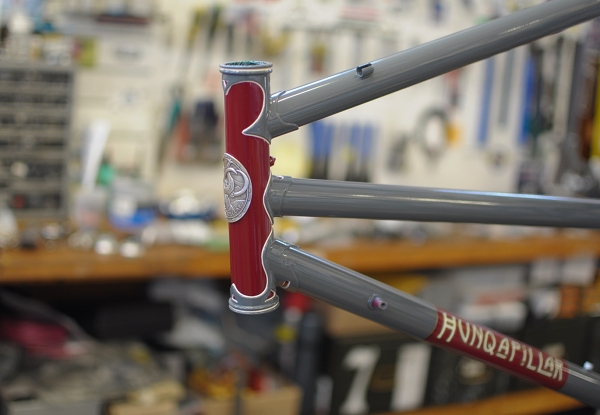
Some new floor models are likely to be available as well, since the shop will actually have time to build them up. This is the first time I've seen the Rivendell Hunqapillar - the version with the diagonal "middle tube." The design is definitely not for me and I cannot help but wonder how many people buying this bike will actually be using it in a way that necessitates this construction. But I do appreciate seeing the monster in person. The wooly mammoth headbadge and the decals are nicely done, as is the lugwork.
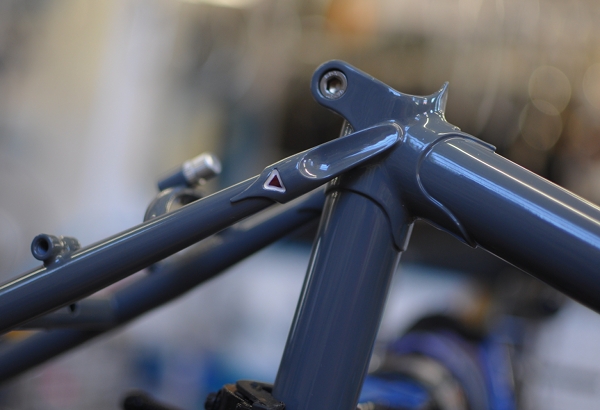
Never seen a seat cluster with a "socketed" seat stay like this before. Any idea what the purpose of this design is, assuming that it is more than aesthetic?
Between the Hunqapillar, the flock of other Rivendells, the vintage Hetchins, and other exotic specimens, it felt as if lugwork was declaring war on modern bikes and taking over the shop. My own modestly lugged bicycle seemed like an underachiever in comparison - though he held himself proudly and was quite happy to have the mechanic's attention.
And if you are going to visit your local shop with a "project bike," there is no better time than the winter months. In the off season, bicycle shops tend to be less crowded, which means that they will be able to work on your bike sooner and will have more time to answer your questions. They are also more likely to have the components and accessories you want in stock, since things don't sell out as quickly as in the summer.
Some new floor models are likely to be available as well, since the shop will actually have time to build them up. This is the first time I've seen the Rivendell Hunqapillar - the version with the diagonal "middle tube." The design is definitely not for me and I cannot help but wonder how many people buying this bike will actually be using it in a way that necessitates this construction. But I do appreciate seeing the monster in person. The wooly mammoth headbadge and the decals are nicely done, as is the lugwork.
Never seen a seat cluster with a "socketed" seat stay like this before. Any idea what the purpose of this design is, assuming that it is more than aesthetic?
Between the Hunqapillar, the flock of other Rivendells, the vintage Hetchins, and other exotic specimens, it felt as if lugwork was declaring war on modern bikes and taking over the shop. My own modestly lugged bicycle seemed like an underachiever in comparison - though he held himself proudly and was quite happy to have the mechanic's attention.
Winter is also the time when bike shops hold end-of-the year sales, where good deals can be found if you are in the market for a new bike. And for those manufacturers whose models do not change year to year, winter is often the last chance to get a bike at the current price tag, before prices go up in the Spring. If you hang around long enough, you might also learn about non-advertised deals, including second hand bikes. Some of the most interesting vintage bicycles never make it to the likes of Craig's List or e-bay, but are sold via word of mouth. Bicycle shops can act as hubs for those types of connections. If you are looking for a particular bike, try asking your bike shop about it - they might just know of a customer, or a friend, who is trying to sell theirs.
The winter months are infamously slow for the bicycle industry - but as a customer, you can take advantage of that in a way that benefits everyone: You get more personal attention, faster turn-around, and better deals - and the bike shop gets winter business. It's win-win!
Saturday, November 27, 2010
Musings on MUSA Knickers
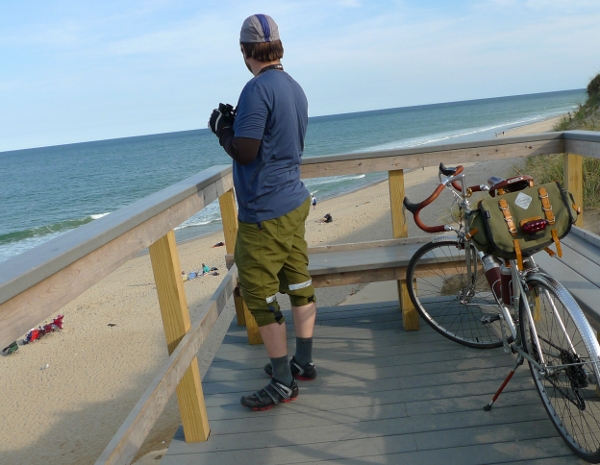
Musa is a Rivendell house brand that stands for "made in USA." Under this label, Rivendell produces a line of clothing and accessories, including the knickers and pants that are designed specifically for cycling, but are described as being wearable "anywhere when formal wear isn't called for." The Co-Habitant ordered both the knickers and the long pants over the summer, because he was wearing out all his regular pants on long rides, and he thought these would be more durable. He immediately loved them and kept recommending them to me - until I finally bought a pair of knickers myself a couple of months later. Our impressions of this product are somewhat different, and put together they will hopefully be informative for both genders.
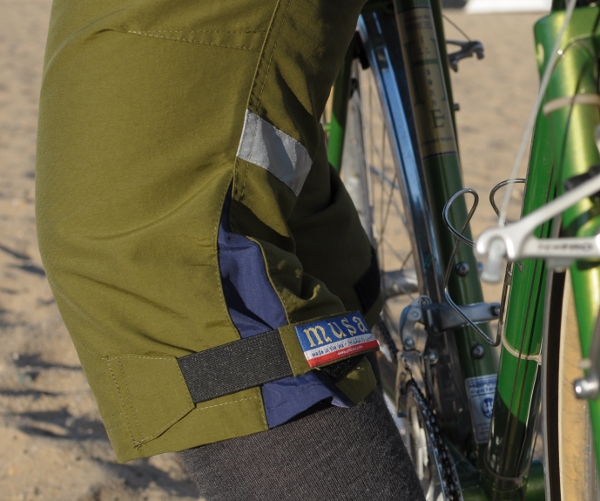
Made of lightweight, breathable, and durable nylon, the Musa knickers work well for cycling, because they feature a roomy gusset in the crotch area, adjustable-width cuffs with velcro straps, and reflective strips.
The adjustable waist closes via one of those nylon belts and plastic buckles you see on hiking pants.
The pockets are deep and cut in a way that stuff doesn't spill out of them while cycling - a useful feature for those who like to keep small items on their person while on the bike.
The Co-Habitant normally wears pants with a 34" waist, and the XL Musas fit him well. They are relaxed, but with a tailored look to them. The cut is flattering to the male body.
The pants and knickers are currently available in olive, gray, black and blue. The Co-Habitant has the olive knickers (pictured) and the gray long pants. The knickers he wore mostly over the Summer and early Fall; the pants he continues to wear now, including off the bike. His feedback is that his Musas are extremely comfortable and useful. Not only does the seamless gusset protect from chafing during long trips, but the pants regulate temperature well in both hot and cold weather, and are a lot more durable than the trousers he wears off the bike (one problem with cycling long distance in regular clothing, is that the clothing can get ruined from rubbing against the saddle and from sweat). For those men who do not want to wear tight, padded cycling shorts, but want something cycling-specific that looks decent off the bike, these are a good option. I do not quite agree with Rivendell's description of them looking like "normal" pants. They are definitely quirky. But I find this particular quirkiness attractive.
Moving on to my own experience with the Musa knickers (and in case you are wondering - no, we do not wear them at the same time!), my main reason for buying them was the gusset. I cannot ride a roadbike for more than 20 minutes while wearing anything with seams along the crotch, and finding pants without seams in that region is not easy. So seeing how happy the Co-Habitant was with his Musas, I finally ordered a pair for myself. Rivendell describes these knickers as unisex and has a size chart for women. Going by the waist measurements on the chart, I initially ordered an XS. However, I could not pull them on over my hips, so I exchanged them for a Small. The Small went on over my hips fine, but fit me overly loosely petty much everywhere else.
Sometimes a loose fit can be flattering, but with the Musa knickers luck was not on my side. The sagginess in the butt distorts the shape of my body in a way that just doesn't look good, and extra material bunches up around my inner thighs.
The knickers are also overly loose in the front. It is as if the fabric won't lie against my body right - bunching up in all the wrong places. This leads me to conclude that the pants were simply not tailored with a female waist-to-hip ratio in mind. While I am not the curviest woman in the world, I do have a narrow waist and comparatively wide hips - a combination that makes it difficult to get the sizing right.
But fit and sizing issues aside, the Musa knickers do have a number of features I find useful. The gusset is huge and there is not a single seam between me and any part of the saddle, which is excellent. The nylon material really is very light and breathable, as well as wind-resistant, mildly water resistant and fast-drying. The fabric does not pill or degrade after prolonged contact with the saddle - and having worn through several pairs of leggings and shorts over the past year, such durability is welcome. The pockets are staggeringly deep - though the feature is wasted on me, as I prefer to cycle without too much stuff in my pockets. The expandable width cuffs with velcro closure are clever, if a bit finicky (I had to redo mine a few times to get them to feel right). As other owners of these have noted, the pants were shiny and slippery in the beginning, but this went away after a few long rides.
All in all, the Musa pants and knickers are excellent if you want to wear something comfortable and durable on a roadbike, and if you are male. If you are female, consider the issues with fit and compare how the pants look on a male vs a female body. For me, the gusset and other positive features are worth it - but only because I found no better alternatives. And I would never wear these knickers in a context other than on a roadbike, which does diminish the value of what was meant to be a "wear them anywhere" design.
Made of lightweight, breathable, and durable nylon, the Musa knickers work well for cycling, because they feature a roomy gusset in the crotch area, adjustable-width cuffs with velcro straps, and reflective strips.
The adjustable waist closes via one of those nylon belts and plastic buckles you see on hiking pants.
The pockets are deep and cut in a way that stuff doesn't spill out of them while cycling - a useful feature for those who like to keep small items on their person while on the bike.
The Co-Habitant normally wears pants with a 34" waist, and the XL Musas fit him well. They are relaxed, but with a tailored look to them. The cut is flattering to the male body.
The pants and knickers are currently available in olive, gray, black and blue. The Co-Habitant has the olive knickers (pictured) and the gray long pants. The knickers he wore mostly over the Summer and early Fall; the pants he continues to wear now, including off the bike. His feedback is that his Musas are extremely comfortable and useful. Not only does the seamless gusset protect from chafing during long trips, but the pants regulate temperature well in both hot and cold weather, and are a lot more durable than the trousers he wears off the bike (one problem with cycling long distance in regular clothing, is that the clothing can get ruined from rubbing against the saddle and from sweat). For those men who do not want to wear tight, padded cycling shorts, but want something cycling-specific that looks decent off the bike, these are a good option. I do not quite agree with Rivendell's description of them looking like "normal" pants. They are definitely quirky. But I find this particular quirkiness attractive.
Moving on to my own experience with the Musa knickers (and in case you are wondering - no, we do not wear them at the same time!), my main reason for buying them was the gusset. I cannot ride a roadbike for more than 20 minutes while wearing anything with seams along the crotch, and finding pants without seams in that region is not easy. So seeing how happy the Co-Habitant was with his Musas, I finally ordered a pair for myself. Rivendell describes these knickers as unisex and has a size chart for women. Going by the waist measurements on the chart, I initially ordered an XS. However, I could not pull them on over my hips, so I exchanged them for a Small. The Small went on over my hips fine, but fit me overly loosely petty much everywhere else.
Sometimes a loose fit can be flattering, but with the Musa knickers luck was not on my side. The sagginess in the butt distorts the shape of my body in a way that just doesn't look good, and extra material bunches up around my inner thighs.
The knickers are also overly loose in the front. It is as if the fabric won't lie against my body right - bunching up in all the wrong places. This leads me to conclude that the pants were simply not tailored with a female waist-to-hip ratio in mind. While I am not the curviest woman in the world, I do have a narrow waist and comparatively wide hips - a combination that makes it difficult to get the sizing right.
But fit and sizing issues aside, the Musa knickers do have a number of features I find useful. The gusset is huge and there is not a single seam between me and any part of the saddle, which is excellent. The nylon material really is very light and breathable, as well as wind-resistant, mildly water resistant and fast-drying. The fabric does not pill or degrade after prolonged contact with the saddle - and having worn through several pairs of leggings and shorts over the past year, such durability is welcome. The pockets are staggeringly deep - though the feature is wasted on me, as I prefer to cycle without too much stuff in my pockets. The expandable width cuffs with velcro closure are clever, if a bit finicky (I had to redo mine a few times to get them to feel right). As other owners of these have noted, the pants were shiny and slippery in the beginning, but this went away after a few long rides.
All in all, the Musa pants and knickers are excellent if you want to wear something comfortable and durable on a roadbike, and if you are male. If you are female, consider the issues with fit and compare how the pants look on a male vs a female body. For me, the gusset and other positive features are worth it - but only because I found no better alternatives. And I would never wear these knickers in a context other than on a roadbike, which does diminish the value of what was meant to be a "wear them anywhere" design.
Monday, November 15, 2010
The Popular Girl: Test Riding the Rivendell Betty Foy
After last week's review of the Rivendell Sam Hillborne, it seemed appropriate to follow up with a test ride report of the Betty Foy. I have ridden her a couple of times before, but never had my camera with me at the time. Harris Cyclery has just built up a new floor model in my size - so I took the opportunity to take some pictures and put my impressions into words. While the pictures reflect how this particular bicycle was built up, keep in mind that it is fully customisable: You can change everything from the saddle and grips, to the handlebars and pedals, to the type of components that are on the bike.
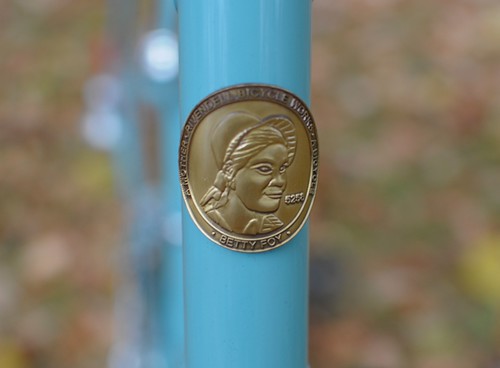
Rivendell released the Betty Foy in Spring 2009, in conjunction with the diamond frame Sam Hillborne model. Inasmuch as a hand-built, niche-market bicycle can "sell like hotcakes" I believe the Betty does. She is charming, comfortable, and tough - and the ladies love her for that. The price of the frame alone is $1,000 and a fully built up bike starts at $2,200 or so, depending on the options. To see how this bicycle compares price-wise to other lady's frames in its class, please visit my new Semi-Custom Options page (now linked in the upper left-hand corner).
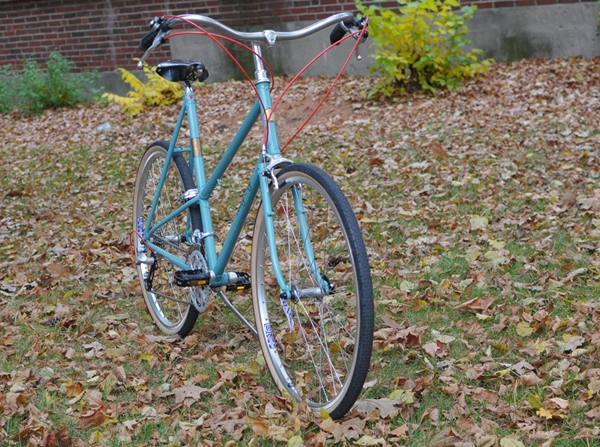
In terms of construction, the Rivendell Betty Foy is a version of the mixte frame: What starts out as a sloped single top tube splits into two stays at the seat tube and continues (at a slightly different angle than the slope of the main top tube) all the way back to the rear dropouts. The frame is lugged, with custom-made lugs in the shape of hearts and elaborate filigreed designs.
There are many cute and feminine touches, such as the downtube decal featuring tiny red apples
and the filled-in curly-cues on the fork crown. Some of the lugs are also filled in with red, complementing the robbin's egg-blue of the frame.
The Betty Foy frame is available in several sizes (47cm, 52cm, 58cm and 62cm), with the middle two built for 650B wheels, the largest built for 700C wheels, and the smallest for 26" wheels. There is enough clearance for 40mm tires plus fenders.
The frame is made for derailleur gearing, and is typically built up with three gears in the front and eight in the rear. There are eyelets and braze-ons for fenders and racks.
Rivendell states that the Betty frame was designed to be built up with Nitto Albatross handlebars - which are wide and swept back, similar to (but wider than) the handlebars you would find on a vintage 3-speed. I have also seen her built up with drop bars, but the upright set-up is more typical. This floor model was fitted with black rubber grips and "thumbie" shifters, though some prefer cork grips and bar-end shifters.
One thing to note about the Betty Foy, is the unusual sizing: The frame sizes recommended by Rivendell seem larger than what a person would normally ride. For example, I am 5'7" and normally ride a 52-54cm road bike or mixte, yet it is recommended that I ride a 58cm Betty Foy. Having tried both the 52cm and the 58cm frames, I can confirm that the recommendation is accurate. The 52cm Betty Foy felt much too small for me, whereas the 58cm version felt just right. I could have raised the saddle by another inch from the position in which it is shown above, but did not feel like going back inside the shop once I started riding the bike.
I rode the Betty Foy on the roads near Harris Cyclery (actual test ride not pictured), both this time and the previous times I've tried her. It is difficult to compare her to other bicycles on the market, because in a way she is unique. If you are accustomed to road bikes and vintage mixtes, you will find the Betty to be considerably more upright, stable, and comfortable. She is more relaxed than a typical mixte and has a long wheelbase - so that there is no toe overlap with the front tire when turning at slow speeds. I also find the step-over height to be lower than on other mixtes I've tried, which is convenient.
If you are accustomed to Dutch-style city bikes, you will find the Betty Foy a faster and sportier ride, but still within your comfort zone. The posture is slightly leaned forward, but still more or less upright. The derailleur gearing may take some getting used to if you have only dealt with internally geared hubs before, but you will appreciate how easy it makes cycling uphill.
In my view, the Betty Foy's greatest asset is her versatility. If you combine the feeling of a vintage 3-speed with that of a derailleur-geared touring bike, she handles like a union of the two: a fast, comfortable bicycle that feels safe and pleasant to ride. I can imagine riding her around the city for transportation, as well as 20 miles over some hills to the next town over. The ride is soft over bumps and potholes (not as soft as on my Sam Hillborne with 42mm tires, but I would need to ride Betty with equally wide tires to compare). Maneuverability in traffic is good, but the handling is not aggressive. I did not ride her on any serious hills, but with the derailleur gearing, the light frame, and the somewhat leaned-forward posture, I imagine it should hardly be a problem. She is what Rivendell says she is: an "all around" bike. If you plan to have only one bicycle for both urban commuting and long distance cycling, this seems like the closest thing on the market to that ideal.
The question I am inevitably asked at this point, is why I did not get a Betty Foy for myself when I was looking for a mixte, if I think she is so great. My main reason, was that I wanted a specific kind of mixte: one with twin lateral stays and proportions that resembled the original French constructeurs. The Betty Foy is not that kind of bicycle. Additionally, I must admit that I find Betty's femininity overwhelming. All the hearts and the bright colours - it's very American 1950s, whereas I am more of a European 1920s kind of girl. And my final reason is ironic - because it is the reason most people love this bike: I don't like the way some of the lugwork is done. If you look at the seat cluster above (see here for what that is), you will notice that the seat stays are welded directly to the main lug, rather than capped. No other Rivendell bicycle is made that way, and I don't know why this model is the exception. Personally, I would rather have a properly lugged seat cluster than hearts and curly-cues.
The same is repeated at the junction of the seat tube and support stays. My preference would be for something like this to have been done here instead. I recognise how nit-picky and obsessive these quibbles are, but little details like this are important to me and I have my preferences when it comes to the way a frame is put together. It's an excellent frame, just not what I was looking for.
After I posted the above image, it was pointed out to me by a couple of attentive readers that there is a blemish right at the weld junction, next to the big lug. I myself did not notice this until my attention was directed to it - but now that it has, it's only fair that I mention it. Personally, I am not particularly bothered by this blemish (I have seen worse on more expensive frames) and it would not stand in the way of my wanting the bike, if it were not for the other factors. Your views may vary.
These issues aside, the Rivendell Betty Foy is an attractive and well-constructed bicycle. A great deal of thought went into the design, with a special emphasis on versatility - which I feel has been achieved here better than on other bicycles I have owned or tried. And apparently others agree, as the Betty has an excellent record of owner satisfaction. All things considered, I think the Betty Foy's popularity is well deserved.
Rivendell released the Betty Foy in Spring 2009, in conjunction with the diamond frame Sam Hillborne model. Inasmuch as a hand-built, niche-market bicycle can "sell like hotcakes" I believe the Betty does. She is charming, comfortable, and tough - and the ladies love her for that. The price of the frame alone is $1,000 and a fully built up bike starts at $2,200 or so, depending on the options. To see how this bicycle compares price-wise to other lady's frames in its class, please visit my new Semi-Custom Options page (now linked in the upper left-hand corner).
In terms of construction, the Rivendell Betty Foy is a version of the mixte frame: What starts out as a sloped single top tube splits into two stays at the seat tube and continues (at a slightly different angle than the slope of the main top tube) all the way back to the rear dropouts. The frame is lugged, with custom-made lugs in the shape of hearts and elaborate filigreed designs.
There are many cute and feminine touches, such as the downtube decal featuring tiny red apples
and the filled-in curly-cues on the fork crown. Some of the lugs are also filled in with red, complementing the robbin's egg-blue of the frame.
The Betty Foy frame is available in several sizes (47cm, 52cm, 58cm and 62cm), with the middle two built for 650B wheels, the largest built for 700C wheels, and the smallest for 26" wheels. There is enough clearance for 40mm tires plus fenders.
The frame is made for derailleur gearing, and is typically built up with three gears in the front and eight in the rear. There are eyelets and braze-ons for fenders and racks.
Rivendell states that the Betty frame was designed to be built up with Nitto Albatross handlebars - which are wide and swept back, similar to (but wider than) the handlebars you would find on a vintage 3-speed. I have also seen her built up with drop bars, but the upright set-up is more typical. This floor model was fitted with black rubber grips and "thumbie" shifters, though some prefer cork grips and bar-end shifters.
One thing to note about the Betty Foy, is the unusual sizing: The frame sizes recommended by Rivendell seem larger than what a person would normally ride. For example, I am 5'7" and normally ride a 52-54cm road bike or mixte, yet it is recommended that I ride a 58cm Betty Foy. Having tried both the 52cm and the 58cm frames, I can confirm that the recommendation is accurate. The 52cm Betty Foy felt much too small for me, whereas the 58cm version felt just right. I could have raised the saddle by another inch from the position in which it is shown above, but did not feel like going back inside the shop once I started riding the bike.
I rode the Betty Foy on the roads near Harris Cyclery (actual test ride not pictured), both this time and the previous times I've tried her. It is difficult to compare her to other bicycles on the market, because in a way she is unique. If you are accustomed to road bikes and vintage mixtes, you will find the Betty to be considerably more upright, stable, and comfortable. She is more relaxed than a typical mixte and has a long wheelbase - so that there is no toe overlap with the front tire when turning at slow speeds. I also find the step-over height to be lower than on other mixtes I've tried, which is convenient.
If you are accustomed to Dutch-style city bikes, you will find the Betty Foy a faster and sportier ride, but still within your comfort zone. The posture is slightly leaned forward, but still more or less upright. The derailleur gearing may take some getting used to if you have only dealt with internally geared hubs before, but you will appreciate how easy it makes cycling uphill.
In my view, the Betty Foy's greatest asset is her versatility. If you combine the feeling of a vintage 3-speed with that of a derailleur-geared touring bike, she handles like a union of the two: a fast, comfortable bicycle that feels safe and pleasant to ride. I can imagine riding her around the city for transportation, as well as 20 miles over some hills to the next town over. The ride is soft over bumps and potholes (not as soft as on my Sam Hillborne with 42mm tires, but I would need to ride Betty with equally wide tires to compare). Maneuverability in traffic is good, but the handling is not aggressive. I did not ride her on any serious hills, but with the derailleur gearing, the light frame, and the somewhat leaned-forward posture, I imagine it should hardly be a problem. She is what Rivendell says she is: an "all around" bike. If you plan to have only one bicycle for both urban commuting and long distance cycling, this seems like the closest thing on the market to that ideal.
The question I am inevitably asked at this point, is why I did not get a Betty Foy for myself when I was looking for a mixte, if I think she is so great. My main reason, was that I wanted a specific kind of mixte: one with twin lateral stays and proportions that resembled the original French constructeurs. The Betty Foy is not that kind of bicycle. Additionally, I must admit that I find Betty's femininity overwhelming. All the hearts and the bright colours - it's very American 1950s, whereas I am more of a European 1920s kind of girl. And my final reason is ironic - because it is the reason most people love this bike: I don't like the way some of the lugwork is done. If you look at the seat cluster above (see here for what that is), you will notice that the seat stays are welded directly to the main lug, rather than capped. No other Rivendell bicycle is made that way, and I don't know why this model is the exception. Personally, I would rather have a properly lugged seat cluster than hearts and curly-cues.
The same is repeated at the junction of the seat tube and support stays. My preference would be for something like this to have been done here instead. I recognise how nit-picky and obsessive these quibbles are, but little details like this are important to me and I have my preferences when it comes to the way a frame is put together. It's an excellent frame, just not what I was looking for.
After I posted the above image, it was pointed out to me by a couple of attentive readers that there is a blemish right at the weld junction, next to the big lug. I myself did not notice this until my attention was directed to it - but now that it has, it's only fair that I mention it. Personally, I am not particularly bothered by this blemish (I have seen worse on more expensive frames) and it would not stand in the way of my wanting the bike, if it were not for the other factors. Your views may vary.
These issues aside, the Rivendell Betty Foy is an attractive and well-constructed bicycle. A great deal of thought went into the design, with a special emphasis on versatility - which I feel has been achieved here better than on other bicycles I have owned or tried. And apparently others agree, as the Betty has an excellent record of owner satisfaction. All things considered, I think the Betty Foy's popularity is well deserved.
Sunday, November 7, 2010
Born for the Hills! A Review of the Rivendell Sam Hillborne
I have owned my Rivendell Sam Hillborne ("Graham Greene") for 6 months now, and have ridden it for 1,800 miles, which makes it long overdue for a review. The short version is: "I love it. I love it so much!" For the long version, read on.
I received a Rivendell Sam Hillborne frame as a holiday gift in December 2009, purchased from Harris Cyclery in West Newton, MA. We were not yet comfortable building up a bike on our own, so the build was done at Harris as well. It took me a few months to save up for the components, and the bicycle was ready in the end of April. Note that Harris Cyclery was not a sponsor at the time, and that everything in relation to this bicycle was a standard purchase.
My choice of build for the Hillborne was informed by test-riding a floor model in my size. Since I had no real experience riding a roadbike at that point, I mostly went with recommended specs. These included a 3x8 drivetrain, Sugino cranks, Nitto Noodle handlebars with Silver bar-end shifters, and a Brooks B17S saddle. My 52cm frame was built for 650B wheels and cantilever brakes.
The three things I specifically chose for this bicycle were handbuilt wheels with dynamo lighting (see details here), Grand Bois Hetre tires (see review here), and Tektro short reach brake levers. The discovery of these brake levers was crucial for me. One thing that had hitherto prevented me from riding bicycles with drop bars, was my inability to squeeze the brake levers - especially from the hoods. I have small hands and I have damaged nerves in my hands. The combination made squeezing this type of lever impossible. When I described the problem to Elton at Harris Cyclery, we went through different brake levers to see whether any existed that I was able to squeeze. The Tektro levers were it and I am extremely happy with them. Elton also showed me some methods of hand and finger placement that work well for me and do not send electric currents through my fingers. I cannot stress enough what a break-through this was in terms of understanding why I was having problems riding with drop bars before.
Over time, I added other personal touches to the bicycle. These include a Carradice saddle bag,
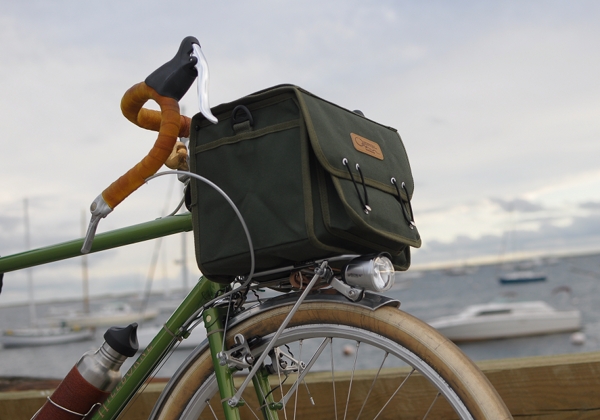
a Nitto M-18 front rack from Renaissance Bicycle (a sponsor), an Ostrich handlebag bag from Velo Orange which I use on long trips,
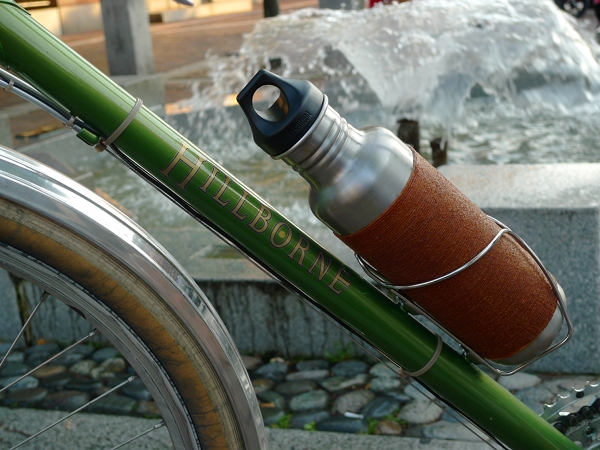
a twined and shellacked Klean Kanteen water bottle,
and my beloved Power Grips (see here for my initial review of them).
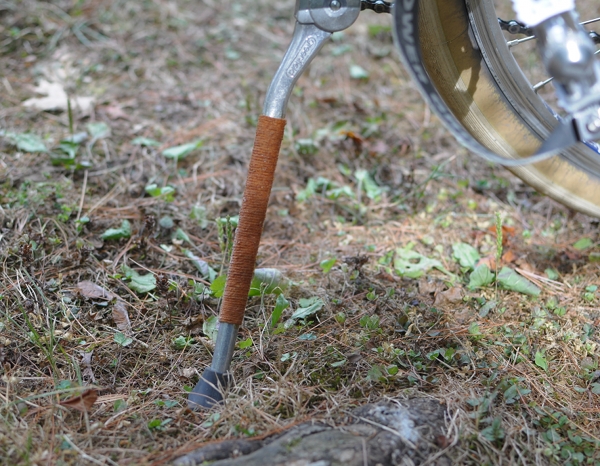
I have also twined and shellacked the kickstand (to prevent it from scraping against the pedal when the bike is parked),
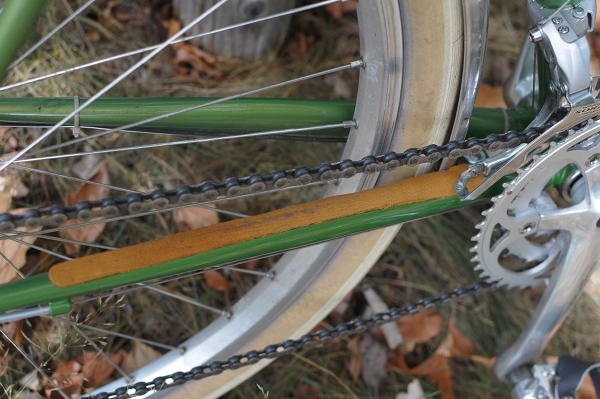
and added a leather Velo Orange chainstay protector. This product is great for preventing the paint on the right chainstay from getting nicked by the chain slapping against it when the bicycle goes over bumps - which began to happen to my Rivendell within the first few rides I went on.
There are a few additional little details that I enjoy, but no one else probably notices - like these green cable endcap crimps,
and the "taupe" zipties (see top right, under the waterbottle) for routing the dynamo lighting that I find to be less noticeable than black ones.
Over the time I have owned him, I feel that Graham has attained an appearance that is distinctly personalised. Looking at him reminds me of the many "firsts" I experienced on this bicycle: from learning to ride with drop bars to going downhill at 30 miles per hour, while cornering, with a full handlebar bag.
These experiences certainly did not happen all at once. After I first brought the complete bicycle home, I had a minor hysterical breakdown when the reality of owning it hit me. What on Earth would I do with such an expensive bike with drop bars? What if I wasn't able to ride it? The bike would end up standing in my livingroom as a beautiful, ridiculous testament to the gap between my imagination and my abilities.
This emotional self-flogging lasted for a couple of days, but then I began to ride the bike. I took it slow and started by setting the handlebars quite high, so that I could get used to the drop bars. The Hillborne has what I would say is a long top tube, and I have a short torso - so the degree of lean this placed me in required some adjustment on my part.
Over the course of the first month I owned the bike, I rode it almost daily and lowered the handlebars weekly - until eventually I was comfortable with them being at the level of the saddle. I would recommend this method to those who find dropbars intimidating.
I love pretty much everything about this bicycle and find it difficult to muster up any words of criticism. It may be worth noting that some dislike the slight upward slope to the top tube on the Hillborne, but I have no problem with it. If I have to find something bad to say, then maybe it's that the paint seems to be a bit delicate - but then I am used to powdercoat, and it's just a fact that liquid paint is easier to nick. I am equally happy with my choice of components - perhaps with the exception of the Shimano Deore rear derailleur, which I have managed to bang up pretty badly in the course of ownership. Next spring, I may replace it with the Shimano XT "Shadow," which seems more immune to abuse. Otherwise, everything is perfect.
I don't know how to describe the ride quality of the Sam Hillborne in technical terms, but in non-technical terms I feel as if I could live on it. Nothing hurts, ever. The bicycle is miraculously cushy over bumps. There is no "toe overlap" with the front tire when turning. The seat tube angle is just right: relaxed enough to be comfortable without having to shove the saddle back on the rails, but not so relaxed as to stand in the way of "performance." I can keep up with the Co-Habitant just fine on the Hillborne, and he is a fast cyclist. The most challenging ride I have gone on so far has been a very hilly metric century (64 miles), and I felt great afterwards. No weight on my hands, no strain on my neck, no knee pain, just comfy cycling goodness. The bicycle seems equally stable at both high and low speeds. I can go over 20 miles per hour while feeling as if I am going 10 and I can plummet downhill while enjoying the view instead of panicking. It is also fantastic on climbs and seems to carry momentum well.
As I have mentioned at the start, I have now cycled 1,800 miles on this bike - which may be more than I have cycled on all my other bicycles combined. I had never imagined that I would be doing this much cycling, let alone on a roadbike. I know that it is all supposed to be about the cyclist and not about the bicycle, but I honestly do not think I would have come this far in my road cycling skills on a different bike, no way. I would even credit the Sam Hillborne with how well I took the track bike I rode in Vienna and to the Italian racing bike I subsequently built up as a fixed gear. Once I learned the skills on the Rivendell, I felt comfortable on other types of roadbikes as well - but I would not have been able to learn on them.
While the Sam Hillborne was great for me as a beginner, I am nowhere close to "outgrowing" it. If anything, I feel as if I am slowly growing into it and am only starting to appreciate its full potential. Next summer I am looking forward to doing some more extensive touring and attempting more challenging hills. After all - my bike was born for them.
I received a Rivendell Sam Hillborne frame as a holiday gift in December 2009, purchased from Harris Cyclery in West Newton, MA. We were not yet comfortable building up a bike on our own, so the build was done at Harris as well. It took me a few months to save up for the components, and the bicycle was ready in the end of April. Note that Harris Cyclery was not a sponsor at the time, and that everything in relation to this bicycle was a standard purchase.
My choice of build for the Hillborne was informed by test-riding a floor model in my size. Since I had no real experience riding a roadbike at that point, I mostly went with recommended specs. These included a 3x8 drivetrain, Sugino cranks, Nitto Noodle handlebars with Silver bar-end shifters, and a Brooks B17S saddle. My 52cm frame was built for 650B wheels and cantilever brakes.
The three things I specifically chose for this bicycle were handbuilt wheels with dynamo lighting (see details here), Grand Bois Hetre tires (see review here), and Tektro short reach brake levers. The discovery of these brake levers was crucial for me. One thing that had hitherto prevented me from riding bicycles with drop bars, was my inability to squeeze the brake levers - especially from the hoods. I have small hands and I have damaged nerves in my hands. The combination made squeezing this type of lever impossible. When I described the problem to Elton at Harris Cyclery, we went through different brake levers to see whether any existed that I was able to squeeze. The Tektro levers were it and I am extremely happy with them. Elton also showed me some methods of hand and finger placement that work well for me and do not send electric currents through my fingers. I cannot stress enough what a break-through this was in terms of understanding why I was having problems riding with drop bars before.
Over time, I added other personal touches to the bicycle. These include a Carradice saddle bag,
a Nitto M-18 front rack from Renaissance Bicycle (a sponsor), an Ostrich handlebag bag from Velo Orange which I use on long trips,
a twined and shellacked Klean Kanteen water bottle,
and my beloved Power Grips (see here for my initial review of them).
I have also twined and shellacked the kickstand (to prevent it from scraping against the pedal when the bike is parked),
and added a leather Velo Orange chainstay protector. This product is great for preventing the paint on the right chainstay from getting nicked by the chain slapping against it when the bicycle goes over bumps - which began to happen to my Rivendell within the first few rides I went on.
There are a few additional little details that I enjoy, but no one else probably notices - like these green cable endcap crimps,
and the "taupe" zipties (see top right, under the waterbottle) for routing the dynamo lighting that I find to be less noticeable than black ones.
Over the time I have owned him, I feel that Graham has attained an appearance that is distinctly personalised. Looking at him reminds me of the many "firsts" I experienced on this bicycle: from learning to ride with drop bars to going downhill at 30 miles per hour, while cornering, with a full handlebar bag.
These experiences certainly did not happen all at once. After I first brought the complete bicycle home, I had a minor hysterical breakdown when the reality of owning it hit me. What on Earth would I do with such an expensive bike with drop bars? What if I wasn't able to ride it? The bike would end up standing in my livingroom as a beautiful, ridiculous testament to the gap between my imagination and my abilities.
This emotional self-flogging lasted for a couple of days, but then I began to ride the bike. I took it slow and started by setting the handlebars quite high, so that I could get used to the drop bars. The Hillborne has what I would say is a long top tube, and I have a short torso - so the degree of lean this placed me in required some adjustment on my part.
Over the course of the first month I owned the bike, I rode it almost daily and lowered the handlebars weekly - until eventually I was comfortable with them being at the level of the saddle. I would recommend this method to those who find dropbars intimidating.
I love pretty much everything about this bicycle and find it difficult to muster up any words of criticism. It may be worth noting that some dislike the slight upward slope to the top tube on the Hillborne, but I have no problem with it. If I have to find something bad to say, then maybe it's that the paint seems to be a bit delicate - but then I am used to powdercoat, and it's just a fact that liquid paint is easier to nick. I am equally happy with my choice of components - perhaps with the exception of the Shimano Deore rear derailleur, which I have managed to bang up pretty badly in the course of ownership. Next spring, I may replace it with the Shimano XT "Shadow," which seems more immune to abuse. Otherwise, everything is perfect.
I don't know how to describe the ride quality of the Sam Hillborne in technical terms, but in non-technical terms I feel as if I could live on it. Nothing hurts, ever. The bicycle is miraculously cushy over bumps. There is no "toe overlap" with the front tire when turning. The seat tube angle is just right: relaxed enough to be comfortable without having to shove the saddle back on the rails, but not so relaxed as to stand in the way of "performance." I can keep up with the Co-Habitant just fine on the Hillborne, and he is a fast cyclist. The most challenging ride I have gone on so far has been a very hilly metric century (64 miles), and I felt great afterwards. No weight on my hands, no strain on my neck, no knee pain, just comfy cycling goodness. The bicycle seems equally stable at both high and low speeds. I can go over 20 miles per hour while feeling as if I am going 10 and I can plummet downhill while enjoying the view instead of panicking. It is also fantastic on climbs and seems to carry momentum well.
As I have mentioned at the start, I have now cycled 1,800 miles on this bike - which may be more than I have cycled on all my other bicycles combined. I had never imagined that I would be doing this much cycling, let alone on a roadbike. I know that it is all supposed to be about the cyclist and not about the bicycle, but I honestly do not think I would have come this far in my road cycling skills on a different bike, no way. I would even credit the Sam Hillborne with how well I took the track bike I rode in Vienna and to the Italian racing bike I subsequently built up as a fixed gear. Once I learned the skills on the Rivendell, I felt comfortable on other types of roadbikes as well - but I would not have been able to learn on them.
While the Sam Hillborne was great for me as a beginner, I am nowhere close to "outgrowing" it. If anything, I feel as if I am slowly growing into it and am only starting to appreciate its full potential. Next summer I am looking forward to doing some more extensive touring and attempting more challenging hills. After all - my bike was born for them.
Subscribe to:
Posts (Atom)