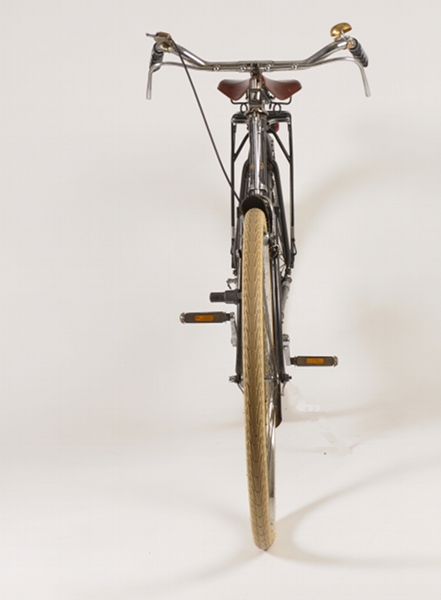
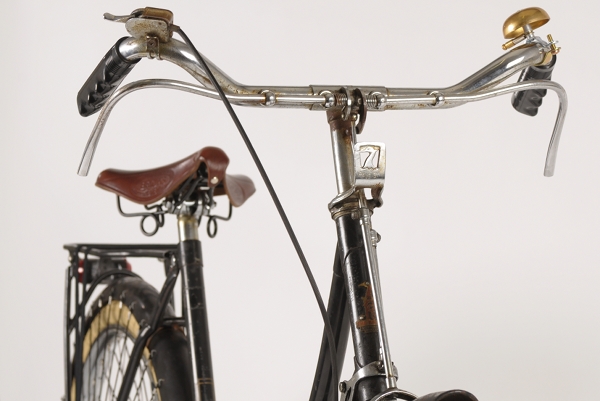
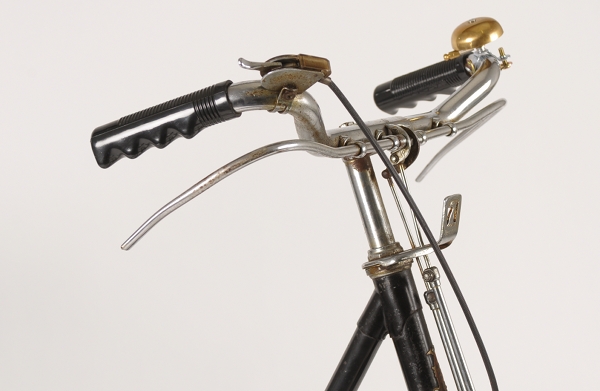
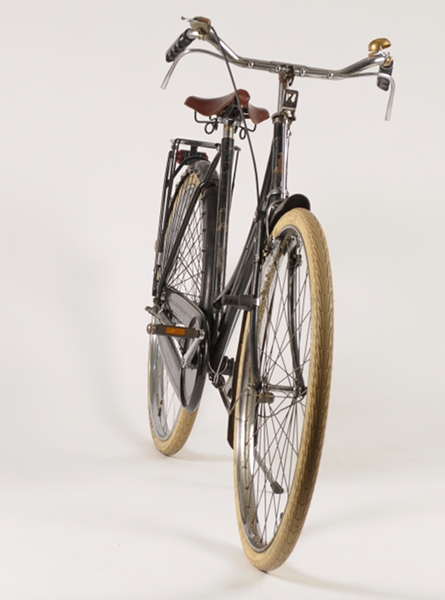
Since the end of the summer, I've received a number of concerned inquiries about "Velouria," my vintage Raleigh DL-1 Tourist (and for those who have only begun reading this blog recently, I am named after this bicycle, not the other way around). Though admittedly I have not featured her for some time, I assure you that Velouria is alive and well. She resides in our photo studio just South of Boston, performing the under-documented but crucial role of "studio bike." And here are the pictures to prove it.
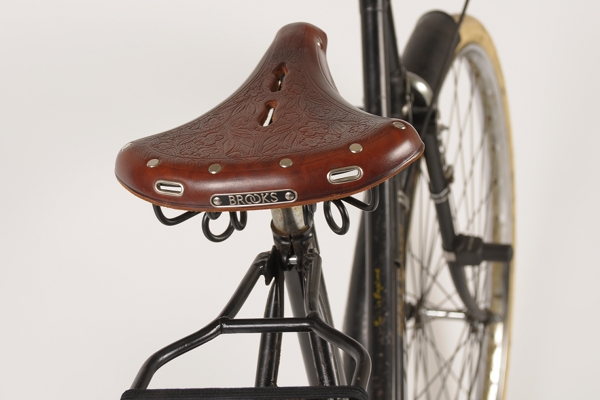
For those unfamiliar with Velouria's history, she is somewhat of a "frankenbike," albeit a darling one. I acquired the 1973 Raleigh DL-1 in the summer of 2009 and over time proceeded to subject her to a number of modifications. These have included: an aftermarket chaincase and dress guards, cream tires, a Brooks B18 saddle, a custom rear rack, and an updated rear wheel with a coaster brake hub to supplement the pitiful braking power of the rod brakes.
Why do I feel the need to mess with a vintage bicycle in this manner? To tell the truth, part of it is simply the compulsion to experiment, to customise, to turn objects that belong to me into "creatures." I am not saying it's a good habit necessarily; but it's how I like to do things.
There was also a practical reason for all the modifications: I loved the ride quality of the DL-1 so much, that I was highly motivated to make it as functional as possible.
But ultimately, my love for this bicycle is also what made me move it to the photo studio after I (literally) found the vintage Gazelle in the end of last summer. At the risk of sounding cruel to the Gazelle, I am willing to run it into the ground. It is a great bike, it handles wonderfully, it is admirably designed, but my feeling toward is appreciation - not "love." The vintage Raleigh, on the other hand, feels almost like a pet. I just can't bring myself to ride its already battered and rusty frame on the salted roads in the winter, or even to leave it for hours in the rain in the summer. "Let the Gazelle take the abuse and spare the Raleigh," says my heart. And so Velouria became "studio bike" - ridden occasionally, but not too much.
And if you've noticed that these pictures are a little different from my typical bike photos, that is because they were taken inside the studio itself. We will soon be doing a couple of photo shoots for a local framebuilder, so we're practicing. When it comes to product photography in a studio setting, every object requires a different approach to lighting - and I would say that bicycles are fairly complicated as far as these things go. They are enormous, they have both matte and reflective parts, and they cast a variety of unusual shadows. Oh, and don't get me started on the kickstand thing; we are still working that one out!
Of course, the trouble with this type of product photography is that it brings every single detail of the object into sharp focus - not exactly the most flattering approach when it comes to vintage bikes!
But after all, "Velouria" is not just any vintage bike. She is mine. The scraped paint, the rust, the solidified crust, the dented fenders and even the bent rodbrake levers are, oddly, all part of what makes me cherish her. She may no longer be the most frequently featured bicycle here, but she epitomises the theme of this blog perhaps more than any other bike I own.
Showing posts with label restoration. Show all posts
Sunday, January 30, 2011
Monday, January 17, 2011
A Lovely Touring Bike... For You?
When I mentioned my "roadbike for women who fear roadbikes" project earlier, I didn't make this clear as I was still figuring out the details - but it is now very much official: I will be giving this bicycle away for free to an interested recipient in the spring.
To recap: Back in November, I picked up a vintage Shogun bike in which I saw a lot of potential, due to its comfortable frame geometry. The Co-Habitant and I are overhauling the bicycle from the frame up and fitting it with nice, comfy components. The goal is to turn it into a touring bike that will hopefully address some issues that fledgling female cyclists tend to have with roadbikes. I was not able to handle a roadbike until (after much trial and error) I discovered that a comfortable frame plus the right components were key. That experience changed my perspective and made me very happy, and I would like to help make that happen for someone else.
I am able to fit this bicycle with extremely nice components and give it away for free, thanks to the generosity of several donors. The main donors for this project are Velo Orange and Cambridge Bicycle, whose contributions will be described below. I have also been offered a monetary donation by a reader "Cedar" to cover the costs of the frame and wheelset I had purchased. Additional contributions of components were made by: Justine Valinotti of Midlife Cycling, reader "Spindizzy," reader "G.E.," reader "neighbourtease," and "somervillain" of Boston Retro Wheelmen. The Co-habitant and I are contributing our time and labor, as well as a few of our own things.
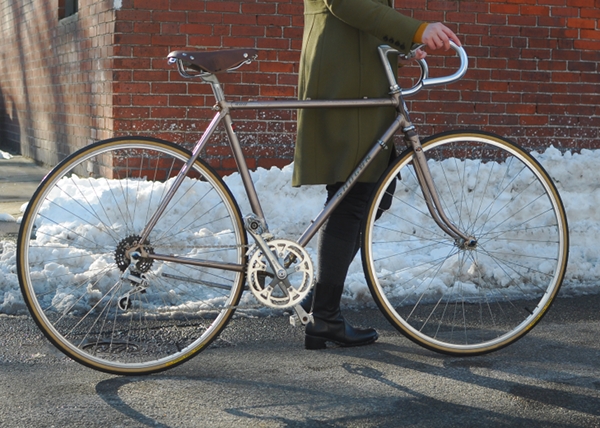
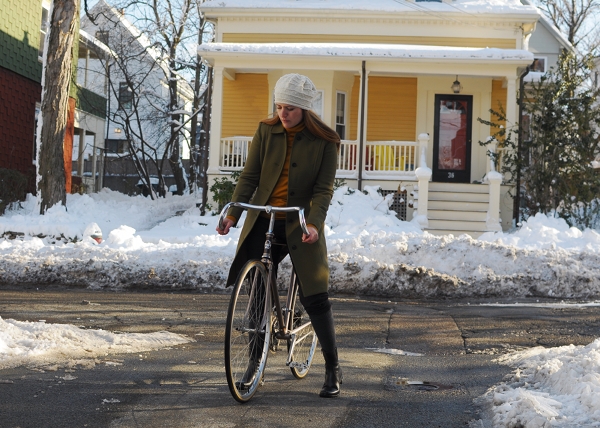
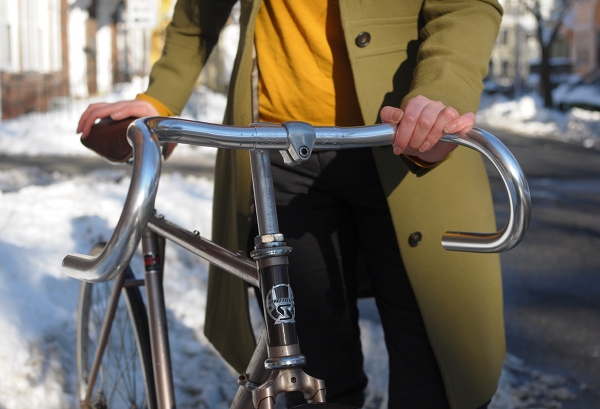
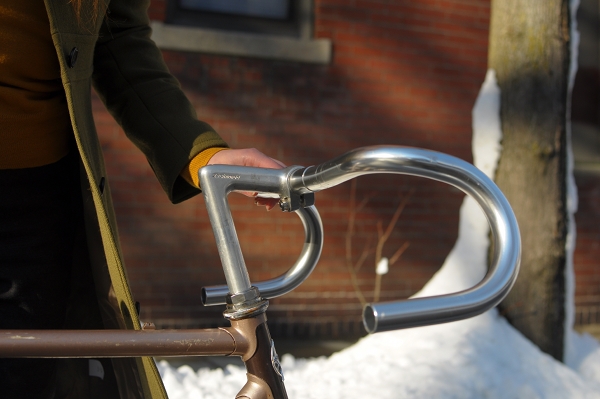
The frame and fork are cro-moly, and the seat tube angle is a comfortable 72.5 degrees. The frame has "touring geometry" and eyelets for fenders and racks. The bicycle as shown in the pictures here has been stripped of most of its original components, fitted with an updated touring wheelset, a Nitto stem, Nitto Randonneur handlebars, and a Velo Orange saddle. The drivetrain shown is original, but it will soon be replaced.
The size of the frame is 52cm, as measured from the center of the bottom bracket to the center of the intersection with the top tube (or 54cm if measured to the top of the seat tube). I am 5'7" and the size is just right for me - with plenty of top tube clearance, but not too much. If you are 5'5" - 5'8" it should fit you as well. Outside of that range, I would need to know your inseam measurement or pubic bone height to give you a better idea. Since there is only one bike, the size will naturally exclude many of you from participating in the give-away, and I am sorry about that.
The frame colour of the bicycle is an ethereal mixture of mauve and champagne. It's a neutral colour, but vibrant, with some shimmer to it; the pictures here portray it accurately. The headtube panel is a deep, dark chocolate-plum. The Shogun insignia on the downtube is sage green.
The Nitto Technomic stem and Randonneur handlebars are from my own parts stash (the handlebars are new, the stem gently used). I am not sure yet whether the final bicycle will have the Randonneur bars or the Noodles - I am planning to do a comparison test.
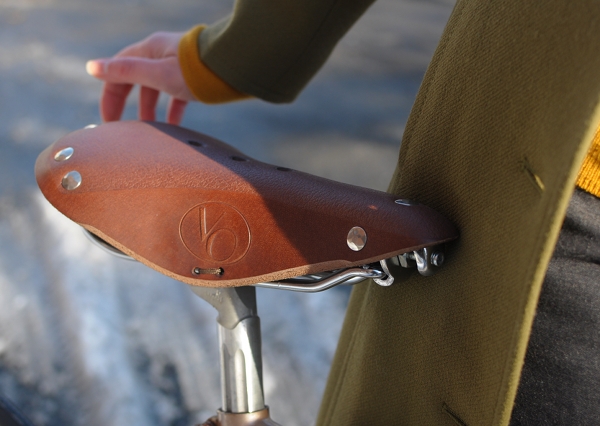
The saddle is a "Model 3" touring saddle from Velo Orange, which I will test out and review once the roads are clear of snow. The person who gets the bike in the end will have a choice between this saddle, and one of my own Brooks B17S saddles (which I no longer use).
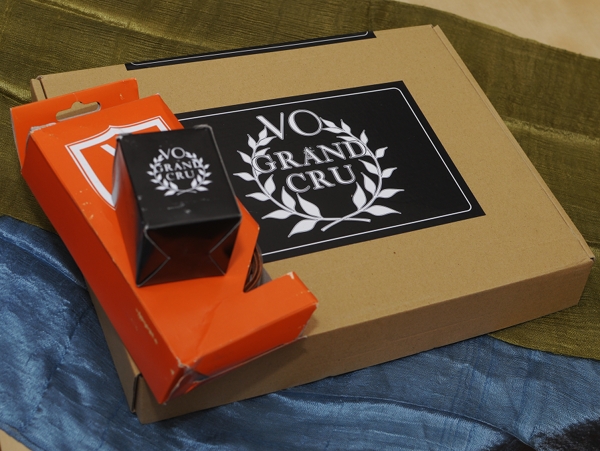
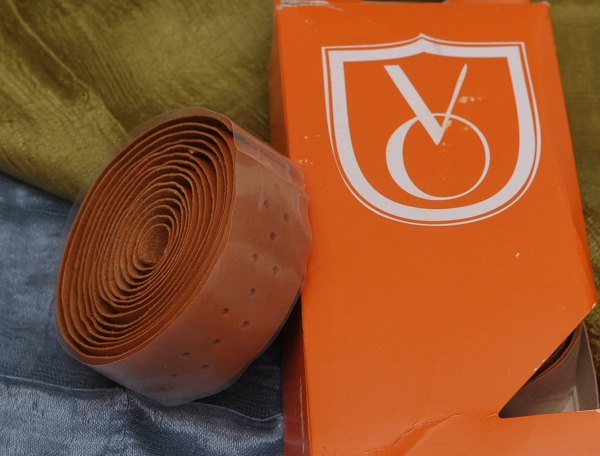
In addition to the saddle, Velo Orange was kind enough to donate: a headset, a crankset, fenders, and leather handlebar tape. The items were ones I requested specifically for this bike.
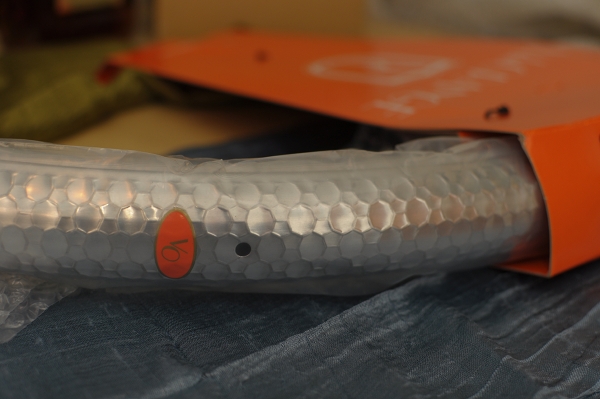
I don't want to remove the hammered fenders from the packaging until it's time to install them, but they look beautiful. The hammered pattern has a "honey comb" look to it that I visually prefer over the Honjo version - though this is, of course, a matter of taste.
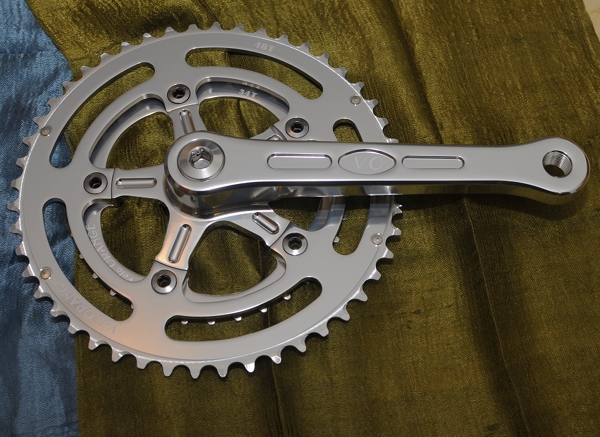
The "Grand Cru" crankset is classic and beautifully made, modeled on vintage TA. Before VO released this model, it was very difficult to find a crankset in a classic style.
I haven't put leather tape on any of my own drop bars, as I consider it too expensive - but if will be fabulous to try it out before giving the bike away!
I have not yet picked up the components donated by Cambridge Bicycle, but they will include: brakes, short-reach brake levers, derailleur, cables, housing, and MKS touring pedals. I will feature these in a separate post.
For others interested in getting involved in this project, I am still in need of the following components for the basic build:bar-end shifters (Shimano or Silver), a bottom bracket (JIS Square Taper, 110mm spindle length, hollow axle), tires (32mm Panaracer Pasela Tourguards), and a few other random items. Additionally, I am looking for a local bike shop that would be willing to ship the bicycle in the event that the recipient is not local, so that their winning does not entail having to pay for shipping. Everything donated will be used for this project only. To contribute, please get in touch at filigreevelo-at-yahoo-dot-com and thanks in advance for the help!
I am not sure yet what form the give-away of this bicycle will take. I hate to call it a "contest," but there will obviously have to be some sort of selection process, as there is only one bicycle. Either way, the formal rules will likely not be announced until early Spring. In the meantime, I would love to hear what you think about the whole idea. A refurbished vintage bike is not a typical give-away item and I am not even certain whether anybody will want it! Do you like the colour? The look so far? And I am especially interested in hearing from women who would like to try a road bike with drop bars, but have not had much luck thus far. What has been your experience? What do you find intimidating or difficult about the process? Similarly, if you already ride a roadbike, but find it uncomfortable or sub-par, I am interested in why.
I am enjoying putting together this bicycle immensely, and I thank once again those whose donations have made this project possible, in particular:
To recap: Back in November, I picked up a vintage Shogun bike in which I saw a lot of potential, due to its comfortable frame geometry. The Co-Habitant and I are overhauling the bicycle from the frame up and fitting it with nice, comfy components. The goal is to turn it into a touring bike that will hopefully address some issues that fledgling female cyclists tend to have with roadbikes. I was not able to handle a roadbike until (after much trial and error) I discovered that a comfortable frame plus the right components were key. That experience changed my perspective and made me very happy, and I would like to help make that happen for someone else.
I am able to fit this bicycle with extremely nice components and give it away for free, thanks to the generosity of several donors. The main donors for this project are Velo Orange and Cambridge Bicycle, whose contributions will be described below. I have also been offered a monetary donation by a reader "Cedar" to cover the costs of the frame and wheelset I had purchased. Additional contributions of components were made by: Justine Valinotti of Midlife Cycling, reader "Spindizzy," reader "G.E.," reader "neighbourtease," and "somervillain" of Boston Retro Wheelmen. The Co-habitant and I are contributing our time and labor, as well as a few of our own things.
The frame and fork are cro-moly, and the seat tube angle is a comfortable 72.5 degrees. The frame has "touring geometry" and eyelets for fenders and racks. The bicycle as shown in the pictures here has been stripped of most of its original components, fitted with an updated touring wheelset, a Nitto stem, Nitto Randonneur handlebars, and a Velo Orange saddle. The drivetrain shown is original, but it will soon be replaced.
The size of the frame is 52cm, as measured from the center of the bottom bracket to the center of the intersection with the top tube (or 54cm if measured to the top of the seat tube). I am 5'7" and the size is just right for me - with plenty of top tube clearance, but not too much. If you are 5'5" - 5'8" it should fit you as well. Outside of that range, I would need to know your inseam measurement or pubic bone height to give you a better idea. Since there is only one bike, the size will naturally exclude many of you from participating in the give-away, and I am sorry about that.
The frame colour of the bicycle is an ethereal mixture of mauve and champagne. It's a neutral colour, but vibrant, with some shimmer to it; the pictures here portray it accurately. The headtube panel is a deep, dark chocolate-plum. The Shogun insignia on the downtube is sage green.
The Nitto Technomic stem and Randonneur handlebars are from my own parts stash (the handlebars are new, the stem gently used). I am not sure yet whether the final bicycle will have the Randonneur bars or the Noodles - I am planning to do a comparison test.
The saddle is a "Model 3" touring saddle from Velo Orange, which I will test out and review once the roads are clear of snow. The person who gets the bike in the end will have a choice between this saddle, and one of my own Brooks B17S saddles (which I no longer use).
In addition to the saddle, Velo Orange was kind enough to donate: a headset, a crankset, fenders, and leather handlebar tape. The items were ones I requested specifically for this bike.
I don't want to remove the hammered fenders from the packaging until it's time to install them, but they look beautiful. The hammered pattern has a "honey comb" look to it that I visually prefer over the Honjo version - though this is, of course, a matter of taste.
The "Grand Cru" crankset is classic and beautifully made, modeled on vintage TA. Before VO released this model, it was very difficult to find a crankset in a classic style.
I haven't put leather tape on any of my own drop bars, as I consider it too expensive - but if will be fabulous to try it out before giving the bike away!
I have not yet picked up the components donated by Cambridge Bicycle, but they will include: brakes, short-reach brake levers, derailleur, cables, housing, and MKS touring pedals. I will feature these in a separate post.
For others interested in getting involved in this project, I am still in need of the following components for the basic build:
I am not sure yet what form the give-away of this bicycle will take. I hate to call it a "contest," but there will obviously have to be some sort of selection process, as there is only one bicycle. Either way, the formal rules will likely not be announced until early Spring. In the meantime, I would love to hear what you think about the whole idea. A refurbished vintage bike is not a typical give-away item and I am not even certain whether anybody will want it! Do you like the colour? The look so far? And I am especially interested in hearing from women who would like to try a road bike with drop bars, but have not had much luck thus far. What has been your experience? What do you find intimidating or difficult about the process? Similarly, if you already ride a roadbike, but find it uncomfortable or sub-par, I am interested in why.
I am enjoying putting together this bicycle immensely, and I thank once again those whose donations have made this project possible, in particular:
Friday, December 17, 2010
The Vintage Bike Shop: a Visit to 'Old Roads' in Cambridge, MA
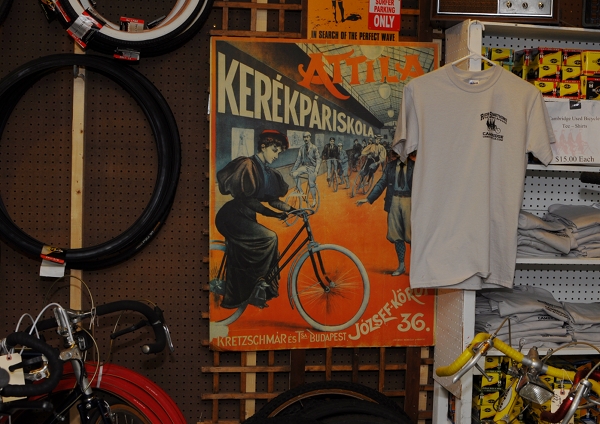
Used and vintage bicycle shops can be great resources on a number of levels. For the beginner cyclist, they can provide clean, tuned-up alternatives to the treacherous waters of Craigslist and ebay. For the DIY tinkerer, they can be a source for older parts and accessories. And for the seasoned collector, they can, on occasion, offer up a gem of a bicycle that one would not normally come across elsewhere. A vintage bike shop is certainly worth a visit, if one exists in your area. In Boston, we are lucky to have Old Roads - located in the Cambridge Antiques Market, just a 15 minute bike ride from my home.
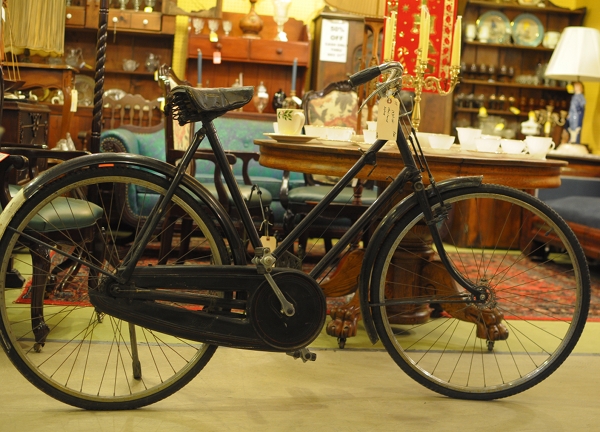
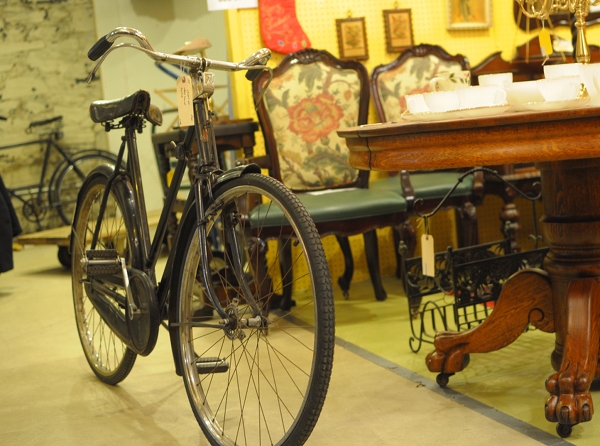
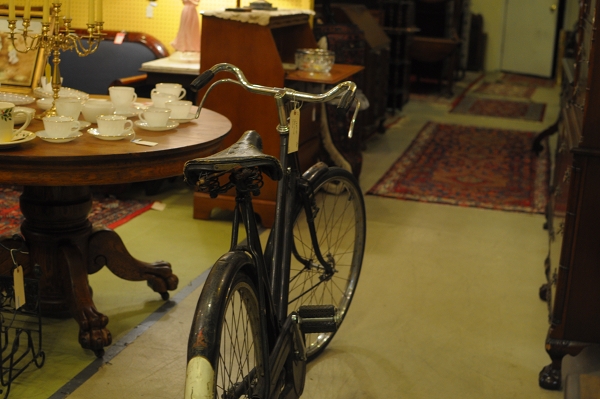
Presuming that most of the bicycles offered are found locally, vintage bike shops are in a sense like museums of history: They give you an idea of what kind of bikes were popular in your area over decades past. It amazes me that no matter how many of these bikes are sold (and I've personally played matchmaker in several deals), Boston does not seem to run out of its stock of early full-chaincase Raleighs. Just imagine how many of these things must have been on the streets in the '30s-70s. The model above is an original early 1930s version.
(Cuppa tea?)
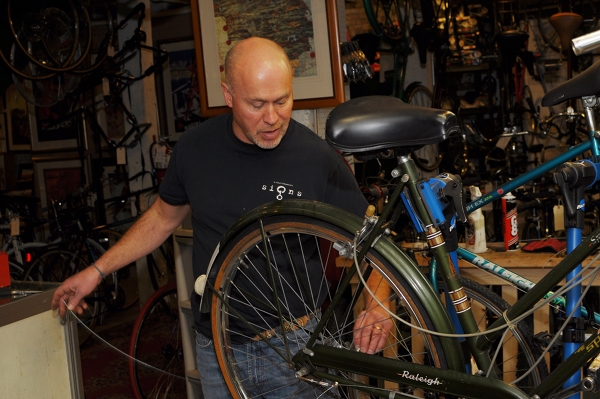
Situated in the dungeon-like basement of the Antiques Market (formerly a coffin factory!), "Old Roads" is really a joint project between two shops: Menotomy Vintage Bicycles, owned by Vinny,
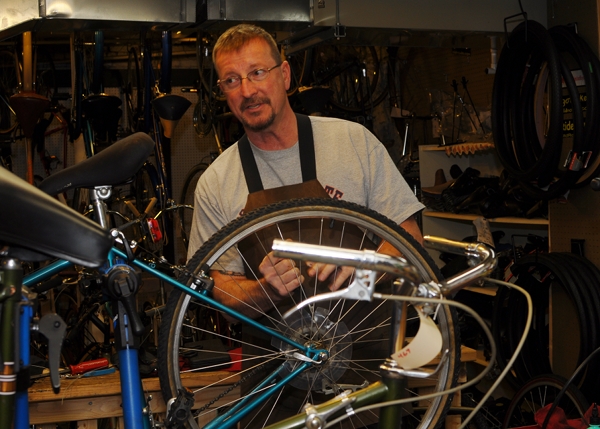
and Cambridge Used Bicycles, owned by Ed. They began selling bikes out of this space in 2008, and have since become a staple of the vintage bicycle scene in the Boston area.
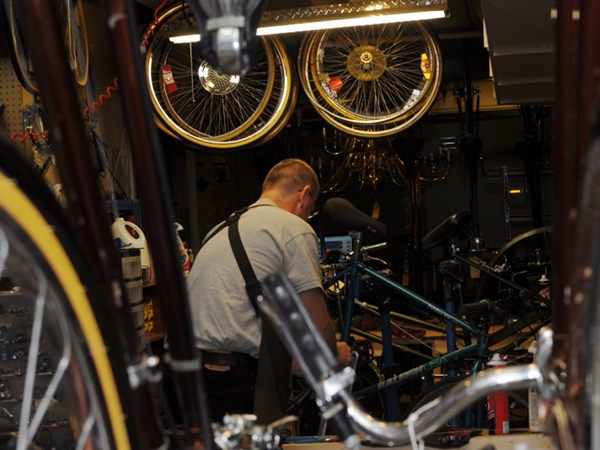
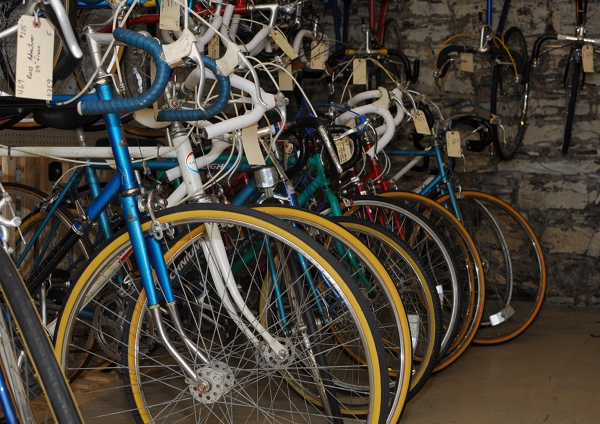
The full extend of their inventory is impossible to capture, due to the sprawling, cavernous nature of the space - which makes being there in person all the more exciting. There are rows and rows of vintage bicycles - on the floor, on the walls, on the ceiling, everywhere you look really.
Though initially, the focus of the shop was meant to be on antique bicycles, it soon became apparent that the local population was mostly interested in reliable 3-speeds and 10-speeds from the 1960s through the early 1980s, to be used as transportation. And so, increasingly, the inventory began to accommodate this. Now the shop offers a stagerring variety of bicycles, in one of five categories: vintage 3-speeds, vintage roadbikes, early vintage cruisers, antique bikes (pre-WWII), and some used newer bikes from the 1990s onward - including a couple of hand-painted "fixies".
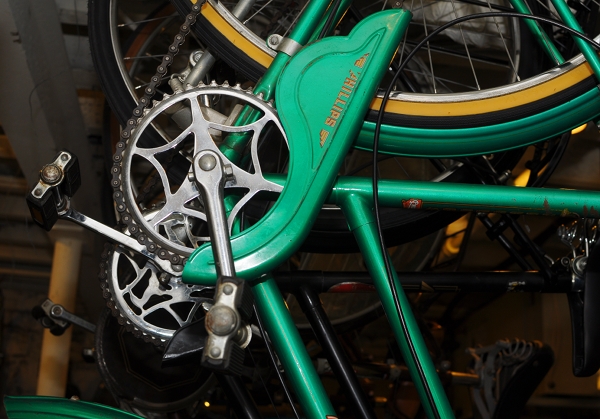
For me, the 3-speeds are the biggest attraction. There are dozens of them, both men's and ladies'. Though Raleigh and Schwinn are the names you will see most frequently, more unusual offerings are often found as well.
Phillips, England
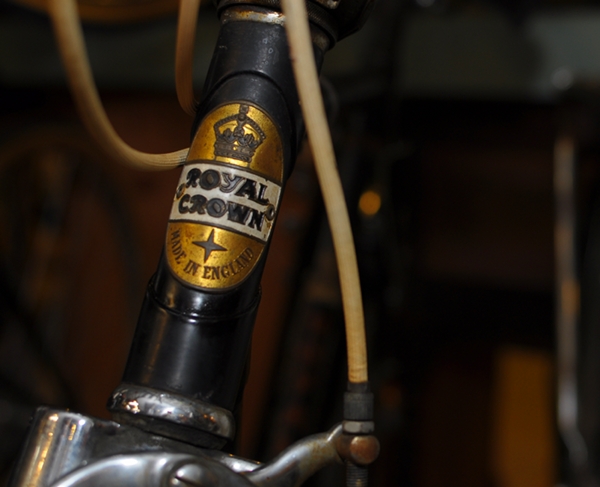
Royal Crown, England
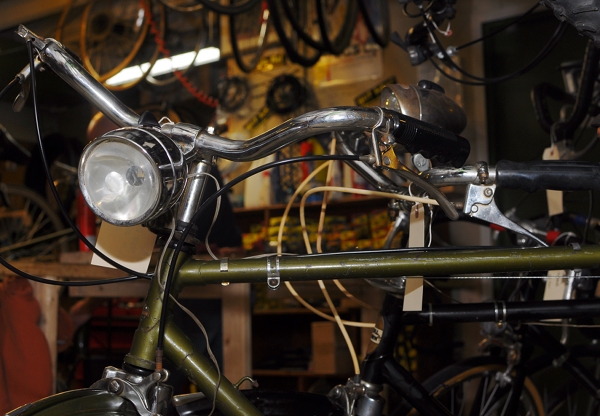
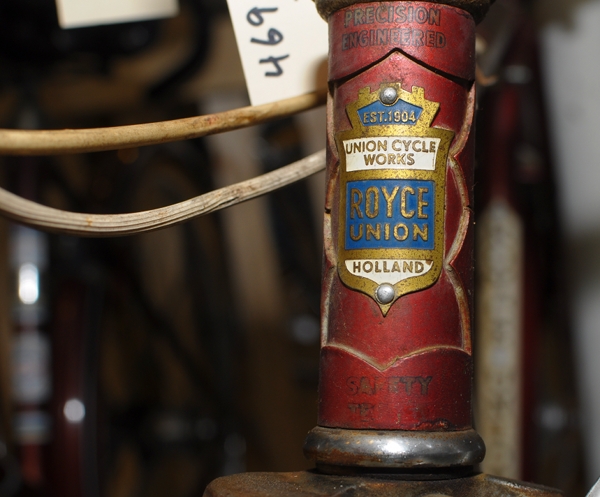
Royce Union, Holland. And there are many others. With chaincases and without, English and Dutch, step through and diamond frame, some even with the original dynamo lighting.
Presuming that most of the bicycles offered are found locally, vintage bike shops are in a sense like museums of history: They give you an idea of what kind of bikes were popular in your area over decades past. It amazes me that no matter how many of these bikes are sold (and I've personally played matchmaker in several deals), Boston does not seem to run out of its stock of early full-chaincase Raleighs. Just imagine how many of these things must have been on the streets in the '30s-70s. The model above is an original early 1930s version.
(Cuppa tea?)
and Cambridge Used Bicycles, owned by Ed. They began selling bikes out of this space in 2008, and have since become a staple of the vintage bicycle scene in the Boston area.
The full extend of their inventory is impossible to capture, due to the sprawling, cavernous nature of the space - which makes being there in person all the more exciting. There are rows and rows of vintage bicycles - on the floor, on the walls, on the ceiling, everywhere you look really.
Though initially, the focus of the shop was meant to be on antique bicycles, it soon became apparent that the local population was mostly interested in reliable 3-speeds and 10-speeds from the 1960s through the early 1980s, to be used as transportation. And so, increasingly, the inventory began to accommodate this. Now the shop offers a stagerring variety of bicycles, in one of five categories: vintage 3-speeds, vintage roadbikes, early vintage cruisers, antique bikes (pre-WWII), and some used newer bikes from the 1990s onward - including a couple of hand-painted "fixies".
For me, the 3-speeds are the biggest attraction. There are dozens of them, both men's and ladies'. Though Raleigh and Schwinn are the names you will see most frequently, more unusual offerings are often found as well.
Phillips, England
Royal Crown, England
Royce Union, Holland. And there are many others. With chaincases and without, English and Dutch, step through and diamond frame, some even with the original dynamo lighting.
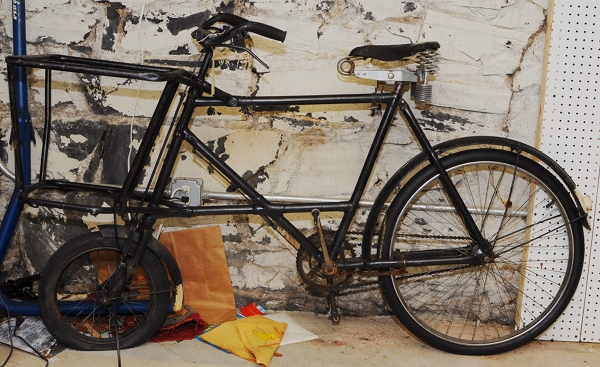
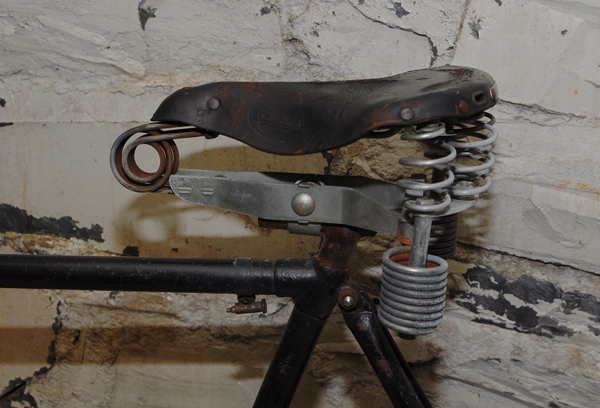
And of course the antique offerings never fail to impress. The above is a Butcher's bike, most likely from the 1920s.
I am guessing this butcher was a heavy guy!
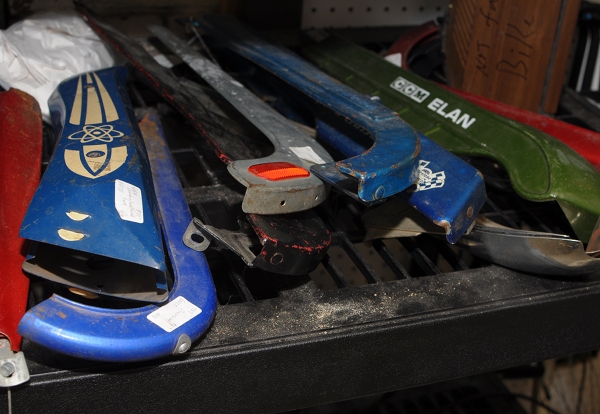
There is also a slew of accessories in stock, including chainguards, handlebars, saddles, tires and racks.
Even vintage bottle generators are available, for those who find the modern ones too high tech.
Ephemera and t-shirts, too.
In addition to its physical presence, Old Roads offers a number of online resources for the Boston area and beyond. They host a message board where visitors can discuss a multitude of topics pertaining to vintage bikes, as well as post for sale/ wanted ads free of charge. They offer a price guide for used and vintage bicycles. And they sell some interesting hard to find parts online. While in the summer, bicycles are sold only locally, during the winter they can be shipped outside the Boston area as well. For those looking for a vintage English 3-speed in clean condition, this can be a good option if your area has a shortage.
Like proprietors of used bookstores, vintage bike shop owners tend to be genuine enthusiasts - which means that the customer can benefit a lot more from interacting with them, than from interacting with someone who just wants to sell their old bike. Interesting stories, helpful advice, and local bicycle lore are just some of these benefits. Out of curiosity: Are there used or vintage bike shops in your area, and do you find them useful?
Sunday, December 12, 2010
Something Special
Having a special bicycle is not about following the latest chic trend. It is not about hunting down a frame made of famous tubing. It is not about obsessing about period-correct components. And it is not about trying to evoke a specific country of origin. It's really about focusing on your preferences and your needs. Only you can make your bicycle uniquely yours.
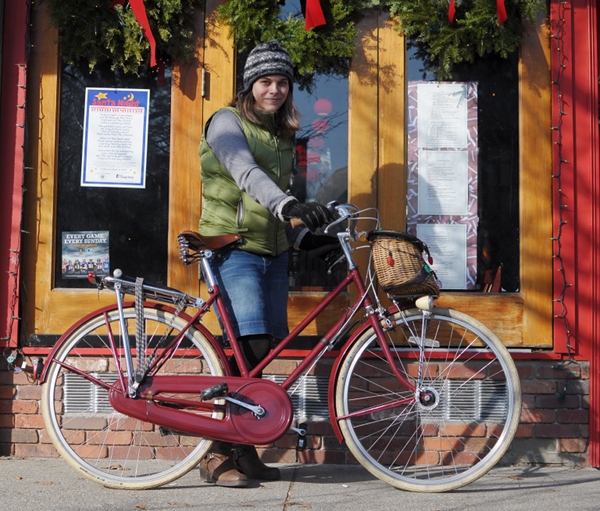
My fellow Bostonian C.P. - or "cycler" on Biking in Heels - has done an impressive job in this regard. Her bicycle, Gilbert, is completely and utterly hers - and very special. CP comes from a family of cyclists and has ridden a bike for as long as she can remember. But it was not until she lived in Italy as a young adult, that her love of city bicycles with step-through frames was ignited. Upon returning to the US, she brought a vintage Italian city bike with her, and the rest is history. An architect by profession and a DIY enthusiast by nature, C.P. enjoys wrenching on her own bikes and now owns a modest stable of vintage ladies' models from the 1930s through the 1970s.
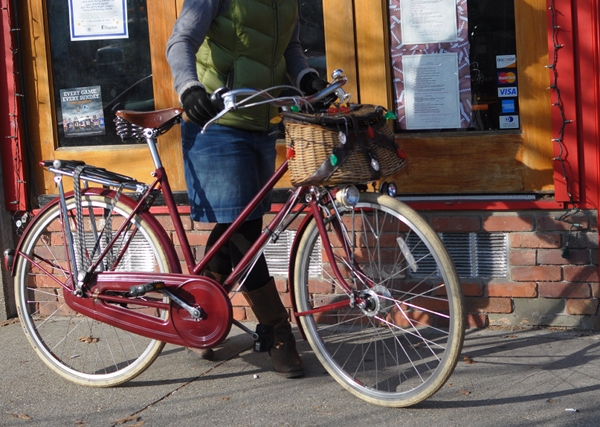
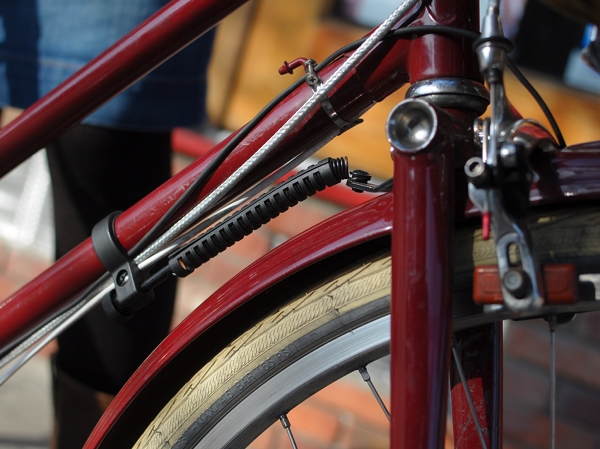
As her ultimate bicycle for transportation, C.P. wanted something that handled like her favourite vintage bikes, yet was as clean and reliable as a new bike. And so her project began. She rescued a 1970s Raleigh Lady's Sports frame and fork, and had them repainted a colour she loved. She bought a suitable chaincase and had it painted to match, along with the fenders. She built modern wheels with alloy rims around a Shimano 8-speed hub in the rear and a Shimano dynamo hub in the front.
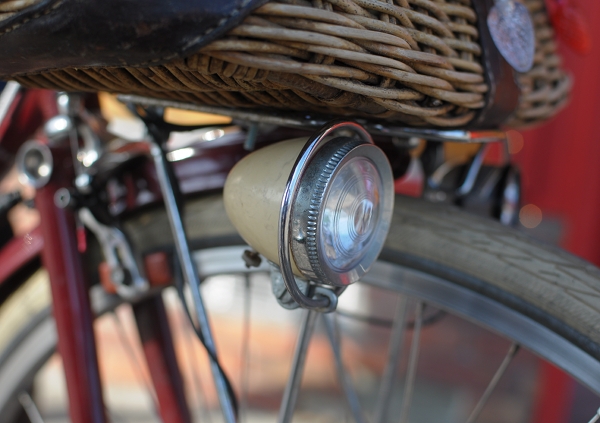
Gilbert's set-up includes handsome and effective lighting,
cushy cream tires,
front and rear racks for maximum hauling capacity,
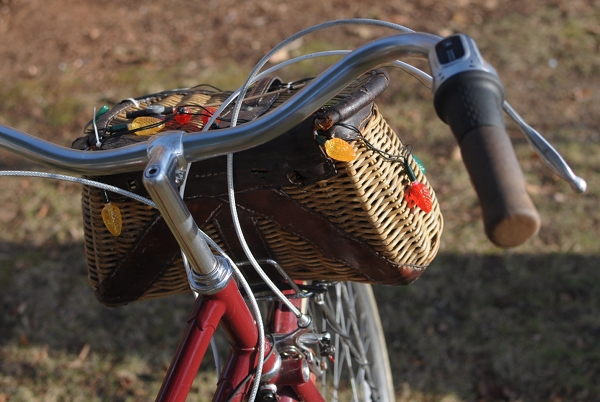
Nitto "Albatross" handlebars with city brake levers and a classic bell,
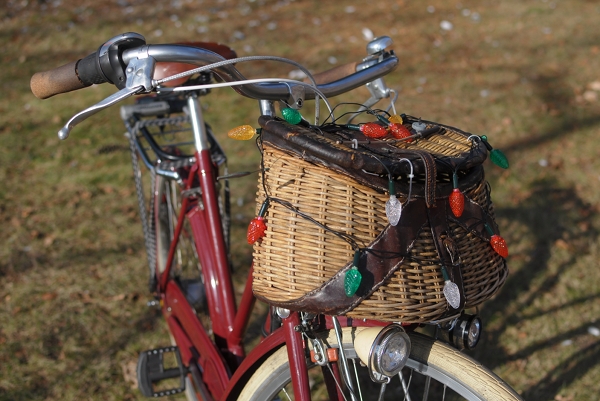
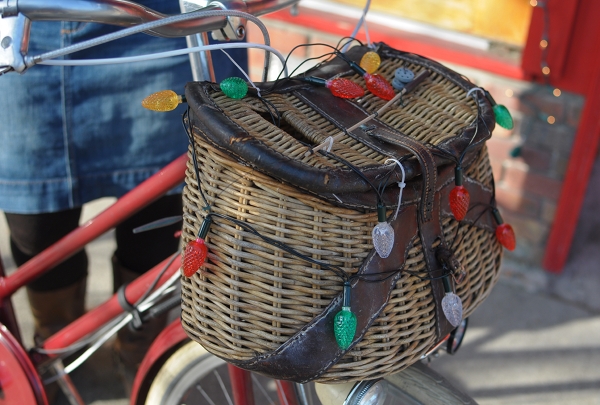
and, last but not least, this fantastic fishing creel basket, made of wicker with leather accents. For the holidays, the basket is decorated with battery-operated Christmas lights. Eccentric? Delightfully so! I imagine this style of basket is quite useful for storing small to medium objects within reach, secured by the closed lid. One thing that never fails to impress me about Biking in Heels, is the amount of stuff "cycler" is able to carry on that bike. This has included: a stack of shipping parcels, large plants, household appliances, and building supplies - most of these, of course, on the rear rack and not in the creel basket. While the Raleigh Lady's Sports was not specifically designed as a utility bike, it seems that Gilbert cab haul pretty much anything.
Given the way Gilbert came into existence, it is difficult to categorise him. The bicycle is no longer a vintage Raleigh 3-speed, yet it certainly isn't a modern bike either. But why categorise him at all? You will not find another like him in any catalogue or bicycle blog. Gilbert is C.P.'s personal bicycle, and he is unique. Visit them both at Biking in Heels.
My fellow Bostonian C.P. - or "cycler" on Biking in Heels - has done an impressive job in this regard. Her bicycle, Gilbert, is completely and utterly hers - and very special. CP comes from a family of cyclists and has ridden a bike for as long as she can remember. But it was not until she lived in Italy as a young adult, that her love of city bicycles with step-through frames was ignited. Upon returning to the US, she brought a vintage Italian city bike with her, and the rest is history. An architect by profession and a DIY enthusiast by nature, C.P. enjoys wrenching on her own bikes and now owns a modest stable of vintage ladies' models from the 1930s through the 1970s.
As her ultimate bicycle for transportation, C.P. wanted something that handled like her favourite vintage bikes, yet was as clean and reliable as a new bike. And so her project began. She rescued a 1970s Raleigh Lady's Sports frame and fork, and had them repainted a colour she loved. She bought a suitable chaincase and had it painted to match, along with the fenders. She built modern wheels with alloy rims around a Shimano 8-speed hub in the rear and a Shimano dynamo hub in the front.
Gilbert's set-up includes handsome and effective lighting,
cushy cream tires,
front and rear racks for maximum hauling capacity,
Nitto "Albatross" handlebars with city brake levers and a classic bell,
a wheel stabiliser,
and, last but not least, this fantastic fishing creel basket, made of wicker with leather accents. For the holidays, the basket is decorated with battery-operated Christmas lights. Eccentric? Delightfully so! I imagine this style of basket is quite useful for storing small to medium objects within reach, secured by the closed lid. One thing that never fails to impress me about Biking in Heels, is the amount of stuff "cycler" is able to carry on that bike. This has included: a stack of shipping parcels, large plants, household appliances, and building supplies - most of these, of course, on the rear rack and not in the creel basket. While the Raleigh Lady's Sports was not specifically designed as a utility bike, it seems that Gilbert cab haul pretty much anything.
Given the way Gilbert came into existence, it is difficult to categorise him. The bicycle is no longer a vintage Raleigh 3-speed, yet it certainly isn't a modern bike either. But why categorise him at all? You will not find another like him in any catalogue or bicycle blog. Gilbert is C.P.'s personal bicycle, and he is unique. Visit them both at Biking in Heels.
Subscribe to:
Posts (Atom)