Showing posts with label sporty cycling. Show all posts

Friday, February 4, 2011

Cycling Indoors: the Kurt Kinetic Trainer

Last month I asked for advice about bicycle trainers, but after reading all the comments decided not to get one after all. It was the promise of horrific boredom that dissuaded me: I didn't want to get a trainer and then end up never using it. But several blizzards and several yards of snow later, I once again found myself climbing the walls and thinking that any way to be on my roadbike would surely do. My birthday is coming up, and so I asked the Co-Habitant to get me a trainer as an early gift - requesting that he do all the obsessive gadget research himself, and just present me with it as soon as possible.

He was suspicious at first. "You want a trainer. For your birthday? Are you sure that's a sufficiently ...romantic gift?"

"It's a fine gift. Totally romantic. Just get it for me, please."

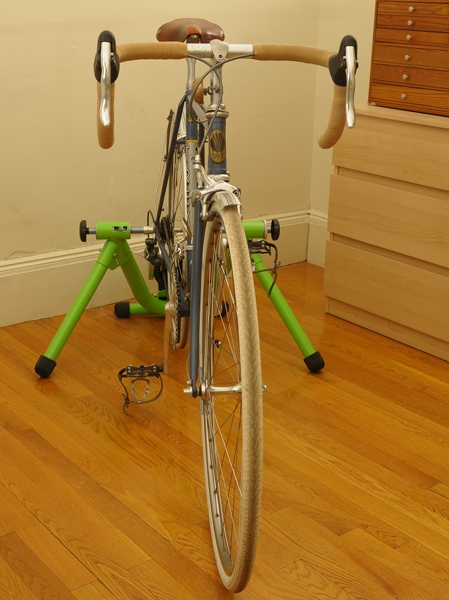
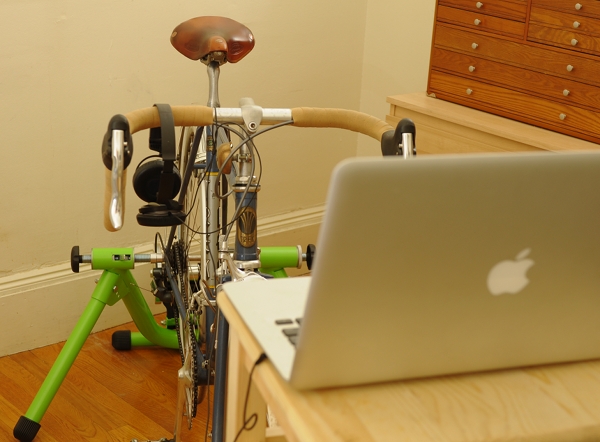
And so, since last week I have been the owner of a Kurt Kinetic Road Machine Fluid Trainer. The 2010 model was on sale at the Wheelworks in Somerville, MA (they had four left as of last week), and the opportunity was ceased. It is lime green and in no way blends in with any normal household decor. It is a good thing we have a "bohemian" apartment where pretty much anything goes, including a bike plugged into a neon contraption in the middle of the bedroom.

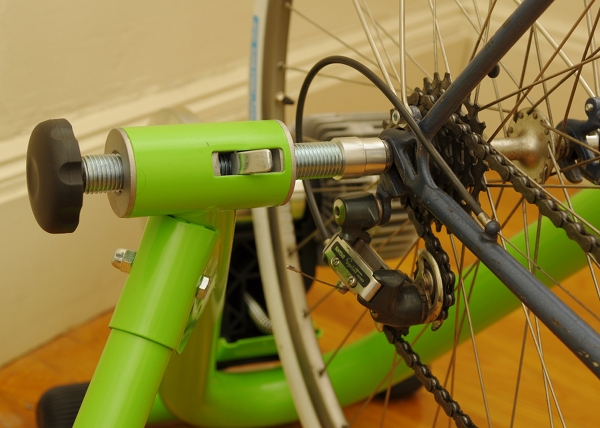
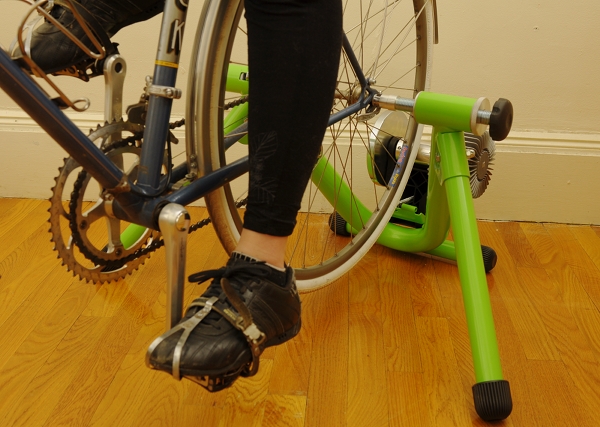
To set up the trainer, you have to attach the rear wheel of the bicycle using a special skewer, so that the tire rests firmly against the mechanism which provides resistance. I would describe the set-up process as somewhat tricky: You have to align the wheel just right and tighten everything just so.

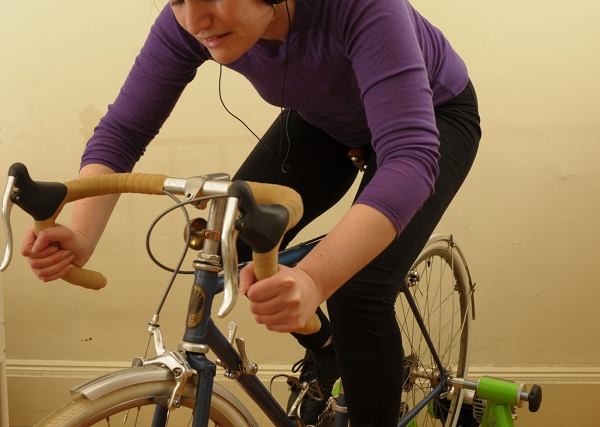
As you pedal, the resistance from the trainer is similar to the resistance you feel when cycling on the road. Beyond that, I admit that I have no idea how it works, and am not particularly curious as long as it does the job. Some prefer to put a block or a riser under the front wheel, but I feel fine without it.

To me, using the trainer emulates the cycling experience realistically insofar that I am on an actual bike, and that the sensation of pedaling really does feel like being on the road. What's different, is that the bicycle doesn't lean, as would have been natural on the road, and - oh yes - that I am in my bedroom, staring at a wall and going absolutely nowhere. After the first time I used the trainer, it became clear that I needed visual stimuli - music alone was not sufficient to counteract the mind-numbing effect of looking at nothing.

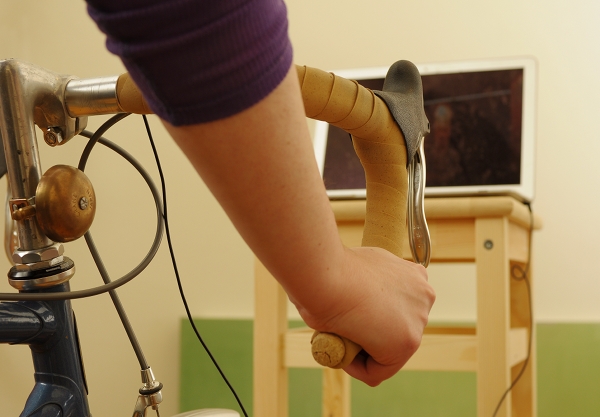
So I rigged up this "tower" using two wooden chairs (don't worry, they are very stable), which allowed me to place my laptop at eye level.

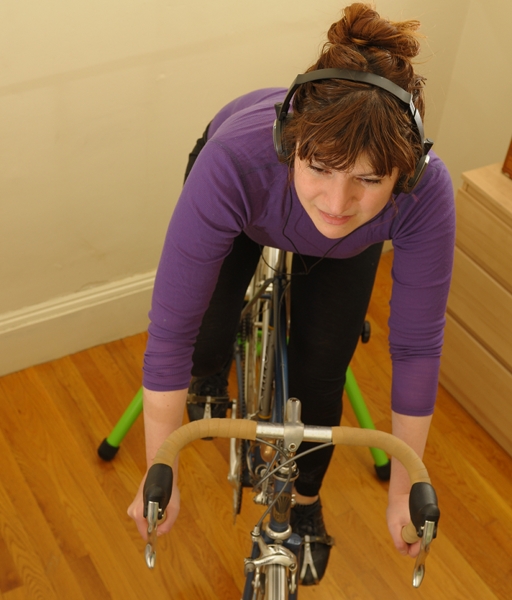
Thank goodness for Netflix and enormous earphones. The trainer is fairly quiet to begin with (the sound it makes is a sort of low hum - not high pitched or annoying), and if I had a TV rather than a tiny laptop, I don't think earphones would even be necessary. But the nice thing about using them, is that they drown out the sound of the trainer entirely, making it easier to get absorbed in the film and put my legs on autopilot.

It took me a couple of days on the trainer to learn how to pace myself. I guess on the road, there are factors that control my speed - traffic lights, obstacles, turns, and even just fear. With these factors gone, I had to keep forcing myself to slow down, so as not to get exhausted immediately. Watching a movie helps, because my pedaling starts to sync up with the highs and lows of the film - slowing down during the quiet parts and speeding up during the exciting parts. At the moment, I am able to keep going for 40 minutes at a time before needing to stop, but I am hoping to make it an hour by next week.

I don't want to give the impression that the trainer is anything other than what it is - a device that allows you to pedal your own bicycle as it remains stationary. The experience does not even begin to compare to "real" roadcycling, which to me is much more about exploration than about exercise. But if I approach it from the other end, and start with the given of wanting indoor exercise that emulates cycling, this trainer pretty much fits the bill. Having never tried others I can't compare, but the Kurt Kinetic trainer does everything I imagined a trainer doing, and it is quieter than I had hoped.

I think I have to face it that something in me has changed over the past year, and I now feel that my body "needs" strenuous exercise. I never thought that would happen to me, and I don't understand human physiology well enough to know how that works. All I know is, that I've been on a roadbike every day for the past week and I am feeling a little more like myself again. It's indoors, it's stationary and it's not real cycling - but I'll take it.

Monday, January 17, 2011

A Lovely Touring Bike... For You?

When I mentioned my "roadbike for women who fear roadbikes" project earlier, I didn't make this clear as I was still figuring out the details - but it is now very much official: I will be giving this bicycle away for free to an interested recipient in the spring.

To recap: Back in November, I picked up a vintage Shogun bike in which I saw a lot of potential, due to its comfortable frame geometry. The Co-Habitant and I are overhauling the bicycle from the frame up and fitting it with nice, comfy components. The goal is to turn it into a touring bike that will hopefully address some issues that fledgling female cyclists tend to have with roadbikes. I was not able to handle a roadbike until (after much trial and error) I discovered that a comfortable frame plus the right components were key. That experience changed my perspective and made me very happy, and I would like to help make that happen for someone else.

I am able to fit this bicycle with extremely nice components and give it away for free, thanks to the generosity of several donors. The main donors for this project are Velo Orange and Cambridge Bicycle, whose contributions will be described below. I have also been offered a monetary donation by a reader "Cedar" to cover the costs of the frame and wheelset I had purchased. Additional contributions of components were made by: Justine Valinotti of Midlife Cycling, reader "Spindizzy," reader "G.E.," reader "neighbourtease," and "somervillain" of Boston Retro Wheelmen. The Co-habitant and I are contributing our time and labor, as well as a few of our own things.

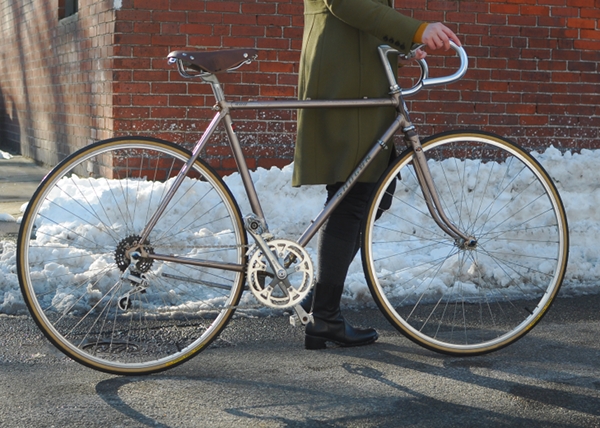
The frame and fork are cro-moly, and the seat tube angle is a comfortable 72.5 degrees. The frame has "touring geometry" and eyelets for fenders and racks. The bicycle as shown in the pictures here has been stripped of most of its original components, fitted with an updated touring wheelset, a Nitto stem, Nitto Randonneur handlebars, and a Velo Orange saddle. The drivetrain shown is original, but it will soon be replaced.

The size of the frame is 52cm, as measured from the center of the bottom bracket to the center of the intersection with the top tube (or 54cm if measured to the top of the seat tube). I am 5'7" and the size is just right for me - with plenty of top tube clearance, but not too much. If you are 5'5" - 5'8" it should fit you as well. Outside of that range, I would need to know your inseam measurement or pubic bone height to give you a better idea. Since there is only one bike, the size will naturally exclude many of you from participating in the give-away, and I am sorry about that.

The frame colour of the bicycle is an ethereal mixture of mauve and champagne. It's a neutral colour, but vibrant, with some shimmer to it; the pictures here portray it accurately. The headtube panel is a deep, dark chocolate-plum. The Shogun insignia on the downtube is sage green.

The Nitto Technomic stem and Randonneur handlebars are from my own parts stash (the handlebars are new, the stem gently used). I am not sure yet whether the final bicycle will have the Randonneur bars or the Noodles - I am planning to do a comparison test.

The saddle is a "Model 3" touring saddle from Velo Orange, which I will test out and review once the roads are clear of snow. The person who gets the bike in the end will have a choice between this saddle, and one of my own Brooks B17S saddles (which I no longer use).

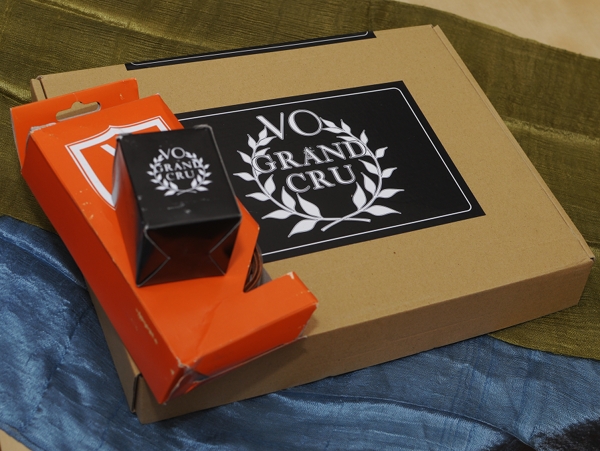
In addition to the saddle, Velo Orange was kind enough to donate: a headset, a crankset, fenders, and leather handlebar tape. The items were ones I requested specifically for this bike.

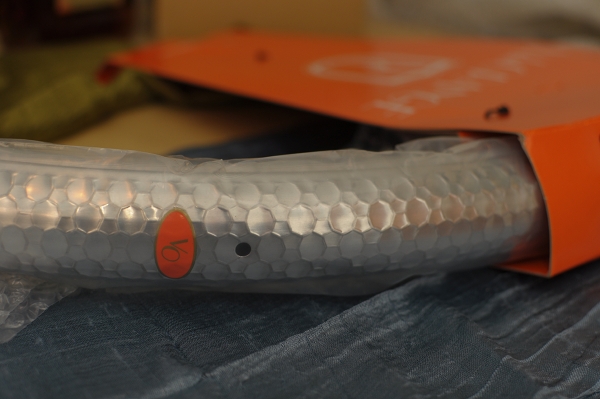
I don't want to remove the hammered fenders from the packaging until it's time to install them, but they look beautiful. The hammered pattern has a "honey comb" look to it that I visually prefer over the Honjo version - though this is, of course, a matter of taste.

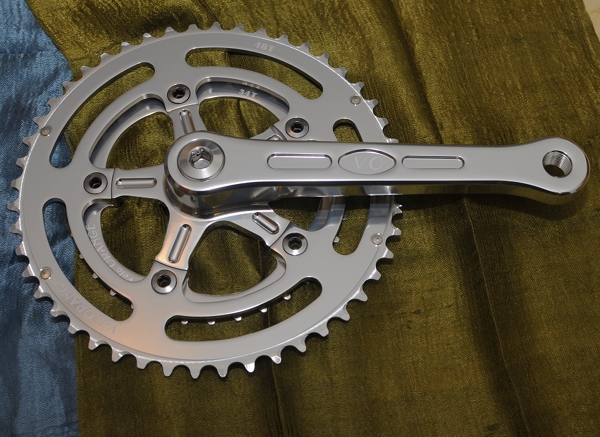
The "Grand Cru" crankset is classic and beautifully made, modeled on vintage TA. Before VO released this model, it was very difficult to find a crankset in a classic style.

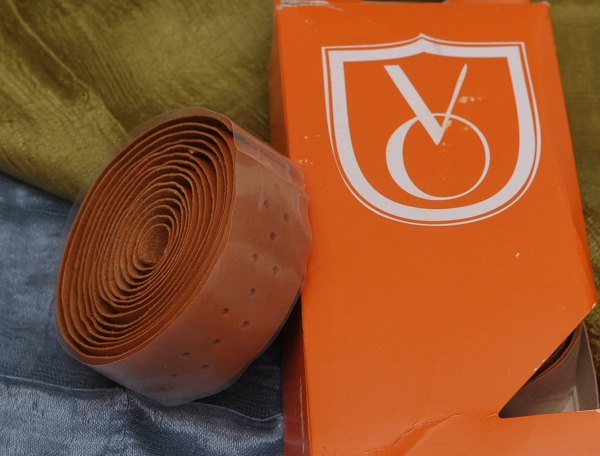
I haven't put leather tape on any of my own drop bars, as I consider it too expensive - but if will be fabulous to try it out before giving the bike away!

I have not yet picked up the components donated by Cambridge Bicycle, but they will include: brakes, short-reach brake levers, derailleur, cables, housing, and MKS touring pedals. I will feature these in a separate post.

For others interested in getting involved in this project, I am still in need of the following components for the basic build: bar-end shifters (Shimano or Silver), a bottom bracket (JIS Square Taper, 110mm spindle length, hollow axle), tires (32mm Panaracer Pasela Tourguards), and a few other random items. Additionally, I am looking for a local bike shop that would be willing to ship the bicycle in the event that the recipient is not local, so that their winning does not entail having to pay for shipping. Everything donated will be used for this project only. To contribute, please get in touch at filigreevelo-at-yahoo-dot-com and thanks in advance for the help!

I am not sure yet what form the give-away of this bicycle will take. I hate to call it a "contest," but there will obviously have to be some sort of selection process, as there is only one bicycle. Either way, the formal rules will likely not be announced until early Spring. In the meantime, I would love to hear what you think about the whole idea. A refurbished vintage bike is not a typical give-away item and I am not even certain whether anybody will want it! Do you like the colour? The look so far? And I am especially interested in hearing from women who would like to try a road bike with drop bars, but have not had much luck thus far. What has been your experience? What do you find intimidating or difficult about the process? Similarly, if you already ride a roadbike, but find it uncomfortable or sub-par, I am interested in why.

I am enjoying putting together this bicycle immensely, and I thank once again those whose donations have made this project possible, in particular:


Sunday, January 9, 2011

Bicycle Trainers and Winter Withdrawal

[1884 trainer, image via Wikipedia]

I am curious to know how many of you out there use bicycle trainers. I am now seriously considering one, as my winter roadcycling situation is truly dire. The frequent snow is making it impossible to plan rides, and all the muscle tone I'd built up over the Spring, Summer and Fall is slowly but surely disappearing. I am starting to feel lethargic and out of shape. There is a lot of pining going onand it's only the start of January!

Bicycle trainers are a new concept for me and I have no idea what to expect. To what extent does being on one resemble actual cycling? Can they be used with fixed gear bikes? Is fluid necessarily better than magnetic? I don't want rollers, I don't want the trainer to be noisy, and I don't want anything overly complicated - but otherwise I have no idea.  Please chime in, and no doubt your comments will be useful to others who are considering this as well. A trainer cannot replace the thrilling experience of riding a roadbike on the open road, but it can at least help me stay in shape while still interacting with my own bicycle. It's going to be a long winter...

Thursday, January 6, 2011

Gilles Berthoud Saddles: Something Different Entirely!

When I started having problems with the width of the Brooks B17 on my roadbike, I received many excellent suggestions from readers. I also received a suggestion from several staff members at Harris Cyclery: a Gilles Berthoud. Bethoud saddles and luggage are made in France and are associated with exquisite randonneuring bicycles. It is generally agreed that their handlebar bags are the finest one can get, and several respected members of the industry describe the saddles as being "even better" than Brooks. However, I was both skeptical of that description and weary of the high price tag. When I returned to Harris Cyclery the following week, I still had not decided what saddle to get, and they suggested that I try the Berthoud and see what I think. So I now have the saddle on loan, and have ridden with it on my Bianchi roadbike.

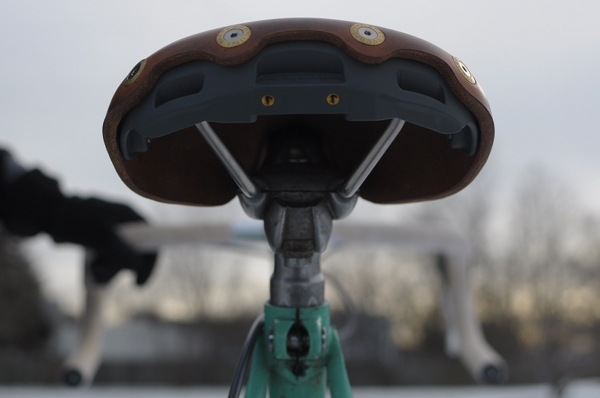
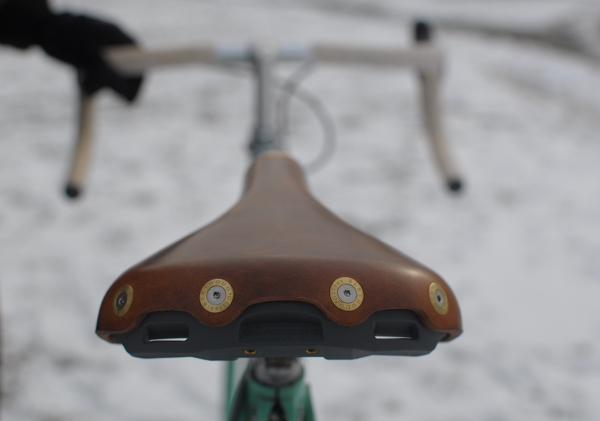
The saddle I have is a Gilles Berthoud touring model, which is available in three different colours (black, natural and cork), with regular or titanium rails, and in either a man's or a woman's length. Mine is the woman's version, which is the same width as the men's (160mm), but with a shorter nose. You can read the detailed specs for these saddles here. The woman's model is called the "Marie Blanque"- after a short, steep climb in the French Pyrenees.

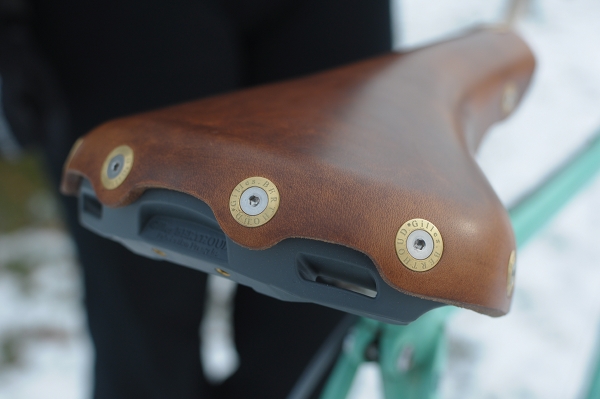
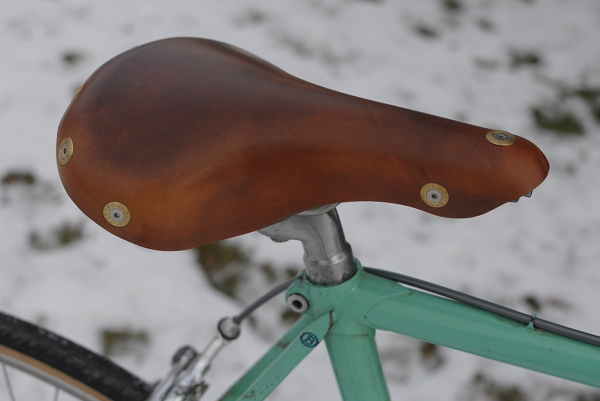
The Berthoud differs from Brooks and the other leather saddles available today in several ways. The leather is stretched using a different method - a modular system involving bolts instead of rivets. This system allows for the saddle to be taken a part and also for more control over tension adjustment. The leather is somewhat thicker than that of other brands.

The undercarriage consists of metal rails combined with a polycarbonate (plastic) rear support, which accommodates the proprietary Berthoud "Klikfix" saddlebag attachments. The openings can probably also be used with standard saddlebag straps, though I have not yet tried to attach one. This aspect is where the Berthoud saddles receive most of their criticism: "Not only is the saddle more expensive, but it has plastic parts?" However, both Berthoud and fans of the saddle insist that this construction method is superior in terms of comfort and adjustment possibilities, and is not prone to failure. I am cautiously open-minded on this, and would be curious to know the statistics of Brooks vs Berthoud saddle failure.

Another distinct feature of the Berthoud's design, is that the bolts (not rivets) are located behind and below the surface of the saddle - so that the cyclist's rear end does not come in contact with them no matter how far back they sit. This will make a huge difference to those who are bothered by the texture of the rivets on other leather saddles.

Finally, the very shape of the saddle is different than what I have gotten used to from Brooks. The Berthoud's surface platform is completely flat, whereas the surface of Brooks has "undulations" to it (some call it the "banana shape"). As a result,  the Berthoud works best when mounted completely level - whereas I mount the Brooks with the nose pointing slightly up, in order to not slide forward.

An additional difference, is the Berthoud's relative lack of "side skirts" (compare it to the Brooks here). Despite being classified as a touring saddle, the leather on the Berthoud is closely trimmed along the sides - typical of a much more aggressive saddle in the Brooks range.

My experience riding on the Berthoud is limited to a short (12 miles or so) winter ride, but here are my impressions so far: The saddle felt "just right" out of the box and I simply forgot about it once I got on the bike and began cycling (no padded shorts). Because the Bianchi is a bit big on me, I am leaned forward on it considerably. The saddle did not feel too wide (it is 10mm narrower than a lady's Brooks B17) and my legs did not rub against the "side skirts". Because the Berthoud is level, the nose does not come into contact with any sensitive areas. With Brooks road saddles, I need to make a lot of adjustments to get this aspect just right - but the Berthoud seems to naturally stay away from that region. As I was cycling, I was not so much experiencing any of this, as not experiencing anything. I was taken with the winter scenery and genuinely forgot that I was supposed to be trying the saddle and forming impressions of it. There were no impressions, and only later did I realise that this in itself meant that the saddle was comfortable.

I have to admit that I am "emotionally biased" towards Brooks, which is an obstacle to recognising that the Berthoud suits me better - at least on roadbikes with considerable forward lean. The Berthoud basically gives me the width of a touring saddle with the side cut-outs of a racing saddle - plus the shape does not interfere with my "lady areas". In that sense, it is also more versatile, and I can see myself using it both on a touring bike and on a more aggressive roadbike. All this is exactly what I need.  But... a $200+ saddle? I suppose that if I sell my spare Brooks B17S and the titanium-rail Brooks Finesse that I received in a trade but find unridable, that would give me the funds. But it still feels like an overindulgence and I need to think about it. Regardless of whether I keep the saddle or not, I hope this write-up was helpful to those considering a Berthoud.

Sunday, December 26, 2010

25th December, 25 Degrees... First Attempts at Winter Road Cycling!

Rejoicing at the empty roads on Christmas Day, the Co-Habitant and I decided to give winter roadcycling a serious try. Once the snow arrives, I find riding a roadbike to be inherently more challenging than cycling for transportation, and have not succeeded in doing it until now. One major concern is the slippery road conditions. On an upright step-through bicycle, navigating winter roads is fairly easy: If there is slush or snow, my tires can usually take it and the bike is sturdy enough to remain upright even if the wheels start to slide. But on a roadbike, my weight is distributed differently and the handling is "twitchier" - making for a potentially hazardous situation under the same conditions. When cycling for sport, I am also going quite a bit faster - giving me less time to react to slippery patches ahead.
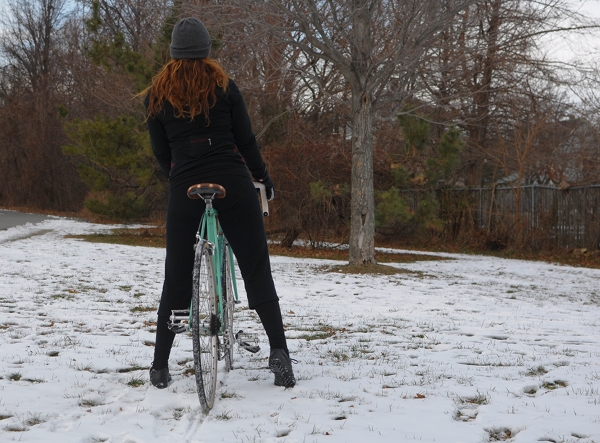
The other challenge of roadcycling in winter, is figuring out how to dress. On an upright transportation bicycle, I can simply bundle up in my regular winter clothes and potter along at whatever speed I am comfortable with until I reach my destination. But when cycling for sport, it is more difficult to regulate body temperature: Most of my body warms up almost immediately once I pick up speed, so bundling up will cause overheating. At the same time, my hands and face are more vulnerable to the windchill than on a transportation bike because of how they are positioned on a roadbike. To find the perfect balance is tricky and can only be done via experimentation.
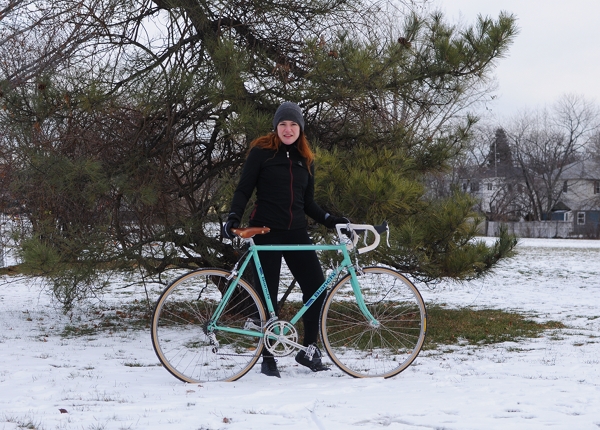
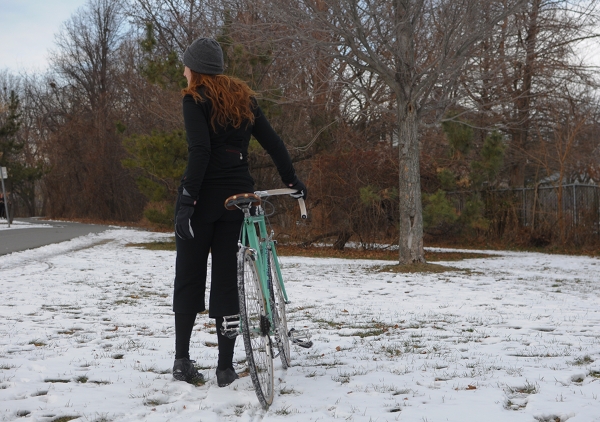
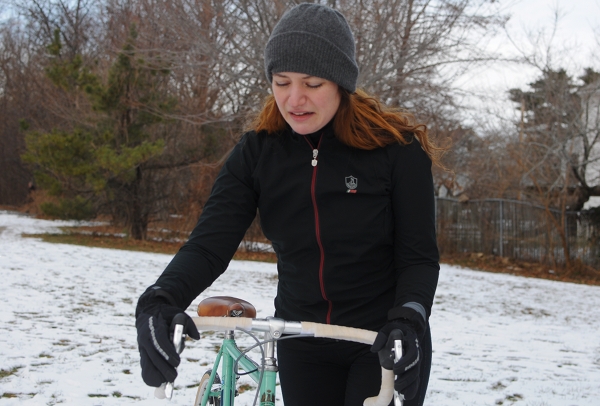
After resisting "technical wool" for as long as I could, I finally gave into it, because nothing else was working for me. I hope to write a comparison review of some popular wool brands soon, but basically what I am wearing in these pictures are just a couple of thin layers by Icebreaker and I/O Bio, an old wool hat, and a wind-proof cycling jacket. I am embarrassed to admit that the jacket is Campagnolo, but it is the best athletic jacket I have worn, ever, and I should write a separate review of it as well, as it certainly deserves it.

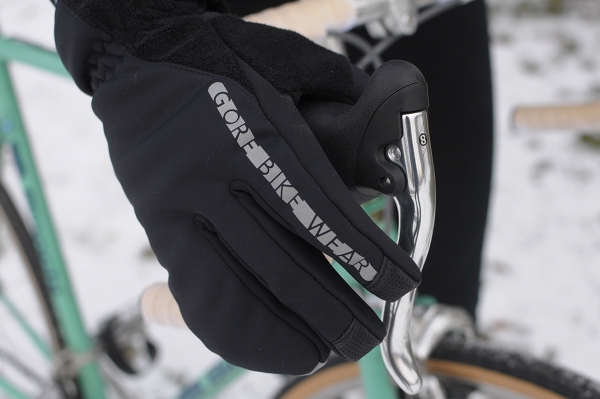
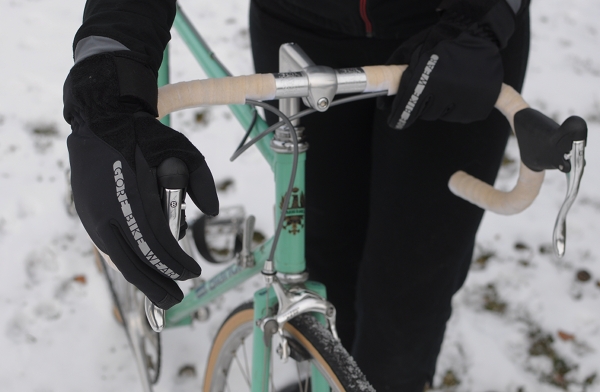
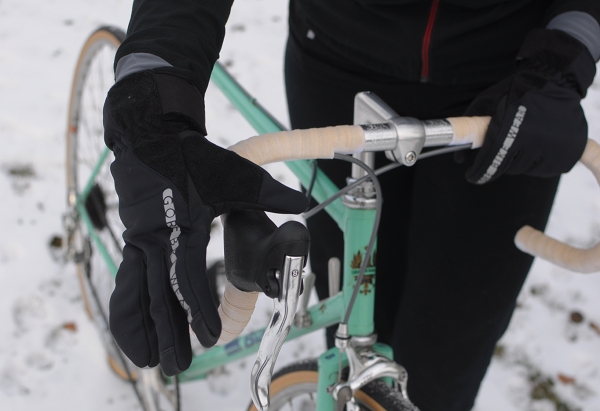
But my most interesting (as in "bizarre") acquisition for winter road cycling are these Gore Bike Wear "lobster gloves". After mentioning in a previous post about my hands freezing when riding with drop bars, I received suggestions from readers for this style of gloves, and the Co-Habitant got them for me as a gift. The concept of "lobster gloves" was new to me, but I was willing to try anything to keep my fingers from going numb when positioned on the brake hoods. These gloves really do make your hands look like enormous, mutant lobster claws, and whether you consider that cute or unacceptably grotesque is a matter of taste.

The ideas is, that, unlike regular mitten shells, "lobster gloves" make it possible to squeeze roadbike levers while still keeping at least your pinkie and ring fingers together for maximum warmth. There are different variations of this style, and some versions keep the index finger and middle finger together as well. We went to a local Eastern Mountain Sports store to look for these gloves, and I tried several versions by different manufacturers. I chose the ones by Gore Bike Wear (called "Radiator Gloves"), because they were the only ones that allowed me to freely squeeze the brake levers on the floor model roadbikes they had in the store. Similar-looking gloves by Pearl Izumi and other manufacturers constrained my hands too much and interfered with lever squeezing motions. The sizing of the Gore gloves was unisex, and size 6 fit me perfectly. Normally I wear I size 7 in women's gloves.

Once I wore the "lobster gloves" in action, I had to make some adjustments to how I positioned my hands on the brake hoods. Braking while wearing the gloves was more difficult than without, but do-able. And they did keep my hands warm, as well as dry. The inside material is soft and silky, and the outside material is textured, preventing slippage on the handlebars. Of all the available choices, I am glad that I got this version. But I would recommend that those looking for gloves in this style try them on in person if at all possible, especially if you have brake lever reach issues on a roadbike.

As for the handling of the bicycle itself - the Bianchi was great, except when encountering patches of ice or snow, at which point it was not great at all (think ice skating) and I had to get off and walk. After doing that a few times on the Minuteman Trail, it became clear that the trail was no longer usable at this time of year and it was only really possible to cycle on the main roads. A pity, as the roads leading out of town are usually heavy with traffic and unpleasant to negotiate. By the time I get through Arlington on my way to the more open countryside areas in Lexington, I am usually in a bad mood from competing with the aggressive drivers - not a situation I want to put myself in under slippery winter conditions. The additional difficulties of decreased visibility from my eyes tearing up, and a constantly running nose, contributed to my feeling of extra vulnerability on the road.

Although this is the closest I've ever gotten to winter roadcycling, it was still far from an actual success - especially since the the emptiness of the roads on Christmas Day is not something I can normally count on. From a logical standpoint, I don't think it's worth it to cycle for sport in the winter under these conditions - particularly for someone like me, whose bicycle handling skills are still relatively poor. But from an emotional standpoint, I am afraid I'll go nuts if I have to stay off roadbikes until late March; I had not realised until now how addicted I've become. Maybe I should snap out of it, be an adult and wait till Spring. Or maybe I should get goggles for my eyes, stuff wads of kleenex in my sleeve for easy nose-wiping access, consult with local cyclist about the safest winter routes, and try again. I guess we'll see how much I really want this. I am not big on setting goals or making resolutions, but I am curious about what will happen next.

Monday, December 20, 2010

Celeste e Bianca: Nice Day for a Ride!

Having finally nursed my celestial beauty back to health, I was ready to take her on a proper test ride... And the snow decided to pick this day of all days to arrive? It felt like the final act of an Italian tragicomic operetta. But since the forecast did not predict snow until late morning, I set off early in hopes of beating the odds. After all the drama with this bicycle, I was not willing to forgo a test ride!

For the past few months I had been patiently hunting for one of these, but having no luck finding anything in my size and budget. Finally, an online bike-friend found something that seemed perfect and I pounced on it immediately. When the bicycle arrived, it initially seemed that my worst fears about sight-unseen deals were realised and the purchase was a disaster: Not only did every single component seem to require work, but the frame was a larger size than advertised - possibly too large for me. I considered just re-selling the bike as-is to save myself the heartbreak. But after much debate and some outside mechanical help, things began to look up and I decided to keep it. Once the wheels were in ridable condition and we put the tires on, the moment of truth came: I did clear the top-tube sufficiently, and so continuing the renovations was deemed worth the risk.

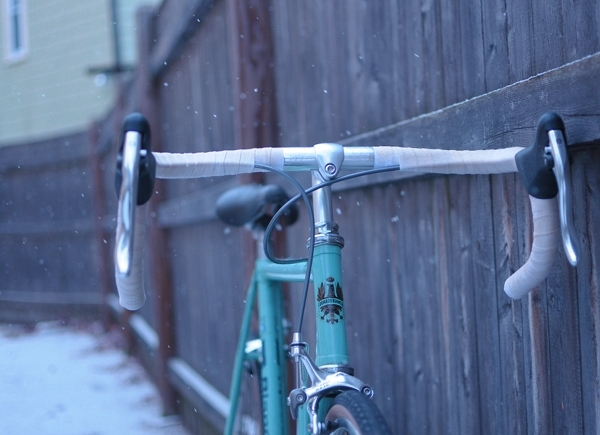
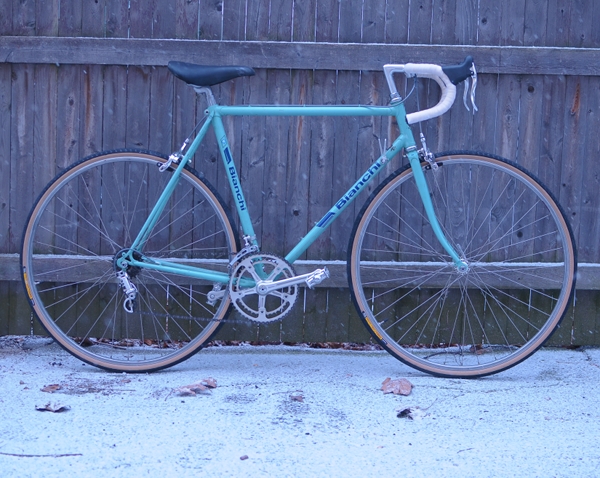
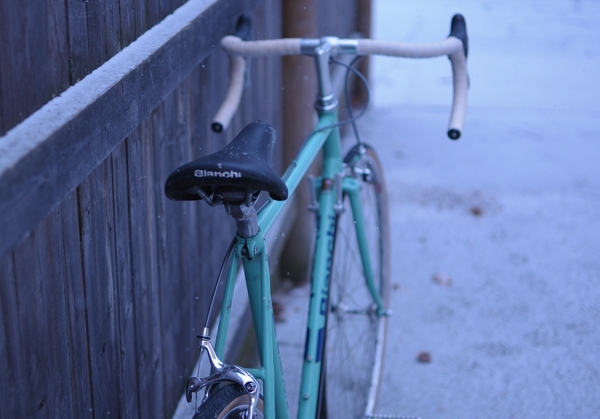
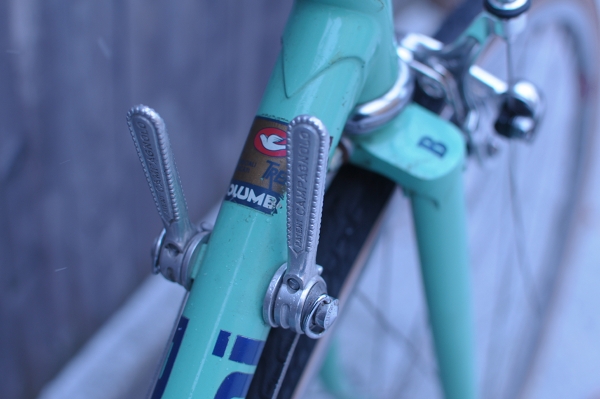
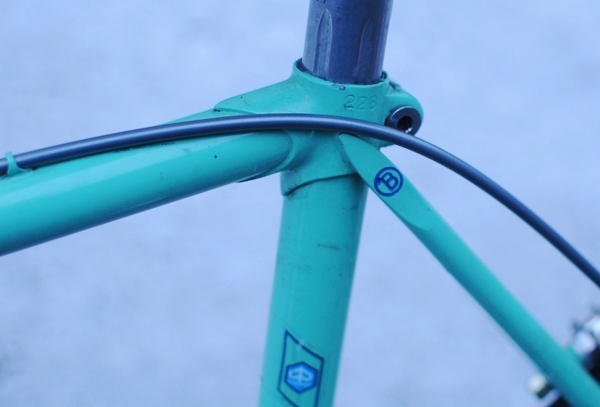
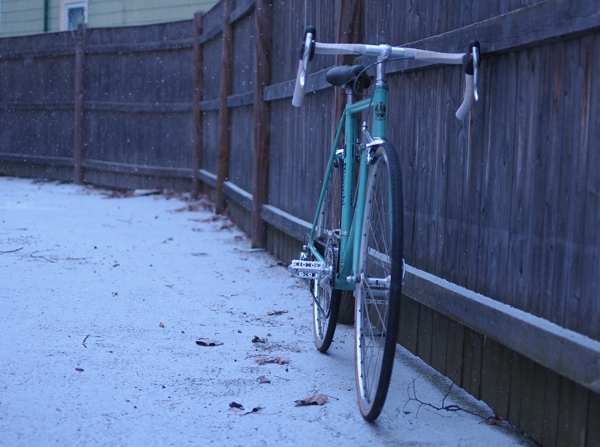
And now here she is: a 54cm Bianchi "Nuovo Racing", circa 1983. Made in Italy, Columbus tubing, some Campagnolo components. When I got the bicycle, everything was original - right down to the water bottle, which I promptly removed.

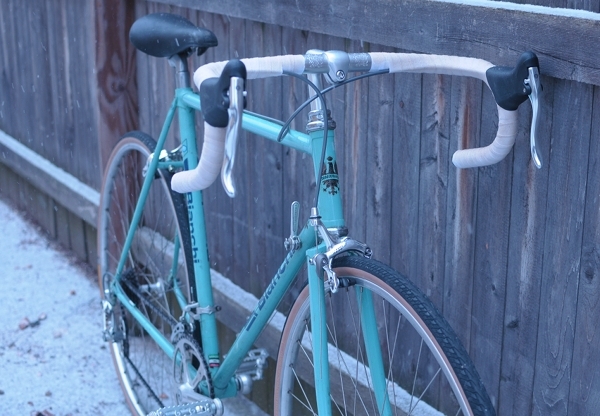
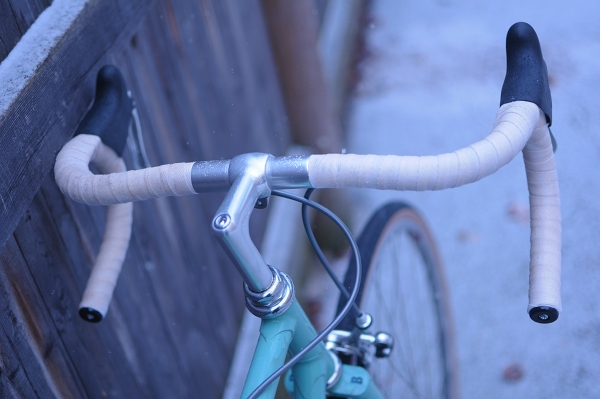
We replaced the handlebars and brake levers with modern Nitto Noodle bars and Tektro short reach levers. (The original bars and levers were damaged. But even if they hadn't been, I have trouble using vintage ones and am only really comfortable with the Noodle + Tektro combination.)

The original Ofmega stem was 11.5cm long - which felt scary, since the bicycle was already larger than what I was used to. We replaced it with a 7mm stem.

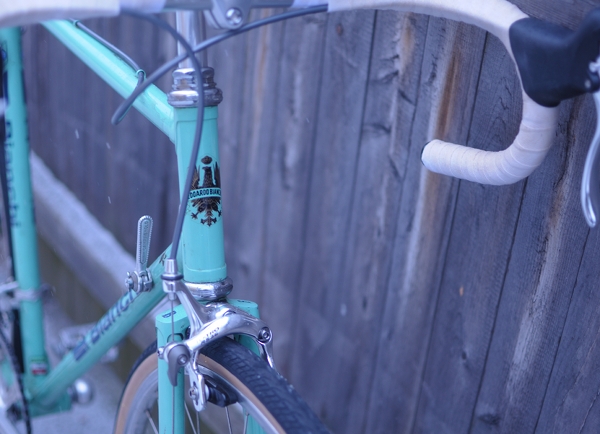
The original 23mm tires were torn to shreds and we replaced them with 28mm gumwall Panaracer Pasela Tourguards. I might eventually switch them with the cream tires on one of my other bikes, but maybe not. The original Modolo Flash brakes on the bike were damaged, and for now we've fitted it with a set of modern Tektro brakes - but they are not an ideal fit, and I am waiting to get a set of vintage Campagnolo brakes from a bike friend which I hope to replace the modern ones with. That should look much better, so I am hoping they work out.

Otherwise, the bicycle is original, including - for now - the foam racing saddle, the shape of which feels surprisingly comfortable. The handlebars are wrapped with white cloth tape and covered in two layers of clear (not amber) shellac - which gives them a nice vintage-cream appearance. The end result is not "period-correct" by any means, but I don't think the modern parts look offensive either. It is subdued and evokes a sense of the early '80s, at least to me.

When you romanticise a particular bicycle and look forward to it too much, there is bound to be disappointment. For me, the disappointment was with the aesthetic aspects. I don't know what I was expecting, because I had poured over catalog pictures of this model before, so nothing should have been a surprise. But I guess, appearance-wise, the bike was more bland than I had anticipated.

I think that I hoped to see "Italian flare", and there simply isn't any. It's a very ordinary-looking early 80s lugged bike, painted turquoise, with a bunch of blue Bianchi decals. Well, that's okay, I thought: Now I know that there is nothing magical about these bicycles. I will either enjoy riding it, or not; either way, it will be a learning experience.

It was not until I rode the bicycle that I began to get attached to it. And make no mistake, get attached to it I did! - How could I have taken these snowy, romantic photos otherwise?  I first tried the bike a couple of days ago - with the long stem and faulty original brakes - for just long enough to determine that the stem was too long and the brakes were too faulty, but the ride quality was lovely. After having replaced the stem and brakes, I finally test rode the bicycle properly, just hours before the snow storm arrived. The Co-Habitant was worried about the bike's performance and about the weather, and so he extracted a promise from me to stay close to our neighborhood. And I did - riding for 45 minutes in loops until my hands went numb from the cold (winter glove recommendations for a road bike, please?) and the snowflakes started to fall.

First impressions: The ride quality is nicer than I had expected. There was no harshness at all, and the bicycle was surprisingly stable at low speeds for a racing-style roadbike. The 54cm frame feels large, but I like it - I hope that I will be able to go back to 52cm bikes after this! The lean, even with the shorter stem, is more extreme than what I am used to. But I think I am okay with expanding my comfort zone in this respect. I was able to use the drops and the downtube shifters without feeling too unstable. And most importantly, this bicycle has the same "smooth and comfy" feel that I love so much about my Moser.

Because I have now shown a preference for several bicycles with Columbus tubing, while not being as crazy about my Reynolds 531 vintage Trek, it has been suggested that I might be a "Columbus person and not a Reynolds person". I don't know about that - or at least, I don't think that I have enough experience yet to determine such a thing. But I do know that I will be keeping this Bianchi and that I will be selling the Trek in the Spring. I won't make sweeping generalisations, such as that "I like Italian bikes" - but I do very much like the ride on the Bianchi, so far. And as beautiful as the snow is, I do hope it clears up and gives us a chance to ride together again this winter.