Showing posts with label vintage. Show all posts

Wednesday, February 9, 2011

Remembering a Man I Never Knew

[image via sheldonbrown.com]

Because I live in Boston and have been writing about Harris Cyclery from the start of this blog, I am sometimes asked whether I knew Sheldon Brown. What was he like? Did he inspire my love of English 3-speeds? But I regret to say, that I have never met him. The first time I walked into Harris Cyclery was just over a year after Sheldon Brown's death, the anniversary of which was last week. I was already reading his articles at that time (this was Spring 2009), but did not realise that he'd passed away. And then at Harris, there was this basket on the counter full of little flyers with his picture and "1944 - 2008" underneath it. Seeing the flyers was like a punch in the stomach. "Oh no, he died!" I blurted out without thinking. I remember the moment well, and particularly the disappointment and sadness of it. Somehow, this man's articles about bicycles had managed to fill me with enough affection toward him, so that his death felt like a personal loss - despite learning of it a year after the fact. 

[image via sheldonbrown.com]

Sheldon Brown was a bicycle mechanic, whose technical knowledge - particularly of classic and vintage bikes - was not only vast, but presented in the most captivating manner through a seemingly endless series of articles, glossaries and instruction pages. He shared his writing, including technical information, history, and decades worth of personal journals and travelogues, via a website he developed with Harris Cyclery, which continues to be maintained today. His writing was sincere, funny, wacky, and excellent in equal measure, and its influence cannot be overstated. I meet people from all over the world who will casually mention that they learned how to work on bicycles "from reading Sheldon Brown," or that thanks to his website they identified an old bike found in the cellar, or even that they took up randonneuring after reading his online journals and descriptions of France. Bicycle forums and news groups are replete with Sheldon Brown references and quotes.

But you can find a far better description of all this in his obituary in The Times, and the tribute on Bike Snob is worth reading as well. I don't want to attempt to paint a portrait of a man I never knew. But I do want to acknowledge his impact on me personally.

[image via sheldonbrown.com]

Like so many others, I stumbled upon Sheldon Brown's website while looking for information on vintage bicycles. And I believe it's what I found in his writing that turned what could have been a passing curiosity into the seeds of an obsession. I cannot put my finger on what it was exactly that drew me in: Maybe it was his easy relationship with technical and historical information, which made everything read like a story, rather than a boring manual. Maybe it was his open-minded curiosity about different types of bicycles and different aspects of cycling. Or maybe it was the way he embraced eccentricity, without trying to either downplay or justify it. It's hard to say, but whatever it was - it got through to me and engaged my imagination. I am just one person, but I am certain there are many, many others who would say the same. And that's quite something.

[image via sheldonbrown.com]

For the last several years of his life, Sheldon Brown suffered from Multiple Sclerosis and was unable to ride his beloved bicycles, yet managed to write an article entitled The Bright Side of MS. But the dominant image I have of him, is that of a young, strong man riding crazy bikes, as captured in his many black and white photos taken with a self timer.

Sheldon Brown was an avid photographer, and the above picture he took of himself has turned out to be chillingly prophetic. The impact he's had on "bicycle culture" is so strong, that three years after his death his presence remains vibrant. I am extremely happy about that. And I thank him for all the help and inspiration he has given me, despite my never having had the privilege of meeting him.

Tuesday, February 1, 2011

The 'Lady's Bicycle': Descriptive, Offensive, or Merely Obsolete?

[an unsuccessful attempt at parody]

There has been some discussion lately about how appropriate it is to refer to diamond and step-through frame bicycles as men's and ladies' bikes. After all - gender roles are flexible these days, women are no longer expected to wear elaborate skirts, and a low standover height can be convenient for everyone. So why use gender specific terminology? Am I just intentionally being quaint?

Well, not exactly. You see, when a bicycle model exists in both diamond frame and step-through designs, the latter is usually not just about lowering the standover height. It is also about taking the female anatomy into account. For example, have a look at the pictures below and see whether you notice anything interesting.

[image via Gazelle USA]

These are the Oma and Opa versions of the current production Gazelle Toer Populair bicycles. If you look closely, you will notice that the Oma on the left has a considerably higher headtube than the Opa on the right. This is done in order to set the Oma's handlebars higher, so as to accommodate the typically shorter torsos and arms of female cyclists. The bikes are named "Grandma and Grandpa," because they are, in fact, gender-specific. The expanded headtube tactic is used by many manufacturers on their step-through models, while others use the alternative tactic of shortening the virtual top tube. Either way, more often than not the step-through version of a given bicycle model is designed for the female body. This is not to say that men cannot or should not ride step through frames, but only that step-through frames are typically optimised for female proportions.

Of course, one could ask: Why confound gender-based anatomical differences with preferences for standover height? After all, some women may prefer diamond frames, while some men may prefer step-throughs. That is where statistics and market research come in. Most manufacturers cannot afford to make two versions of diamond frames and two versions of step-through frames within the same model. And statistically, women are considerably more likely to wear skirts and are thus more likely to prefer a step-through transportation bike. Therefore, it makes more sense to optimise the step-through design for the female anatomy, while optimising the diamond frame design for the male anatomy. Naturally, there will be some females who prefer the diamond frame and some males who prefer the step-through. Furthermore, not every woman has a short torso and not every man has a long torso. But when it comes to manufacturing decisions, it's all about tendencies and probabilities - not about individuals.

And speaking of statistics, perhaps we could indulge in another poll (a weekly tradition?). No purpose for this other than my own curiosity, and possibly yours:


In my own vocabulary, I use terms like "lady's bike" or "woman's frame" when I am referring specifically to the bicycle's suitability for females - be it anatomically, or in terms of their ability to accommodate skirts. On the other hand, I use terms such as "step through," "loop frame," "mixte," and "shortened top tube," when I am describing frame geometry. And while some worry that referring to bicycles as "women's bikes" makes them seem inferior or less valuable, I am not on board with that line of thinking. After all, what is considered "standard" frame geometry in the industry, is in fact optimised for the male anatomy. We are female, we are wonderful, and we need bicycles designed for us. To me, that is neither offensive nor obsolete - it's just common sense.

Sunday, January 30, 2011

Where Have You Been...

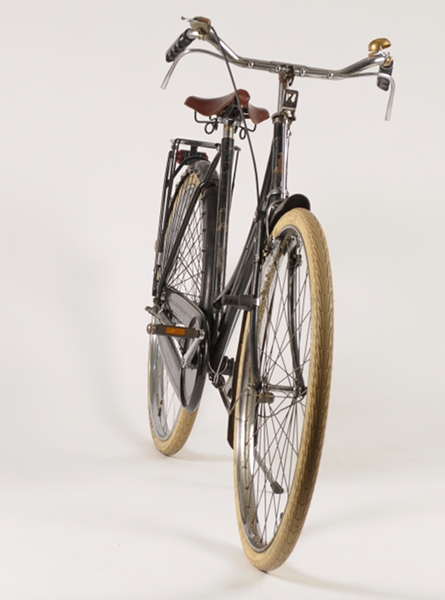
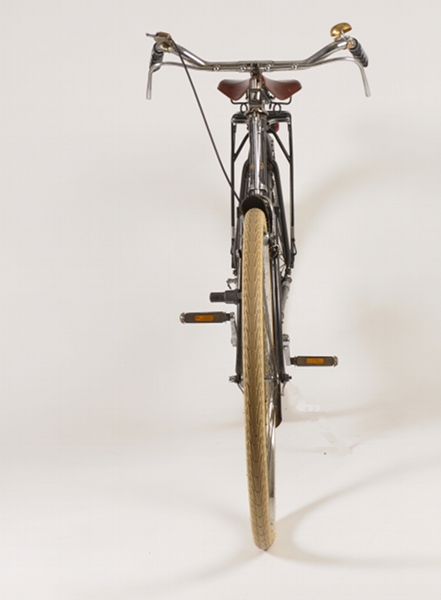
Since the end of the summer, I've received a number of concerned inquiries about "Velouria," my vintage Raleigh DL-1 Tourist (and for those who have only begun reading this blog recently, I am named after this bicycle, not the other way around). Though admittedly I have not featured her for some time, I assure you that Velouria is alive and well. She resides in our photo studio just South of Boston, performing the under-documented but crucial role of "studio bike." And here are the pictures to prove it.

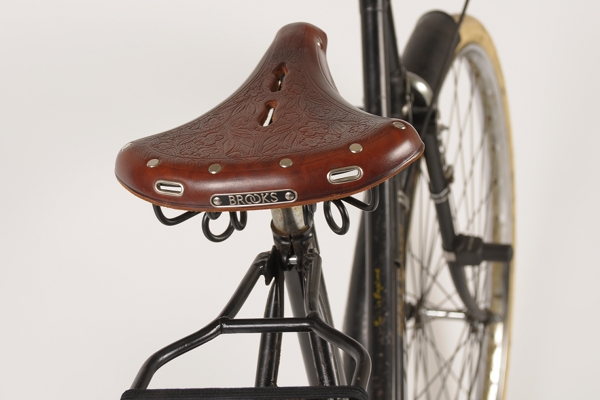
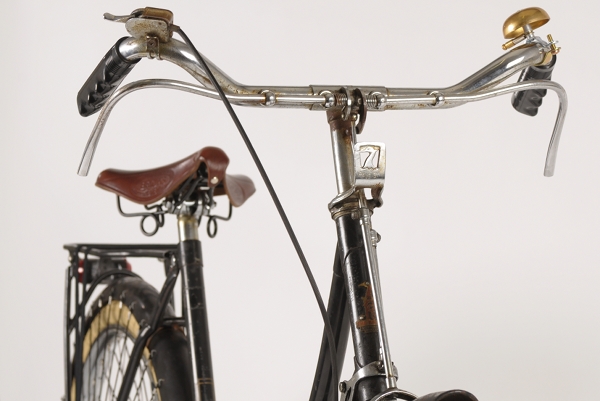
For those unfamiliar with Velouria's history, she is somewhat of a "frankenbike," albeit a darling one. I acquired the 1973 Raleigh DL-1 in the summer of 2009 and over time proceeded to subject her to a number of modifications. These have included: an aftermarket chaincase and dress guards, cream tires, a Brooks B18 saddle, a custom rear rack, and an updated rear wheel with a coaster brake hub to supplement the pitiful braking power of the rod brakes.

Why do I feel the need to mess with a vintage bicycle in this manner? To tell the truth, part of it is simply the compulsion to experiment, to customise, to turn objects that belong to me into "creatures." I am not saying it's a good habit necessarily; but it's how I like to do things.

There was also a practical reason for all the modifications: I loved the ride quality of the DL-1 so much, that I was highly motivated to make it as functional as possible.

But ultimately, my love for this bicycle is also what made me move it to the photo studio after I (literally) found the vintage Gazelle in the end of last summer. At the risk of sounding cruel to the Gazelle, I am willing to run it into the ground. It is a great bike, it handles wonderfully, it is admirably designed, but my feeling toward is appreciation - not "love." The vintage Raleigh, on the other hand, feels almost like a pet. I just can't bring myself to ride its already battered and rusty frame on the salted roads in the winter, or even to leave it for hours in the rain in the summer. "Let the Gazelle take the abuse and spare the Raleigh," says my heart. And so Velouria became "studio bike" - ridden occasionally, but not too much.

And if you've noticed that these pictures are a little different from my typical bike photos, that is because they were taken inside the studio itself. We will soon be doing a couple of photo shoots for a local framebuilder, so we're practicing. When it comes to product photography in a studio setting, every object requires a different approach to lighting - and I would say that bicycles are fairly complicated as far as these things go. They are enormous, they have both matte and reflective parts, and they cast a variety of unusual shadows. Oh, and don't get me started on the kickstand thing; we are still working that one out!

Of course, the trouble with this type of product photography is that it brings every single detail of the object into sharp focus - not exactly the most flattering approach when it comes to vintage bikes!

But after all, "Velouria" is not just any vintage bike.  She is mine. The scraped paint, the rust, the solidified crust, the dented fenders and even the bent rodbrake levers are, oddly, all part of what makes me cherish her. She may no longer be the most frequently featured bicycle here, but she epitomises the theme of this blog perhaps more than any other bike I own.

Wednesday, January 19, 2011

Bicycle Portraits in Ambrotype and Tintype

I've been helping a Lovely Bicycle reader with the process of ordering a custom bike, and he sent me something rather wonderful as a Thank You gift.

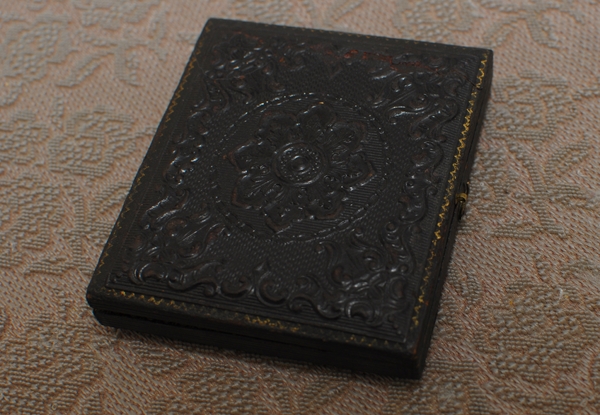
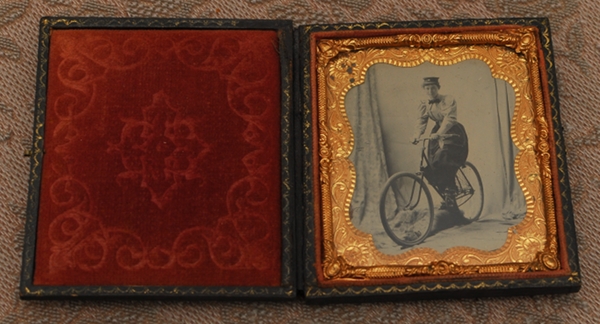
It's a beautiful little antique case, about 4x3", with the tiniest, delicate latch closure.  And inside of it, there is this:

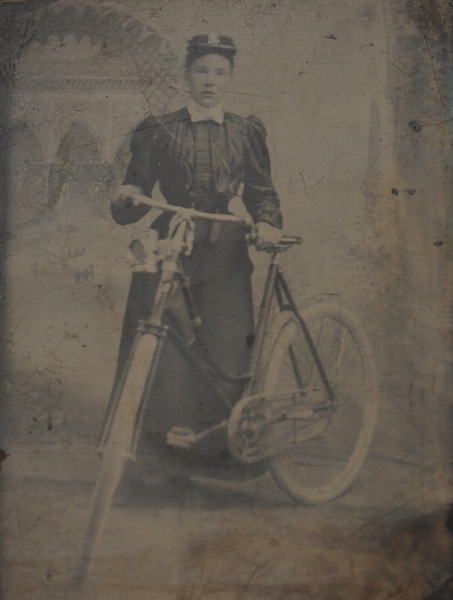
An ambrotype portrait of a young lady on her bicycle, c.1893-94. The ambrotype  is one of the oldest methods of photography, where the image is captured as a positive on glass using a wet plate process. Being on glass, ambrotypes are extremely fragile, which is why they were preserved in these enclosed, padded cases. And even with these careful storage methods, not many of them remain. This is a fine gift indeed, to say the least - especially for one obsessed with both bicycles and photographic processes.

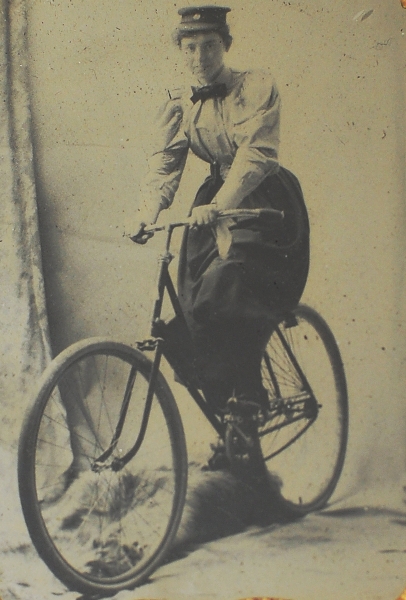
Here is a close-up of the image itself. I cannot remove it from its case, so excuse the murkiness. Notice that it is a mirror image - the drivetrain is on the wrong side. The first commercial freewheel was produced by Sachs in 1898, which means that this lady and others of her era were riding fixed gears. Also, notice the absence of fenders, but the presence of dress guards - at least her muddy skirt would not get stuck in the spokes? Otherwise, the bicycle is a fairly classic lady's Roadster (and apropos the earlier gender discussion - yes, these were made specifically for ladies).

The encased ambrotype came in a set with a free-standing tintype - another positive photographic process, this one created on a sheet of blackened iron. Just amazing. Again, there is the mirror image effect. The bicycle here is similar, but with a fancier chaincase and with a headlamp. The person who sent me these pictures believes the women might be bicycle messengers, though it is also possible that the caps represent cycling clubs that were popular at the time. I must admit that I liked the image of them cycling on fixed gear loop frames through the city delivering letters.

With the rising popularity of flickr, many vintage bicycle photos have been getting scanned and placed on the web in the course of the past several years. And it always amazes me to see specifically the portraits of young ladies posing with their bicycles in a proud and stately manner. Getting one's photo taken was a special occasion in the 1890's, something that was only done once in a great while. And opting to pose with a bicycle in one of the few photos that would ever exist of you, seems telling of the relationship the person in the portrait had with their machine. The word ambrotype means "immortal impression" in Greek, and these ladies wanted to be together with their bicycle for eternity. Was it a status symbol, or an object of obsession? Probably both. And I wonder how the digital bike portraits of today will be interpreted 120 years from now - that is, if they remain at all.

Monday, January 17, 2011

A Lovely Touring Bike... For You?

When I mentioned my "roadbike for women who fear roadbikes" project earlier, I didn't make this clear as I was still figuring out the details - but it is now very much official: I will be giving this bicycle away for free to an interested recipient in the spring.

To recap: Back in November, I picked up a vintage Shogun bike in which I saw a lot of potential, due to its comfortable frame geometry. The Co-Habitant and I are overhauling the bicycle from the frame up and fitting it with nice, comfy components. The goal is to turn it into a touring bike that will hopefully address some issues that fledgling female cyclists tend to have with roadbikes. I was not able to handle a roadbike until (after much trial and error) I discovered that a comfortable frame plus the right components were key. That experience changed my perspective and made me very happy, and I would like to help make that happen for someone else.

I am able to fit this bicycle with extremely nice components and give it away for free, thanks to the generosity of several donors. The main donors for this project are Velo Orange and Cambridge Bicycle, whose contributions will be described below. I have also been offered a monetary donation by a reader "Cedar" to cover the costs of the frame and wheelset I had purchased. Additional contributions of components were made by: Justine Valinotti of Midlife Cycling, reader "Spindizzy," reader "G.E.," reader "neighbourtease," and "somervillain" of Boston Retro Wheelmen. The Co-habitant and I are contributing our time and labor, as well as a few of our own things.

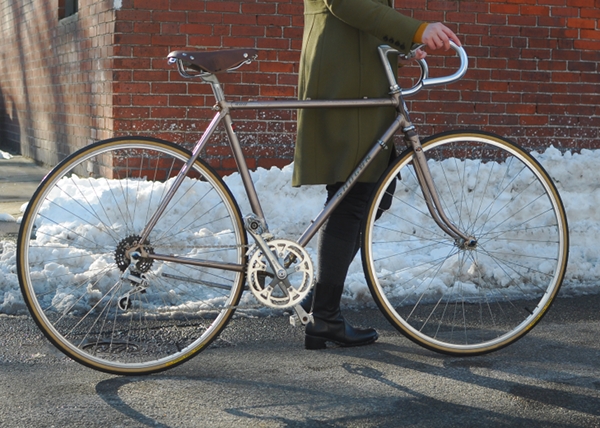
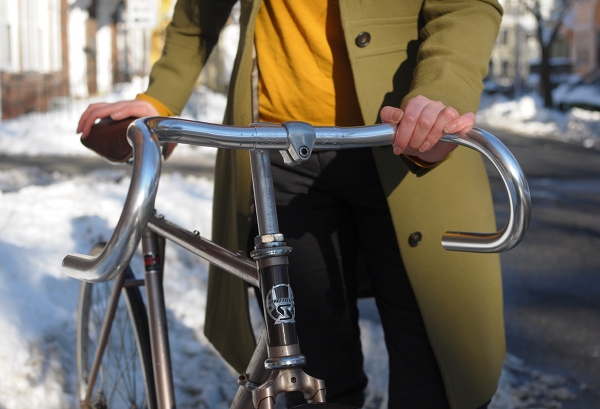
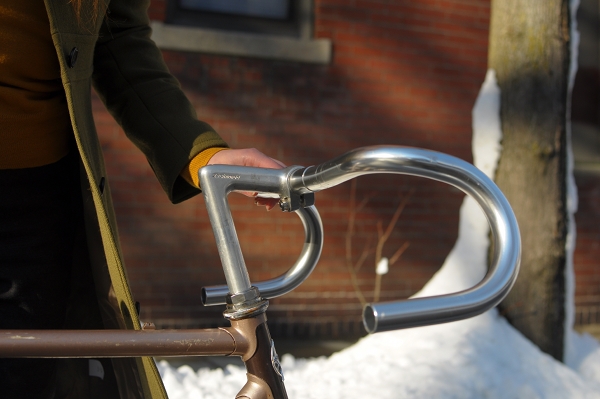
The frame and fork are cro-moly, and the seat tube angle is a comfortable 72.5 degrees. The frame has "touring geometry" and eyelets for fenders and racks. The bicycle as shown in the pictures here has been stripped of most of its original components, fitted with an updated touring wheelset, a Nitto stem, Nitto Randonneur handlebars, and a Velo Orange saddle. The drivetrain shown is original, but it will soon be replaced.

The size of the frame is 52cm, as measured from the center of the bottom bracket to the center of the intersection with the top tube (or 54cm if measured to the top of the seat tube). I am 5'7" and the size is just right for me - with plenty of top tube clearance, but not too much. If you are 5'5" - 5'8" it should fit you as well. Outside of that range, I would need to know your inseam measurement or pubic bone height to give you a better idea. Since there is only one bike, the size will naturally exclude many of you from participating in the give-away, and I am sorry about that.

The frame colour of the bicycle is an ethereal mixture of mauve and champagne. It's a neutral colour, but vibrant, with some shimmer to it; the pictures here portray it accurately. The headtube panel is a deep, dark chocolate-plum. The Shogun insignia on the downtube is sage green.
The Nitto Technomic stem and Randonneur handlebars are from my own parts stash (the handlebars are new, the stem gently used). I am not sure yet whether the final bicycle will have the Randonneur bars or the Noodles - I am planning to do a comparison test.

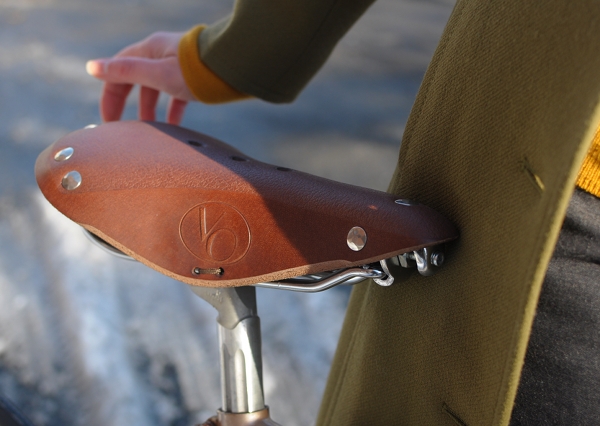
The saddle is a "Model 3" touring saddle from Velo Orange, which I will test out and review once the roads are clear of snow. The person who gets the bike in the end will have a choice between this saddle, and one of my own Brooks B17S saddles (which I no longer use).

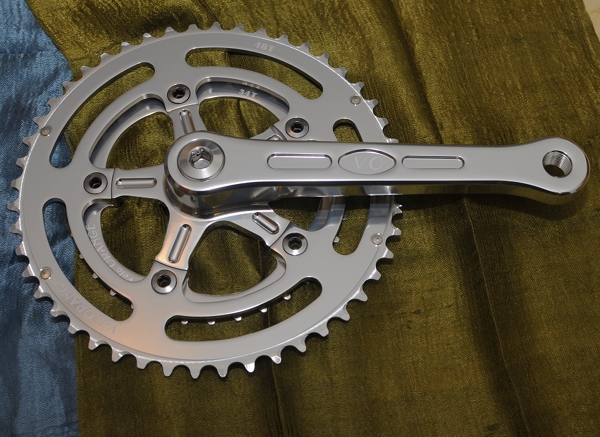
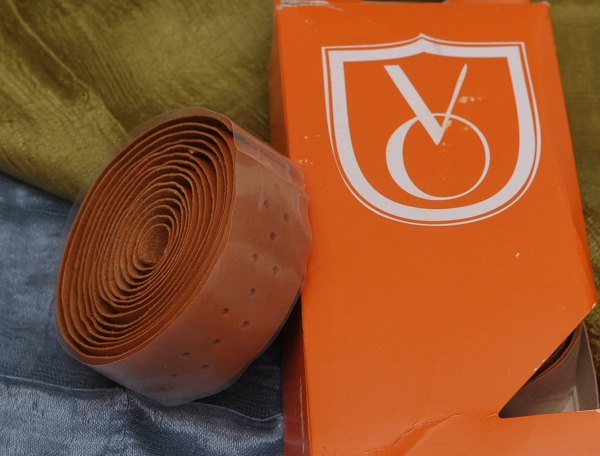
In addition to the saddle, Velo Orange was kind enough to donate: a headset, a crankset, fenders, and leather handlebar tape. The items were ones I requested specifically for this bike.

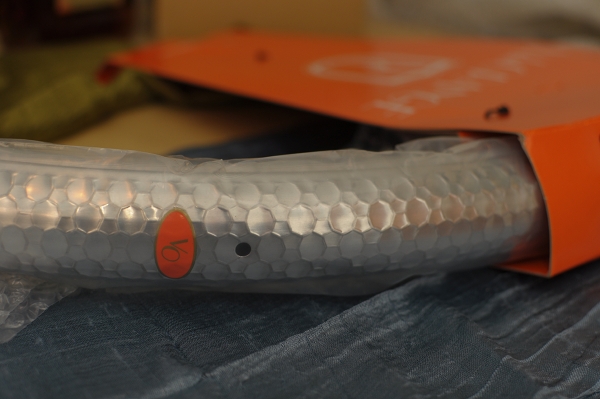
I don't want to remove the hammered fenders from the packaging until it's time to install them, but they look beautiful. The hammered pattern has a "honey comb" look to it that I visually prefer over the Honjo version - though this is, of course, a matter of taste.

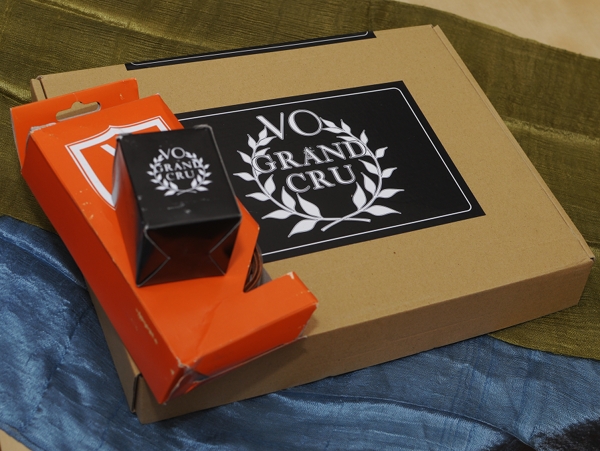
The "Grand Cru" crankset is classic and beautifully made, modeled on vintage TA. Before VO released this model, it was very difficult to find a crankset in a classic style.

I haven't put leather tape on any of my own drop bars, as I consider it too expensive - but if will be fabulous to try it out before giving the bike away!

I have not yet picked up the components donated by Cambridge Bicycle, but they will include: brakes, short-reach brake levers, derailleur, cables, housing, and MKS touring pedals. I will feature these in a separate post.

For others interested in getting involved in this project, I am still in need of the following components for the basic build: bar-end shifters (Shimano or Silver), a bottom bracket (JIS Square Taper, 110mm spindle length, hollow axle), tires (32mm Panaracer Pasela Tourguards), and a few other random items. Additionally, I am looking for a local bike shop that would be willing to ship the bicycle in the event that the recipient is not local, so that their winning does not entail having to pay for shipping. Everything donated will be used for this project only. To contribute, please get in touch at filigreevelo-at-yahoo-dot-com and thanks in advance for the help!

I am not sure yet what form the give-away of this bicycle will take. I hate to call it a "contest," but there will obviously have to be some sort of selection process, as there is only one bicycle. Either way, the formal rules will likely not be announced until early Spring. In the meantime, I would love to hear what you think about the whole idea. A refurbished vintage bike is not a typical give-away item and I am not even certain whether anybody will want it! Do you like the colour? The look so far? And I am especially interested in hearing from women who would like to try a road bike with drop bars, but have not had much luck thus far. What has been your experience? What do you find intimidating or difficult about the process? Similarly, if you already ride a roadbike, but find it uncomfortable or sub-par, I am interested in why.

I am enjoying putting together this bicycle immensely, and I thank once again those whose donations have made this project possible, in particular:


Monday, December 27, 2010

15 Years Under the Chaincase

With a blizzard raging outside, what better way to spend an evening than working on bikes?  The Co-Habitant agreed to help with my Gazelle (and by "help" I mean "do most of the work"), in exchange for which I prepared lavish portions of a dish that is sort of a cross between French Toast and a Croque Monsieur - only larger, fluffier, more generous on the cheese, and with some secret herbs that make it special. He likes my cooking, I like his mechanics: win-win! 

Though I bought new tires for my Gazelle months ago, we had been procrastinating with their installation, as it required dealing with the formidable chaincase. Removing it seemed complicated. And who knew what was under there after all these years?

The Gazelle's chaincase is a vinyl casing that is stretched over a metal support structure. It is clipped and fastened at several attachment points - including an amazing system of clasps along the bottom, the likes of which we have never seen before. I am not certain how closely the current-production Gazelle chaincase resembles the one on my 15-year-old A-Touren model, but mine was not exactly easy to remove and install - not a project for beginners at least.

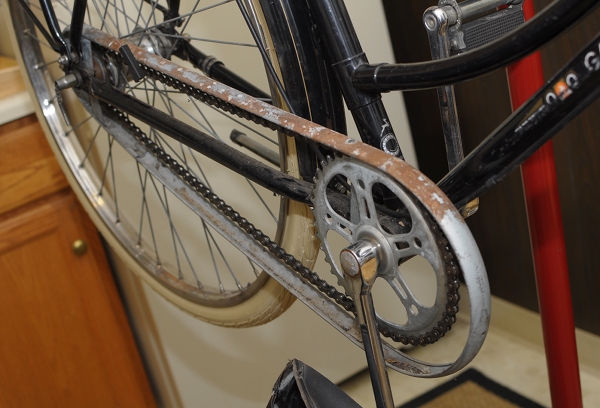
Once removed, this is what was inside. It's entirely possible that the drivetrain has not been worked on since the bicycle was first purchased by the original owner. The metal structure supporting the vinyl casing was covered in surface rust, as were parts of the chain itself. But otherwise, there were no apparent problems. These bicycles were built to be used and abused for years without any need for maintenance. 

We were disappointed to see that the chainring did not have little gazelles carved into it like the older ones did. But I suppose that would be too much to expect from a '90s model. The metal chaincase support structure disassembles into several parts - allowing the rear portion to be removed without taking the whole thing apart.

The main chaincase attachment bolt is on the chainstay - a more secure method than attaching chaincases or chainguards to the bottom bracket. Another point of attachment rests on the rear axle. While more difficult to tinker with, the benefit of the vinyl chaincase design, is that it is less likely to rub or knock against the chain. It also weighs less than plastic or metal chaincases - though somehow I doubt that was a concern for the makers of Gazelle.

The Co-Habitant was thoroughly impressed by the design of the Gazelle A-Touren's rear triangle, and believes it to be a better (more integrated) system than that of the vintage Raleigh DL-1 or of the modern Pashley

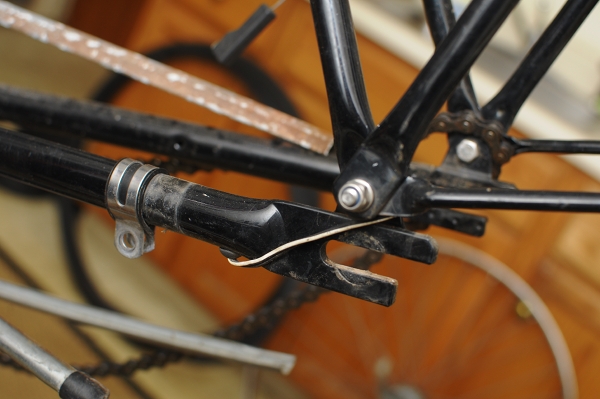
Everything on the Gazelle fits together just so, as if the parts were all custom-made for each other.  And once the chainguard is off, the fork ends are cut in such a way, so as to facilitate wheel removal. The 28" wheels with the stainless steel rims weigh a ton. 

The routing of the tail light is entirely internal: The wiring comes out of the chainstay right next to the fork-end, and snakes along the inside of the rear fender invisibly. These are the kinds of design elements that make this bicycle a fully integrated system - almost an organism - that experiences very few problems. There are fewer things to shake loose, break, or fall out of adjustment, which is what makes it so low maintenance. 

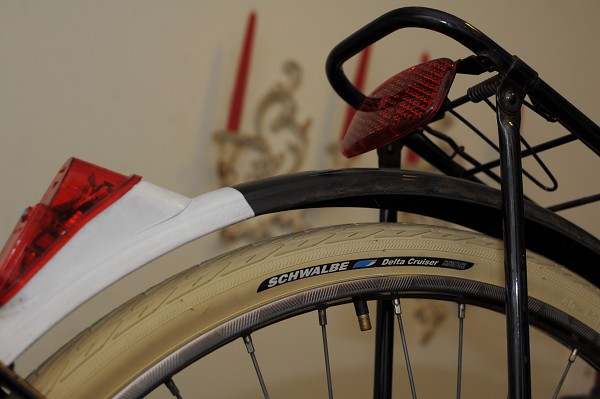
I know that some enthusiasts would have next taken the whole bike apart, scrubbed off the rust, polished the frame and components, and put it back together - but we prefer to let functional bikes be. Having checked the drivetrain, none of the components seemed to be any worse for wear despite some cosmetic degradation, so we just cleaned them up a bit, greased everything, adjusted the brakes and shifter, and closed the whole thing back up. I will replace the chain soon just in case, but that is about it. Changing the tires on this bike was easy, and the cracked originals are now replaced with new Schwalbe Delta Cruisers. We also removed the vinyl dressguards and are replacing them with something more personalised. The snow continues today, but by the time it is over the winterised Gazelle will hopefully be ready for her test-ride. Working on this bicycle has made us both appreciate just how well it was built. I know that the current-production Gazelles differ in the way they are constructed, but I hope that they retained at least some of the ingenuity of the original design. 

Monday, December 20, 2010

The Drop Frame Bicycle - The 'Queen of Safeties' Returns

[image via Atomic Antiques]

Browsing through my favourite vintage bicycle posters, I've always noticed something unusual about the ones of the Boston-based Overman Wheel Co.: The lady's bicycle appeared to have only a single curved tube - rather than a down tube and a top tube, like the vintage loop frames we are accustomed to seeing. Could this be artistic license for the sake of making the graphics simpler, or did bicycles like this really exist? Several times I had tried to investigate, until finally I found what I was looking for:

[image via the Smithsonian Institution]

The Overman Wheel Co. "Victoria" - a "drop frame woman's safety bicycle," according to the Smithsonian. It had 28" wheels, rod-like brakes, what appears to be some sort of suspension contraption on the fork, an enormous saddle, high handlebars, and a chainguard. Finally, confirmation that the bicycle hinted at in the posters was a real model. And for a machine that was manufactured in 1889, the Victoria looks awfully familiar...


And you thought this design was funky and new, eh? Bicycles in this style have been popping up in Europe with increasing frequency over the past 5 years, and have recently made their way to the US as well: A single, oversized curved tube connecting the head tube and the seat tube - sometimes with reinforcements and sometimes without, combined with a suspension fork, suspension seat post, plush saddle and high handlebars.

[image via Tom Coghlan]

The reasoning behind the single curved tube design, is that it allows for extra low step-over height, making the bicycle especially accessible for those who wear long, loose clothing, as well as for those who have balancing problems when mounting even the standard step-through frames. And the funny thing is, that while everyone agrees that the low step-over is beneficial, many also complain about how "ugly and modern" it is. I wonder how many are aware that the "drop frame" design is in fact 120 years old!

[image via The Daily Postcard]

As I've mentioned here earlier, I think that any design that makes the bicycle more accessible to those who would otherwise be intimidated by it, is a good design. With its super-low step-over, the drop frame is inviting and safe-looking - no wonder the original was described as "the queen of safeties". Having ridden a few modern versions of these bikes in Austria a couple of years ago, I found them easy to deal with. But I wish there was a way to make them look and feel a little nicer. The suspension fork on the modern bikes is probably there because the aluminum frame makes them painful to ride over bumps. But the suspension has the side-effect of creating a "bouncy" feeling that  does not give the cyclist optimal control of the bicycle. I wonder how the original Overman bicycles were made: Were the frames lugged? Was the ride comfortable? I suppose we will never truly know how these compared to today's bikes. 

I think the modern reincarnation of the drop frame is a great idea in principle, if only it could be made more elegant. What do you think of the vintage and modern versions? - could you benefit from the low step-over, or do you find the regular step-through designs sufficient?

Friday, December 17, 2010

The Vintage Bike Shop: a Visit to 'Old Roads' in Cambridge, MA

Used and vintage bicycle shops can be great resources on a number of levels. For the beginner cyclist, they can provide clean, tuned-up alternatives to the treacherous waters of Craigslist and ebay. For the DIY tinkerer, they can be a source for older parts and accessories. And for the seasoned collector, they can, on occasion, offer up a gem of a bicycle that one would not normally come across elsewhere. A vintage bike shop is certainly worth a visit, if one exists in your area. In Boston, we are lucky to have Old Roads - located in the Cambridge Antiques Market, just a 15 minute bike ride from my home.

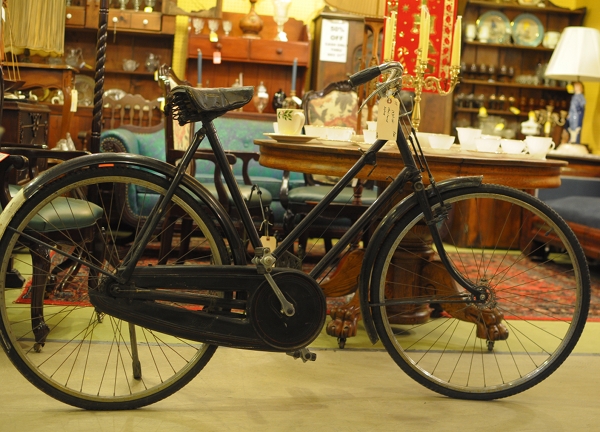
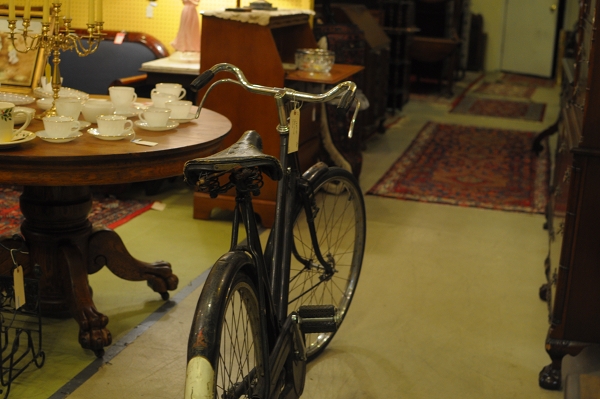
Presuming that most of the bicycles offered are found locally, vintage bike shops are in a sense like museums of history: They give you an idea of what kind of bikes were popular in your area over decades past. It amazes me that no matter how many of these bikes are sold (and I've personally played matchmaker in several deals), Boston does not seem to run out of its stock of early full-chaincase Raleighs. Just imagine how many of these things must have been on the streets in the '30s-70s. The model above is an original early 1930s version.

(Cuppa tea?)

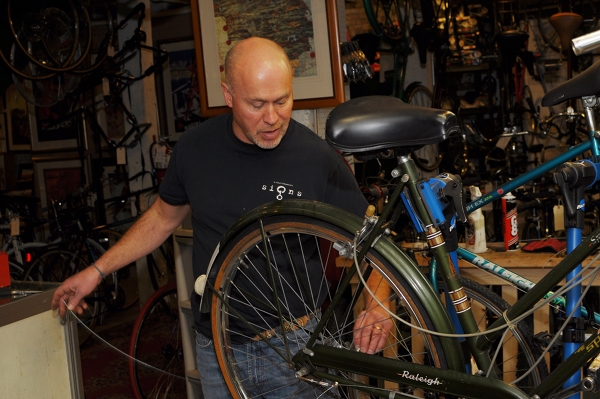
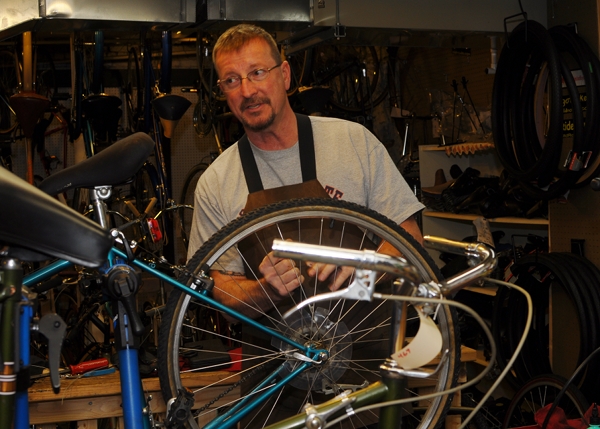
Situated in the dungeon-like basement of the Antiques Market (formerly a coffin factory!), "Old Roads" is really a joint project between two shops: Menotomy Vintage Bicycles, owned by Vinny,

and Cambridge Used Bicycles, owned by Ed. They began selling bikes out of this space in 2008, and have since become a staple of the vintage bicycle scene in the Boston area.

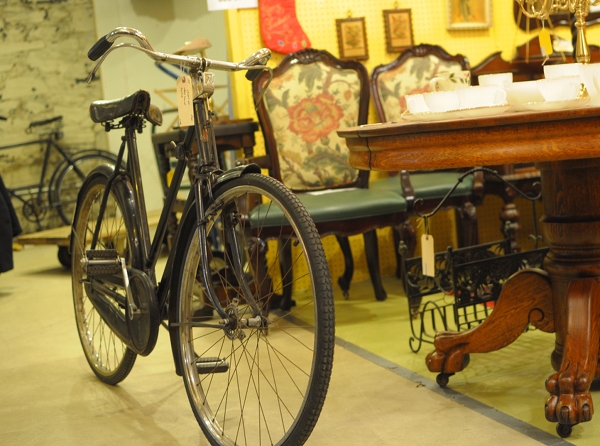
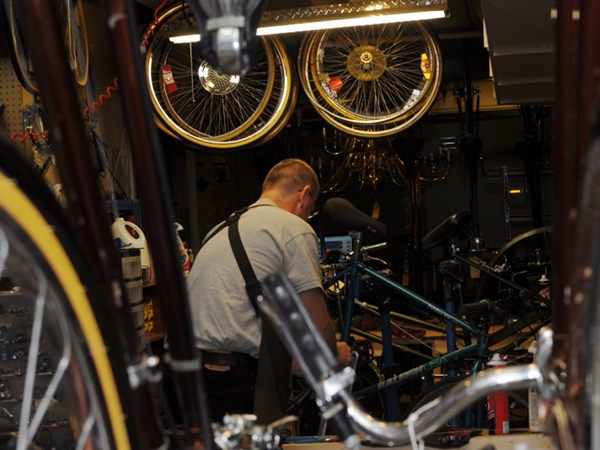
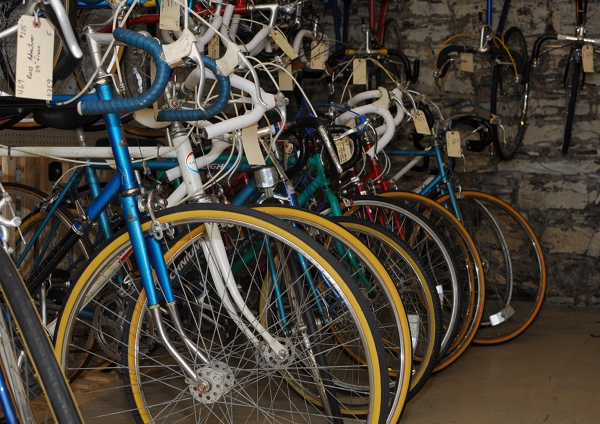
The full extend of their inventory is impossible to capture, due to the sprawling, cavernous nature of the space - which makes being there in person all the more exciting. There are rows and rows of vintage bicycles - on the floor, on the walls, on the ceiling, everywhere you look really.

Though initially, the focus of the shop was meant to be on antique bicycles, it soon became apparent that the local population was mostly interested in reliable 3-speeds and 10-speeds from the 1960s through the early 1980s, to be used as transportation. And so, increasingly, the inventory began to accommodate this. Now the shop offers a stagerring variety of bicycles, in one of five categories: vintage 3-speeds, vintage roadbikes, early vintage cruisers, antique bikes (pre-WWII), and some used newer bikes from the 1990s onward - including a couple of hand-painted "fixies".

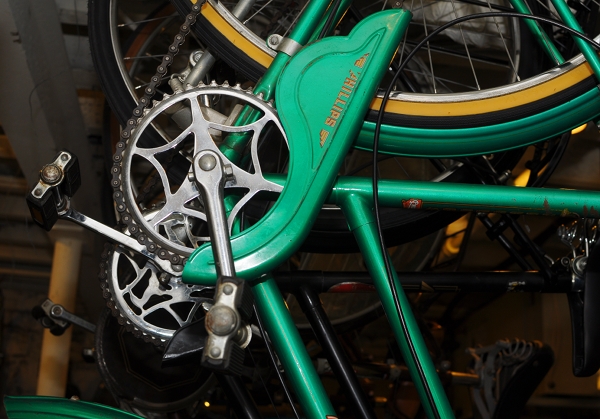
For me, the 3-speeds are the biggest attraction. There are dozens of them, both men's and ladies'. Though Raleigh and Schwinn are the names you will see most frequently, more unusual offerings are often found as well.

Phillips, England

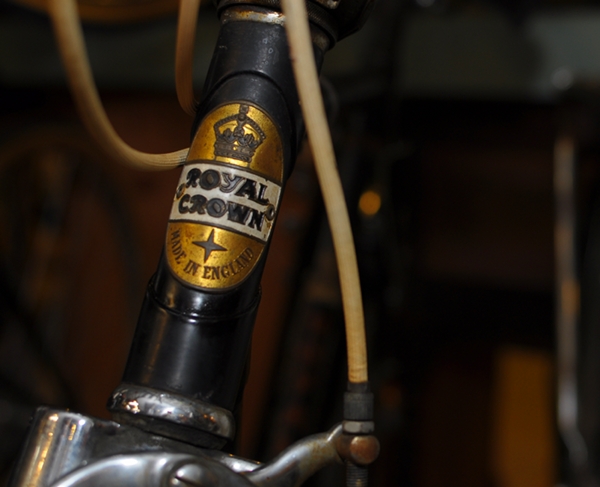
Royal Crown, England

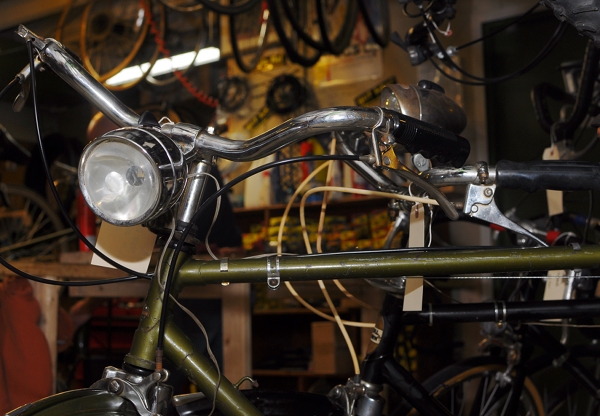
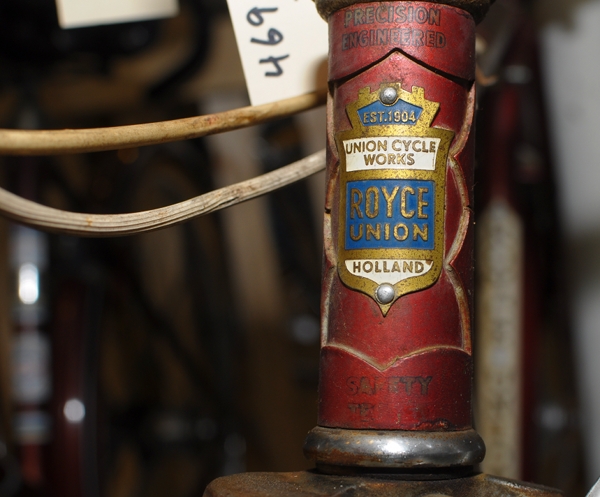
Royce Union, Holland. And there are many others. With chaincases and without, English and Dutch, step through and diamond frame, some even with the original dynamo lighting.

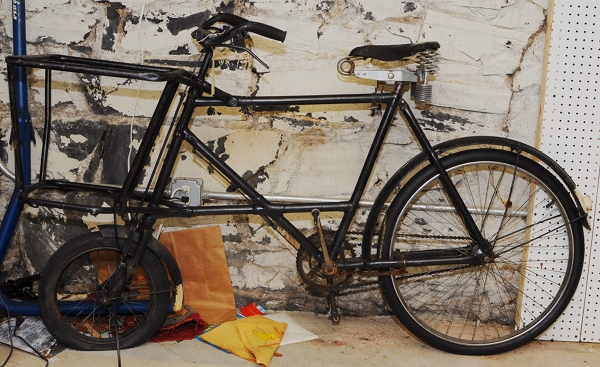
And of course the antique offerings never fail to impress. The above is a Butcher's bike, most likely from the 1920s. 

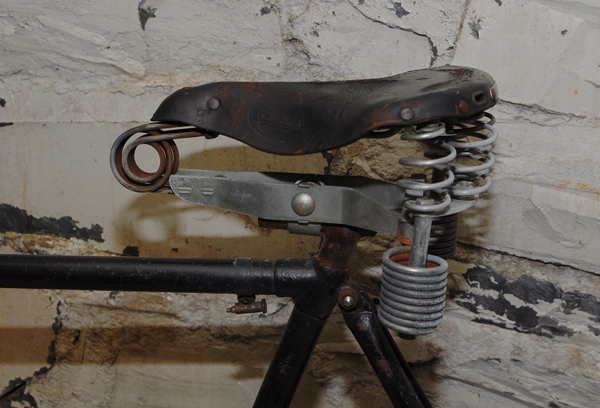
I am guessing this butcher was a heavy guy!

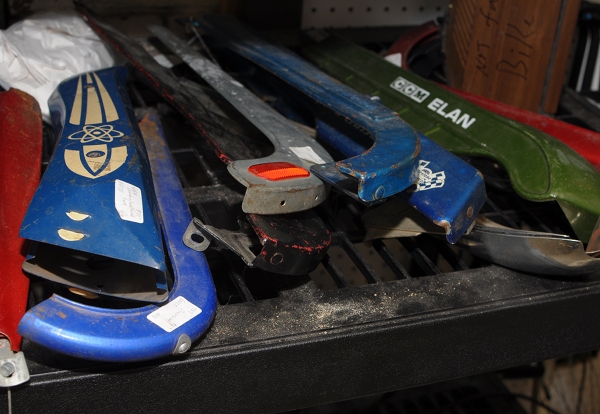
There is also a slew of accessories in stock, including chainguards, handlebars, saddles, tires and racks.

Even vintage bottle generators are available, for those who find the modern ones too high tech.

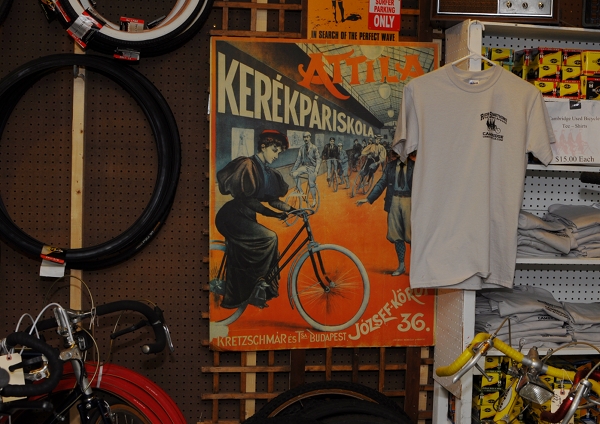
Ephemera and t-shirts, too. 

In addition to its physical presence, Old Roads offers a number of online resources for the Boston area and beyond. They host a message board where visitors can discuss a multitude of topics pertaining to vintage bikes, as well as post for sale/ wanted ads free of charge. They offer a price guide for used and vintage bicycles. And they sell some interesting hard to find parts online. While in the summer, bicycles are sold only locally, during the winter they can be shipped outside the Boston area as well. For those looking for a vintage English 3-speed in clean condition, this can be a good option if your area has a shortage. 

Like proprietors of used bookstores, vintage bike shop owners tend to be genuine enthusiasts - which means that the customer can benefit a lot more from interacting with them, than from interacting with someone who just wants to sell their old bike. Interesting stories, helpful advice, and local bicycle lore are just some of these benefits. Out of curiosity: Are there used or vintage bike shops in your area, and do you find them useful?