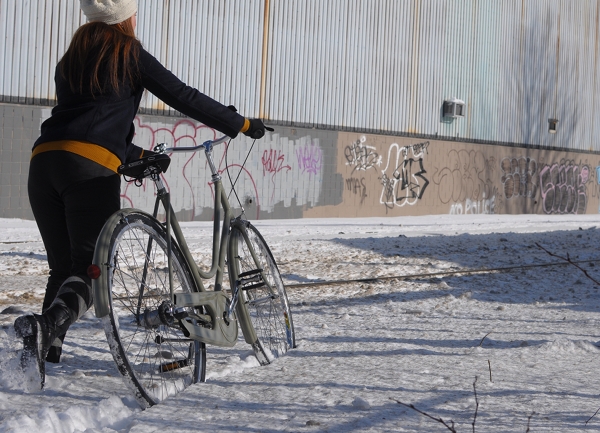
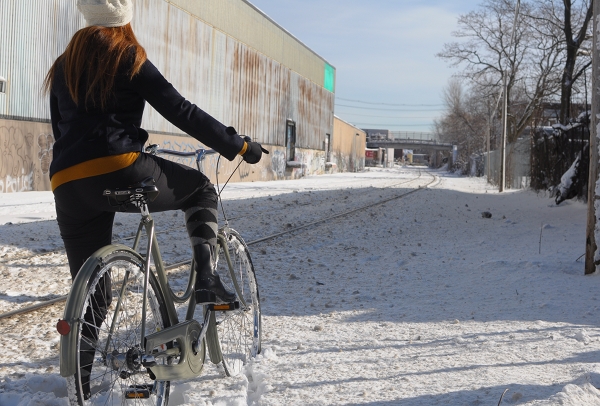
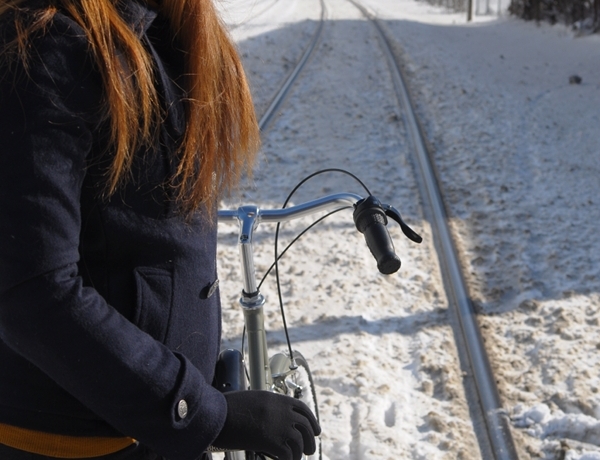
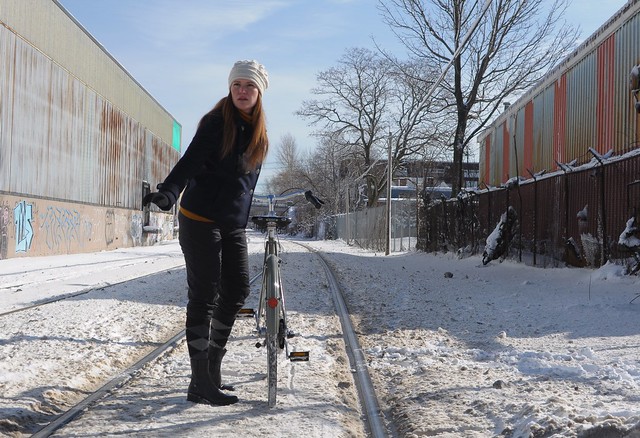
Okay, I promise not to make this another post with deep thoughts inspired by the snowpocalyptic weather in Boston. Because at this point, my bikes have reached a state that clinicians like to call "learned helplessness": The individual, convinced that no action on their part can alter their fate, just gives up and stops trying, possibly curling up in the fetal position and gently rocking back and forth. The snow won, dear readers. Oh yes, it won.
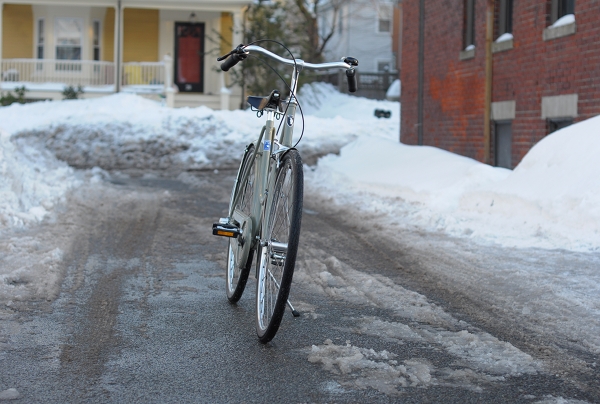
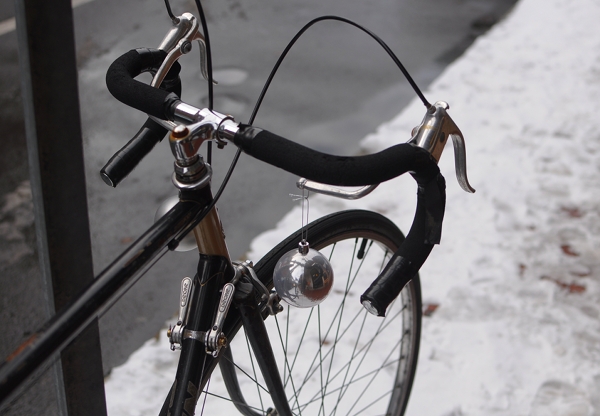
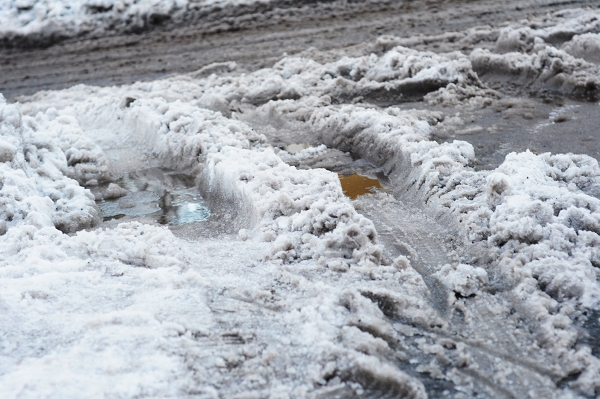
Yesterday, this was "the road" outside my house. Perhaps not surprisingly, last night I had a dream about this fellow. Though I am normally drawn neither to Surly nor to mountain bikes, I've had the hots for the Surly Pugsley since the first time I saw one a couple of years ago. I have no intention of getting one, honest. But part of me wishes I still lived in Northern NH, so that I'd "have no choice but to get it," you understand. I have seen pictures of that bicycle ridden through waist-deep snow, through soft sand, and crossing medium sized lakes. And something about the proportions seems just right to me, making the Pugsley an "ugly, in a handsome kind of way" type of bike. The Joe Viterelli of bikes, if you will.
But whenever I bring up the Pugsley with its 3.8" tires as an example of a dream "winter bike," someone inevitably replies that "bikes with skinny tires are actually better in the snow" - which, no matter how many times a proponent of that concept tries to explain it, does not make a great deal of sense to me. While I understand that skinny tires can supposedly pierce through the snow, I am skeptical. Doesn't that mean the bike could easily get stuck? And why do I see only mountain bikes when there's significant snow on the roads?
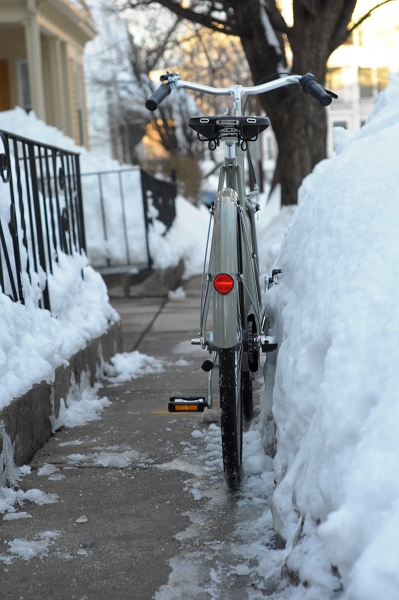
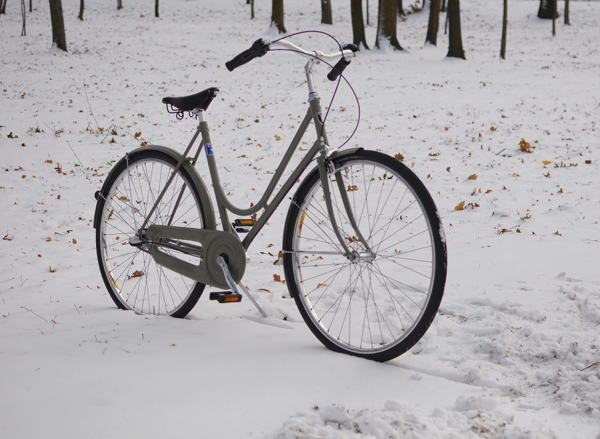
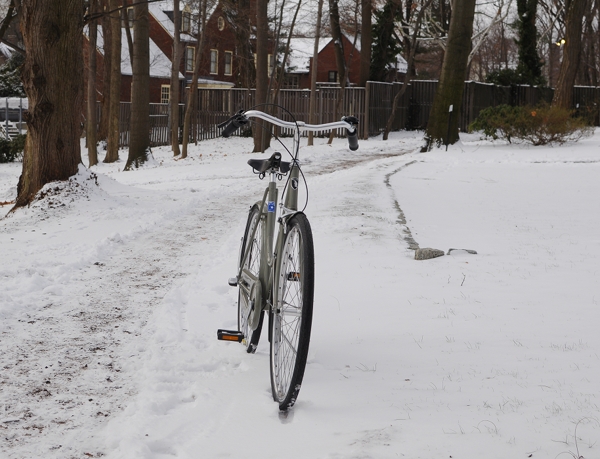
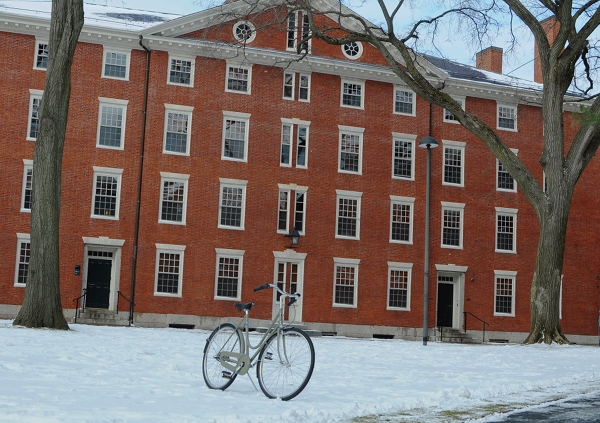
There is no doubt that my massively heavy, long wheelbase, 38mm tire Gazelle handles better when going over snow than the lighter and sprightlier 35mm tire Bella Ciao. But neither of them is sufficient when things get really bad. And oddly, on the worse days I actually find myself favouring the Bella Ciao, only because its easier to wield when acrossing enormous snowbanks. Poor bike, I look forward to seeing what the chain will look like under that nearly-but-not-quite-full chaincase after the winter is over...
If anybody out there is riding on streets that look like this, what bike are you riding and how is it working out for you? And if you say "skinny tires," I want pictures! As for me, I stayed indoors all day today - drinking tea, catching up on work, and daydreaming of crossing frozen rivers on a white Pugsley.
Showing posts with label Bella Ciao. Show all posts
Sunday, February 6, 2011
Sunday, January 23, 2011
Superba Colour and Other Decisions: Your Feedback Welcome!
I will soon need to make a decision on the colour for the Bella Ciao "Superba" and would like to know what you think. I realise that the usefulness of asking this question is limited, as the persons answering might not be the ones considering buying the bicycle. But I think it's still helpful to me. The Superba is not meant as an overall crowd pleaser (that's an impossible task anyway!), but as something that will reflect my design aesthetic and will appeal to those who share it. Keeping that in mind, please feel free to let me know which, if any, of the above colour families you prefer [poll now closed]:
It will probably come as no surprise that I am leaning toward the greens. It's hard to get a good idea of a colour by looking at a small swatch on a computer screen, but the "pale sage" I am considering would be a more vibrant, less military version of the colour of my bike. A fresh, airy, Spring green. The "deep sage" would be a slightly darker, and also a bit more vibrant, version of the colour of my bike. The "mauve," "periwinkle," and "slate" would all be very subdued colours, close to gray. And of course, picture each colour choice paired with cream tires.
The other question I want to ask, has to do with a possibility of a gentleman's Superba - and I call them lady's and gentleman's, because that is what the frames are called in Italian, not because I am sexist! But anyhow, there have been some comments and emails from male readers expressing interest, so I've thought about it. But here are my concerns: First, despite the comments I am just not sure that the demand is there. And it's trickier to order the diamond frames, because they are available in four sizes (measured c-t). But the bigger issue, is that I have never ridden a diamond frame Bella Ciao, and therefore cannot make any endorsements regarding how it handles. It looks lovely, but nonetheless I have never ridden one or even examined one in person. So, keeping that bit in mind, do you still think a gentlemen's Superba is a good idea [poll now closed]?
My own inclination is to recommend that Harris Cyclery orders a couple of standard (non-Superba) Bella Ciao "Corvo Citta" Uomo bicycles first, so that either I or the Co-Habitant can ride them and form an impression of how they handle. But it will be nice to see what you think. Thanks in advance for the feedback on both questions, and please feel free to elaborate in the comments.
Friday, January 21, 2011
The Least Daunting Option
Well, it seems that we've been having one of two weather conditions in Boston lately: (a) blizzard, or (b) in between blizzards. When it's the latter, I have been riding my bike - sort of. To be honest, I would not be doing it if I didn't have to, because the road conditions are pretty bad. But the bus makes me motion sick, the nearest subway stop is a 15 minute walk from our house (longer in the snow), and the sidewalks are slippery. So except on days when the roads are completely impassable, cycling seems to be the least daunting option. Still, "least daunting" doesn't mean "easy," and I've had to make a number of adjustments to the way I ride a bike, in order to be able to do it at all.
For one thing, I cycle much slower than usual, because I am scared of hitting not only ice patches, but those mini-mountains of hard snow that seem to pop up when I least expect them, like some treacherous obstacle course. Cycling slowly allows me to see them in time to either brake, or figure out how to go around them safely (I am a slow thinker when it comes to spacial rotation tasks). Happily, there are almost no other cyclists on the roads, so there is no one to get annoyed at my crawling speed - I've found that I can go as slow as I like, and no one seems bothered. I guess to cars, it's pretty much the same whether I am cycling at 7mph or 20mph: Either way, they are faster than me and will have to pass me eventually.
I also simply accept that I will have to get off my bike and walk a lot - across impassable stretches of slush and even over snowbanks. Sometimes I'll walk for a quarter of a block, then get back on the bike and ride for a couple of blocks, then get off again, and so on. It's annoying, but still better than walking the entire way - at least to me. Warmer and faster.
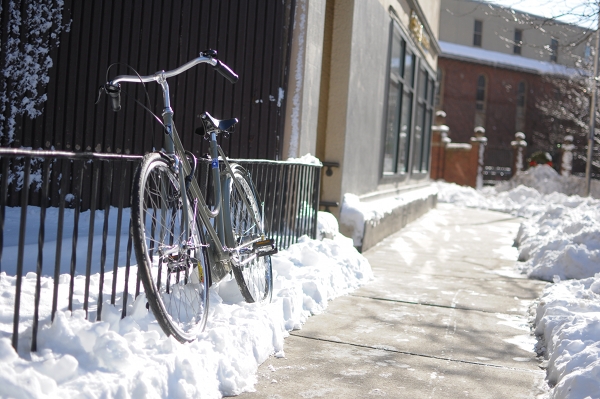
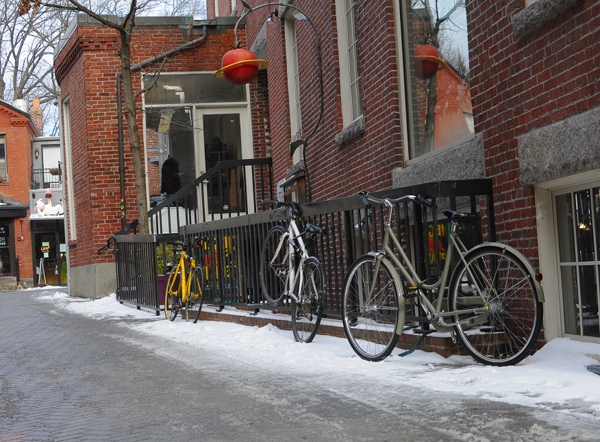
Finally, I've been having to get really creative about locking up my bike. Most bike racks have been made inaccessible by the surrounding knee-deep snow. So I will usually chain my bike to a fence, or whatever is handy - often having to rest it on top of a snowbank.
While all this is kind of miserable, I also find it pretty funny. I am not a "hard core" cyclist by any means and I am extremely risk averse. "Wimp" would probably be the appropriate word. And yet I am one of the few people out there on a bike, which does make me question my sanity. But I guess there is no better motivator than having no other choice - or at least no alternative options that are less daunting. Cycling in slow motion through a winter wonderland is not so bad, after all, when I compare it to feeling nauseous inside of a stuffy bus, or slip-sliding along icy sidewalks.
Tuesday, January 18, 2011
Showing Off or Showing How? On Bicycle Blog Exhibitionism
I've been having a discussion with a reader about "the exhibitionist culture of bicycle blogs" and more specifically, about "those girly bike blogs" that, in his view, are the most exhibitionist of all. This is a theme that keeps coming up now and again, and so I would like to say a few words on the subject. Certainly there are elements of exhibitionism to photographing yourself regularly and then posting those pictures on a publicly viewable website. My intent is not to debate this. But consider the possibility, that this element is not the main point.
Human beings tend to learn by doing - or at least by watching someone else demonstrating the doing, which automatically causes the viewer to imagine themselves in the doer's place. Pictures that show a real person - ideally the author of whatever narrative is being presented - performing the behaviour described in the narrative, are more engaging to viewers. In other words, a photo of me cycling through the park, followed by the text "and then I cycled through the park" will make the reader "feel" the experience more poignantly than a photo of the park alone followed by the identical text. This has been demonstrated countless times - mainly within the genre of empathy, motor mimicry, and emotional contagion research - and it is why instructional videos most typically have a human narrator who acts out the instructions.
Even in the absence of visual cues, first person narrative in itself is more engaging to readers than other forms of narrative. That is why fictional stories told in the first person, or personal accounts of events, are more interesting and memorable for most people than scientific writing.
As a graduate student, I once devised an experiment where participants were given sentences to read that contained identical information, but were phrased either in the first person ("I placed the shoe in the bedroom"), in the third person ("She placed the shoe in the bedroom"), or in the passive voice ("The shoe was placed in the bedroom"). When asked questions about the information later ("Where is the shoe?"), participants recalled it best when that information had been embedded in first person sentences. An interesting side-effect of this, was that people also tended to give more elaborate answers about the first person sentences, frequently adding extra information. For example: "The shoe is in the bedroom, on the rug by the dresser." To me, this means that the first person voice encouraged the reader to use their imagination more, essentially re-enacting the sentence in their mind and picturing themselves taking the shoe to the bedroom. Where would they have put it? Apparently on the rug, by the dresser.
It does not take a huge mental leap to see how this relates to bicycle blogs. By telling personal stories and by posting pictures of themselves engaged in the activities they write about, the so-called "girly bike blogs" make the cycling experience more poignant and memorable to a world wide web audience (especially if the members of this audience are not already bike enthusiasts) than dry, technical blogs ever can. While I seldom post diary-style entries where I discuss what I did that day, what I wore, what I had for lunch, etc., I enjoy other blogs written in that format very much and I find them helpful. Blogs like that do not only introduce ideas as mere concepts: They enable viewers to imagine integrating those ideas into their own lives. To call it gratuitous exhibitionism is to grossly undervalue their impact on audiences.
When it comes to females in particular, there are layers upon layers of self-consciousness about how we are perceived by others - formed by too many social, historical and evolutionary factors to mention here. But... so what? Depicting yourself as an actor - rather than a passive narrator armed with academic phraseology - is a means of connecting with an audience that is emotional and visceral. That might make it disconcerting to some, but it also makes it effective, as it taps into the most basic mechanisms underlying the human desire to communicate and learn. Sure, on some level, it may be showing off. But more significantly, it is showing how.
Tuesday, January 11, 2011
The Bella Ciao 'Superba' - My Take on the Italian City Bicycle
As mentioned previously, I am collaborating with the small European manufacturer, Bella Ciao, in developing my own version of their classic lady's bicycle model. This special edition bicycle will be available in late Spring 2011, exclusively at Harris Cyclery in West Newton, MA. I do not yet have a prototype to show you, but upon reader request I am making the announcement regardless. Read on for all the details!
About the Project
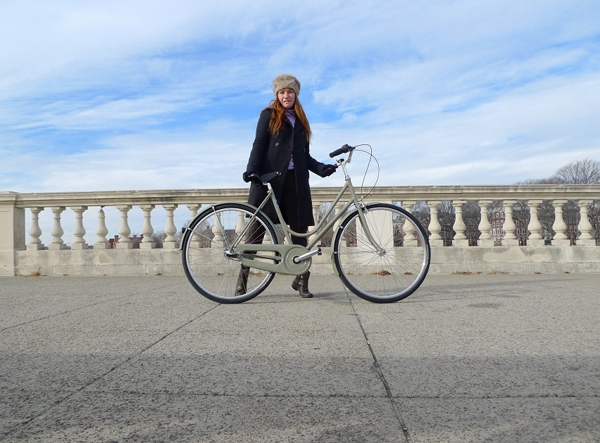
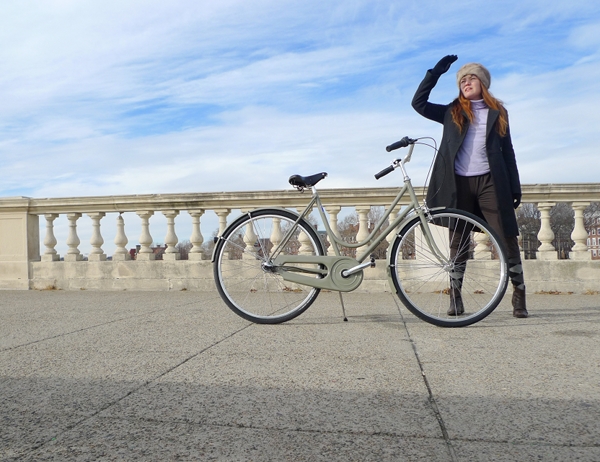
Last year I received a 'Corvo Citta Donna' bicycle (shown above with stock everything, other than the saddle and kickstand) from Bella Ciao as part of a barter exchange. My impression of the bicycle (you can read the review here) was very positive, but of course not without criticism. Basically, I absolutely love the frame design, the quality of construction, and the handling. But were it my bike, my choice of components would have been different. There was some debate about this between myself and Bella Ciao, and they did not agree with my criticism. But they found my point of view interesting. And after some back and forth, they invited me to put together my own version of the bicycle - and I gladly accepted. Bella Ciao has now made a deal with Harris Cyclery, who will sell the bicycles in the US. If all goes according to plan, they should be available by May 2011. My role in the project is that of a consulting designer.
About Bella Ciao
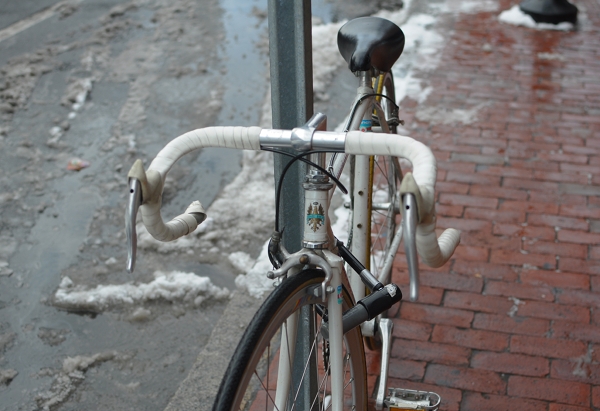
Describing their take on bicycles as "the poetry of freedom," Bella Ciao is a small company based in Berlin with an attitude that is both serious and tongue-in-cheek. Bella Ciao frames are handbuilt in Northern Italy by a family of framebuilders who have been in business since 1898 (see image above). They are then powdercoated and built up in Germany. The standard line-up includes cro-moly men's and lady's city models, deluxe men's and lady's models with Columbus tubing, and a single speed/ fixed gear model. There are occasional special edition bicycles as well. You can read about all of these on their website in German and English.
Why I like Bella Ciao bicycles
While I find the bicycles beautiful, what really attracts me is the performance. Of all the upright bicycles I have tried, I have found my Bella Ciao bike superior for long rides, and especially for hills. I do not say that lightly. It is an easy bike in every respect: easy to ride, easy to carry, easy to own. Additionally, I like it that Bella Ciao frames are fully lugged , including the fork crown. And they are handmade. There are other terrific details, such as the proprietary handlebars and wheels (yes, they make their own). All this is becoming increasingly rare even with classic modern bicycles.
The Bella Ciao 'Superba'
The Bella Ciao 'Superba' (pronounced: "su-PAIR-bah") will be a special edition lady's bicycle with a lightweight cro-moly frame, a Sturmey Archer 3-speed hub, cream Schwalbe Delta Cruiser tires, dynamo lighting and a rear rack. The specs as they currently are:
frame, chaincase, fenders
Based on Bella Ciao's cro-moly Corvo Citta Donna (lady's) frame with the classic "Frascona curve" of the top tube, with the additional feature of internal routing for the dynamo lighting; complemented by a full (two-sided) chaincase with opening at the rear and fenders.
size
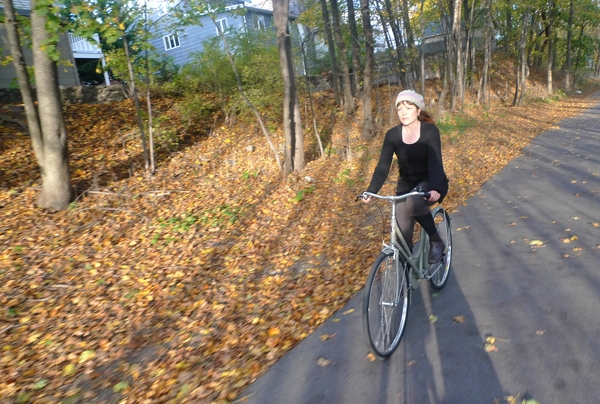
The frames are 54cm and will fit ladies 5'5" - 5'10." To give you an idea of fit, I am 5'7" and this is how I look on my bike. The model in the pictures here is 5'10".
colour
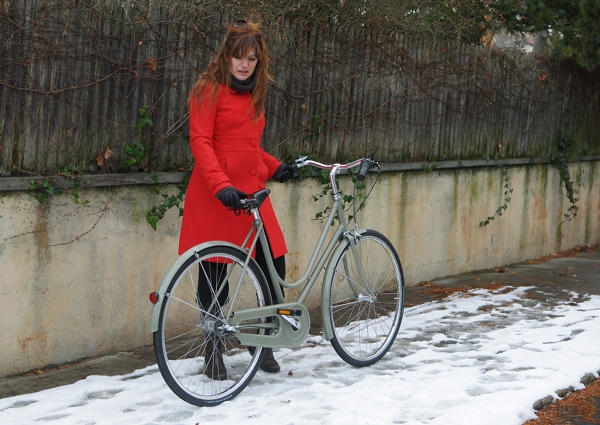
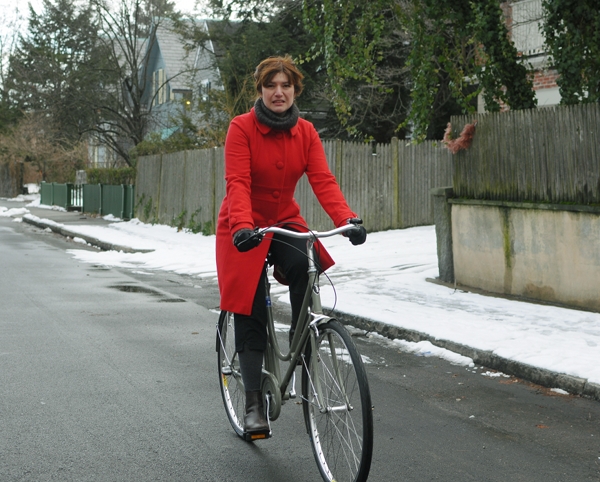
The colour will be custom to this edition, most likely some shade of pastel green. Not the same green as you see on my bike (I think it's a bit too military for most people), but perhaps some version of sage. Or maybe not green at all and I'll have a reader's vote at a later point?
wheels and tires
700C proprietary Bella Ciao wheel rims of light, high-polish alloy, with cream Schwalbe Delta Cruiser tires.
gearing and brakes
3-speed Sturmey Archer hub with coaster brake, classic trigger shifter; front caliper brake with classic chrome city brake lever.
handlebars
"Deluxe" (high polish) alloy Bella Ciao bars. The model I like are a sort of hybrid between Porteur and North Road style bars. Posssibly my favourite handlebars for a city bike thus far.
accessories
Brooks B72 saddle in antique brown, special grips TBA, brass bell
lighting
Internally routed, hub-generated dynamo lighting, front and rear, with standlight feature; classic look.
rear rack
There will be a rear rack that will elegantly suit the frame, and I am currently working out the details. If all goes well, it will be a custom handmade rack - fingers crossed!
weight
Including rack and lighting, total weight is likely to be around 33lb.
retail price
The price of the complete bicycle will be $1,490
availability
The 'Superba' will be at Harris Cyclery by May 2011. There will be 12 bicycles available. Harris Cyclery will take pre-orders with a non-refundable $300 deposit. If you would like to pre-order, please contact Elton Pope-Lance at 'elton[at]harriscyclery[dot]net'. I believe that11 9 of the 12 bicycles remain at the moment. I am not involved in the sale of the bicycles, so please contact Harris Cyclery and not me with questions about purchasing.
Will you like this bicycle?
As someone who does not believe in "the" perfect bicycle, I can only say that it depends. What are you looking for? What features please or disappoint you in your current or previous bicycle? Or are you just looking for something different? Bella Ciao bicycles are light, elegant, nimble, and easy uphill. They are also comfortable and very simple. If you live in a hilly area and struggle with a Dutch or English Roadster-style bike, a Bella Ciao could be the perfect solution. However, if you need to transport 50lb of groceries and two children as part of your daily routine, I think there are more appropriate options. You might also find it helpful to read this post, comparing the different categories of upright bikes that are currently out there.
[edited to add:] As for my version of the bicycle specifically, please understand that it is exactly that - my version. Obviously it will not suit everyone's tastes, but I hope it will appeal to a dozen people in North America who cannot find what they are looking for elsewhere. If there is popular demand for an alternative version (non-coaster brake, diamond frame, etc), there could be another batch later. Also, for those interested in the standard production Bella Ciao models, there is a possibility that Harris Cyclery may be selling them in future - please express your interest to them directly.
I will post pictures once the 'Superba' prototype is built up, but realistically that will not be for another month. I will also write in more detail about being involved in this project, as some might find it interesting to know more about the industry. This has certainly been an educational experience for me so far, and I hope you like the end result. If you have any questions, please feel free to ask.
About the Project
Last year I received a 'Corvo Citta Donna' bicycle (shown above with stock everything, other than the saddle and kickstand) from Bella Ciao as part of a barter exchange. My impression of the bicycle (you can read the review here) was very positive, but of course not without criticism. Basically, I absolutely love the frame design, the quality of construction, and the handling. But were it my bike, my choice of components would have been different. There was some debate about this between myself and Bella Ciao, and they did not agree with my criticism. But they found my point of view interesting. And after some back and forth, they invited me to put together my own version of the bicycle - and I gladly accepted. Bella Ciao has now made a deal with Harris Cyclery, who will sell the bicycles in the US. If all goes according to plan, they should be available by May 2011. My role in the project is that of a consulting designer.
About Bella Ciao
Describing their take on bicycles as "the poetry of freedom," Bella Ciao is a small company based in Berlin with an attitude that is both serious and tongue-in-cheek. Bella Ciao frames are handbuilt in Northern Italy by a family of framebuilders who have been in business since 1898 (see image above). They are then powdercoated and built up in Germany. The standard line-up includes cro-moly men's and lady's city models, deluxe men's and lady's models with Columbus tubing, and a single speed/ fixed gear model. There are occasional special edition bicycles as well. You can read about all of these on their website in German and English.
Why I like Bella Ciao bicycles
While I find the bicycles beautiful, what really attracts me is the performance. Of all the upright bicycles I have tried, I have found my Bella Ciao bike superior for long rides, and especially for hills. I do not say that lightly. It is an easy bike in every respect: easy to ride, easy to carry, easy to own. Additionally, I like it that Bella Ciao frames are fully lugged , including the fork crown. And they are handmade. There are other terrific details, such as the proprietary handlebars and wheels (yes, they make their own). All this is becoming increasingly rare even with classic modern bicycles.
The Bella Ciao 'Superba'
The Bella Ciao 'Superba' (pronounced: "su-PAIR-bah") will be a special edition lady's bicycle with a lightweight cro-moly frame, a Sturmey Archer 3-speed hub, cream Schwalbe Delta Cruiser tires, dynamo lighting and a rear rack. The specs as they currently are:
frame, chaincase, fenders
Based on Bella Ciao's cro-moly Corvo Citta Donna (lady's) frame with the classic "Frascona curve" of the top tube, with the additional feature of internal routing for the dynamo lighting; complemented by a full (two-sided) chaincase with opening at the rear and fenders.
size
The frames are 54cm and will fit ladies 5'5" - 5'10." To give you an idea of fit, I am 5'7" and this is how I look on my bike. The model in the pictures here is 5'10".
colour
The colour will be custom to this edition, most likely some shade of pastel green. Not the same green as you see on my bike (I think it's a bit too military for most people), but perhaps some version of sage. Or maybe not green at all and I'll have a reader's vote at a later point?
wheels and tires
700C proprietary Bella Ciao wheel rims of light, high-polish alloy, with cream Schwalbe Delta Cruiser tires.
gearing and brakes
3-speed Sturmey Archer hub with coaster brake, classic trigger shifter; front caliper brake with classic chrome city brake lever.
handlebars
"Deluxe" (high polish) alloy Bella Ciao bars. The model I like are a sort of hybrid between Porteur and North Road style bars. Posssibly my favourite handlebars for a city bike thus far.
accessories
Brooks B72 saddle in antique brown, special grips TBA, brass bell
lighting
Internally routed, hub-generated dynamo lighting, front and rear, with standlight feature; classic look.
rear rack
There will be a rear rack that will elegantly suit the frame, and I am currently working out the details. If all goes well, it will be a custom handmade rack - fingers crossed!
weight
Including rack and lighting, total weight is likely to be around 33lb.
retail price
The price of the complete bicycle will be $1,490
availability
The 'Superba' will be at Harris Cyclery by May 2011. There will be 12 bicycles available. Harris Cyclery will take pre-orders with a non-refundable $300 deposit. If you would like to pre-order, please contact Elton Pope-Lance at 'elton[at]harriscyclery[dot]net'. I believe that
Will you like this bicycle?
As someone who does not believe in "the" perfect bicycle, I can only say that it depends. What are you looking for? What features please or disappoint you in your current or previous bicycle? Or are you just looking for something different? Bella Ciao bicycles are light, elegant, nimble, and easy uphill. They are also comfortable and very simple. If you live in a hilly area and struggle with a Dutch or English Roadster-style bike, a Bella Ciao could be the perfect solution. However, if you need to transport 50lb of groceries and two children as part of your daily routine, I think there are more appropriate options. You might also find it helpful to read this post, comparing the different categories of upright bikes that are currently out there.
[edited to add:] As for my version of the bicycle specifically, please understand that it is exactly that - my version. Obviously it will not suit everyone's tastes, but I hope it will appeal to a dozen people in North America who cannot find what they are looking for elsewhere. If there is popular demand for an alternative version (non-coaster brake, diamond frame, etc), there could be another batch later. Also, for those interested in the standard production Bella Ciao models, there is a possibility that Harris Cyclery may be selling them in future - please express your interest to them directly.
I will post pictures once the 'Superba' prototype is built up, but realistically that will not be for another month. I will also write in more detail about being involved in this project, as some might find it interesting to know more about the industry. This has certainly been an educational experience for me so far, and I hope you like the end result. If you have any questions, please feel free to ask.
Friday, January 7, 2011
On Winter Skies and the Solace of Open Spaces
In a high school English class, we were once made to read an essay, called "The Solace of Open Spaces" by Gretel Ehrlich. I remember the piece only vaguely and don't want to spoil my memory's version of it by re-reading it today. It was about the great plains of Wyoming - or rather, about the author's reaction to their overwhelming vastness. I have never been to that part of the US and have not seen the landscape she describes. But I recall vividly the flash of self-recognition I experienced when reading her words. The solace of open spaces. Yes, that is how I feel.
Even as a child, I had the habit of wandering, of exploring - in a way that was driven not so much by curiosity or desire to conquer, but by what I can only describe as an emotional response to the act of moving through natural space. As a teenager I spent hours after school walking around the lakes near our house. And when I lived in England as a university student, there were these meadows that began just outside town and went on forever. I would walk through them, then turn around after an hour and lose myself in the views that surrounded me: The meadows stretched endlessly in all directions and the sky was close enough to touch. Just as the author of "The Solace of Open Spaces" describes, the vastness in itself felt sheltering - the outlines of the horizon creating the illusion of a domed structure.
In Boston, as in most cities, there is not much opportunity to experience vastness. I can cycle to the Harbor to get my fix, but somehow that only reminds me of how far removed I normally am from such a landscape; it is not part of my everyday existence.
And then yesterday, I was crossing a bridge over the Charles River and looked up at the sky. The sky was everywhere. And it was a winter sky - such a surreal, piercing shade of blue can only manifest itself this time of year. The black branches of the bare trees almost looked like bits of lace trim against the satin-white ribbon of the icy river, and the expanse of the sky itself seemed otherworldly. I felt light-headed and comforted at the same time, and the speed of the bicycle, with the icy wind against my face, accentuated the experience. While I know that this is just my way of dramaticising daily existence, I am nonetheless thankful for it. Life in general happens mostly in our minds, and now my mind is filled with winter sky, the sensation of speed, and the solace of open spaces.
Friday, December 24, 2010
Memories of an Italian Christmas
In the winter of 1989-1990, my family and I lived in Rome. It was an unstable and nomadic time for us. My sister and I - then aged 5 and 10 - were home schooled during this period and spent most of our free time in the nearby park. We picked up a bit of Italian from the local children and were able to play with them. But mostly we observed.
It's funny, the things we notice as children. I remember being stunned by the presence of snow and palm trees in the same landscape. I remember being upset about how ugly the road around the Coliseum was. I remember a man pushing a fruit cart outside our window every morning, singing "Arance! Mandarance!" And I remember the sight of several glamorously dressed women sitting on a park bench with their infants, breastfeeding while smoking cigarettes with a synchronised rhythmic energy. I have since been to Italy a number of times as an adult, but these childhood impressions of Rome remain prominent.
And then, of course, there was Christmas - Natale! The lavish holiday decorations, the lights, the musicians on the streets and the general festive atmosphere, served as an antidote to the stress of being in a foreign country. We were living in a small apartment, in a building full of other apartments - and between mid-December and the first week of January, there was a constant stream of gifts (mostly cakes, fruit baskets, and beautifully packaged bottles of alcohol) left outside of our door by our neighbours. These were accompanied by "Buon Natale!" notes, but no names or apartment numbers. We did not know whom to thank, or for whom to leave return gifts. When my parents asked our landlord about it, she assured them that this was normal: "They know that you are foreign and don't want you to be lonely." We were impressed and cheered by this thoughtful gesture that seemed to be such a matter of course for our neighbours. Most importantly, we felt wanted in the country, despite being strangers to it.
And I think ever since that childhood Christmas in Rome, that has been my association with Italy: feeling welcome and comfortable, despite not really belonging there. (Kind of like I feel on my Italian racing bikes, come to think of it.) I always remember Italy around Christmastime, and this year even more so - as I ride my sleek Italian beauties through the wintry landscape.
I have noticed that I tend to be most interested in bicycles whose country of origin holds significance for me. Their history becomes more relevant that way, and they evoke warm memories. Happy holidays to everyone and happy winter cycling!
Tuesday, December 21, 2010
First Snow Report
I have been looking forward to testing my Bella Ciao ("Patricia") in winter conditions, and with the arrival of the season's first snow I finally got my chance. Before I go on, I will preface with the disclaimer / mini-announcement that I have begun collaborating with Bella Ciao on a special edition bicycle, which will be sold by Harris Cyclery in Spring 2011. I will have more details about that soon, but just wanted to make that affiliation known in the meantime.
Though I love the way my Bella Ciao "Corvo Citta" model handles, I don't ride it as often as I'd like, because I haven't yet installed a rack and lights. Now that winter has begun in earnest, that will be my next project - I just wanted to first make sure that I'd actually be able to ride this bicycle comfortably in snowy conditions. At just over 30lb, the Bella Ciao is considerably lighter than the likes of Gazelle and Pashley, and - justifiably or not - I am weary of lighter bikes when it comes to cycling in poor weather. To my relief, I had nothing to worry about and Patricia handled just fine after the first snowfall: She remained stable on slush, on slush mixed with salt, and on thin layers of packed snow.
As with other bikes I have ridden in such conditions, I switched to a lower gear and went slower than usual. The bicycle remained sturdy and cooperative. When braking in slush, I used the coaster brake only, which I find easier to modulate on slippery surfaces. The bike also did well cycling on the slippery stretch of brickwork that was part of my route. As far as safety goes, I feel comfortable using the Bella Ciao as a winter commuter in Boston and will get on with the lights/ rack installation so that I can use it more this winter.
While the brave Patricia performed admirably, my first snow commute of the season was not entirely stress-free. Driver behaviour was chaotic and there were few cyclists out on the roads. Several times, I got spooked by a car's ambiguous maneuvers and ended up cycling through a mess of wet snow by the curb. Based on last winter's experience, I know that things will get better once drivers get into their "winter mode". Meanwhile, perhaps there is a reason why most cyclists seem to have chosen to wait it out!
What I found fascinating about the Boston "bike scene" last winter and also noticed yesterday, is that often the only bikes on the streets seem to be those that are least suited for winter cycling - for instance, aggressive roadbikes with narrow tires and no fenders. Where are the fully equipped city bikes? Where are the rugged vintage 3-speeds?
It could be, that the aggressive roadcyclists are the ones most likely to brave these conditions, while, ironically, having the worst possible bikes for doing so. That's too bad, because winter is the time when features like fenders, stable handling, wide tires, internal gearing, and an upright sitting position, really make themselves felt. Last winter, I was extremely appreciative of the Pashley I used to own, and this winter it looks like I will do equally well on the Gazelle and Bella Ciao.
Though Patricia and I did not have many companions on our first snowy commute of the season, we hope that the winter wonderland will coax more cyclists outside soon. Once the drivers calm down, it is really not so bad: Just take it easy, dress warmly, ride a sturdy and properly equipped bicycle, and enjoy the beautiful landscape!
Tuesday, November 30, 2010
What Our Hands Can Do
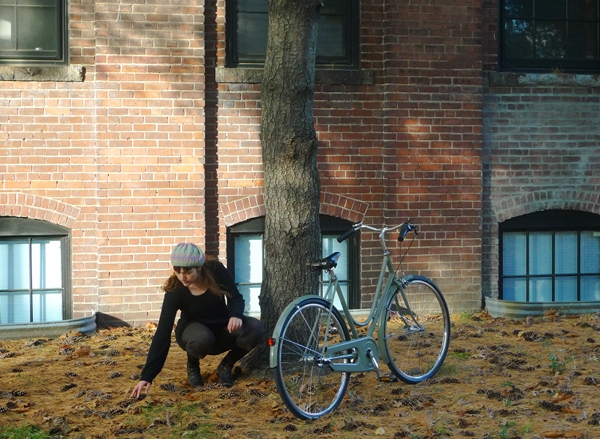
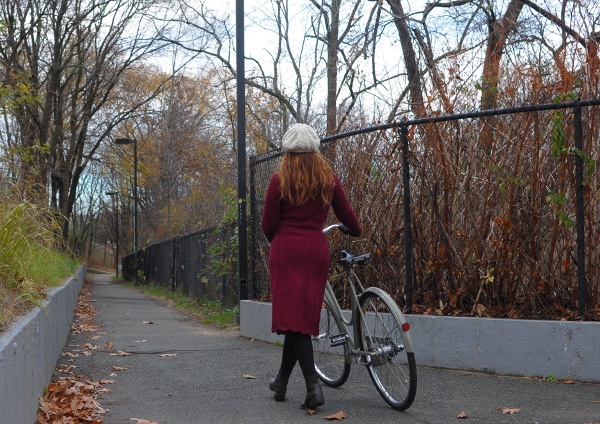
Looking over these photos from the Friday after Thanksgiving, I noticed something interesting: Almost everything pictured here is hand-made. The dress I am wearing was made by my mother. The hat and scarf were made by me. Even the bicycle was hand-made by an Italian frame builder for Bella Ciao. This combination was not intentional, but once I noticed it, I found it striking.
My mother knitted this elaborate wool dress for herself in the early 1980s and wore it all through her 20s and 30s, after which point she gave it to me. The dress suited her much better, but that has not stopped me from wearing it since I were a teenager. It only occurred to me recently how remarkable it is for a dress like this to survive being worn for three decades by two different women - neither of whom are at all gentle with their clothing. And yet here it is, still looking fresh and current. The tailoring, the textural variation, and the attention to detail are incredible by today's standards - and my mother made tons of this stuff when I was a child, while being a busy career woman, too. (I remember seeing her knit while speaking on the phone and reading a book about mathematics at the same time... )
While my own attempts at knitting are fairly pedestrian compared to my mother's past projects, they do have one feature in common: longevity. I knitted this scarf back in grad school, and 8 years later it remains alive and well, while countless store-bought ones have since fallen apart. My friends, for whom I've made clothing as far back as high school, give me the same feedback - some of them still wear the things I made in the mid-'90s. Noticing this was a big reason why I started to knit and sew again this year: I am not that great at it, but the stuff I make lasts and fits me better than store-bought.
Over this past year I have done something a little nuts: I've sold or given away most of my clothing - stuff that I had collected and saved for more than 10 years. When I was younger, I was into edgy fashion and quirky designers, but lately that interest has all but faded - replaced by a curiosity regarding how far I can go making things on my own. Aside from knitting, I have been cutting up some of my remaining old clothing and handsewing "new" clothes out of it. Hopefully I will get a sewing machine for the holidays, which will allow me to take things further. In the past I have dabbled in making my own fountain pens as well. And eventually - maybe, just maybe, I would like to try my hand at building bicycle frames - or at least designing them à la Grant Petersen.
While my framebuilding days are not yet on the horizon, I do have enormous respect for bicycles hand-made by others, and an insatiable curiosity about the process. Whether independent framebuilders such as JP Weigle, Peter Mooney, Royal H. and ANT, or small manufacturers such as Mercian, Rivendell, Velo Orange and even Pashley and Bella Ciao - I am impressed by the sheer amount of work and consideration it takes to get the design, the construction, and the finishing just right. The more I learn about the process, the more overwhelming it seems. In a world of homogenous, mass-produced goods, it is amazing to witness what our minds and our hands are capable of creating.
Wednesday, November 10, 2010
A Cruel Transition
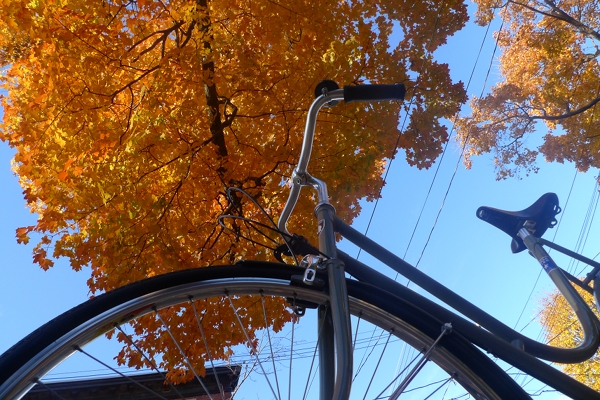
Particularly in New England, November has always struck me as a cruel month. At the beginning, the fiery foliage and the azure skies carry over from October.
The crisp, but still warm air is charged with just the right amount of electricity to gently stir our emotions. And we are lulled into a state of self-willed denial that soon it will all be yanked away from us in one fell swoop - replaced with desolate landscapes, freezing temperatures and perilous road conditions... for the next 4 months.
As far as cycling goes, I must admit the memories of how difficult last winter was fill me with dread. I am trying not to panic, but to be prepared instead. And part of that is just being mentally prepared for what's to come.
My biggest disappointment last winter was discovering that any kind of sporty cycling was out of the question after temperatures dropped below freezing, because I had trouble breathing at speeds over 10-12 mph. The science of that is still a mystery to me, especially since I can cross-country ski in the winter without experiencing the same problem. And I know that other cyclists have trouble with this as well - it might just be a genetic difference in how our lungs are structured, whereby for some it is a problem and for others not. This year I will try some tricks that have been suggested to deal with the breathing issue, but if it doesn't work I am prepared to accept things as they are and hang up my roadbikes until spring. Or so I tell myself.
But as far as transportation cycling goes, I do not anticipate any great changes in my routine. Last winter I was able to get anywhere I needed to go on my Pashley, taking it slowly and enjoying its stability and winter-proofness (wide tires, internally geared hub, full chaincase). This winter I am looking forward to seeing how the Gazelle and Bella Ciao perform in comparison. Most likely I will ride the Gazelle for local trips, and the Bella Ciao (after I get a rack and lights for it) for more hilly, long-distance trips. And the rest of my bicycles will be put away, including my custom mixte - which I just cannot bring myself to ride in the winter, yet.
But all this is still in the future. For now November has been good, and the increasingly desolate landscape has a romantic charm to it that I hope it will retain for at least another few weeks. It's a cruel transition, but a trusty bicycle is a good ally to have.
Tuesday, November 9, 2010
Choosing an Upright Saddle: Brooks B72 vs Brooks B66
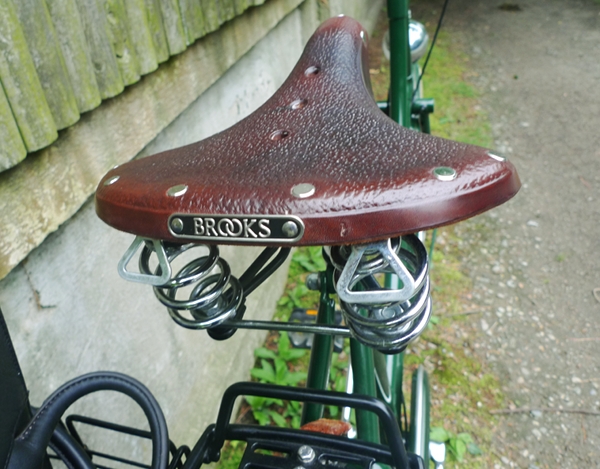
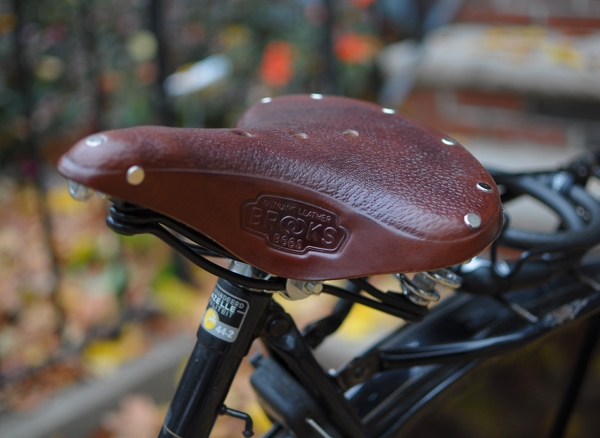
The Brooks saddles most typically fitted on upright bicycles are the B72 and the B66 (the B67 is the same model as the B66, only made for modern seatposts). Having ridden on both, I like each of them very much and cannot say that one is "better" than the other. For me it depends on the bicycle - or more specifically, on my experience of the bicycle.
I had a brown Brooks B66 S ("S" indicates the shorter, women's version) on my previously-owned Pashley Princess, which I rode for over a year. And I recently bought the same saddle for my vintage Gazelle.
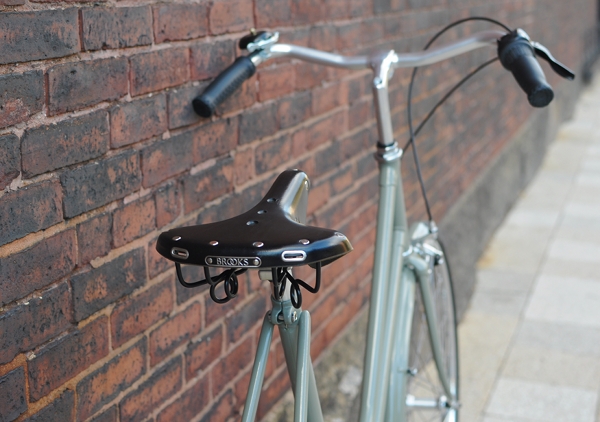
I have Brooks B72 saddles on two of my current bicycles: a brown one on my Royal H. mixte, and a black one on my Bella Ciao 3-speed. (I have also owned several vintage B72s, but will leave those out of this discussion).
To get a good sense of the differences in dimensions, I've compiled the specs from Brooks into a single chart. You can see that the B72 is very slightly wider than the B66 models (though a 4mm difference is negligible). The B72 is a unisex saddle and does not come in separate male and female versions; its length is in between the male and female B66. The B72 is lighter and has less height to it, because its springs are tighter and smaller than the springs on the B66. Unlike the B66 models, the B72 is available in black and brown only.
In terms of experiencing the saddles, the main differences are the springs, the shape, and the texture. The B66 has large springs that provide quite a bit of suspension. The texture of the saddle's surface is pebbled. And the edges - including the sides and the nose - are rounded. To me, these features make the B66 particularly comfortable on a bolt-upright, heavy city bicycle. The substantial springs provide excellent cushiness when most of my weight rests on the saddle. The pebbled texture keeps me from sliding around. And the rounded edges make it easier to slide off the bicycle when dismounting - which is convenient when making frequent stops in the city. On the other hand, when I try the B66 on sportier bicycles (with lower handlebars and steeper geometry), I find some of these comfort features distracting: The springs are too much and the pebbled texture is annoying when I am always shifting on the saddle.
In comparison to the B66, the B72 seems like a more versatile saddle to me. The B72's springs are tighter and smaller - still providing suspension, but not to the extent that it interferes with a more forward lean. The surface of the B72 is smooth and the edges are squarely tapered - which I find more comfortable for long distance cycling, during which I slide around on the saddle more, but get off the bike less frequently.
While both saddles are great for upright bicycles, for me the B72 works better on the more sporty variety, whereas the B66 works better on the super-relaxed ones. As they say, your mileage may vary. If you have tried both models and have a preference for one over the other, please share your experiences.
Monday, November 8, 2010
Up-lifting Experiences
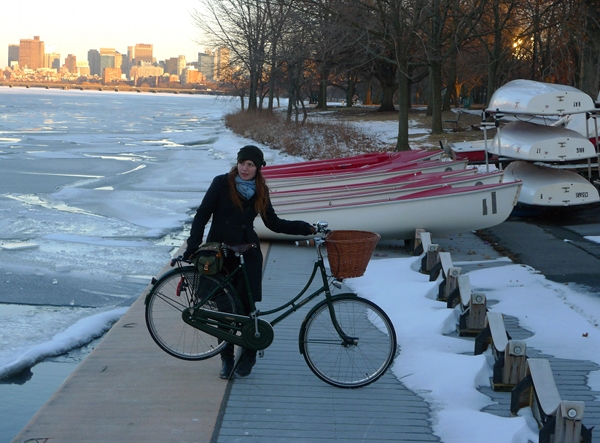
While a diamond-frame bicycle can be easily lifted by the top tube, a step-through frame does not have one - posing the question of how to hold the bike when picking it up. This becomes especially important when the bicycle is on the heavy side and frequently needs to be carried up and down the stairs. In the course of owning a number of loop frames, I have found that different bicycles require different approaches in this regard.
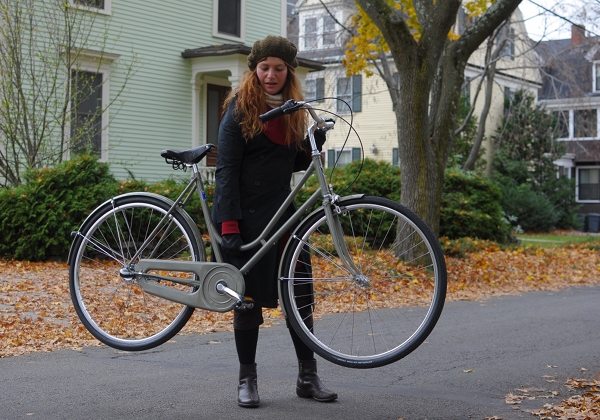
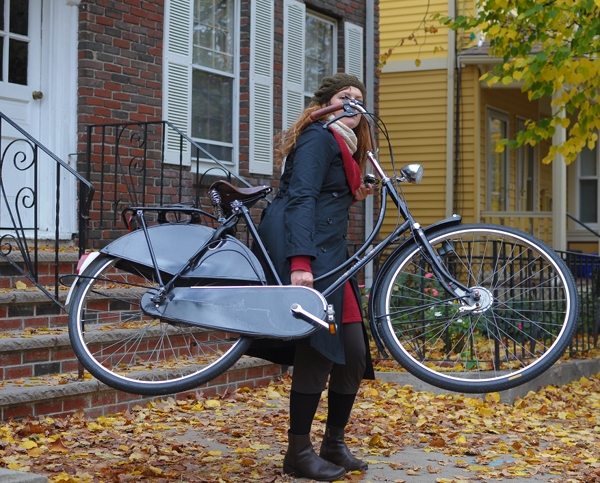
My Bella Ciao bicycle likes to be picked up by the rear portion of the curved top tube. This is such a stable position that I can even carry it with one hand without the bicycle buckling. When held in this manner, I feel that the bike's center of gravity is directly under my hand, which is probably what accounts for the stability of this position. Also, my hand is snugly stuck in that little space between the upward sweep of the curve to one side and the top-downtube connector on the other - an important factor, because this way my hand cannot slip, even if the bicycle is wet from rain.
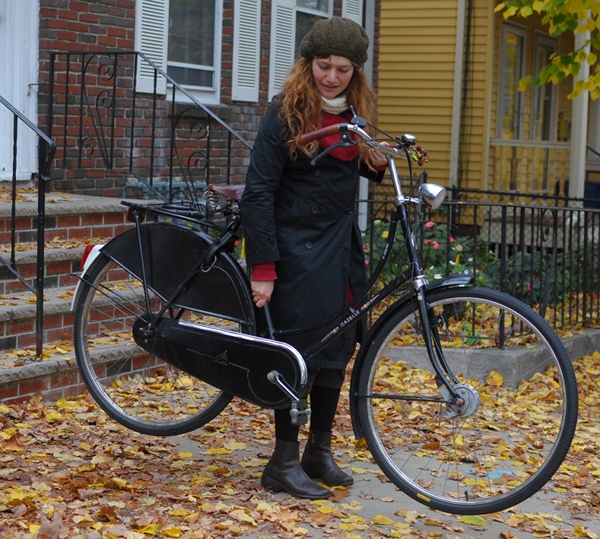
By contrast, this is what happens when I attempt to lift my Gazelle in the same manner. It's not that the bicycle feels too heavy - in fact, lifting it by that loopy spot makes it feel lighter than otherwise. But something is off in the balance, and the Gazelle tries to flip over sideways, onto me, when held in this manner. It feels as if the center of gravity is not under my hand, but somewhere else. With the Pashley Princess I previously owned, this effect was even more pronounced - when lifted by this portion of the frame, the bicycle seemed to twist in my arms and threaten to bring both of us down. On the other hand, the vintage Steyr Waffenrad I rode in Austria was amenable to being picked up by the top tube of its "swan" frame. For reference, my Pashley was somewhere in between the weight of the Gazelle and the Bella Ciao, and the Steyr was as heavy as the Gazelle - so again, it is not merely a matter of weight.
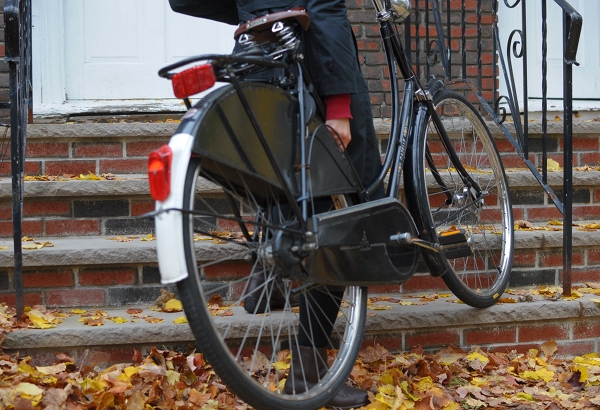
This is how the Gazelle wants to be lifted: by the seat tube. It stays stable and does not buckle when grasped in this position, despite feeling heavier than in the previously shown method. Could it be that for bicycles that prefer this method, the center of gravity is more toward the rear?
To get my bicycles home I must carry them up the porch stairs, through a narrow doorway, and then through another narrow doorway, after turning around in a cramped hallway. That may not seem like a big deal to those who have several flights of stairs to negotiate, but consider that I am a female with limited upper body strength and a bicycle like a Gazelle or a Pashley is half my weight once it's loaded with bags. Getting a good grip on the frame is key if I don't want to drop the bike or, worse, have it fall on top of me. If you own a heavy step-through bicycle, how do you lift it and how do you carry it up the stairs?
Subscribe to:
Posts (Atom)