Showing posts with label social commentary. Show all posts

Thursday, February 3, 2011

Cycling and Statistics

As someone with a background in the social and natural sciences, I was "raised" on statistics by the academic system. If we compare academia to religion, then making claims without statistical evidence is akin to taking the Lord's name in vain. But even beyond academia, we have an inherent faith in statistics as a culture. We respect numbers and charts, and we turn to them for comfort at times of uncertainty. Consider, for instance, this beautiful bar graph:

Now, some of us may have suspected that diamond frames tend to be ridden by men, whereas step-throughs and mixtes tend to be ridden by women, but only numbers and graphs have the power to lift us from the murky waters of speculation. We can now say that, in a recent poll conducted by Lovely Bicycle, of the 221 respondents who claimed to ride mainly diamond frame bikes for transportation, 76% were male. Of the 95 respondents who claimed to ride mainly step-through bikes for transportation, 80% were female. And of the 39 respondents who claimed to ride mainly mixte bikes for transportation, 66% were female. This numerical evidence we can wield like a mighty weapon the next time someone contradicts these tendencies.

Of course the one little problem with Statistics, is that it's mostly BS. In the words of comedian Vic Reeves, "88.2% of Statistics are made up on the spot" - which may very well be the case. But numbers need not be maliciously forged in order to misrepresent reality. There are multitudes of ways in which a study can be flawed or biased from the start, set up so as to elicit particular responses. Often this is done unintentionally, or at least unconsciously, by researchers eager to find evidence for their pet theories. Other scenarios can include how data is processed, or even how the final results are presented. Statistics are highly prone to human error and bias, which means that they are inherently subjective. This, combined with the fact that we respect them so much, makes our statistics-loving culture susceptible to misinformation.

[image via NHTSA]

The idea of statistics and misinformation brings me to what I really wanted to talk about here, and this is something I've been trying to make sense of for a while. I am puzzled by the use of safety statistics in bicycle advocacy, and I am hoping that someone could explain them to me. For example, many bicycle advocacy talks and internet presentations stress that it is safer to ride a bike than it is to travel in a car. In support of this, they use statistics such as this data from the National Highway Traffic Safety Administration (NHTSA), according to which there were about 30,000 motor vehicle traffic fatalities, and about 600 bicycle fatalities in the USA in 2009. These numbers are used by cycling advocates to point out how much safer it is to cycle than to drive. But unless I am missing something, the figures mean just the opposite.

Yes, the NHTSA numbers suggest that in 2009 there were 50 times more motor vehicle fatalities than there were bicycle fatalities in the US. But those numbers mean nothing until they are weighed against how many cars vs bicycles there are on the roads at large. If there were 50 times more cars on the road than bicycles, than the risks of fatal traffic accident would be equal for each mode of transportation. But I believe that in actuality, there are more like 1,000 more cars on the roads than bicycles... which means that the number of cycling fatalities is disproportionately high.

Obviously, I am not trying to prove that cycling is unsafe. But I do want to understand the reality of the situation. After all, if cycling advocates use statistics incorrectly, they open themselves up to some very harsh critique from unfriendly forces. Where could one go to obtain accurate statistics about the number of cars vs bicycles on the roads, and the number of traffic accidents for each?

Tuesday, February 1, 2011

The 'Lady's Bicycle': Descriptive, Offensive, or Merely Obsolete?

[an unsuccessful attempt at parody]

There has been some discussion lately about how appropriate it is to refer to diamond and step-through frame bicycles as men's and ladies' bikes. After all - gender roles are flexible these days, women are no longer expected to wear elaborate skirts, and a low standover height can be convenient for everyone. So why use gender specific terminology? Am I just intentionally being quaint?

Well, not exactly. You see, when a bicycle model exists in both diamond frame and step-through designs, the latter is usually not just about lowering the standover height. It is also about taking the female anatomy into account. For example, have a look at the pictures below and see whether you notice anything interesting.

[image via Gazelle USA]

These are the Oma and Opa versions of the current production Gazelle Toer Populair bicycles. If you look closely, you will notice that the Oma on the left has a considerably higher headtube than the Opa on the right. This is done in order to set the Oma's handlebars higher, so as to accommodate the typically shorter torsos and arms of female cyclists. The bikes are named "Grandma and Grandpa," because they are, in fact, gender-specific. The expanded headtube tactic is used by many manufacturers on their step-through models, while others use the alternative tactic of shortening the virtual top tube. Either way, more often than not the step-through version of a given bicycle model is designed for the female body. This is not to say that men cannot or should not ride step through frames, but only that step-through frames are typically optimised for female proportions.

Of course, one could ask: Why confound gender-based anatomical differences with preferences for standover height? After all, some women may prefer diamond frames, while some men may prefer step-throughs. That is where statistics and market research come in. Most manufacturers cannot afford to make two versions of diamond frames and two versions of step-through frames within the same model. And statistically, women are considerably more likely to wear skirts and are thus more likely to prefer a step-through transportation bike. Therefore, it makes more sense to optimise the step-through design for the female anatomy, while optimising the diamond frame design for the male anatomy. Naturally, there will be some females who prefer the diamond frame and some males who prefer the step-through. Furthermore, not every woman has a short torso and not every man has a long torso. But when it comes to manufacturing decisions, it's all about tendencies and probabilities - not about individuals.

And speaking of statistics, perhaps we could indulge in another poll (a weekly tradition?). No purpose for this other than my own curiosity, and possibly yours:


In my own vocabulary, I use terms like "lady's bike" or "woman's frame" when I am referring specifically to the bicycle's suitability for females - be it anatomically, or in terms of their ability to accommodate skirts. On the other hand, I use terms such as "step through," "loop frame," "mixte," and "shortened top tube," when I am describing frame geometry. And while some worry that referring to bicycles as "women's bikes" makes them seem inferior or less valuable, I am not on board with that line of thinking. After all, what is considered "standard" frame geometry in the industry, is in fact optimised for the male anatomy. We are female, we are wonderful, and we need bicycles designed for us. To me, that is neither offensive nor obsolete - it's just common sense.

Monday, January 31, 2011

Comments, Arguments, Bicycles...

[image via Chris 531]

Over the past couple of weeks, I've spent considerably more time moderaring comments than usual. For the most part, it's been a handful of readers getting overzealous in their debates with one another. But when hostility enters a discussion, others get sucked into it as well. All I know is: I don't want to be the Jerry Springer of bicycle blogs. I would rather have fewer comments, but retain the atmosphere of comradery that has been characteristic here thus far.

I have wondered whether discussions about bicycles are somehow more prone to conflict than other topics. Readers often tell me that they are uncomfortable commenting on various online bicycle forums and blogs, because they find the atmosphere hostile. And I understand that: I myself have a difficult time communicating on bikeforums, despite it being such a valuable resource for technical information. I also can no longer read the comments on Yehuda Moon, because of all the bickering between readers there. It is well documented that there exist genuine differences between what kind of interactions people find enjoyable: Some prefer for everything to be in the style of a debate, with technical inaccuracies in the wording of others victoriously exposed. Others favour a more nurturing, open form of communication. My own preference is somewhere in between: I like a good debate and I am fine with being challenged, as long as the underlying mood feels friendly.

[images via Schwar]

Sometimes I think that we'd all be nicer over the internet, if we just imagined all the unknown others out there as kittens. Kittens, who love bicycles - at times feisty, but ultimately sweet and fluffy, pedaling happily through the fragrant meadows. Do you really want to hurt their feelings?

But for those who can't deal with the kitten metaphor and prefer specifics, I will be more direct: I think that it is a matter of common sense to refrain from mocking or deriding others' points of view in the comments. It's not that everyone has to agree, but sometimes there are nicer ways to disagree. In the same vein, consider refraining from statements that, while technically speaking may be phrased politely, you know in your heart of hearts are inflammatory (for example: "No offense meant, but riding a blue bicycle lowers your IQ and transmits STDs"). Finally, allow me to suggest that it is best to avoid making speculative, or misleading statements about individuals or entities that can be considered slanderous (for example: "I heard that Lovely Bicycle is written in the Far East, using child labor and toxic inks"). I trust that most people understand the difference between comments that are "in good faith" and "not in good faith."

Meaningful reader feedback has been a defining element of "Lovely Bicycle" from the start, and it makes me happy to be the hostess of such thoughtful, interesting discussions. As one reader recently suggested, my posts are collaborative: I offer my views, and others offer their views in return. It's a constructive exchange, which I think works nicely. Please help me keep it that way. And think of the cycling kittens.

Tuesday, January 18, 2011

Showing Off or Showing How? On Bicycle Blog Exhibitionism

I've been having a discussion with a reader about "the exhibitionist culture of bicycle blogs" and more specifically, about "those girly bike blogs" that, in his view, are the most exhibitionist of all. This is a theme that keeps coming up now and again, and so I would like to say a few words on the subject. Certainly there are elements of exhibitionism to photographing yourself regularly and then posting those pictures on a publicly viewable website. My intent is not to debate this. But consider the possibility, that this element is not the main point.

Human beings tend to learn by doing - or at least by watching someone else demonstrating the doing, which automatically causes the viewer to imagine themselves in the doer's place. Pictures that show a real person - ideally the author of whatever narrative is being presented - performing the behaviour described in the narrative, are more engaging to viewers. In other words, a photo of me cycling through the park, followed by the text "and then I cycled through the park" will make the reader "feel" the experience more poignantly than a photo of the park alone followed by the identical text. This has been demonstrated countless times - mainly within the genre of empathy, motor mimicry, and emotional contagion research - and it is why instructional videos most typically have a human narrator who acts out the instructions.

Even in the absence of visual cues, first person narrative in itself is more engaging to readers than other forms of narrative. That is why fictional stories told in the first person, or personal accounts of events, are more interesting and memorable for most people than scientific writing.

As a graduate student, I once devised an experiment where participants were given sentences to read that contained identical information, but were phrased either in the first person ("I placed the shoe in the bedroom"), in the third person ("She placed the shoe in the bedroom"), or in the passive voice ("The shoe was placed in the bedroom"). When asked questions about the information later ("Where is the shoe?"), participants recalled it best when that information had been embedded in first person sentences.  An interesting side-effect of this, was that people also tended to give more elaborate answers about the first person sentences, frequently adding extra information. For example: "The shoe is in the bedroom, on the rug by the dresser." To me, this means that the first person voice encouraged the reader to use their imagination more, essentially re-enacting the sentence in their mind and picturing themselves taking the shoe to the bedroom. Where would they have put it? Apparently on the rug, by the dresser.

It does not take a huge mental leap to see how this relates to bicycle blogs. By telling personal stories and by posting pictures of themselves engaged in the activities they write about, the so-called "girly bike blogs" make the cycling experience more poignant and memorable to a world wide web audience (especially if the members of this audience are not already bike enthusiasts) than dry, technical blogs ever can. While I seldom post diary-style entries where I discuss what I did that day, what I wore, what I had for lunch, etc., I enjoy other blogs written in that format very much and I find them helpful. Blogs like that do not only introduce ideas as mere concepts: They enable viewers to imagine integrating those ideas into their own lives. To call it gratuitous exhibitionism is to grossly undervalue their impact on audiences.

When it comes to females in particular, there are layers upon layers of self-consciousness about how we are perceived by others - formed by too many social, historical and evolutionary factors to mention here. But... so what? Depicting yourself as an actor - rather than a passive narrator armed with academic phraseology - is a means of connecting with an audience that is emotional and visceral. That might make it disconcerting to some, but it also makes it effective, as it taps into the most basic mechanisms underlying the human desire to communicate and learn. Sure, on some level, it may be showing off. But more significantly, it is showing how.

Tuesday, December 28, 2010

Get in the Bunker, It's Snowing Out! Our Relationship with 'The Elements'

The blizzard that has swept over the East Coast in the past couple of days has left everyone stunned. After Boston received over a foot of snow within a 24-hour period and another half a foot the next day, life came to a halt. The street plows were quickly overwhelmed, a snow emergency was declared, public transportation ceased, and drivers were asked to stay off the roads. What had been a perfectly functional city only a day earlier quickly turned into a desolate snow-covered landscape. Our Cambridge/Somerville neighbourhood in particular resembled a Siberian village by Sunday evening, with only the rooftops and the tips of pine trees peaking out under a thick blanket of white, as the darkened sky continued to dump more powder onto the abandoned streets. 

Our family phoned to ask how we were coping. Did we have enough food and was our heating working? I had to giggle at the imagery of being trapped in our home, eating canned food next to a space heater. After all, I had just returned from a mile-long trek to the grocery store, somehow managing not to perish in the process. I sympathise deeply with those whose travel plans were derailed because of the storm, and even more so with those who are stuck in airports. But I am surprised by the mass panic and the "hide in the bunker" sentiment of those who are merely staying at home in the city. We are not being bombed. The snow is not radioactive or poisonous (well, at least not significantly so). We can conquer it by... walking! and by wearing really warm clothing!

It seems to me that at least part of the problem, is that "dressing for the weather" has become a novel concept for so many people after years of driving. Despite living in a cold climate, a number of my friends simply do not own warm clothing. A thick wool coat and proper winter boots are not necessary for getting in and out of the car and walking across a parking lot, so why spend money on them? It makes sense, given an automobile-reliant lifestyle. But as soon as the car is unavailable or non-functional, you are trapped - and that is a horrible feeling for those who like to be independent.

I do not subscribe to the "you're not made of sugar and won't melt " line of thought: We can get sick if we go out in bad weather dressed inappropriately. But dressing appropriately is not difficult, and can vastly improve our relationship with nature. Remember the fun of "snow days"? A walk to the grocery store during a blizzard can be just as nice. There are parts of the world where this weather is normal and not a "snow emergency" at all. I have lived in such areas and found my winters to be more enjoyably spent there. But in Southern New England, the winter months are treated as something one just needs to tolerate until they are over - which, to me at least, is rather sad. While I miss cycling on the days the roads are impassable, I don't want to contribute to that mentality. I love snow, and I love the magic of winter. And I did see a mountain biker on my way to the grocery store! The streets were abandoned except for me, him, and the occasional snowplow. We waved to each other across the vast expanse of white and silver, each encouraged by the other's presence.

Wednesday, December 15, 2010

User Friendly Interface

Now that it's winter, I find that strangers talk to me more than usual about cycling - typically when they see me locking up my bike. Over the past couple of weeks, several women have told me that they'd love to ride a bike, but find the logistics daunting: having to buy lights and figure out how to mount them; constantly getting flats (something they remember from previous cycling experiences); having to figure out how to carry their handbag, struggling to mount the bike in business attire, and other similar concerns. Their misgivings are fueled by the perception that cycling will complicate their lives - compared to walking, or taking public transportation, or driving.

What frustrates me about this, is that all of their concerns can be addressed with the right bike. As I explain about step-through frames, dynamo lighting, tires with puncture-protection, dress guards, chain cases, and panniers that attach to the bicycle's rack in seconds, I can see the ladies' faces light up as they eye these features hungrily.

One woman tried to step through my frame in her skirt-suit and squealed with delight when she was able to do it. She had never tried anything other than a mountainbike before. She said: "I knew you had a special type of bike! It's got this... user-friendly interface!" That phrase echoed in my mind for some time.

Even though I enjoy learning about bicycle design and own multiple bikes on which I constantly experiment, I am first and foremost a "transportation cyclist." My main priority is to have that one bike that is reliable, comfortable, and as low-maintenance as possible. The bicycle I use for transportation needs to make life easy for me. It needs to minimise the extent to which I think about it and tinker with it - so that I can focus on work and life itself, not on the bicycle.  Skirt suit? Heavy bag?  Dark outside? Raining like crazy? The "user friendly interface" on my machine accommodates all of these scenarios.

Many manufacturers are making what they are calling "transportation bicycles" nowadays, but not all of these bikes work for everyone. When a woman wearing a skirt suit walks into a bike store and says she would like to start cycling to work, my hope is that the salesperson will point to the section with the right kind of bicycle for her - rather than saying "Well, you won't be able to do it wearing that!" A user-friendly interface means that we should all be able to do it. Holiday wish: more elegant, practical, comfortable bicycle options for the women in skirt-suits who feel out of place in bike shops. It's getting better, but we aren't there yet.

Tuesday, November 30, 2010

What Our Hands Can Do

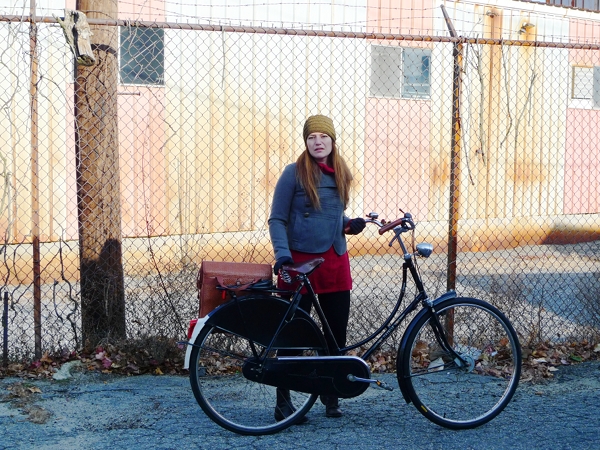
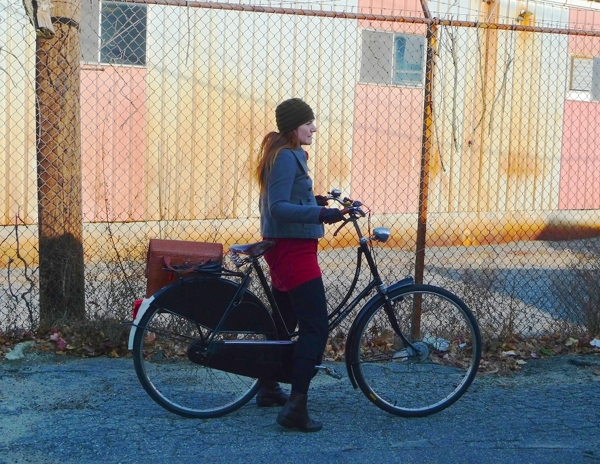
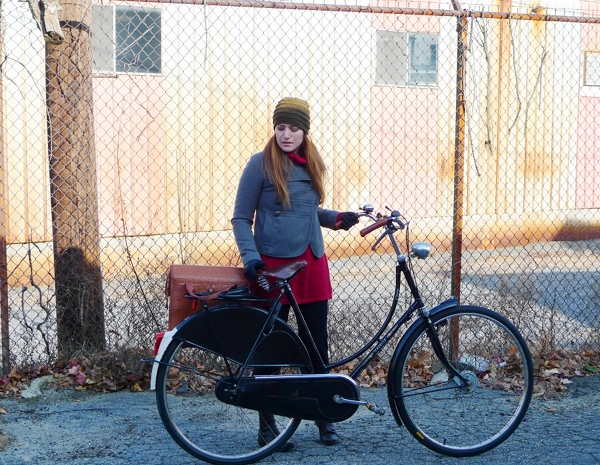
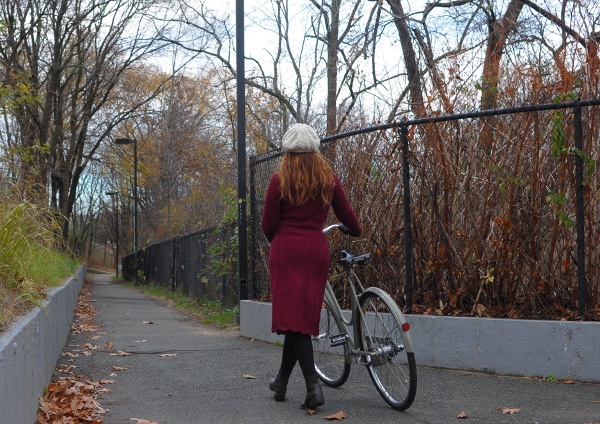
Looking over these photos from the Friday after Thanksgiving, I noticed something interesting: Almost everything pictured here is hand-made. The dress I am wearing was made by my mother. The hat and scarf were made by me. Even the bicycle was hand-made by an Italian frame builder for Bella Ciao. This combination was not intentional, but once I noticed it, I found it striking. 

My mother knitted this elaborate wool dress for herself in the early 1980s and wore it all through her 20s and 30s, after which point she gave it to me. The dress suited her much better, but that has not stopped me from wearing it since I were a teenager. It only occurred to me recently how remarkable it is for a dress like this to survive being worn for three decades by two different women - neither of whom are at all gentle with their clothing. And yet here it is, still looking fresh and current. The tailoring, the textural variation, and the attention to detail are incredible by today's standards - and my mother made tons of this stuff when I was a child, while being a busy career woman, too. (I remember seeing her knit while speaking on the phone and reading a book about mathematics at the same time... )

While my own attempts at knitting are fairly pedestrian compared to my mother's past projects, they do have one feature in common: longevity. I knitted this scarf back in grad school, and 8 years later it remains alive and well, while countless store-bought ones have since fallen apart. My friends, for whom I've made clothing as far back as high school, give me the same feedback - some of them still wear the things I made in the mid-'90s. Noticing this was a big reason why I started to knit and sew again this year: I am not that great at it, but the stuff I make lasts and fits me better than store-bought.

Over this past year I have done something a little nuts: I've sold or given away most of my clothing - stuff that I had collected and saved for more than 10 years. When I was younger, I was into edgy fashion and quirky designers, but lately that interest has all but faded - replaced by a curiosity regarding how far I can go making things on my own. Aside from knitting, I have been cutting up some of my remaining old clothing and handsewing "new" clothes out of it. Hopefully I will get a sewing machine for the holidays, which will allow me to take things further. In the past I have dabbled in making my own fountain pens as well. And eventually - maybe, just maybe, I would like to try my hand at building bicycle frames - or at least designing them à la Grant Petersen.

While my framebuilding days are not yet on the horizon, I do have enormous respect for bicycles hand-made by others, and an insatiable curiosity about the process. Whether independent framebuilders such as JP Weigle, Peter Mooney, Royal H. and ANT, or small manufacturers such as Mercian, Rivendell, Velo Orange and even Pashley and Bella Ciao - I am impressed by the sheer amount of work and consideration it takes to get the design, the construction, and the finishing just right. The more I learn about the process, the more overwhelming it seems. In a world of homogenous, mass-produced goods, it is amazing to witness what our minds and our hands are capable of creating.

Thursday, November 25, 2010

Fade to Black


For as long as I can remember, the idea of Black Friday has sort of frightened me. The name sounds so dark and sinister - like a day of mourning rather than a day of shopping. And the reports in recent years of shoppers getting crushed to death in stampedes have only strengthened that association. The possibility of someone wanting to save money on something so badly, that they are willing to wake up at 4 am, stand in line waiting for a store's doors to open, and then... walk over bodies in a rush to get to it, is upsetting. What can inspire that kind of drive for acquisition? - a laptop? a beautiful dress? a bicycle? Or just the very notion that "stuff is on sale today" and that "the thing to do is to go out and get those deals"?  Year after year, I find myself recoiling from those messages - not so much in protest against consumerism, as in protest against being expected to blindly follow those crude marketing tactics.

[image via radlmax]

I want to be free to do as I like with my holiday weekend, and I don't want to be controlled by a vague, socially-induced fear of missing out on a bargain. I will buy the stuff I need when I need it. "Black Friday" can fade to black; I am off to enjoy my day!

Wednesday, November 10, 2010

Reaching a Non-Cycling Audience

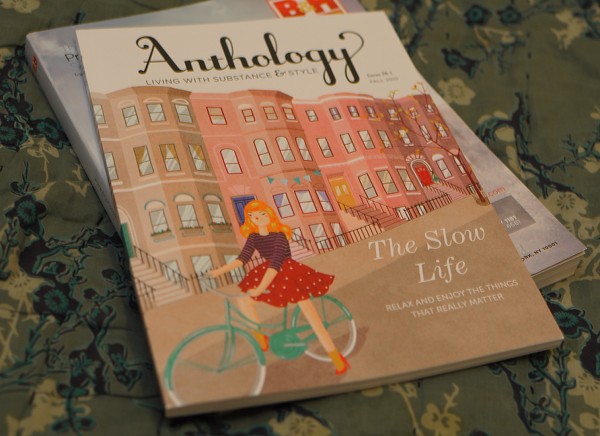
I received a copy of the first issue of Anthology magazine in the mail today - sent to me, because they ran a feature on Lovely Bicycle. I knew they'd made some illustrations based on my photos, but I did not expect to see a cartoon version of myself and the Pashley Princess (depicted complete with cream tires!) cycling through a cartoon version of Boston. Funny! Unlike the real me, my cartoon self likes to cycle in high heels - so perhaps she can teach me a thing or two!

The story they ran included an edited version of my "Bicycles for Everyday Cycling" page, which I hope will be helpful to readers of the magazine who are considering purchasing their first bike.

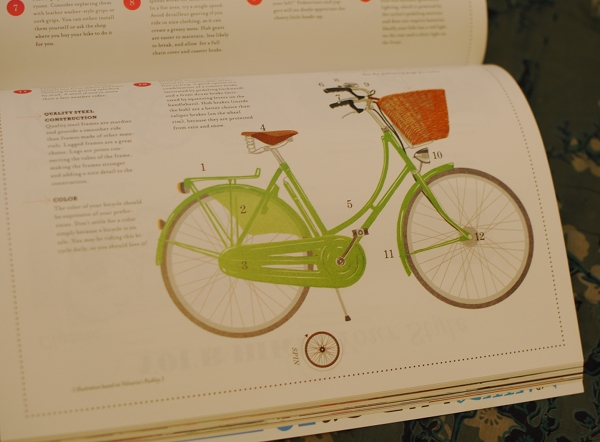
I think it's neat that Anthology presented the information as an "anatomy lesson" and made its own hand-drawn illustrations (by Kris Atomic). This makes the text a lot more engaging than my original version (I read it with interest!) - and achieving that is important for print publications trying to compete with online media. I can imagine somebody who is not into cycling at all picking up this magazine in their local coffee shop or book store and getting drawn into the article, becoming curious about bicycles as a result.

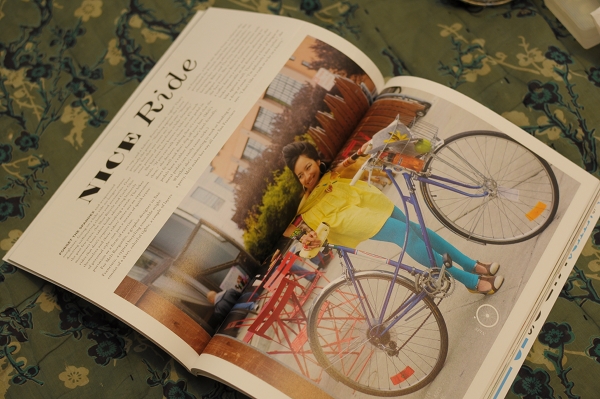
In addition to the "Anatomy of a Lovely Bike" article, there was also a beautiful feature on Meligrosa of Bikes and the City with her cool mixte, as well as a helpful piece on shopping for bicycles and accessories.

One reason I am pleased to be featured in Anthology, is because they are not a cycling publication, but a more general lifestyle magazine. Before I began Lovely Bicycle, there was a period of a year or so when I vaguely wanted  a bike but did not know how to even begin looking for one that was right for me. There was a disconnect between the sort of bicycle I wanted and what was available in most bike shops at the time, and I simply did not know where else to get information. A series of bike-related articles like the ones Anthology published would have helped me, and I hope that they can now help others. Besides, I just love the idea of things like dress guards, chain cases and "lugged steel construction" being presented as standard features. I hope that women walk into bike shops and ask for them, as casually and matter-of-factly as they would ask for cake in a bakery.

Monday, October 25, 2010

The Bicycle, and on Building (and Protecting) Your World

For myself and a number of my acquaintances, the desire to get a bicycle corresponded with experiencing what I can only describe as an early midlife crisis. Early, because it hit us some time in our late 20s. And crisis, because it was marked by a devastating discrepancy between what we were achieving in our lives at the time (impressive things, by society's standards) and the absolute lack of personal fulfilment derived from those achievements. Somehow, we were living in a way that did not make us happy, spending money on things we did not enjoy, and advancing along career paths we no longer believed in - yet saw no way of escaping after having dedicated huge portions of our no-longer-that-young lives to the education that led to those careers.

How does the bicycle tie into this?... I cannot yet verbalise it as eloquently as I would like, but I know for certain that it does. Maybe disentangling myself from one aspect of societal expectations and life's inertia made me realise that it was generally possible. Prior to getting a bicycle, I had made some radical changes in my life, and have continued to make others since. Those changes have made me considerably worse off financially, but the quality of my life improved. And most importantly, I feel that I have re-claimed my intellect and creativity, which I now understand was necessary for my sense of personal integrity.

When I ride a bicycle, I experience a heightened awareness of the extent to which we are the architects of our own worlds. Things don't just happen to us, as we like to think when feeling helpless about our situations. Whether we realise it or not, we orchestrate our daily experiences through a complex web of choices and decisions we make - which includes the choice to be passive and let our circumstances, or other people around us, shape our world for us. To live the life we want to live, we must actively build and protect it - not violently or smugly, but committedly and persistently, even if others don't understand us or criticise our choices. For me, this is an important parallel between cycling and life in general.

Tuesday, October 19, 2010

Functionality, Comfort, Aesthetics

A couple of my recent posts have generated some engaging commentary on "form vs function" and the validity of aesthetic preoccupations in cycling. I put the phrase "form vs function" in quotation marks, because I do not view it as a dichotomy that needs to be resolved. For me, the two concepts are in a symbiotic relationship, whereby one enhances the other and is incomplete without the other. I readily acknowledge my interest in aesthetics. But I stop well short of putting aesthetic factors before practical ones, which I hope comes across clearly throughout Lovely Bicycle. 

There are three basic qualities that matter to me in a bicycle, and these qualities are functionality, comfort, and aesthetics. All three are essential for me, and I could not love a bicycle if either were lacking.

To me, functionality means that a bicycle must be good at what it was designed to do. For instance, a racing bicycle is designed with the goal of winning races. It therefore must possess qualities such as the ability to gain speed quickly and extreme maneuverability. Anything in the design of a racing bicycle that detracts from its ability to win races is a functional flaw. By the same token, an urban transport bicycle is designed to serve as a viable means of transportation for the city dweller. It therefore must possess features that enable the cyclist to comfortably and conveniently travel in everyday clothing, to observe their surroundings, to securely transport their bags and packages, and to travel in the dark. Anything in the design of an urban transport bicycle that detracts from this is a functional flaw.

Because functionality is a factor of individual needs, it is subject to great variability. Just as there are different types of bicycle racers, so are there different types of urban commuters. A diplomat who wears crisp skirt-suits and freshly-polished shoes to work and has a 2-mile commute will likely require different features from a transport bike than a  computer programmer who wears jeans, sweaters and sneakers and has a 12-mile commute. A bicycle's functionality can only be evaluated in the context of its intended use.

And of course, regardless of what kind of cycling a bicycle was designed for, functionality means that everything should be working properly: structurally sound frame, proper assembly, and quality components.

The notion of comfort is equally important, and equally subjective. We need to be comfortable on a bicycle in order to enjoy riding it, or even to tolerate riding it. The more comfortable we are, the more we ride, and the safer our cycling behaviour. An uncomfortable bicycle can make commuting, touring and even racing a nightmare. There are many, many factors that go into what makes a bicycle comfortable - from the geometry and material of the frame, to the positioning of the saddle and handlebars, to other, more elusive aspects.

Being comfortable on a bicycle involves, first and foremost, being pain-free. In particular, pain in the hands, knees, butt, crotch and neck are the sort one should not be experiencing while cycling, as it can cause injury.

Comfort also means that a cyclist should feel good about their ability to control and handle their bicycle: to mount and dismount, to balance, to pick up speed in the manner they want, to handle turns, to climb hills, to control descents, to make emergency stops, to carry a load, and to cycle through traffic. And while to an extent all of this certainly depends on the cyclist's skill level, it also very much depends on the bicycle. A given cyclist may be comfortable doing these things on one type of bike, but not on another. I am a firm believer in finding a bicycle that both feels good to ride, and matches your skill level and comfort zone, rather than attempting to adapt to a bicycle that does not feel right.

Finally, I believe that the aesthetics of a bicycle are no less crucial in the enjoyment of the overall cycling experience. Put simply, aesthetics is how appealing or attractive we find the bicycle to be. Do we enjoy looking at it? Does it fill us with excitement and pleasure? Do we feel compelled to touch it, to ride it? It is about an emotional response, and it is about individual definitions of beauty.

Though some are more aware of it than others, the aesthetic experience is a natural part of our everyday lives. As we move through our environments and go about our daily activities, we are always looking and always responding with some degree of emotionality - whether it is positive, negative, or some form of confusion. Almost nothing leaves us entirely indifferent, unless we do not notice it. We prefer certain colours over others, certain shapes over others, certain spaces over others, and certain faces over others. Aesthetics are not just for the frivolous or the rich; they are not something you are aware of only when looking at paintings or choosing expensive curtains. All ordinary objects and everyday experiences have aesthetic qualities, and being able to extract these qualities can bring joy and fulfillment to the way we experience life.

Needless to say, what we consider "aesthetically pleasing" is extremely subjective, probably even more so than comfort and functionality. To some extent, it has to do with our inherent sense of harmony, symmetry, and balance, as well as with the associations evoked by the given object. Suffice to say, beauty is in the eye of the beholder.

The importance of functionality, comfort and aesthetics in the cycling experience extends beyond their individual roles; it is the interaction of the three that is crucial. How useful is the functionality of a bicycle that is not comfortable? How useful is the comfort of a bicycle if it is not functional? What good is a beautiful bicycle that is either uncomfortable or non-functional? And how sad it is for a bicycle to be functional and comfortable, but not excite you or make you smile? The most successful bicycle design is one where functionality, comfort, and aesthetics intersect. The graceful sweep of a loop frame is not only visually pleasing, but allows easy step-through. A handle bar bag secured to a randonneur-style front rack is not only handsome, but extremely useful on long trips. Form and function are best enjoyed as a happy couple.

In my posts on Lovely Bicycle, I do not pretend to be "everyman" or the voice of other cyclists.  Far from it! I am a kooky, peculiar person with an unconventional lifestyle and profession, and I am comfortable with that. Neither do I make prescriptive statements about what kinds of bicycles other people should like or should be riding.  Personally, I love bicycles that are functional, comfortable, and beautiful - and that is what I write about. You may relate, or you may not. Life is all about personal preferences.

Thursday, October 7, 2010

Upright Mammals

Upon returning to the city and getting on my Gazelle again, I was surprised by how different the cycling experience felt from being on my Rivendell.

Normally, I ride both bicycles regularly, so the switch back and forth does not feel remarkable. But after having cycled solely on a roadbike for three weeks, I almost felt as if I had to forcefully uncurl my spine as I transformed from a quadruped to a biped.

While we were away, the Co-Habitant teased that I would get accustomed to using a roadbike for transportation and would probably just keep doing it when we got home - after all, it's faster. But it soon became clear that when it comes to upright bicycles, absence made the heart grow fonder. (Now, if I can just stop trying to use the non-existent bar-end shifters on my poor Dutch bike!)

I think that as upright mammals, we are accustomed to seeing the world from the vantage point of bipedalism and we feel the most relaxed when adopting that posture. It is only natural that people prefer to remain upright when moving through their environment - whether on foot, or on bike, or on public transport. While upright bicycles may not be appropriate for sport or long distance travel, their importance in the realm of "normal cycling" cannot be overstated. Most people considering a bicycle for transportation do not see themselves as "cyclists". They want to be their usual selves, except on a bike. I think the ability to remain an upright mammal is crucial to retaining one's inherent sense of self while cycling for transportation. 

Saturday, August 7, 2010

Cycling and Suffering

In my view, the most unfortunate myth about cycling for transportation is that it is difficult. Understandably, this is how non-cyclists often perceive it - due to the overabundance of athletic cyclists and heavily armoured utility cyclists on the roads in comparison to cyclists who look like regular people. But even among the "everyday cyclists",  I feel that there is a tendency to focus on the challenging aspects of riding a bike in a way that takes pride in these challenges and thereby dwells on them: the pain of cycling uphill, the heroics of cycling in cold weather, the battle of cycling in traffic... Come on, be fair! Cycling is fun and convenient, giving us the most independence and flexibility of all other transport options. Compared to the poor drivers stuck in traffic and the users of public transport pushing their ways through overcrowded buses, we coast through life with smiles on our faces.

[image via BostonBiker.org]

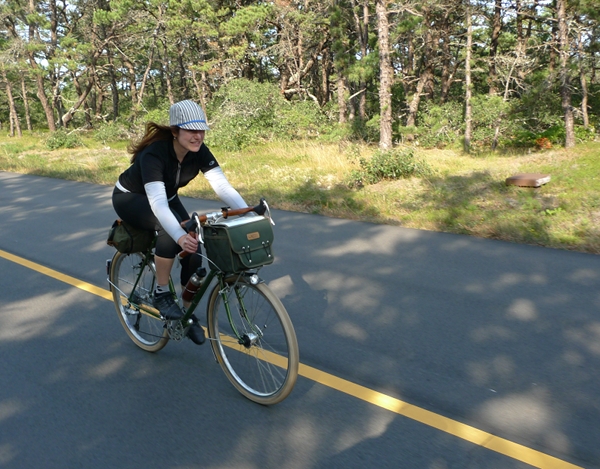
Reading Boston Biker this week, I was reminded of my all time favourite misrepresentation of cycling's "difficulties": Our love of exaggerating the fortitude of cycling in the rain. On cycling blogs, we often read stories that describe a non-cyclist asking a cyclist, "But what do you do when it rains?" and the cyclist replying "I get wet!" After this exchange is retold in the blog post, the author will then muse about how people nowadays are out of touch with the elements, and how ridiculous it is that "the car culture" has taught us to fear getting rained on. This, however, is simply untrue. Car culture did not teach us to dislike getting rained on. Seeking protection from the elements is a natural impulse that has been with us pretty much forever. In non-car-oriented societies people still use umbrellas and hide under awnings. Cave people sought shelter in caves. It is completely normal not to want to get rained on on the way to work or a date, so that we can both arrive in dignity and not come down with the flu the next day.
[image via BostonBiker.org]

Cyclists however, sometimes seem to experience pride from getting soaking wet in the rain, and this pride translates into projecting an intimidating image to those who do not ride a bike. The non-cyclist is given to understand, that in order to embrace cycling they must accept the idea that getting wet is "normal" rather than something to be avoided... In other words, to accept an idea that goes against people's natural instincts since the dawn of civilization.

I don't know about you. But when a non-cyclist asks me what I do when it rains, I reply that I wear a raincoat. When a non-cyclist asks me about hills, I explain that I switch to a lower gear and pedaling gets easy again. And when a non-cyclist asks me whether I am scared of traffic, I point out that it was less scary than driving once I got used to it. And all of these things are true. Why tell them I am suffering, when I am not?

Wednesday, August 4, 2010

Everybody Loves a Lovely Bicycle

Sometimes, between trying to squeeze in 30-mile rides, obsessing about components and taking close-ups for product reviews, I forget the big picture: Beautiful bicycles can lift our spirits.

These two ladies are Isha Ware and Caroline Robinson, from the neighborhood, and they reminded me of why I like bicycles in the first place.
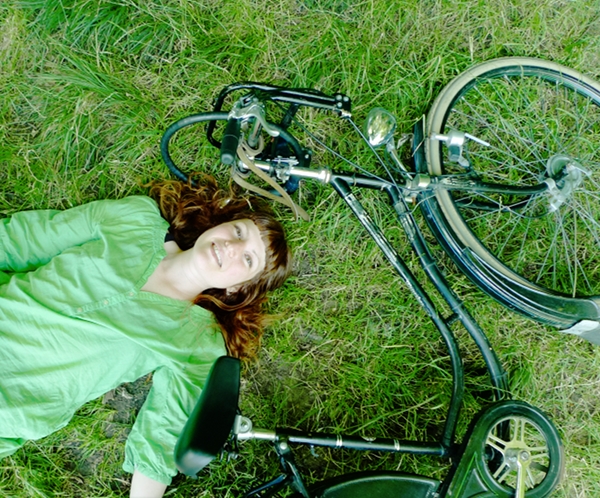
Today I fitted my bike Marianne with a very funky new set of dressguards (from Simeli) and dragged her outside to photograph. On three separate occasions, women walking down the street stopped to ask me about the bicycle. They were clearly happy to see such a bike - eccentric and undeniably "girly", with a colourful "thingie" on the wheel, flowers on the handlebars, and a shiny bell. Isha (pictured above) was wearing an outfit that was the exact same colour as Marianne's frame, and so naturally this had to be documented.

One young woman (not pictured here) told me that she wanted to buy a bicycle, but found bike shops to be male-oriented and intimidating. I remember lots of stories like this from 1-2 years ago, but I thought that things were a lot better now. Apparently they are not completely better; at least not yet. One of my main goals for Lovely Bicycle, is that ladies who have been disappointed or intimidated by bike shops can find the information they are looking for here.

A nice bicycle can make even people who are not into bicycles at all - just people who are passing by - smile and want to pet it. The very form of a nicely designed bicycle is welcoming; the texture of its components inviting. Maybe it's a "woman thing". Or maybe it's universal. But it sure is nice. Lovely bicycles for all!

Friday, July 30, 2010

Excess in the Bicycle Industry: Explanations and Implications

[Aurumania crystal and gold track bike, image via forbes.com]

A couple of weeks ago, Forbes published an article on "The World's Most Expensive Bikes".  Readers have been sending me links to this article asking what I think, until finally I gave in and read it. 

[Golden Brompton, image via forbes.com]

Glancing over the pictures, I noticed a strong trend for gold plating, crystals and diamonds - the usual when it comes to "luxury bikes". It made me wonder how much of these bicycles' price was due to ride quality (can they even be ridden?) and how much was due to the decorative elements. 

[KGS custom Parlee bicycle, image via forbes.com]

I was also surprised to see that I actually know someone whose bicycle is on the Forbes list (not my cup of tea, this bike, but I understand that some people like to race on such things).  Kevin Saunders of KGS Bikes is an acquaintance (now also a sponsor, but initially an acquaintance) and the proprietor of a custom bicycle shop in San Antonio, Texas specialising in roadbikes that promise the "perfect fit." While admittedly high end, I did not think that most KGS bikes fetched the kinds of prices featured in Forbes. So I asked Kevin about it. His answers were pretty straightforward, and I include them here in response to this discussion on Chic Cyclist (see the comments section):
Velouria: Kevin, how do you justify your $32,000 bicycle that was featured on the Forbes list?
Kevin Saunders: The bicycles in that price range that we have created were commissioned as one-offs. (They were also done prior to the Recession that started in 2008.) A price of around $18.000-20,000 is where we find the line between premium (where more expensive components actually perform better) and luxury (where more expensive components may have a special finish or paint job but do not actually perform better). 
V: So special paint can cost over $10,000?...
KS: Yes. Some fringe exotic components and one of a kind paint jobs (that includes not only the frame but all the components as well) can mean the difference between a $22,000 and a $32,000 bike. Our price for this is based on actual cost plus a reasonable markup.
V: And performance-wise, would a client even notice the ride quality difference between, say, a $10,000 bike, a $20,000 bike, and a $32,000 KGS bike?
KS: Performance wise, the difference between a $10,000 and a $20,000 bike is significant. There is almost no performance improvement to get to the next level (up to $32,000 or more). The only value above the $22,000 price point  is artistic.
So, if I understand this correctly, even if you try to build a top of the line bicycle for competitive road cycling with full custom geometry and the highest performance available, the price will top out at $22,000. Anything beyond that will be mainly decorative. Keeping this in mind, consider that some of the bicycles on the Forbes list are priced at over $100,000. 

[Montante gold-plated bike, image via forbes.com]

So what are the implications of such bicycles existing?  The "designer bicycle" not only goes beyond the typical prices of custom builders, but specifically presents itself as a luxury good - incorporating costly decorative materials and accessories from haute couture houses. The "Fendi Abici Bike" I wrote about last year is one such example. There have also been similar products from Hermes and Chanel. Based on the feedback I have read about such bikes so far, cyclists in the blogging universe tend to be critical of excess in the bicycle industry. And this applies to accessories as much as to the bicycles themselves: When ecovelo wrote about a Brompton leather briefcase that retails for $600, some readers questioned that such an expensive bicycle accessory was allowed to exist.

[Formigli track bike, image via KGS Bikes]

My view however, is that the trend for "luxury bicycles" is great. Bring on the gold-plated framesets, the diamond-encrusted derailleurs, and the haute couture panniers! Even though I would not buy any of it, I am glad it is there. The trend for cycling-related luxury goods is a positive one, because it successfully combats that stereotype we all know: The stereotype of cycling being something people do because they either cannot afford a car, or are part of some weird fringe subculture. Rather than making people feel guilty about materialism - which is after all, a basic trait of human nature - this trend takes advantage of materialism to make bicycles appealing for people who otherwise would not have been drawn to them. Think about that the next time you curse that luxury car cutting into the bicycle lane. Wouldn't you rather they were riding a luxury bicycle?