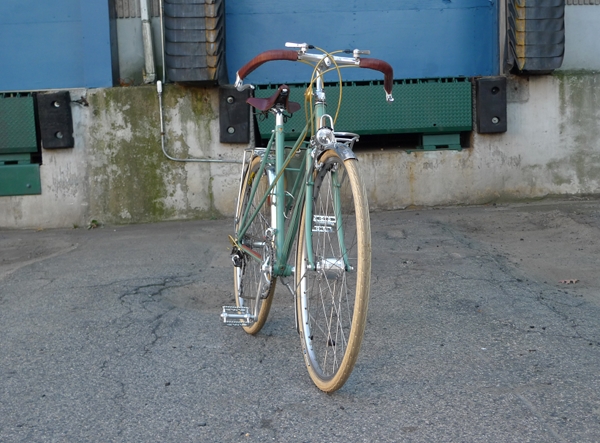
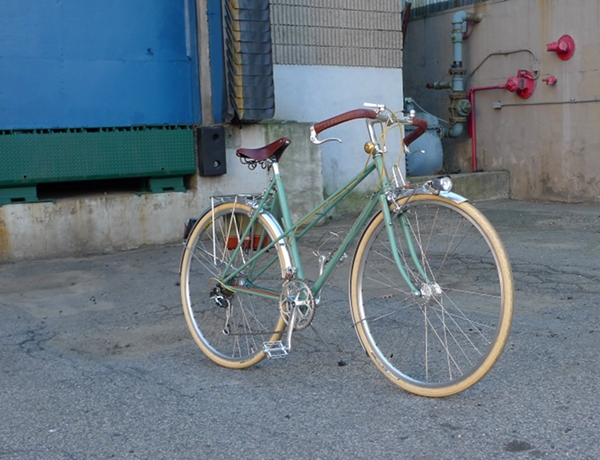
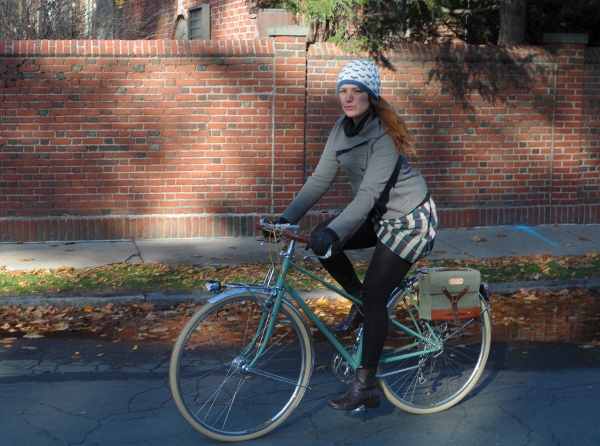
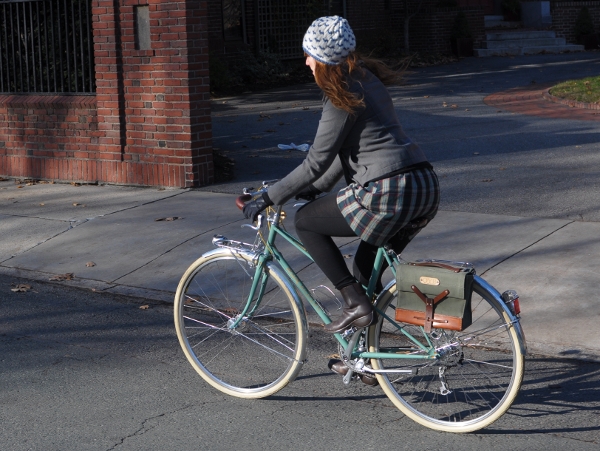
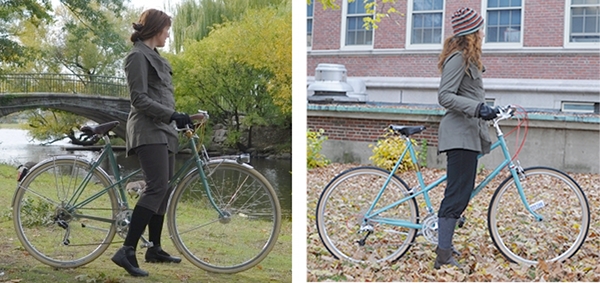
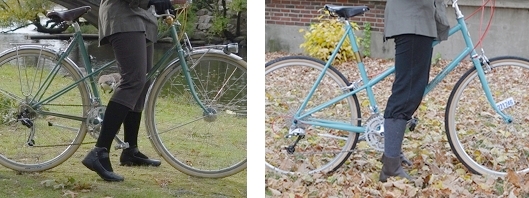
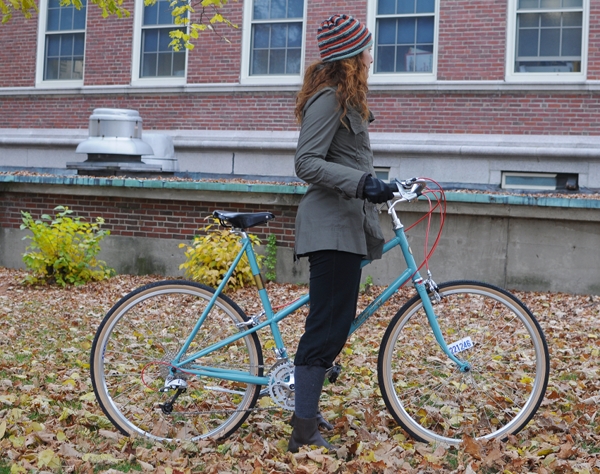
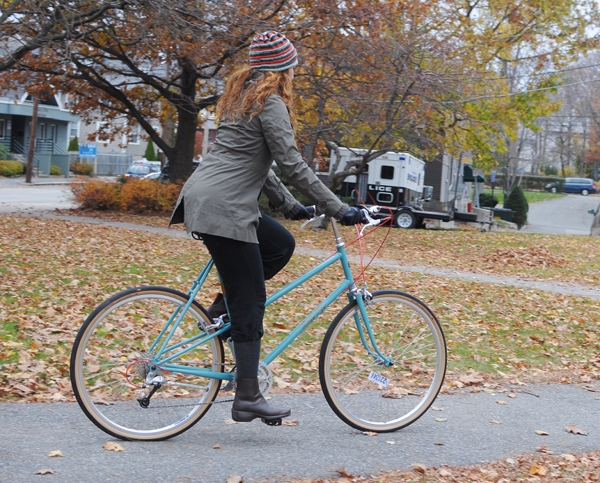
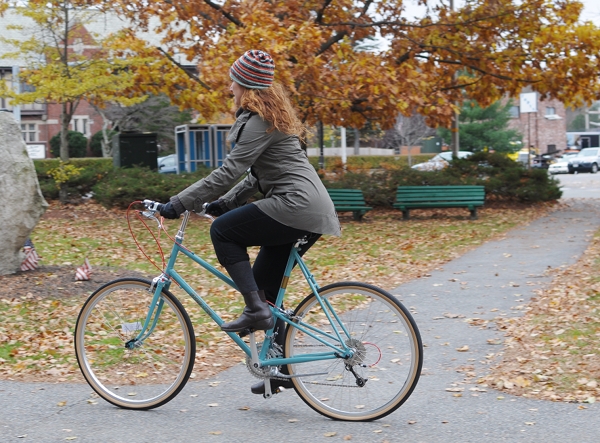
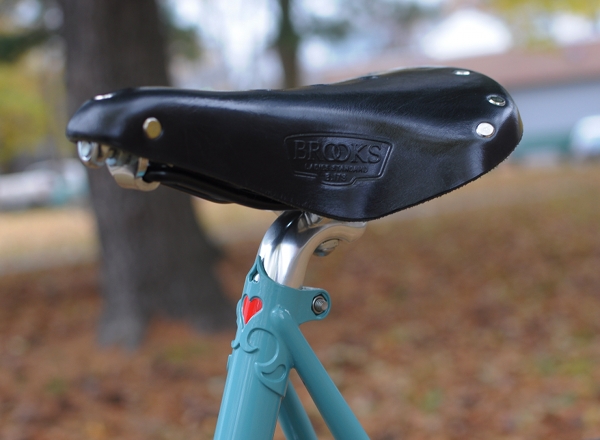
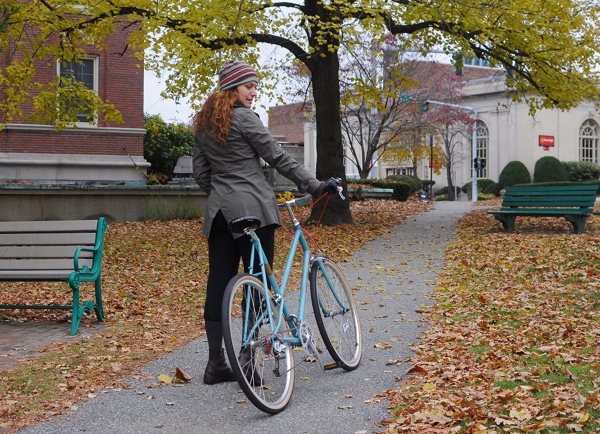
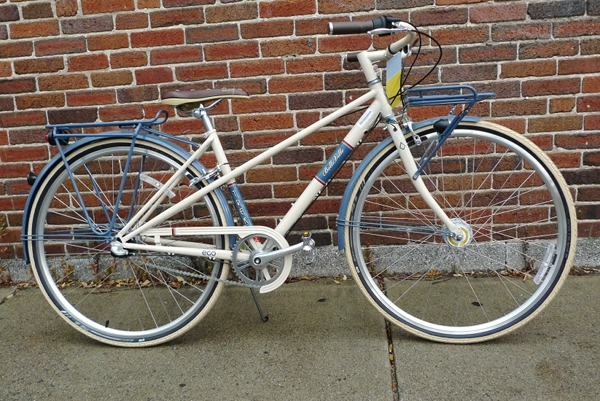
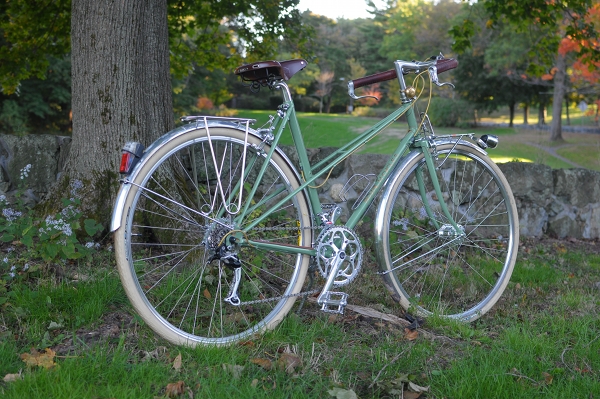
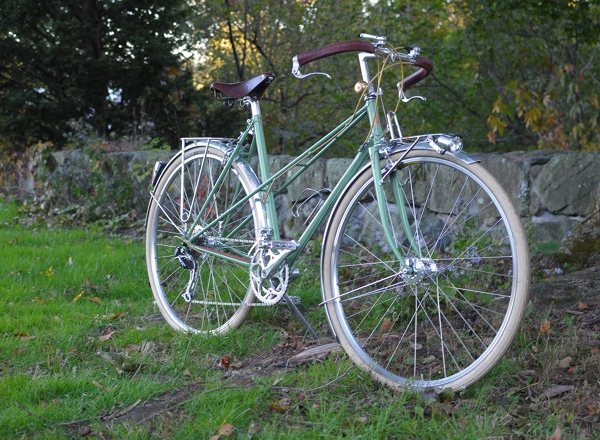
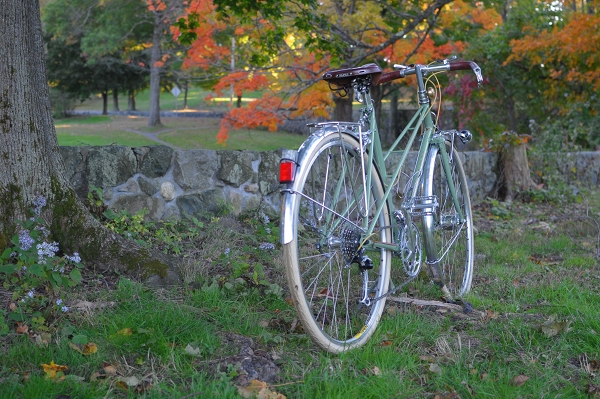
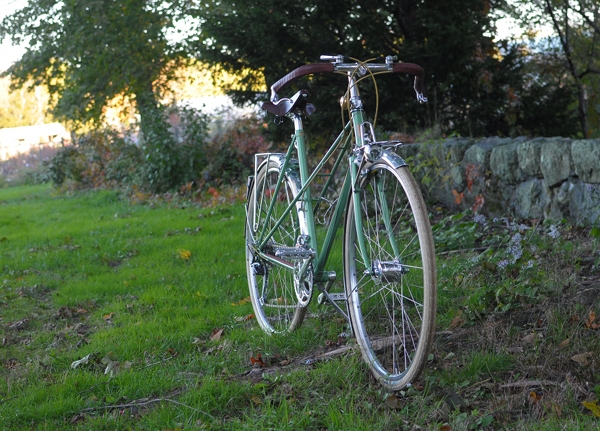
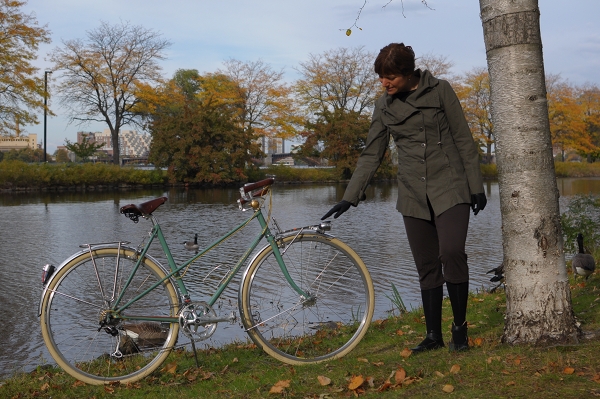
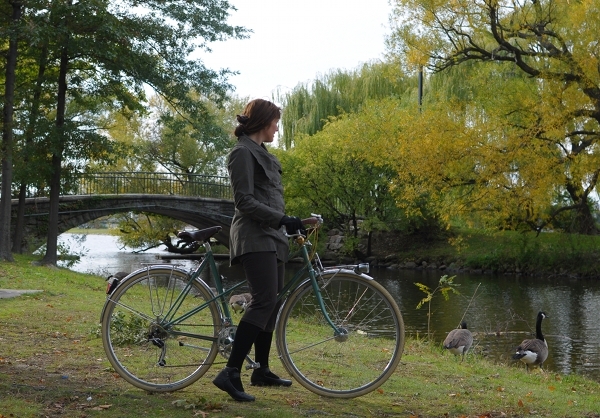
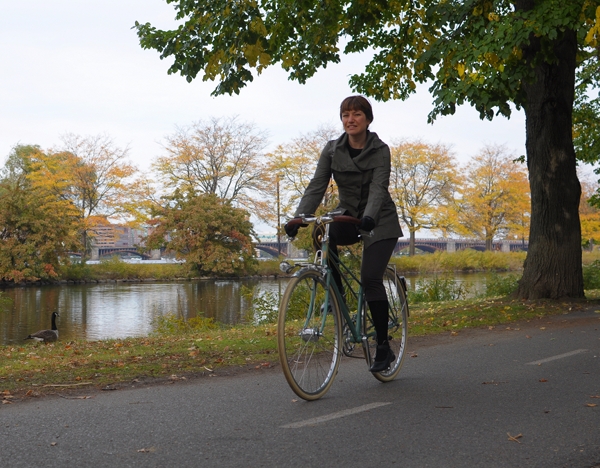
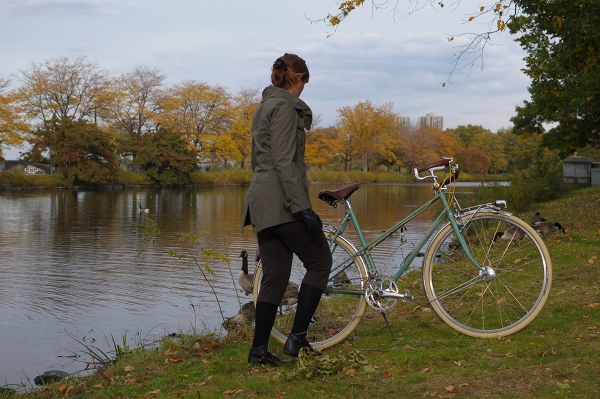
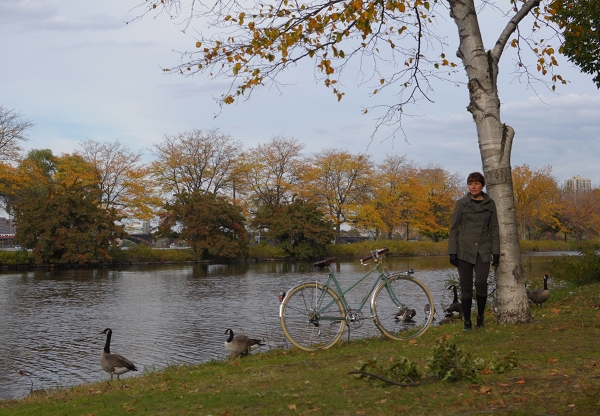
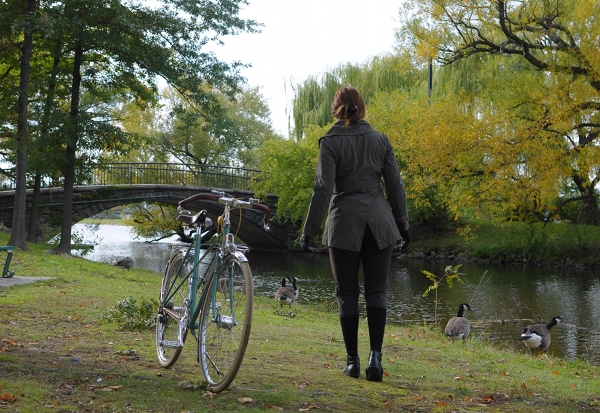
Alternating between the Royal H mixte and the Gazelle for transportation over the past few months, I've realised something funny: I have a minimum weight preference when it comes to commuter bikes. For fast cycling on hilly terrain, I love the feel of a light bike. But when riding for transportation in the city, the mixte is pretty much where I draw the line for how light I'd want my bicycle to be. Does that make me a reverse "weight weenie"?
What I like about commuting on heavier bikes, is that they tend to feel extremely sturdy in traffic. They also seem to have a more solid, commanding presence - useful when mixing it up with cars. I have found that drivers give me more room when I am riding something big and heavy-looking, possibly because they are more worried about damage to their car, should they accidentally clip me. Alternatively, it could be that on a massive bike - combined with an upright posture - I might seem like a more "legitimate" commuter to drivers. Whatever the reasons, I do tend to feel more comfortable and confident on a heavier bike in traffic than on a lighter one.
For me, the most important aspects of ride quality in a city bike are stability, comfort over pot holes and bumps, and the ability to accelerate and slow down while maintaining full control. And heavier bicycles tend to do better in those areas. I am not saying "the heavier the better." But I think it is important to recognise that some of the merits of traditional city bicycles cannot be separated from their traditional heftiness.
The nice thing about my mixte, is that it can go from being laden with bags for commuting, to being light and ready for a fast ride, in a matter of seconds. And, unlike most other light bikes I've ridden, this one is comfortable over bumps - a major plus. For those reasons, I have been riding the mixte for transportation more than I thought I would (the bike was originally intended for long country rides). But she is definitely my lower limit for how light of a bike I enjoy riding in traffic.
Showing posts with label mixte. Show all posts
Thursday, December 9, 2010
Saturday, December 4, 2010
Budget Bikes: What's Your View?
As more beginner cyclists are in the market for new bicycles, I receive more and more questions from readers asking what I think about various makes and models listed on the Budget Options page. People want nice bikes, but, understandably, they also want to save money - and my vintage bicycle recommendation is not for everyone. What about a simple, basic new bike that is classic and comfortable, at a reasonable price? After all, it seems that more and more manufacturers are starting to offer exactly that.
The latest that has been brought to my attention in that regard, is this promotional video from Bikes Direct - an online seller of extremely inexpensive mass-produced bicycles. The video shows cyclists riding colourful mixtes along a path lined with palm trees. The caption reads: "single and 3speed Windsor retro city bikes, style which was popular in the 50s, 60s and early 70s". These are not on the Bikes Direct website yet, but I imagine they soon will be - most likely priced in the $300s. What do you think - Do they look good to you and would you consider ordering?
I am always torn when asked for my own opinion: While I want to be objective, I simply don't like most of the lower-priced bikes that are out there at the moment. I have tried 80% or so of the bicycles on my Budget Options list, and so far very few of them have made me feel that they are worth the price. It's one thing to spend a couple hundred dollars on a bike and not care, but a price tag in the range of $500-600 is a lot of money to me - too much money to spend on something that I believe is shoddily made, will likely require upgrades, will not feel entirely comfortable even with those upgrades, and may fall apart on me within a year. In the long run, I believe that such a bicycle may cost more than an "expensive" bike. And I am especially surprised to hear of people choosing the lower-end bikes, and then buying Brooks saddles, leather grips, fancy lighting and expensive pannier systems to go with them. By the time they are done upgrading, the cost of the bike can reach a price point at which they could have gotten a higher-end bicycle - with many of those upgrades already included, not to mention with a better frame and higher quality components.
Beyond that, I am not really sure what to say when asked for suggestions. I believe that a well-made, comfortable bicycle can be mass-produced at a reasonable price in the Far East. But I don't think it's happening yet. What has your experience been and what are your views on "budget bikes"?
Monday, November 29, 2010
OYB Pannier: a Modified Swiss Army Bag for Your Bike
The OYB Pannier is a small Swiss army surplus bag, modified via the addition of rack attachments and other features by Jeff Potter - the owner and author of the project Out Your Backdoor ("indie outdoor lore and more"). I purchased this bag as a smaller alternative to the enormous shopper pannier I normally use. My criteria were durability, classic aesthetics, a trustworthy attachment system, a reasonable price, and a size just large enough to snugly fit my medium format camera equipment or my (very small) laptop. While I am aware that these same bags (without the bike-ready modifications) can be purchased from several other sources, I opted for the OYB version because I wanted the modifications to be made by someone with experience and because I wanted to support the "Out Your Backdoor" project, which provides some great resources for its readers.
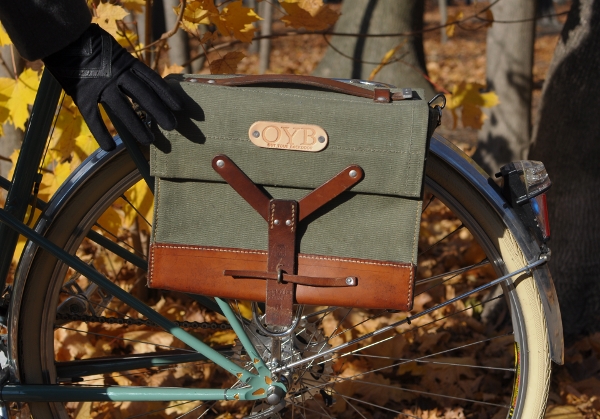
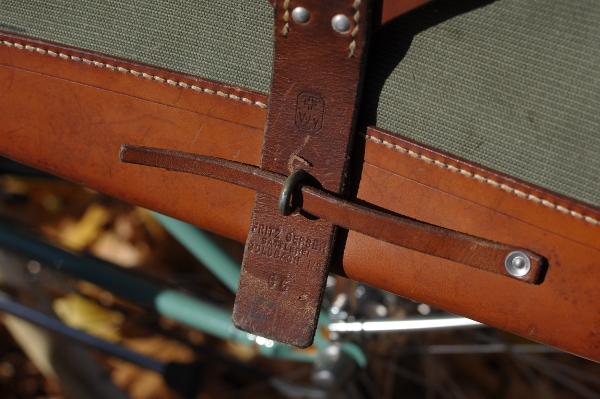
Compact and boxy, the pannier is a Swiss military bag made of a thick, stiff, olive-green waxed canvas with brown leather trim and steel rivets. The OYB leather patch is a lighter shade than the rest of the leather on the bag, but this can easily be changed with a modest application of neatsfoot oil or even Proofide. I am not sure whether this particular bag started out as new-old-stock, or whether it had been used in its previous life, but to me it looks more like the former. The condition is better than I had expected based on the pictures and product description on OYB.
The closure system is simple and secure: That very stiff leather cord pulls out of the metal loop, and the thick leather strap lifts up off the loop to open the bag. For those curious, the imprint on the leather reads "Fritz Gerber Sattlerei, Goldbach."
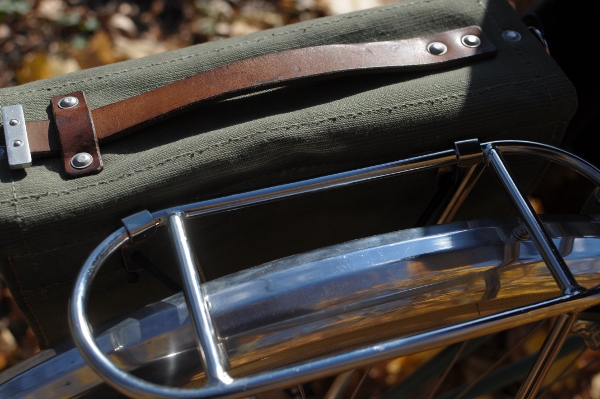
Here is a close-up of the metal hooks. They are riveted on to the bag.
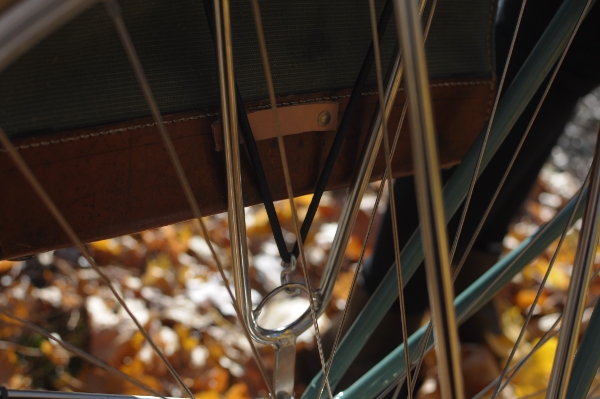
And here is a close-up of the bungee attachment. Together, these two attachment points ensure that the pannier does not sway or bounce against the rack - a good feature when you are planning to carry camera equipment. When the bag is not being used as a pannier, the bungee hook attaches to that small leather strip you see on the back of the bag - so that it does not hang loose. [Edited to add: I am now told that the bungee cord is supposed to go through that leather loop before you hook it to the bottom of the rack - oops.]
In addition to the rack attachments, the OYB pannier can be ordered with a number of other optional features, including shoulder strap attachments with a removable shoulder strap. I asked for the strap, because I pan to carry the bag around when off the bike, and this set-up essentially this gives me a camera bag and pannier in one. Other options include lights mounts, and a variety of other attachments.
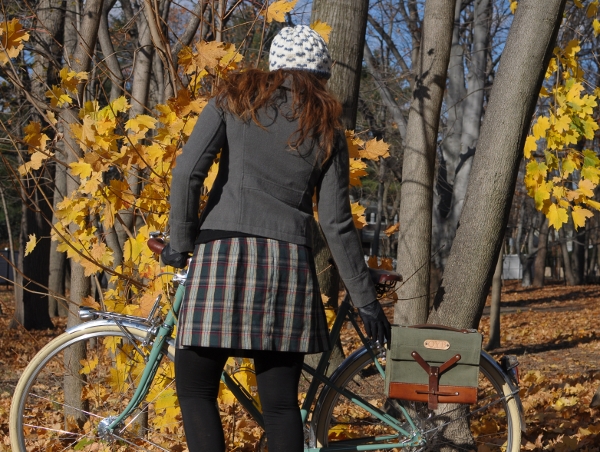
To give you a sense of scale, here is the pannier in relation to me and to the entire bike. It is a small bag. Dimensions are listed as: 8.5" tall, 4" deep, 11.25" wide (5.4 liters). Inside, the length of the bag is listed at 10.75", but I was hoping against hope that it would fit my 8 1/2 x 11" laptop. OYB gives instructions for stretching the bag out with magazines in order to make it fit items of that size, and I will give this a try. If I can get my laptop to fit, I will be thrilled - but I am not getting my hopes up and am prepared to content myself with this being a camera bag only.
If it were not for the laptop fit issue, this would pretty much be my dream pannier. The mil-spec colour scheme is not for everyone, but I love it, and it suits almost all of my bikes nicely. The durability of military surplus items is superb, and I appreciated getting the bag customised by Jeff at OYB. This is a classic, versatile, and reliable little pannier refashioned by someone who loves bicycles.
Compact and boxy, the pannier is a Swiss military bag made of a thick, stiff, olive-green waxed canvas with brown leather trim and steel rivets. The OYB leather patch is a lighter shade than the rest of the leather on the bag, but this can easily be changed with a modest application of neatsfoot oil or even Proofide. I am not sure whether this particular bag started out as new-old-stock, or whether it had been used in its previous life, but to me it looks more like the former. The condition is better than I had expected based on the pictures and product description on OYB.
The closure system is simple and secure: That very stiff leather cord pulls out of the metal loop, and the thick leather strap lifts up off the loop to open the bag. For those curious, the imprint on the leather reads "Fritz Gerber Sattlerei, Goldbach."
The attachment system is a combination of metal hooks and bungee cords, with which the pannier is secured to the rear rack. The rack I have on this bicycle is the Constructeur rack from Velo Orange, which is quite small.
Here is a close-up of the metal hooks. They are riveted on to the bag.
And here is a close-up of the bungee attachment. Together, these two attachment points ensure that the pannier does not sway or bounce against the rack - a good feature when you are planning to carry camera equipment. When the bag is not being used as a pannier, the bungee hook attaches to that small leather strip you see on the back of the bag - so that it does not hang loose. [Edited to add: I am now told that the bungee cord is supposed to go through that leather loop before you hook it to the bottom of the rack - oops.]
To give you a sense of scale, here is the pannier in relation to me and to the entire bike. It is a small bag. Dimensions are listed as: 8.5" tall, 4" deep, 11.25" wide (5.4 liters). Inside, the length of the bag is listed at 10.75", but I was hoping against hope that it would fit my 8 1/2 x 11" laptop. OYB gives instructions for stretching the bag out with magazines in order to make it fit items of that size, and I will give this a try. If I can get my laptop to fit, I will be thrilled - but I am not getting my hopes up and am prepared to content myself with this being a camera bag only.
If it were not for the laptop fit issue, this would pretty much be my dream pannier. The mil-spec colour scheme is not for everyone, but I love it, and it suits almost all of my bikes nicely. The durability of military surplus items is superb, and I appreciated getting the bag customised by Jeff at OYB. This is a classic, versatile, and reliable little pannier refashioned by someone who loves bicycles.
Sunday, November 28, 2010
Winter Hibernators
With temperatures now falling below 40˚F, there is no denying that winter will soon be here. As I rode through a stretch of frozen mud this morning, it finally began to seem real: The snow, the black ice, the heavily salted roads - it's all coming. And once it does, I will be putting most of my bicycles away, keeping around only those equipped to take on winter's fury.
The bicycles destined for "hibernation" are those that have derailleur gearing: my roadbikes, and, sadly my mixte. The ones staying are my 3-speed loop frames with internally geared hubs and chaincases. I will also tentatively keep my fixed gear bike.
Everybody has a different philosophy regarding what makes a bicycle suitable for winter. Having seen countless cyclists struggling with derailleur bikes last winter in Boston - as well as many bikes abandoned, their drivetrains iced over or rusted - I am pretty comfortable with my decision to only ride internally geared hub bicycles once the snow arrives. While I am sad to put away my beautiful mixte after only a few months together, I would be even more sad to ruin her with salt and crud while she is still so new and shiny.
What are your thoughts on "winter bikes" versus "hibernators"? Do you put any of your bicycles away for the season, or ride them all?
Thursday, November 18, 2010
Mixte vs Mixte: What's the Difference?
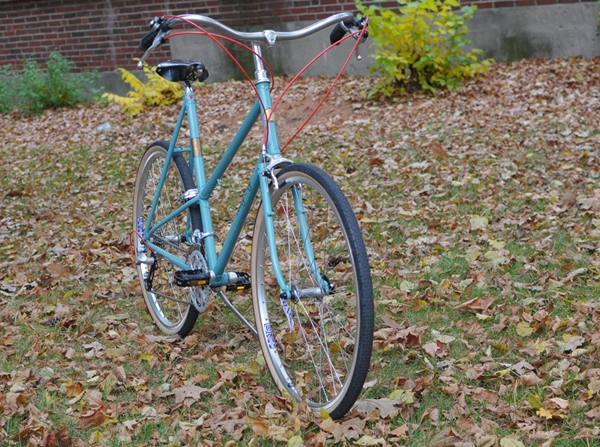
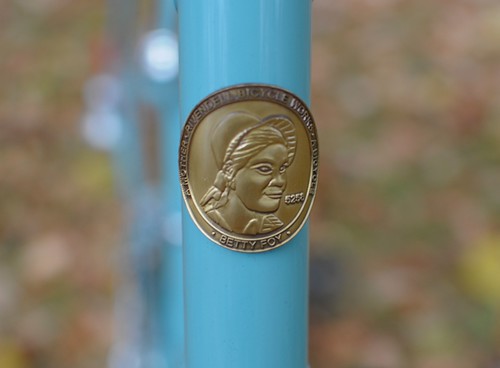
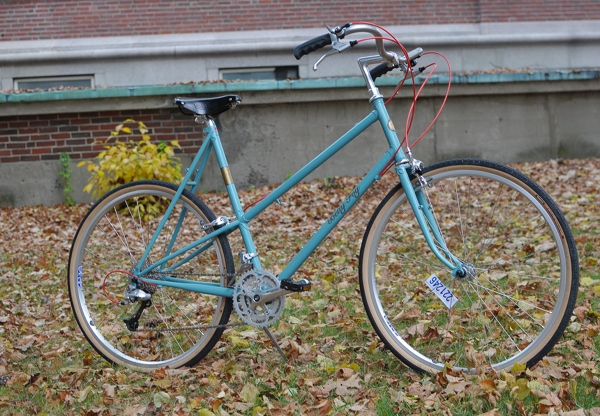
Mixte-frame bicycles have become popular again over the past couple of years, with many women buying them, or considering buying them. But what kind of bicycle is it that they are looking for? Mixtes can differ from one another considerably, both in looks and in ride quality: You cannot assume that because you have ridden one, you know them all. Just to give you an example, I have prepared a side-by-side comparison between my custom Royal H. mixte and the Rivendell Betty Foy. It takes some time to train your eye to differentiate between bicycles that may seem similar at first glance. But see whether you can get a sense of the differences just by looking at the pictures.
Overall proportions
Take a close look at the overall "body types" of the two bicycles. Despite their being the same size in relation to me, my custom mixte has a "short and fat" look to her, whereas the Betty Foy looks "tall and skinny". That is because my mixte is dominated by the round forms of the large wheels, whereas the Betty is dominated by the angular forms of the large frame. The Betty Foy has smaller wheels, so the frame automatically needs to be larger in order for the overall bicycle to be the same size as mine. This also explains why my mixte frame is 52cm and the Betty Foy frame is 58cm - yet when the bicycles are assembled they are both my size.
The "short and fat" vs "tall and skinny" difference between the two bikes is accentuated by the position of the handlebars. The handlebars on the Betty Foy are set higher, with some stem showing - which further elongates Betty's "body." The handlebars on my mixte are pushed almost all the way down - which accentuates the round look. Both bicycles were designed to be set up with the handlebars in these respective positions.
If you look at the vintage René Herse mixtes in this post from last year, as well as at some modern bicycles that emulate them, you will notice that they all have similar proportions to my custom mixte. Not a coincidence, because that is the look I was going for. The Rivendell Betty Foy, on the other hand, is a more contemporary take on the mixte and does not conform to this traditional design. Other modern framebuilders have taken a similar approach - playing with proportions to create their own versions.
Wheelbase
"Wheelbase" is the distance between the center of the front and the rear wheel of a bicycle. But to get a more concrete idea of what that means, look at the space between the wheels. On my custom mixte (left) you can see that the wheels are fairly close together, while on the Betty Foy (right) there is an enormous amount of space between the wheels.
Another easy difference to spot is the length of the chainstays. The chainstays are those skinny tubes on the frame that run parallel to the ground along the rear wheel. If you look closely, on the Betty Foy these are considerably longer than on my mixte.
Angles
The angles of a frame are actually directly related to the wheelbase, but I am not going to go into this here and will discuss angles separately.
Even without measuring, you can see in the side by side pictures, that both the seat tube and the head tube on the Betty Foy are more relaxed (they lean further back) than on my custom mixte. The difference in angles is actually very small (1 degree difference in the seat tubes and 2 degree difference in the head tubes), which makes it all the more interesting that it is visually apparent. Even a small difference can be important.
Step-over height
Not related to any of the previous factors, but worth mentioning, is that the Betty Foy top tube is lower than my mixte's twin lateral stays. On the Betty this was achieved by virtue of not continuing the top tube in a straight line after the seat post, but angling it a bit. This angle produces a similar effect to creating a "swoop" or slight loop in the frame's top tube. It is still not as easy to step over as a step-through, but it is lower than other mixtes out there.
Ride quality
If you have managed to read this far and not fall asleep or close your browser window, you are probably wondering how these features affect ride quality. After all, it is useful to be able to look at a bike and have an idea of how it rides compared to other bikes.
Speaking very generally and summarily, bicycles with a longer wheelbase and more relaxed angles tend to feel more comfortable and stable, whereas bicycles with a shorter wheelbase and steeper angles tend to feel more aggressive and maneuverable. Of all these qualities, comfort is the most subjective - and also depends on other factors (such as tubing material and tires) that are independent of geometry. I would say that my custom mixte is equally comfortable to the Betty Foy - which means that the builder must have done something to enhance comfort despite the steeper angles and shorter wheelbase. As for the other factors, my mixte is indeed aggressive in comparison to Betty, with a ride quality that feels more "zesty." Both bicycles are fast and stable, but mine is quicker to accelerate and a tad more responsive, whereas Betty is more even-tempered.
Either of those qualities can be considered a virtue, depending on the cyclist's needs: A mixte like the Betty Foy is a better idea if you are looking for a relaxed, even-paced ride, whereas a mixte like mine will be more enjoyable if you want something more racy. And it helps to recognise which is which by looking at them.
Monday, November 15, 2010
The Popular Girl: Test Riding the Rivendell Betty Foy
After last week's review of the Rivendell Sam Hillborne, it seemed appropriate to follow up with a test ride report of the Betty Foy. I have ridden her a couple of times before, but never had my camera with me at the time. Harris Cyclery has just built up a new floor model in my size - so I took the opportunity to take some pictures and put my impressions into words. While the pictures reflect how this particular bicycle was built up, keep in mind that it is fully customisable: You can change everything from the saddle and grips, to the handlebars and pedals, to the type of components that are on the bike.
Rivendell released the Betty Foy in Spring 2009, in conjunction with the diamond frame Sam Hillborne model. Inasmuch as a hand-built, niche-market bicycle can "sell like hotcakes" I believe the Betty does. She is charming, comfortable, and tough - and the ladies love her for that. The price of the frame alone is $1,000 and a fully built up bike starts at $2,200 or so, depending on the options. To see how this bicycle compares price-wise to other lady's frames in its class, please visit my new Semi-Custom Options page (now linked in the upper left-hand corner).
In terms of construction, the Rivendell Betty Foy is a version of the mixte frame: What starts out as a sloped single top tube splits into two stays at the seat tube and continues (at a slightly different angle than the slope of the main top tube) all the way back to the rear dropouts. The frame is lugged, with custom-made lugs in the shape of hearts and elaborate filigreed designs.
There are many cute and feminine touches, such as the downtube decal featuring tiny red apples
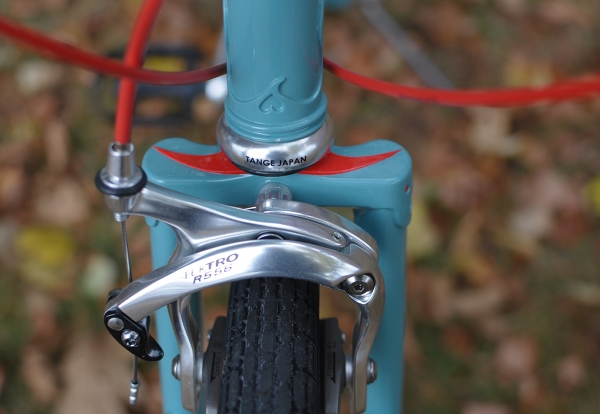
and the filled-in curly-cues on the fork crown. Some of the lugs are also filled in with red, complementing the robbin's egg-blue of the frame.
The Betty Foy frame is available in several sizes (47cm, 52cm, 58cm and 62cm), with the middle two built for 650B wheels, the largest built for 700C wheels, and the smallest for 26" wheels. There is enough clearance for 40mm tires plus fenders.
The frame is made for derailleur gearing, and is typically built up with three gears in the front and eight in the rear. There are eyelets and braze-ons for fenders and racks.
Rivendell states that the Betty frame was designed to be built up with Nitto Albatross handlebars - which are wide and swept back, similar to (but wider than) the handlebars you would find on a vintage 3-speed. I have also seen her built up with drop bars, but the upright set-up is more typical. This floor model was fitted with black rubber grips and "thumbie" shifters, though some prefer cork grips and bar-end shifters.
One thing to note about the Betty Foy, is the unusual sizing: The frame sizes recommended by Rivendell seem larger than what a person would normally ride. For example, I am 5'7" and normally ride a 52-54cm road bike or mixte, yet it is recommended that I ride a 58cm Betty Foy. Having tried both the 52cm and the 58cm frames, I can confirm that the recommendation is accurate. The 52cm Betty Foy felt much too small for me, whereas the 58cm version felt just right. I could have raised the saddle by another inch from the position in which it is shown above, but did not feel like going back inside the shop once I started riding the bike.
I rode the Betty Foy on the roads near Harris Cyclery (actual test ride not pictured), both this time and the previous times I've tried her. It is difficult to compare her to other bicycles on the market, because in a way she is unique. If you are accustomed to road bikes and vintage mixtes, you will find the Betty to be considerably more upright, stable, and comfortable. She is more relaxed than a typical mixte and has a long wheelbase - so that there is no toe overlap with the front tire when turning at slow speeds. I also find the step-over height to be lower than on other mixtes I've tried, which is convenient.
If you are accustomed to Dutch-style city bikes, you will find the Betty Foy a faster and sportier ride, but still within your comfort zone. The posture is slightly leaned forward, but still more or less upright. The derailleur gearing may take some getting used to if you have only dealt with internally geared hubs before, but you will appreciate how easy it makes cycling uphill.
In my view, the Betty Foy's greatest asset is her versatility. If you combine the feeling of a vintage 3-speed with that of a derailleur-geared touring bike, she handles like a union of the two: a fast, comfortable bicycle that feels safe and pleasant to ride. I can imagine riding her around the city for transportation, as well as 20 miles over some hills to the next town over. The ride is soft over bumps and potholes (not as soft as on my Sam Hillborne with 42mm tires, but I would need to ride Betty with equally wide tires to compare). Maneuverability in traffic is good, but the handling is not aggressive. I did not ride her on any serious hills, but with the derailleur gearing, the light frame, and the somewhat leaned-forward posture, I imagine it should hardly be a problem. She is what Rivendell says she is: an "all around" bike. If you plan to have only one bicycle for both urban commuting and long distance cycling, this seems like the closest thing on the market to that ideal.
The question I am inevitably asked at this point, is why I did not get a Betty Foy for myself when I was looking for a mixte, if I think she is so great. My main reason, was that I wanted a specific kind of mixte: one with twin lateral stays and proportions that resembled the original French constructeurs. The Betty Foy is not that kind of bicycle. Additionally, I must admit that I find Betty's femininity overwhelming. All the hearts and the bright colours - it's very American 1950s, whereas I am more of a European 1920s kind of girl. And my final reason is ironic - because it is the reason most people love this bike: I don't like the way some of the lugwork is done. If you look at the seat cluster above (see here for what that is), you will notice that the seat stays are welded directly to the main lug, rather than capped. No other Rivendell bicycle is made that way, and I don't know why this model is the exception. Personally, I would rather have a properly lugged seat cluster than hearts and curly-cues.
The same is repeated at the junction of the seat tube and support stays. My preference would be for something like this to have been done here instead. I recognise how nit-picky and obsessive these quibbles are, but little details like this are important to me and I have my preferences when it comes to the way a frame is put together. It's an excellent frame, just not what I was looking for.
After I posted the above image, it was pointed out to me by a couple of attentive readers that there is a blemish right at the weld junction, next to the big lug. I myself did not notice this until my attention was directed to it - but now that it has, it's only fair that I mention it. Personally, I am not particularly bothered by this blemish (I have seen worse on more expensive frames) and it would not stand in the way of my wanting the bike, if it were not for the other factors. Your views may vary.
These issues aside, the Rivendell Betty Foy is an attractive and well-constructed bicycle. A great deal of thought went into the design, with a special emphasis on versatility - which I feel has been achieved here better than on other bicycles I have owned or tried. And apparently others agree, as the Betty has an excellent record of owner satisfaction. All things considered, I think the Betty Foy's popularity is well deserved.
Rivendell released the Betty Foy in Spring 2009, in conjunction with the diamond frame Sam Hillborne model. Inasmuch as a hand-built, niche-market bicycle can "sell like hotcakes" I believe the Betty does. She is charming, comfortable, and tough - and the ladies love her for that. The price of the frame alone is $1,000 and a fully built up bike starts at $2,200 or so, depending on the options. To see how this bicycle compares price-wise to other lady's frames in its class, please visit my new Semi-Custom Options page (now linked in the upper left-hand corner).
In terms of construction, the Rivendell Betty Foy is a version of the mixte frame: What starts out as a sloped single top tube splits into two stays at the seat tube and continues (at a slightly different angle than the slope of the main top tube) all the way back to the rear dropouts. The frame is lugged, with custom-made lugs in the shape of hearts and elaborate filigreed designs.
There are many cute and feminine touches, such as the downtube decal featuring tiny red apples
and the filled-in curly-cues on the fork crown. Some of the lugs are also filled in with red, complementing the robbin's egg-blue of the frame.
The Betty Foy frame is available in several sizes (47cm, 52cm, 58cm and 62cm), with the middle two built for 650B wheels, the largest built for 700C wheels, and the smallest for 26" wheels. There is enough clearance for 40mm tires plus fenders.
The frame is made for derailleur gearing, and is typically built up with three gears in the front and eight in the rear. There are eyelets and braze-ons for fenders and racks.
Rivendell states that the Betty frame was designed to be built up with Nitto Albatross handlebars - which are wide and swept back, similar to (but wider than) the handlebars you would find on a vintage 3-speed. I have also seen her built up with drop bars, but the upright set-up is more typical. This floor model was fitted with black rubber grips and "thumbie" shifters, though some prefer cork grips and bar-end shifters.
One thing to note about the Betty Foy, is the unusual sizing: The frame sizes recommended by Rivendell seem larger than what a person would normally ride. For example, I am 5'7" and normally ride a 52-54cm road bike or mixte, yet it is recommended that I ride a 58cm Betty Foy. Having tried both the 52cm and the 58cm frames, I can confirm that the recommendation is accurate. The 52cm Betty Foy felt much too small for me, whereas the 58cm version felt just right. I could have raised the saddle by another inch from the position in which it is shown above, but did not feel like going back inside the shop once I started riding the bike.
I rode the Betty Foy on the roads near Harris Cyclery (actual test ride not pictured), both this time and the previous times I've tried her. It is difficult to compare her to other bicycles on the market, because in a way she is unique. If you are accustomed to road bikes and vintage mixtes, you will find the Betty to be considerably more upright, stable, and comfortable. She is more relaxed than a typical mixte and has a long wheelbase - so that there is no toe overlap with the front tire when turning at slow speeds. I also find the step-over height to be lower than on other mixtes I've tried, which is convenient.
If you are accustomed to Dutch-style city bikes, you will find the Betty Foy a faster and sportier ride, but still within your comfort zone. The posture is slightly leaned forward, but still more or less upright. The derailleur gearing may take some getting used to if you have only dealt with internally geared hubs before, but you will appreciate how easy it makes cycling uphill.
In my view, the Betty Foy's greatest asset is her versatility. If you combine the feeling of a vintage 3-speed with that of a derailleur-geared touring bike, she handles like a union of the two: a fast, comfortable bicycle that feels safe and pleasant to ride. I can imagine riding her around the city for transportation, as well as 20 miles over some hills to the next town over. The ride is soft over bumps and potholes (not as soft as on my Sam Hillborne with 42mm tires, but I would need to ride Betty with equally wide tires to compare). Maneuverability in traffic is good, but the handling is not aggressive. I did not ride her on any serious hills, but with the derailleur gearing, the light frame, and the somewhat leaned-forward posture, I imagine it should hardly be a problem. She is what Rivendell says she is: an "all around" bike. If you plan to have only one bicycle for both urban commuting and long distance cycling, this seems like the closest thing on the market to that ideal.
The question I am inevitably asked at this point, is why I did not get a Betty Foy for myself when I was looking for a mixte, if I think she is so great. My main reason, was that I wanted a specific kind of mixte: one with twin lateral stays and proportions that resembled the original French constructeurs. The Betty Foy is not that kind of bicycle. Additionally, I must admit that I find Betty's femininity overwhelming. All the hearts and the bright colours - it's very American 1950s, whereas I am more of a European 1920s kind of girl. And my final reason is ironic - because it is the reason most people love this bike: I don't like the way some of the lugwork is done. If you look at the seat cluster above (see here for what that is), you will notice that the seat stays are welded directly to the main lug, rather than capped. No other Rivendell bicycle is made that way, and I don't know why this model is the exception. Personally, I would rather have a properly lugged seat cluster than hearts and curly-cues.
The same is repeated at the junction of the seat tube and support stays. My preference would be for something like this to have been done here instead. I recognise how nit-picky and obsessive these quibbles are, but little details like this are important to me and I have my preferences when it comes to the way a frame is put together. It's an excellent frame, just not what I was looking for.
After I posted the above image, it was pointed out to me by a couple of attentive readers that there is a blemish right at the weld junction, next to the big lug. I myself did not notice this until my attention was directed to it - but now that it has, it's only fair that I mention it. Personally, I am not particularly bothered by this blemish (I have seen worse on more expensive frames) and it would not stand in the way of my wanting the bike, if it were not for the other factors. Your views may vary.
These issues aside, the Rivendell Betty Foy is an attractive and well-constructed bicycle. A great deal of thought went into the design, with a special emphasis on versatility - which I feel has been achieved here better than on other bicycles I have owned or tried. And apparently others agree, as the Betty has an excellent record of owner satisfaction. All things considered, I think the Betty Foy's popularity is well deserved.
Monday, November 1, 2010
Mixed Impressions: a Look at the Trek Belleville WSD Mixte
Lately, readers have been asking about the Trek Belleville WSD mixte. It has been out for about a year and looks promising in pictures, but what is it like in person? I had noticed this bicycle earlier at one of my local bike shops - the Wheelworks in Somerville, MA - and recently had a chance to try it.
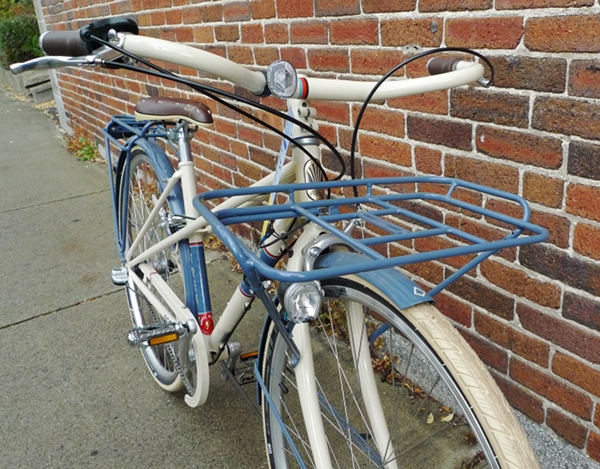
The Trek Belleville mixte is a "real" mixte - in the sense that it is built with twin lateral stays that extend from the head tube to the rear dropouts. The bicycle reflects the ideas of the French constructeurs (or, more likely, the contemporary builders who emulate the original constructeurs) in that it is fully equipped with fenders, front and rear racks, and dynamo-powered lighting. However, unlike classic mixtes with their elegant lines and lugged steel construction, the Trek Belleville's frame is made of a strangely thick, welded cromoly tubing. The tubing is so chunky in fact, that I was certain the bike was aluminum until I was corrected. In industry photos the chunkiness is easily disguised with good lighting and careful choice of angles. But in person, the bicycle looks like what it is: a somewhat clumsy mass-produced bike fitted with some admittedly impressive extras. Trek also promotes the "eco-design" of this model, which you can read about here.
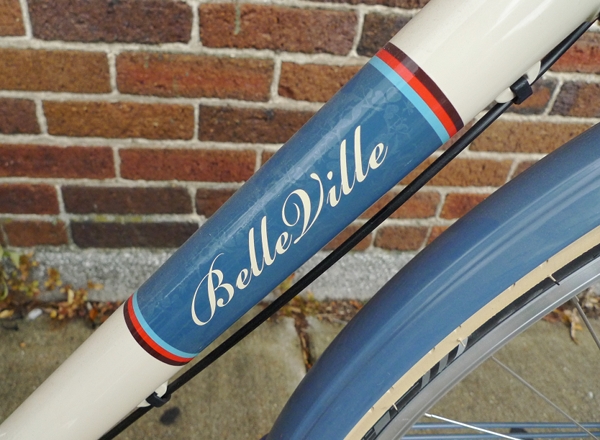
I think that one of the most successful aspects of the Trek Belleville is the colour scheme and graphics. We like to fool ourselves into thinking that this stuff does not influence us, but it does. The slate-blue and cream colour combination with subtle red accents is harmonious, beautiful, and nostalgic. It dominates the aesthetics of the bicycle, distracting the eye from its less appealing aspects.
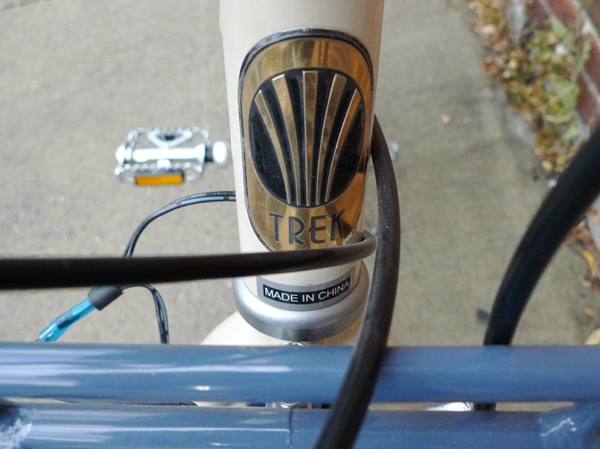
Trek also used a vintage headbadge for the Belleville, which goes nicely with the classic theme.
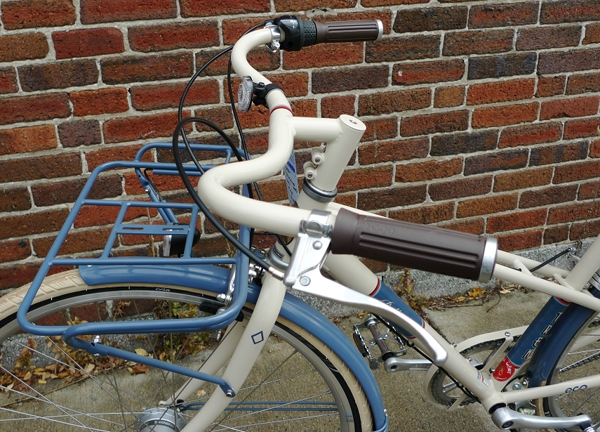
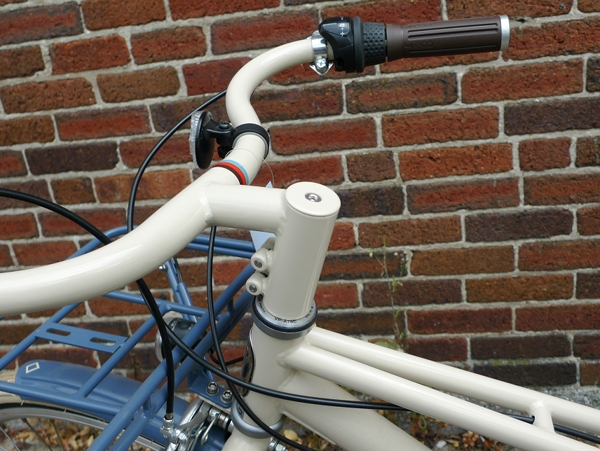
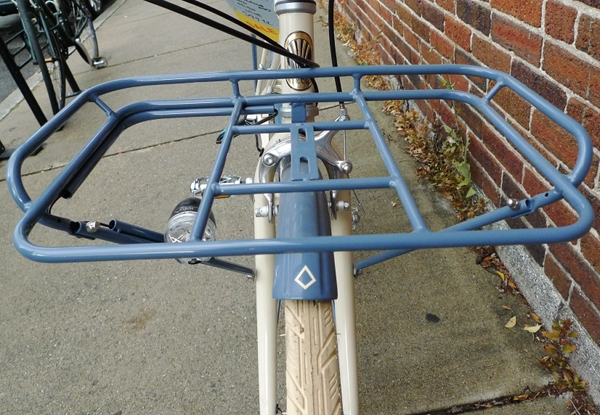
The Trek Belleville uses a threadless stem and Porteur-style handlebars. Both the stem and the handlebars are painted body colour, which is nice. A Porteur-style front rack is attached to the fork.
Close-up of the stem, grips, shifter and the points where the lateral stays attach to the head tube. While I do not normally like threadless stems and integrated handlebars, I think here the look is appealing. However, the design makes it impossible to adjust stem height and the angle of the handlebars, which is problematic.
The front rack is quite elegant, as well as smoothly integrated with the body of the bike. The tires are Bontrager, cream with black sidewalls.
The rear rack is nice as well. I don't remember the weight rating, but it was considerable. One thing I noticed, is that the attachment points are set back from the rear dropouts - presumably because the chainstays are otherwise not long enough to accommodate a rack?
The Trek Belleville is fitted with an internally geared hub (Shimano Nexus 3-speed), caliper brakes, a decent-looking crankset, touring-style pedals, and a body-coloured chainguard.
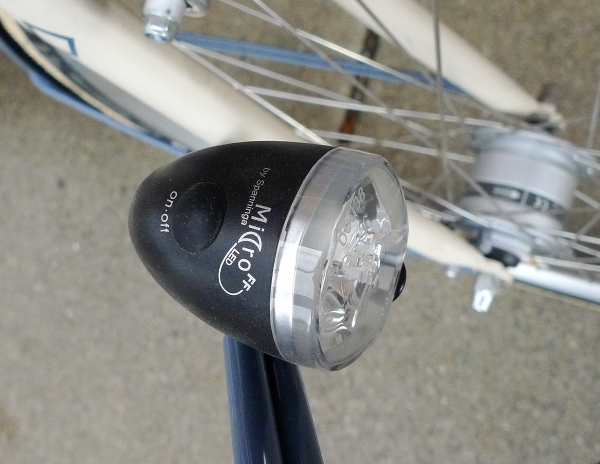
The front dynamo hub is a Shimano (I did not see the model name), and the lights used are Spanniga. The headlight is a Spanniga Micro, mounted on right stay of the front rack.
The tail light is a Spanniga Eclipse, attached to the rear rack. I have not tried the lights, as it was daytime, but I have heard good things about these models.
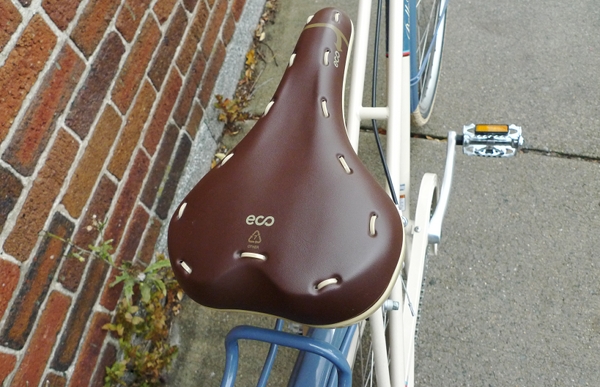
The saddle has a faux-handsewn leather look to it and feels like a typical padded vinyl saddle. I have read that it was designed to be disassembled and recycled after use, though I am not clear on the details.
The Trek Belleville mixte comes in two frame sizes - 43cm (17") and 50cm (20"). I am fairly certain that I tried the smaller frame, because I had to raise the saddle half a foot from its original position in order to ride the bike (note that the pictures here show the original position, not the raised position). However, while the seat tube was short, the rest of the bicycle seemed quite large. The step-over was high and bringing my leg over took some careful negotiating. And the reach from the saddle to the handlebars was characteristic of a larger frame.
I would estimate the weight of the Belleville mixte around 35lbs. Very reasonable, considering the steel tubing and all the extras.
Preparing to test-ride the bike, I walked it off of the sidewalk curb - at which point it made loud clunking noises. Upon investigation, we discovered that the fenders were wobbly - and the cause seemed to be in the design of the attachment points, rather than in the assembly. This could be an issue when riding over bumps or potholes.
I test-rode the Trek Belleville mixte briefly, and I apologise for my disgraceful "salmoning" - it was only done for the photo. As reflected in the picture, the first thing I noted was the unusually generous width of the handlebars - I almost felt as if I were holding the edges of a hula hoop. Maybe this was the cause of the strange feel to the steering, because I found the front end to be "aloof" - almost as if it was receiving its steering instructions via a third party rather than from me directly. I wonder whether it would handle differently with a front load, but that is not something I was able to test. Otherwise, the ride felt okay - with the exception perhaps of too much pressure on my hands despite the upright handlebars.
Of all the other bicycles I have test ridden, the Trek Belleville mixte is the most similar to the Specialized Globe Haul I tried last year. Both feature mixte-style construction and integrated racks, and are roughly in the same price range. Comparing the two, my impression is that the Globe Haul's construction is of somewhat better quality and I preferred the feel of the Globe's ride. In pictures and from a distance, the Trek Belleville comes across as a prettier and more classic-looking bicycle, but in person this is not so. As for comparing the Trek Belleville WSD to traditional, classic mixtes - there is something clumsy about the Trek, as a result of which it does not resemble the real deal despite the twin-stay construction.
The racks on the Trek Belleville mixte are impressive, and the fact that dynamo lighting comes standard on this bicycle is nothing short of amazing. The gorgeous paint job is also to be commended. But despite all the extras, the bicycle has an awkward and flimsy feel to it in person. The current retail of the Trek Belleville mixte is around $650, and the Wheelworks in Somerville has it on sale at the moment for a lower price. Regardless of what I think of the Trek Belleville, one thing is for sure: A production bicycle with racks and dynamo lighting is a step forward for the industry that is in itself worth applauding.
The Trek Belleville mixte is a "real" mixte - in the sense that it is built with twin lateral stays that extend from the head tube to the rear dropouts. The bicycle reflects the ideas of the French constructeurs (or, more likely, the contemporary builders who emulate the original constructeurs) in that it is fully equipped with fenders, front and rear racks, and dynamo-powered lighting. However, unlike classic mixtes with their elegant lines and lugged steel construction, the Trek Belleville's frame is made of a strangely thick, welded cromoly tubing. The tubing is so chunky in fact, that I was certain the bike was aluminum until I was corrected. In industry photos the chunkiness is easily disguised with good lighting and careful choice of angles. But in person, the bicycle looks like what it is: a somewhat clumsy mass-produced bike fitted with some admittedly impressive extras. Trek also promotes the "eco-design" of this model, which you can read about here.
I think that one of the most successful aspects of the Trek Belleville is the colour scheme and graphics. We like to fool ourselves into thinking that this stuff does not influence us, but it does. The slate-blue and cream colour combination with subtle red accents is harmonious, beautiful, and nostalgic. It dominates the aesthetics of the bicycle, distracting the eye from its less appealing aspects.
Trek also used a vintage headbadge for the Belleville, which goes nicely with the classic theme.
The Trek Belleville uses a threadless stem and Porteur-style handlebars. Both the stem and the handlebars are painted body colour, which is nice. A Porteur-style front rack is attached to the fork.
Close-up of the stem, grips, shifter and the points where the lateral stays attach to the head tube. While I do not normally like threadless stems and integrated handlebars, I think here the look is appealing. However, the design makes it impossible to adjust stem height and the angle of the handlebars, which is problematic.
The front rack is quite elegant, as well as smoothly integrated with the body of the bike. The tires are Bontrager, cream with black sidewalls.
The rear rack is nice as well. I don't remember the weight rating, but it was considerable. One thing I noticed, is that the attachment points are set back from the rear dropouts - presumably because the chainstays are otherwise not long enough to accommodate a rack?
The Trek Belleville is fitted with an internally geared hub (Shimano Nexus 3-speed), caliper brakes, a decent-looking crankset, touring-style pedals, and a body-coloured chainguard.
The front dynamo hub is a Shimano (I did not see the model name), and the lights used are Spanniga. The headlight is a Spanniga Micro, mounted on right stay of the front rack.
The tail light is a Spanniga Eclipse, attached to the rear rack. I have not tried the lights, as it was daytime, but I have heard good things about these models.
The saddle has a faux-handsewn leather look to it and feels like a typical padded vinyl saddle. I have read that it was designed to be disassembled and recycled after use, though I am not clear on the details.
The Trek Belleville mixte comes in two frame sizes - 43cm (17") and 50cm (20"). I am fairly certain that I tried the smaller frame, because I had to raise the saddle half a foot from its original position in order to ride the bike (note that the pictures here show the original position, not the raised position). However, while the seat tube was short, the rest of the bicycle seemed quite large. The step-over was high and bringing my leg over took some careful negotiating. And the reach from the saddle to the handlebars was characteristic of a larger frame.
I would estimate the weight of the Belleville mixte around 35lbs. Very reasonable, considering the steel tubing and all the extras.
Preparing to test-ride the bike, I walked it off of the sidewalk curb - at which point it made loud clunking noises. Upon investigation, we discovered that the fenders were wobbly - and the cause seemed to be in the design of the attachment points, rather than in the assembly. This could be an issue when riding over bumps or potholes.
I test-rode the Trek Belleville mixte briefly, and I apologise for my disgraceful "salmoning" - it was only done for the photo. As reflected in the picture, the first thing I noted was the unusually generous width of the handlebars - I almost felt as if I were holding the edges of a hula hoop. Maybe this was the cause of the strange feel to the steering, because I found the front end to be "aloof" - almost as if it was receiving its steering instructions via a third party rather than from me directly. I wonder whether it would handle differently with a front load, but that is not something I was able to test. Otherwise, the ride felt okay - with the exception perhaps of too much pressure on my hands despite the upright handlebars.
Of all the other bicycles I have test ridden, the Trek Belleville mixte is the most similar to the Specialized Globe Haul I tried last year. Both feature mixte-style construction and integrated racks, and are roughly in the same price range. Comparing the two, my impression is that the Globe Haul's construction is of somewhat better quality and I preferred the feel of the Globe's ride. In pictures and from a distance, the Trek Belleville comes across as a prettier and more classic-looking bicycle, but in person this is not so. As for comparing the Trek Belleville WSD to traditional, classic mixtes - there is something clumsy about the Trek, as a result of which it does not resemble the real deal despite the twin-stay construction.
The racks on the Trek Belleville mixte are impressive, and the fact that dynamo lighting comes standard on this bicycle is nothing short of amazing. The gorgeous paint job is also to be commended. But despite all the extras, the bicycle has an awkward and flimsy feel to it in person. The current retail of the Trek Belleville mixte is around $650, and the Wheelworks in Somerville has it on sale at the moment for a lower price. Regardless of what I think of the Trek Belleville, one thing is for sure: A production bicycle with racks and dynamo lighting is a step forward for the industry that is in itself worth applauding.
Wednesday, October 20, 2010
The One and Only 'Constance'! a Mixte by Royal H. Cycles
Trying to write a definitive post about the completion of my custom mixte (whom I have named "Constance") has been overwhelming, but I am forcing myself to do it before too much time goes by. Perhaps it will help if I try to cut down on the sappy stuff and just write about it briefly, matter-of-factly. After all, it's just a bike forgoddsake... Right!
To start with a basic description of the bicycle, it is a classic, fully lugged mixte frame with twin lateral stays. The tubing is eclectic, designed with comfort and strength as the main priorities: The downtube and seat stays are Columbus. The seat tube is Nova. The chainstays are Vitus. And the twin stays are domestic 4130 straight gauge.
For those interested in numbers, they are as follows: 52cm seat tube, 54cm virtual top tube, 73° seat tube angle, 72° head tube angle, 53mm fork rake, 54.5mm trail, and a bottom bracket drop of 65mm.
The liquid paint and lug outlining were done by Circle A Cycles in Providence, RI - as is standard for a Royal H. frame.
The colour was matched to a swatch I provided. It is somewhere between a mint green and a sage green, depending on the light. I chose it because it is my favourite colour. The Royal H. insignia and lug outlining were done in copper.
As far as construction goes, several nifty features make the bicycle special. To start with, it is nearly impossible to have a fully lugged mixte built nowadays, because the twin headtube lugs are no longer made. These were procured new old stock.
The "bullet" style seat stay caps were the framebuilder's idea and I was not sure I wanted them at first, but they look spectacular.
The flat-top fork crown has a small custom embellishment, and notice the little lugged braze-on for the shifter boss. I should mention that this bicycle has clearances for 35mm+ tires plus fenders...
Everything that could possibly be lugged on this mixte, is!
- including these amazing triple sockets on the rear dropouts. Read more about them, and other aspects of the lugwork here (not to mention the custom stainless steel kickstand plate!).
There are braze-ons for both front and rear racks, and the bicycle was built to accommodate reasonable front and rear loads.
If you are interested in a full technical description of the components, you can find that here. But for those who just want the main points of interest, I will describe a few.
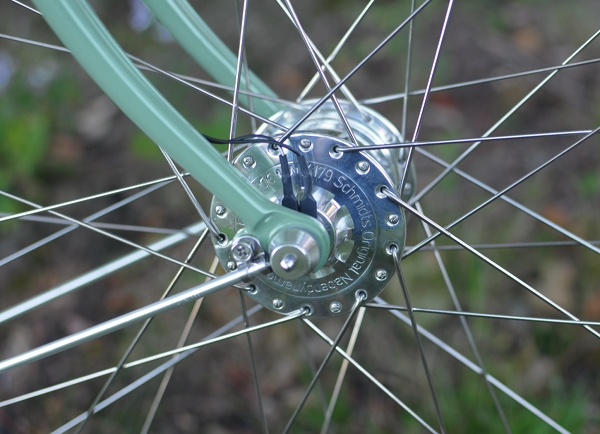
The 700C wheels were built by Peter White, with a Schmidt SON dynohub to power the lights. The headlight and tail light are the same as on my Rivendell, and you can read about them here.
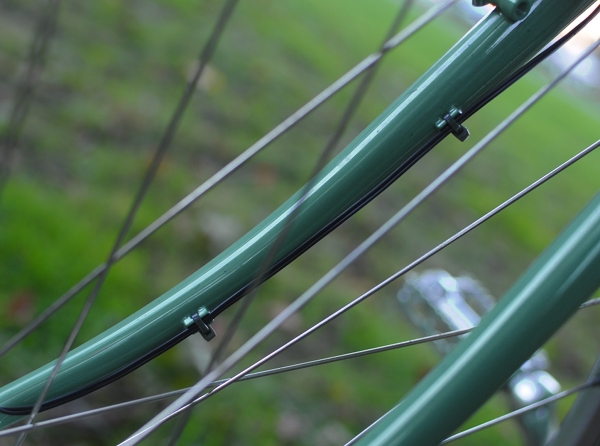
Braze-ons along the inside of the fork accommodate the wiring for the headlight.
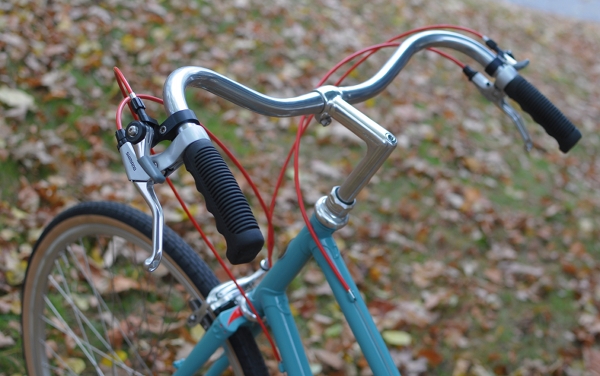
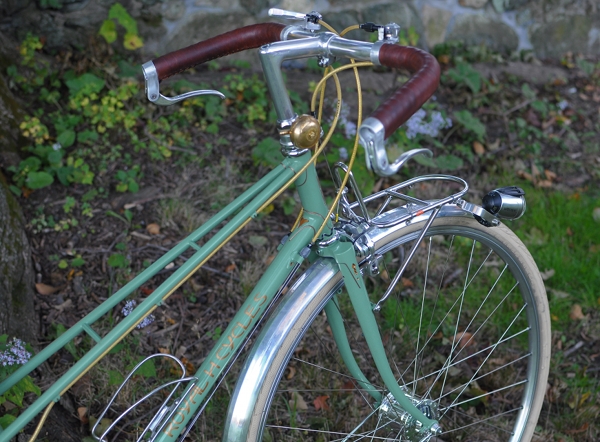
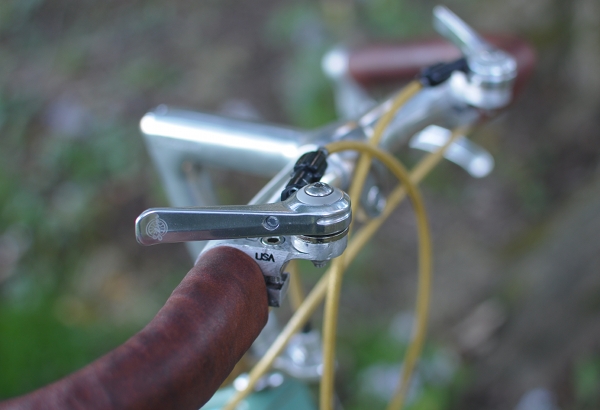
The handlebars are the Velo Orange Porteur bars, used with a 10mm stem, inverse brake levers, and Silver shifters inserted into Paul thumbies - which were heavily modified for the purpose.
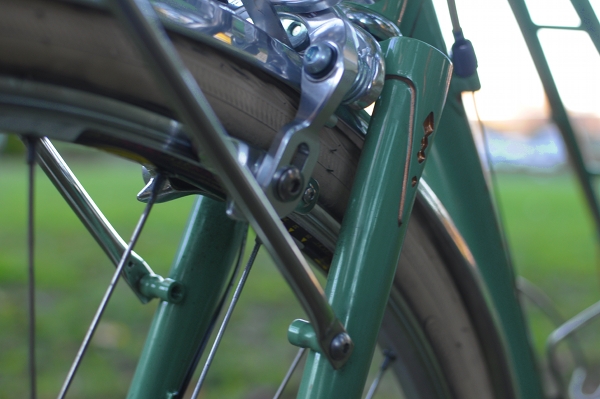
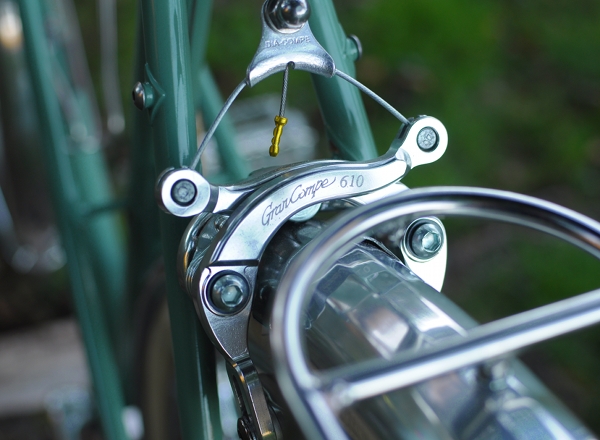
The bicycle was built to accommodate centerpull brakes, as this is my preferred style of brakes. The brakes are Dia Compe centerpulls from VO - which function great, but had to be slightly modified to fit properly (which, as I understand, is a problem other have had as well).
The crankset is a Sugino Alpina double. You can't tell in this picture, but there is a neat braze-on for the front derailleur.
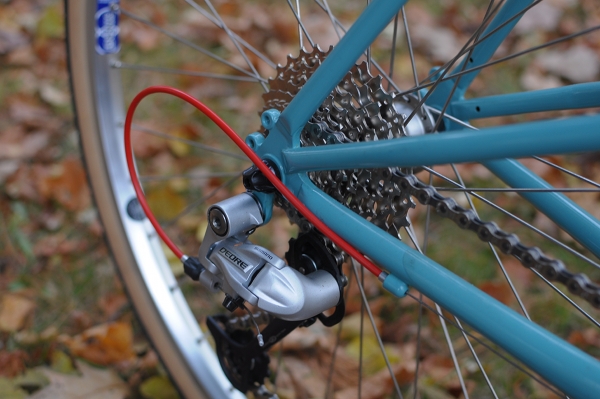
The rear derailleur is the Shimano XT "Shadow". I love this derailleur, because it tucks in closely to the wheel, so that it is less likely to get dinged if you are riding off-road, or even if the bike gets slammed by a door. Given that I have nearly destroyed the rear derailleur on my Rivendell in half a year's time, I think the "Shadow" was made for me. Oh, and if you are wondering what that monstrous-looking cassette is, that is a Sheldon Brown custom touring cassette. Please be honest about this one: how bad does this look? I considered switching the biggest ring (currently a 34t) to a slightly smaller one, so that it blends in with the others visually - though over time the weirdness of it has grown on me.
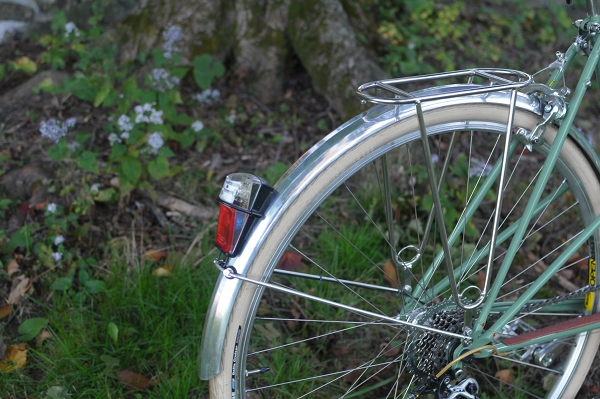
The bicycle is fitted with the beautiful Honjo "Le Paon" fenders (similar to the VO "Zeppelins" I have on my Rivendell, but shinier and somehow more elegant), and the front rack is a VO Randonneur.
The rear rack is a VO Constructeur, which is small but can nonetheless fit a standard Dutch-size pannier. Oh, and the tires are (big surprise!) Schwalbe Delta Cruisers, 700C x 35mm. And I think I will stop now with the components, before I put everybody to sleep! If you have questions after reading this post and the spec list here, please ask in the comments and I will be glad to answer.
My impression of the mixte is multi-layered, but all the layers can be placed firmly in the category of "love". The bicycle handles differently than I had imagined, but only because I had no way of imagining something I had never experienced before. It is freakishly light, and luxuriously, almost abnormally comfortable while at the same time being faster and more responsive than any upright bicycle I have ever ridden. It is more responsive than the vintage mixte, "Marianne," I used to own, which I had complained was "twitchy". Somehow, on the Royal H. the responsiveness does not feel scary; I can control it. No idea how this all works, but I am certainly happy about it!
The fit of the mixte is just perfect for me, and I can feel that my proportions have been taken into consideration - everything just feels "right". The bicycle handles best with a 10cm stem, with the handlebars close to level with the saddle, and with the saddle pushed back a bit.
I have ridden the mixte all over town since early September, and have taken it on two longish rides (40 miles and 30 miles). Everything is beyond perfect and there is zero pain. I have tried to describe the ride quality here and here if you are interested in the details. One thing I love that I would never have expected to love, is the high bottom bracket. I feel almost majestically tall on this bicycle, even when leaned over and holding the front of the bars.
Given that this is a custom bicycle, I should probably conclude with a few words about the framebuilder. Bryan Hollingsworth is a young builder with considerable experience working for the world-famous Seven Cycles. He is a knowledgeable, enthusiastic, easy-going, and genuinely nice person. I knew that Bryan was the right builder for me, because he immediately understood the kind of bicycle I wanted, and got excited about building it. He was surprisingly pro-active about design solutions and pointed out possibilities that even my detail-obsessed imagination had not considered. As a result, my frame has some unique features that I cannot take any credit for what so ever; they were Bryan's idea! Additionally, now that I am actually riding the bicycle, it is clear that Bryan had put a lot of thought into making it comfortable for me, while, at the same time, giving it a degree of fiestiness that I had not expected.
I will also address price and affordability, since some have already been asking about this. I would rather not disclose the cost of my frame - mainly because that figure will no longer be of use to anyone. When I met Bryan, he had only just begun building custom frames under his own name, and that is how I was able to afford the project. A year later, Royal H. has taken off like a rocket, and, naturally, the price structure has changed somewhat. As for affordability, my advice would be to find a frame builder you like, and then discuss the possibility of breaking up the payment into several installments. This makes paying for the frame considerably easier. Furthermore, no one says that you must buy all the components immediately, and all at once. I saved up for them gradually, which is why it took nearly a year for my bicycle to reach completion. And yes, it was worth it!
I named this bicycle "Constance", because I hope she always remains in my life. Thank you to everyone who made my custom mixte possible, both directly and indirectly.
Subscribe to:
Posts (Atom)