Okay, I promise not to make this another post with deep thoughts inspired by the snowpocalyptic weather in Boston. Because at this point, my bikes have reached a state that clinicians like to call "learned helplessness": The individual, convinced that no action on their part can alter their fate, just gives up and stops trying, possibly curling up in the fetal position and gently rocking back and forth. The snow won, dear readers. Oh yes, it won.
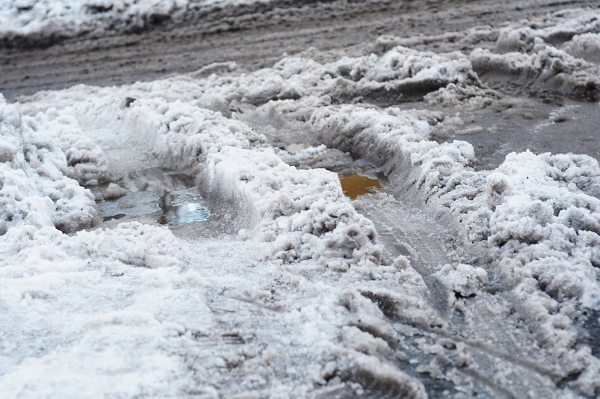
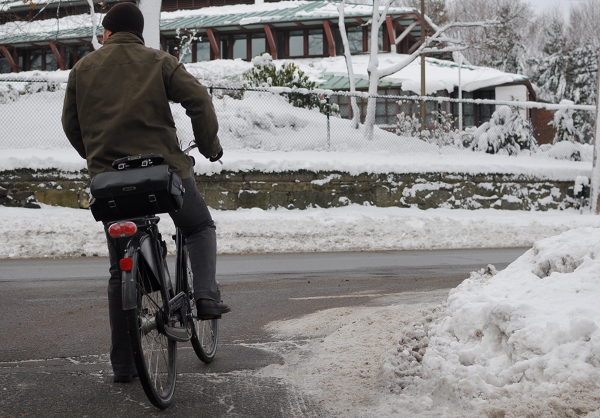
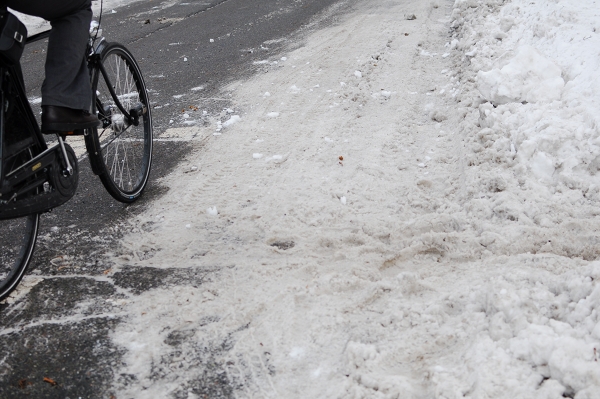
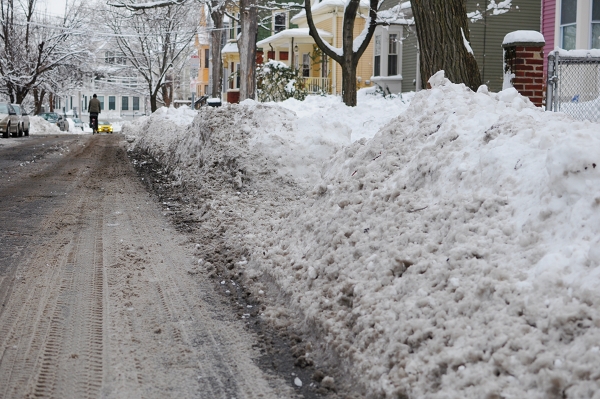
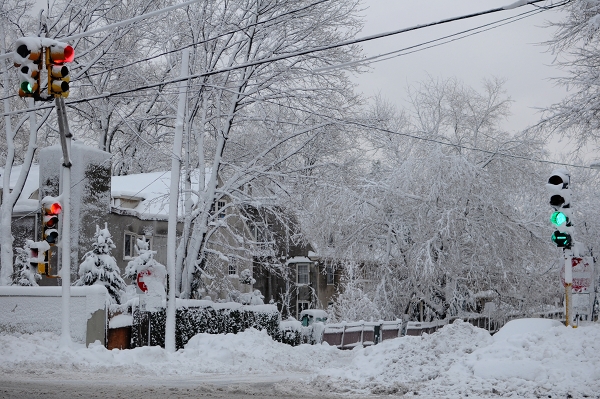
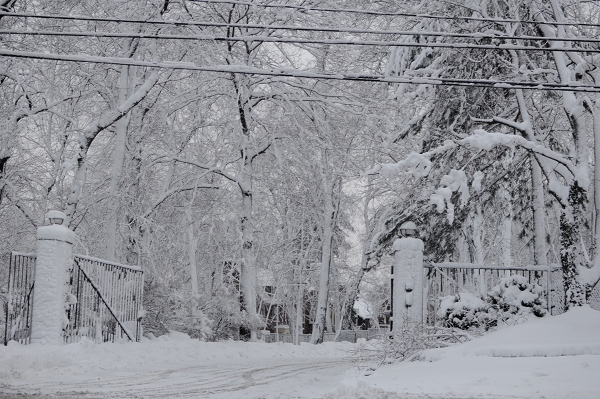
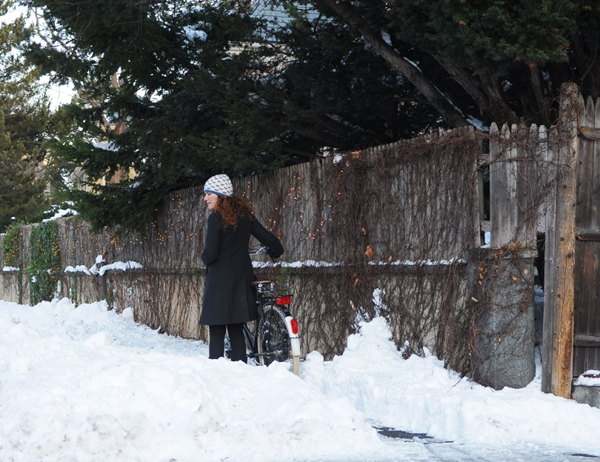
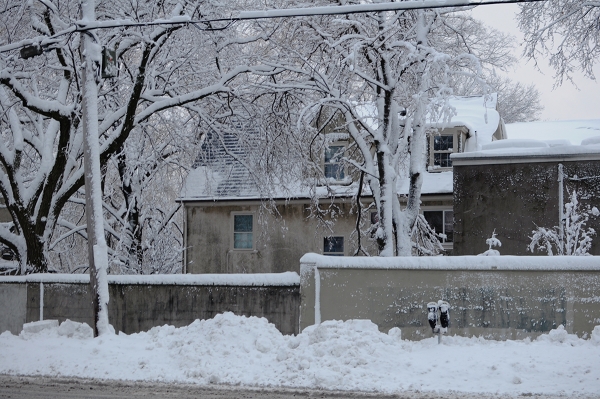
Yesterday, this was "the road" outside my house. Perhaps not surprisingly, last night I had a dream about this fellow. Though I am normally drawn neither to Surly nor to mountain bikes, I've had the hots for the Surly Pugsley since the first time I saw one a couple of years ago. I have no intention of getting one, honest. But part of me wishes I still lived in Northern NH, so that I'd "have no choice but to get it," you understand. I have seen pictures of that bicycle ridden through waist-deep snow, through soft sand, and crossing medium sized lakes. And something about the proportions seems just right to me, making the Pugsley an "ugly, in a handsome kind of way" type of bike. The Joe Viterelli of bikes, if you will.
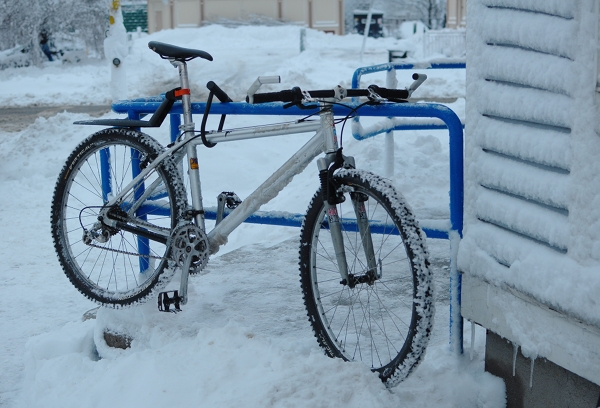
But whenever I bring up the Pugsley with its 3.8" tires as an example of a dream "winter bike," someone inevitably replies that "bikes with skinny tires are actually better in the snow" - which, no matter how many times a proponent of that concept tries to explain it, does not make a great deal of sense to me. While I understand that skinny tires can supposedly pierce through the snow, I am skeptical. Doesn't that mean the bike could easily get stuck? And why do I see only mountain bikes when there's significant snow on the roads?
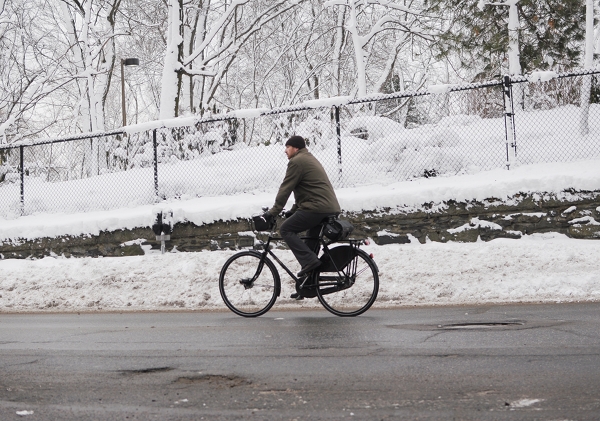
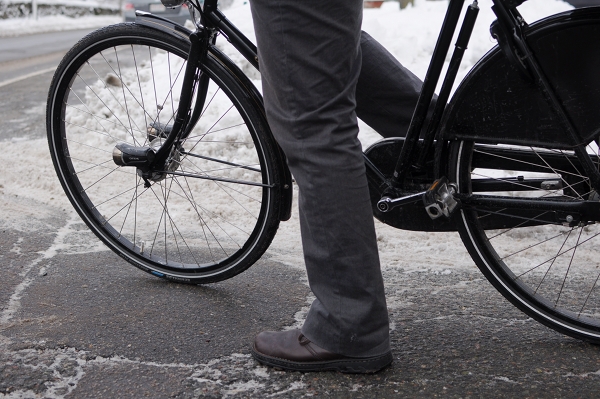
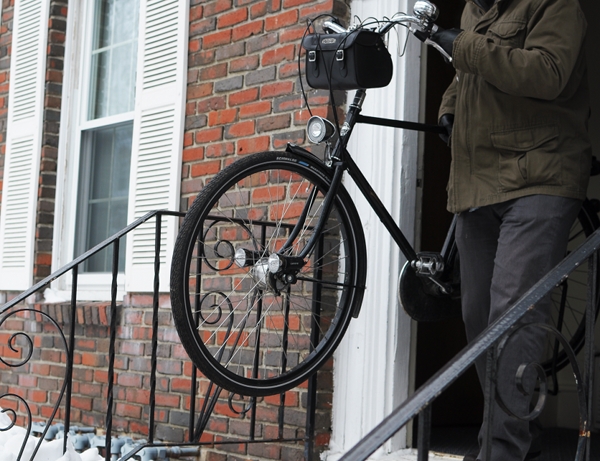
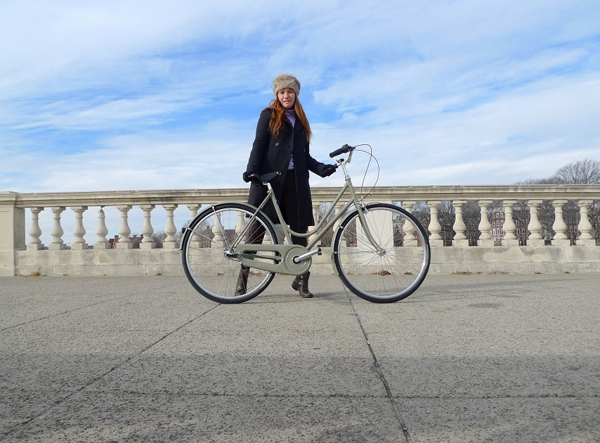
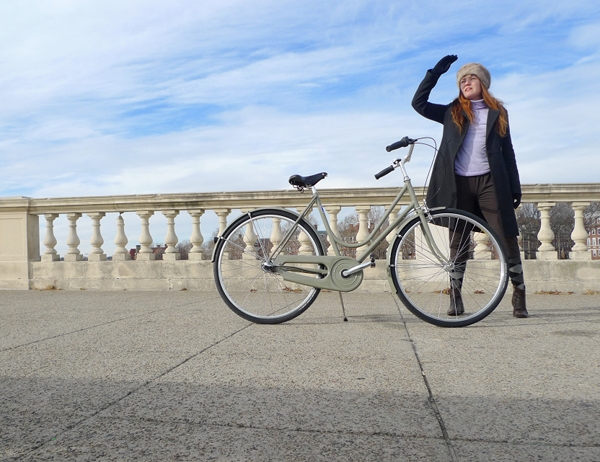
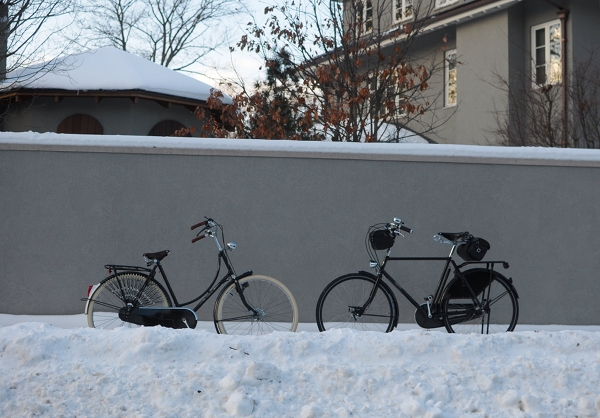
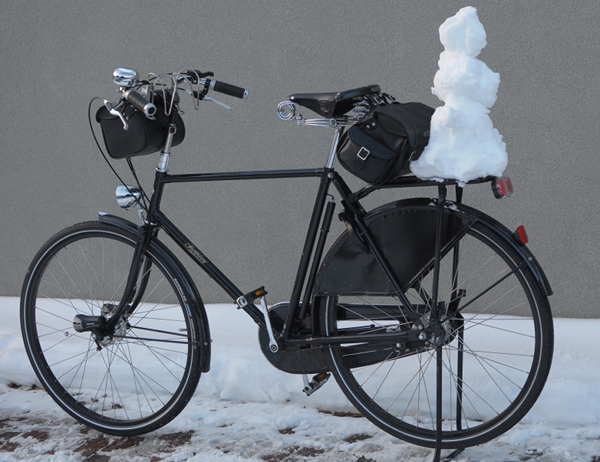
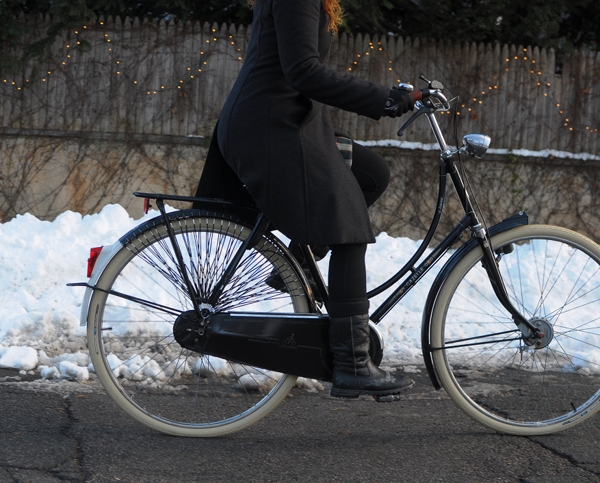
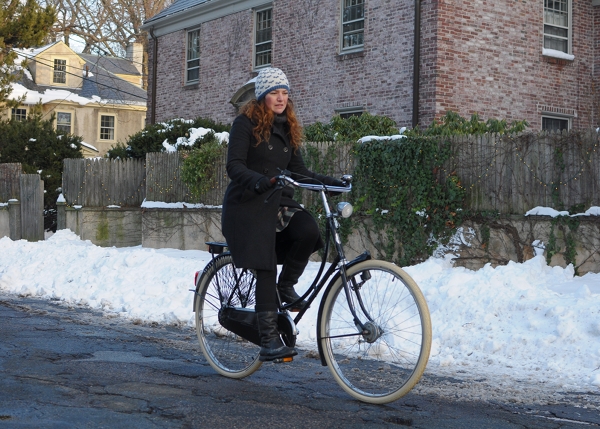
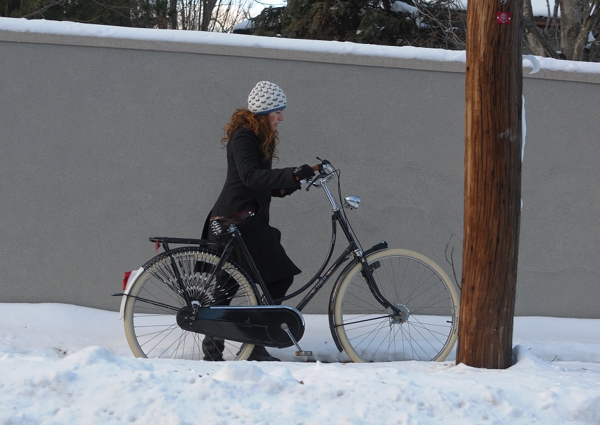
There is no doubt that my massively heavy, long wheelbase, 38mm tire Gazelle handles better when going over snow than the lighter and sprightlier 35mm tire Bella Ciao. But neither of them is sufficient when things get really bad. And oddly, on the worse days I actually find myself favouring the Bella Ciao, only because its easier to wield when acrossing enormous snowbanks. Poor bike, I look forward to seeing what the chain will look like under that nearly-but-not-quite-full chaincase after the winter is over...
If anybody out there is riding on streets that look like this, what bike are you riding and how is it working out for you? And if you say "skinny tires," I want pictures! As for me, I stayed indoors all day today - drinking tea, catching up on work, and daydreaming of crossing frozen rivers on a white Pugsley.
Showing posts with label winter cycling. Show all posts
Sunday, February 6, 2011
Thursday, January 27, 2011
Stop, Look Around...
All the walking I've been doing lately on account of the weather has made me pay even closer attention to my surroundings than I do while cycling. Everything looks different in the snow - elegant and magical. The thin patch of woods near my house has turned into a majestic white forest worthy of a 19th century Scandinavian painting. It's as if the sky was squeezed straight out of a tube of cerulean blue and the austere vertical strokes of the trees were applied with a pallet knife. It's not my style, but I am certain this scene has been painted many times. It's archetypal.
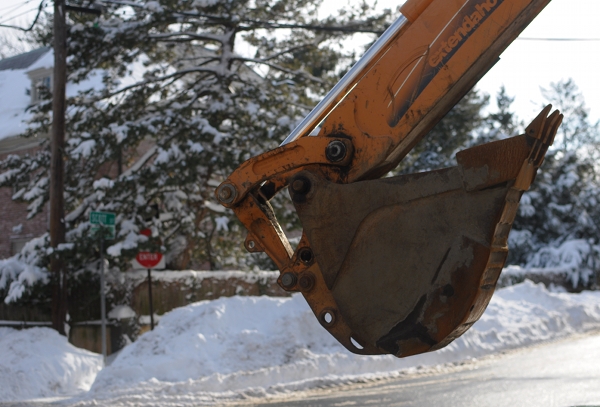
Upon emerging from the pristine wonderland, I came face to face with this. Literally: It was located at face level, and in my willingness to submerge myself so fully in my daydream, I nearly walked into it.
The city is using excavators to facilitate snow removal, as the plows alone are not enough. The effect is interesting, making the neighbourhood look like an igloo construction zone. In order to clear the center of the roads, the excavator dumps more and more snow to the sides - creating monstrous, densely packed snowbanks that line the streets like the walls of some arctic city-state.
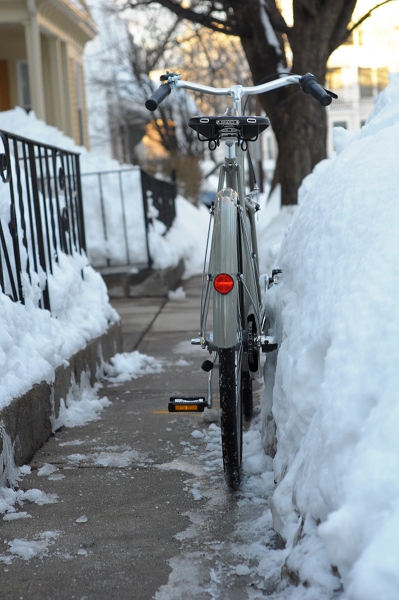
Walking on the sidewalk is a surreal experience. You are essentially in a tunnel - with buildings on one side, igloo wall on the other. Along some stretches, the snowbanks are taller than the average human height, so as a pedestrian I can only see the sidewalk in front of me and not the road to the side of me.
Those "Do Not Enter" and "Except Bicycles" signs are for a one-way side street that has a bike lane going in the direction against traffic. For most of last winter the lane looked like this. How cute that I complained about it then: This year it's been swallowed up by the snow banks entirely.
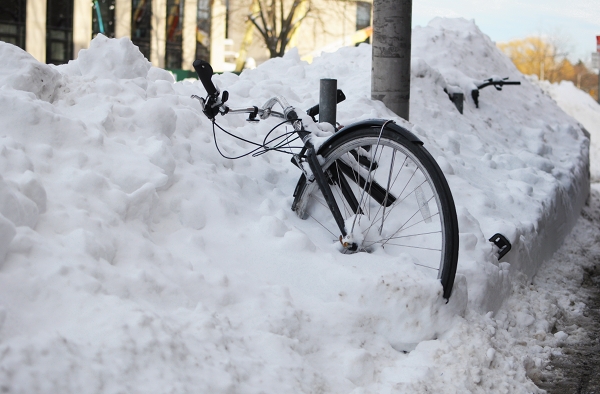
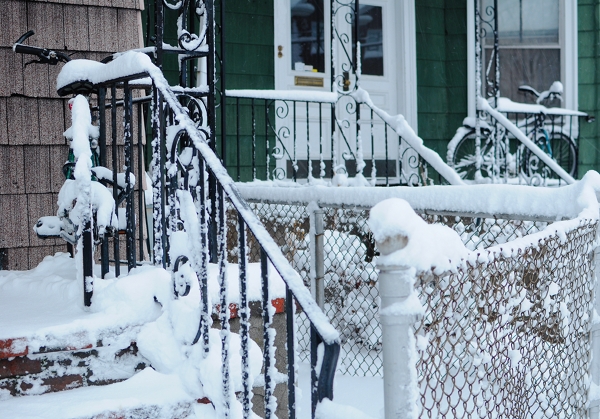
It is not uncommon to encounter bicycles "buried alive." There were actually three separate bicycles inside this snowbank.
Less common is the sight of a bicycle being ridden - but it happens, especially on the heavily salted main roads. Note how the yellow crosswalk sign, its reflection in the puddle, and the golden light of the setting sun play off the colours in the cyclist's knitted hat - all of it especially noticeable against the white, snowy backdrop. Somehow, everything seems to be reminding me of a painting these days. Certainly this person and his hat deserve to be painted.
It's been over a month and a half now without the car. We signed up for zipcar through the Co-Habitant's work, but have not used it yet. And ironically, the blizzards are making it easier to do without: With the roads as bad as they are, we wouldn't have been traveling to any photoshoots up North anyway, and so we don't feel as if not having our car is keeping us from accomplishing anything. We'll get the car fixed as it gets closer to Spring. But for now, it's been remarkably easy to just forget about that thing and for us both to get around entirely on foot and bike. And with so many snow days, I am rediscovering walking - which I appreciate for making me stop, look around, and see my neighborhood in a new light.
Upon emerging from the pristine wonderland, I came face to face with this. Literally: It was located at face level, and in my willingness to submerge myself so fully in my daydream, I nearly walked into it.
The city is using excavators to facilitate snow removal, as the plows alone are not enough. The effect is interesting, making the neighbourhood look like an igloo construction zone. In order to clear the center of the roads, the excavator dumps more and more snow to the sides - creating monstrous, densely packed snowbanks that line the streets like the walls of some arctic city-state.
Walking on the sidewalk is a surreal experience. You are essentially in a tunnel - with buildings on one side, igloo wall on the other. Along some stretches, the snowbanks are taller than the average human height, so as a pedestrian I can only see the sidewalk in front of me and not the road to the side of me.
Those "Do Not Enter" and "Except Bicycles" signs are for a one-way side street that has a bike lane going in the direction against traffic. For most of last winter the lane looked like this. How cute that I complained about it then: This year it's been swallowed up by the snow banks entirely.
It is not uncommon to encounter bicycles "buried alive." There were actually three separate bicycles inside this snowbank.
Less common is the sight of a bicycle being ridden - but it happens, especially on the heavily salted main roads. Note how the yellow crosswalk sign, its reflection in the puddle, and the golden light of the setting sun play off the colours in the cyclist's knitted hat - all of it especially noticeable against the white, snowy backdrop. Somehow, everything seems to be reminding me of a painting these days. Certainly this person and his hat deserve to be painted.
It's been over a month and a half now without the car. We signed up for zipcar through the Co-Habitant's work, but have not used it yet. And ironically, the blizzards are making it easier to do without: With the roads as bad as they are, we wouldn't have been traveling to any photoshoots up North anyway, and so we don't feel as if not having our car is keeping us from accomplishing anything. We'll get the car fixed as it gets closer to Spring. But for now, it's been remarkably easy to just forget about that thing and for us both to get around entirely on foot and bike. And with so many snow days, I am rediscovering walking - which I appreciate for making me stop, look around, and see my neighborhood in a new light.
Tuesday, January 25, 2011
Regular Wool vs 'Technical' Wool
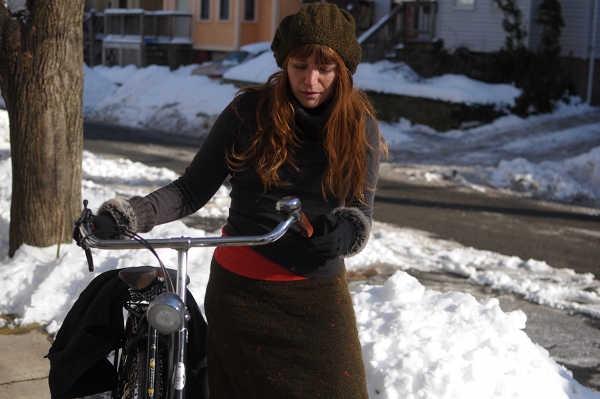
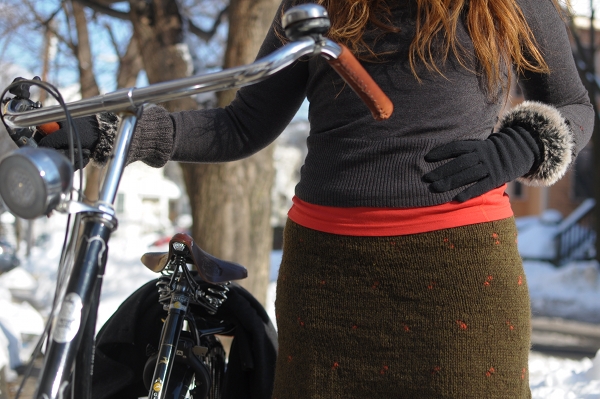
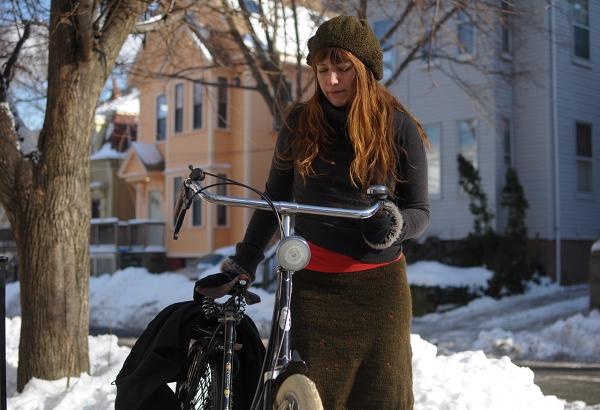
Despite this winter being colder than last, I am finding cycling in freezing temperatures easier this time around. The reason, is that I have finally surrendered to wool. Clad in head to toe wool, I no longer complain about the cold and life has gotten easier. Pictured here: a long sleeve wool t-shirt from Icebreaker (the red bit sticking out), wool sweater and gloves from Jigsaw, wool skirt and hat that I knitted myself, and wool coat (folded over the back of the bike) from Benetton. Not visible here are Icebreaker leggings, Smartwool socks, and I/O Bio underwear and bra - also all wool.
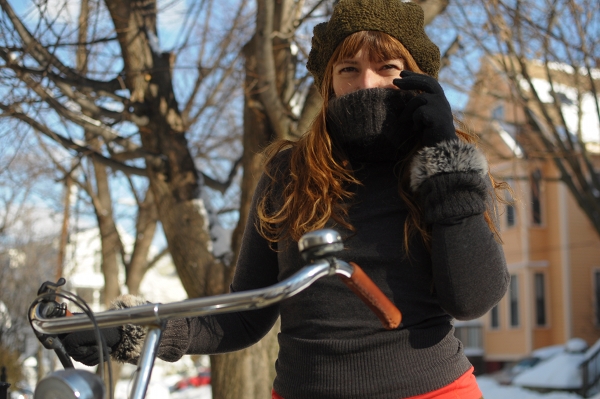
I've certainly worn wool in the past, and - like Dottie from Let's Go Ride a Bike - I have always loved sweaters with enormous turtle/cowl necks that can be unfolded over my face to protect against the frost. But before this year, I have limited wool clothing to outer layers, and did not think I was tolerant of wool right next to my skin. That was why I repeatedly ignored advice that was given me last year to buy lightweight "technical" wool. I remember trying to wear wool shirts and tights next to my skin before, and finding them irritatingly itchy. Today's manufacturers of technical wool - the most popular being Smartwool, Ibex and Icebreaker - promise featherweight, itch-free garments. But they are also super expensive. It took me a long time to suspend my disbelief and commit to giving these things a try, and it also took me a long time to find everything I wanted on sale. But now that I have, I can never go back. The stuff works, and it really is non-itchy - even for someone whose skin is normally sensitive to wool.
I am not sure how exactly "technical wool" is made, and most likely every manufacturer's version is different. But the idea is, that the merino fibers are kept super fine, but made to interlock in a way that results in efficient temperature regulation. In comparison, if you examine a "regular wool" garment - like the sweater I am wearing here - you will find that it is more porous, not quite as smoothly textured, and thicker. Even the finest merino and cashmere sweaters do not have the same tissue-weight quality and smooth, dense texture as the technical wool garments.
All this makes it possible to wear "technical wool" next to one's skin, and for those struggling with the cold, I would highly recommend it. Wearing a wool sweater and overcoat did nothing for me last year, when the stuff I'd wear underneath was made of cotton or some other fabric. My underlayers would get soaked with sweat, and then the wind would chill me to the bone when I would stop at intersections. The feeling of my skin being covered with frozen sweat underneath three layers of clothing was just awful. But wearing wool underwear, bra, tights, and long-sleeve tee, has solved this problem for me completely. As far as the difference between the popular brands, I think they are all pretty good and I just get whatever is on sale. For ultra-thin layers, I prefer Icebreaker. And I also love Icebreaker leggings - they are gusseted, whereas Smartwool leggings are not.
For layers that are not directly next to the skin, I find "regular" wool sufficient - either store bought wool clothing, or things I knit myself. While Smartwool, Ibex, Icebreaker and others do offer technical outer layers, I think it is just too expensive for most people to amass an entire wardrobe out of that stuff. And, of course, it is also stylistically limiting. For me, as long as the layers next to my skin are the technical garments, I can wear pretty much anything over them and it will feel fine. I like to knit my own hats and skirts, because making them is fairly easy and I can invent my own styles. But sweaters are complicated, so mine are all store-bought.
One thing to keep in mind, is that thin merino sweaters are usually warmer than chunky sweaters, because the tightly-knit merino is less porous. Unfortunately, I have noticed lately that even stores that used to sell simple wool sweaters no longer do: I could not find a single sweater at our local Gap, Old Navy, or Banana Republic stores that was 100% wool over the past couple of seasons - and I checked at various points in time out of curiosity. Several years ago, you could walk in and buy a wool sweater without a problem, so I wonder what accounts for this change. Has the price of wool risen? J. Crew still offers a good variety of merino sweaters, as well as cashmere, but I wonder whether that is on its way out as well. It would be a shame, since it seems that an increasing number of people are re-discovering the benefits of natural fibers over synthetics - particularly in the winter. What are your experiences with "regular" wool, "technical" wool, and other fibers?
Friday, January 21, 2011
The Least Daunting Option
Well, it seems that we've been having one of two weather conditions in Boston lately: (a) blizzard, or (b) in between blizzards. When it's the latter, I have been riding my bike - sort of. To be honest, I would not be doing it if I didn't have to, because the road conditions are pretty bad. But the bus makes me motion sick, the nearest subway stop is a 15 minute walk from our house (longer in the snow), and the sidewalks are slippery. So except on days when the roads are completely impassable, cycling seems to be the least daunting option. Still, "least daunting" doesn't mean "easy," and I've had to make a number of adjustments to the way I ride a bike, in order to be able to do it at all.
For one thing, I cycle much slower than usual, because I am scared of hitting not only ice patches, but those mini-mountains of hard snow that seem to pop up when I least expect them, like some treacherous obstacle course. Cycling slowly allows me to see them in time to either brake, or figure out how to go around them safely (I am a slow thinker when it comes to spacial rotation tasks). Happily, there are almost no other cyclists on the roads, so there is no one to get annoyed at my crawling speed - I've found that I can go as slow as I like, and no one seems bothered. I guess to cars, it's pretty much the same whether I am cycling at 7mph or 20mph: Either way, they are faster than me and will have to pass me eventually.
I also simply accept that I will have to get off my bike and walk a lot - across impassable stretches of slush and even over snowbanks. Sometimes I'll walk for a quarter of a block, then get back on the bike and ride for a couple of blocks, then get off again, and so on. It's annoying, but still better than walking the entire way - at least to me. Warmer and faster.
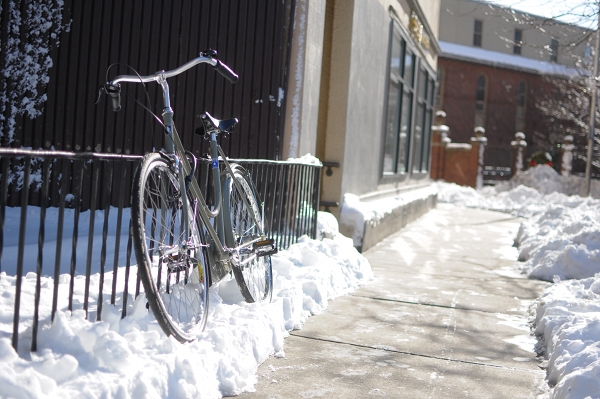
Finally, I've been having to get really creative about locking up my bike. Most bike racks have been made inaccessible by the surrounding knee-deep snow. So I will usually chain my bike to a fence, or whatever is handy - often having to rest it on top of a snowbank.
While all this is kind of miserable, I also find it pretty funny. I am not a "hard core" cyclist by any means and I am extremely risk averse. "Wimp" would probably be the appropriate word. And yet I am one of the few people out there on a bike, which does make me question my sanity. But I guess there is no better motivator than having no other choice - or at least no alternative options that are less daunting. Cycling in slow motion through a winter wonderland is not so bad, after all, when I compare it to feeling nauseous inside of a stuffy bus, or slip-sliding along icy sidewalks.
For one thing, I cycle much slower than usual, because I am scared of hitting not only ice patches, but those mini-mountains of hard snow that seem to pop up when I least expect them, like some treacherous obstacle course. Cycling slowly allows me to see them in time to either brake, or figure out how to go around them safely (I am a slow thinker when it comes to spacial rotation tasks). Happily, there are almost no other cyclists on the roads, so there is no one to get annoyed at my crawling speed - I've found that I can go as slow as I like, and no one seems bothered. I guess to cars, it's pretty much the same whether I am cycling at 7mph or 20mph: Either way, they are faster than me and will have to pass me eventually.
I also simply accept that I will have to get off my bike and walk a lot - across impassable stretches of slush and even over snowbanks. Sometimes I'll walk for a quarter of a block, then get back on the bike and ride for a couple of blocks, then get off again, and so on. It's annoying, but still better than walking the entire way - at least to me. Warmer and faster.
Finally, I've been having to get really creative about locking up my bike. Most bike racks have been made inaccessible by the surrounding knee-deep snow. So I will usually chain my bike to a fence, or whatever is handy - often having to rest it on top of a snowbank.
While all this is kind of miserable, I also find it pretty funny. I am not a "hard core" cyclist by any means and I am extremely risk averse. "Wimp" would probably be the appropriate word. And yet I am one of the few people out there on a bike, which does make me question my sanity. But I guess there is no better motivator than having no other choice - or at least no alternative options that are less daunting. Cycling in slow motion through a winter wonderland is not so bad, after all, when I compare it to feeling nauseous inside of a stuffy bus, or slip-sliding along icy sidewalks.
Tuesday, January 18, 2011
Showing Off or Showing How? On Bicycle Blog Exhibitionism
I've been having a discussion with a reader about "the exhibitionist culture of bicycle blogs" and more specifically, about "those girly bike blogs" that, in his view, are the most exhibitionist of all. This is a theme that keeps coming up now and again, and so I would like to say a few words on the subject. Certainly there are elements of exhibitionism to photographing yourself regularly and then posting those pictures on a publicly viewable website. My intent is not to debate this. But consider the possibility, that this element is not the main point.
Human beings tend to learn by doing - or at least by watching someone else demonstrating the doing, which automatically causes the viewer to imagine themselves in the doer's place. Pictures that show a real person - ideally the author of whatever narrative is being presented - performing the behaviour described in the narrative, are more engaging to viewers. In other words, a photo of me cycling through the park, followed by the text "and then I cycled through the park" will make the reader "feel" the experience more poignantly than a photo of the park alone followed by the identical text. This has been demonstrated countless times - mainly within the genre of empathy, motor mimicry, and emotional contagion research - and it is why instructional videos most typically have a human narrator who acts out the instructions.
Even in the absence of visual cues, first person narrative in itself is more engaging to readers than other forms of narrative. That is why fictional stories told in the first person, or personal accounts of events, are more interesting and memorable for most people than scientific writing.
As a graduate student, I once devised an experiment where participants were given sentences to read that contained identical information, but were phrased either in the first person ("I placed the shoe in the bedroom"), in the third person ("She placed the shoe in the bedroom"), or in the passive voice ("The shoe was placed in the bedroom"). When asked questions about the information later ("Where is the shoe?"), participants recalled it best when that information had been embedded in first person sentences. An interesting side-effect of this, was that people also tended to give more elaborate answers about the first person sentences, frequently adding extra information. For example: "The shoe is in the bedroom, on the rug by the dresser." To me, this means that the first person voice encouraged the reader to use their imagination more, essentially re-enacting the sentence in their mind and picturing themselves taking the shoe to the bedroom. Where would they have put it? Apparently on the rug, by the dresser.
It does not take a huge mental leap to see how this relates to bicycle blogs. By telling personal stories and by posting pictures of themselves engaged in the activities they write about, the so-called "girly bike blogs" make the cycling experience more poignant and memorable to a world wide web audience (especially if the members of this audience are not already bike enthusiasts) than dry, technical blogs ever can. While I seldom post diary-style entries where I discuss what I did that day, what I wore, what I had for lunch, etc., I enjoy other blogs written in that format very much and I find them helpful. Blogs like that do not only introduce ideas as mere concepts: They enable viewers to imagine integrating those ideas into their own lives. To call it gratuitous exhibitionism is to grossly undervalue their impact on audiences.
When it comes to females in particular, there are layers upon layers of self-consciousness about how we are perceived by others - formed by too many social, historical and evolutionary factors to mention here. But... so what? Depicting yourself as an actor - rather than a passive narrator armed with academic phraseology - is a means of connecting with an audience that is emotional and visceral. That might make it disconcerting to some, but it also makes it effective, as it taps into the most basic mechanisms underlying the human desire to communicate and learn. Sure, on some level, it may be showing off. But more significantly, it is showing how.
Human beings tend to learn by doing - or at least by watching someone else demonstrating the doing, which automatically causes the viewer to imagine themselves in the doer's place. Pictures that show a real person - ideally the author of whatever narrative is being presented - performing the behaviour described in the narrative, are more engaging to viewers. In other words, a photo of me cycling through the park, followed by the text "and then I cycled through the park" will make the reader "feel" the experience more poignantly than a photo of the park alone followed by the identical text. This has been demonstrated countless times - mainly within the genre of empathy, motor mimicry, and emotional contagion research - and it is why instructional videos most typically have a human narrator who acts out the instructions.
Even in the absence of visual cues, first person narrative in itself is more engaging to readers than other forms of narrative. That is why fictional stories told in the first person, or personal accounts of events, are more interesting and memorable for most people than scientific writing.
As a graduate student, I once devised an experiment where participants were given sentences to read that contained identical information, but were phrased either in the first person ("I placed the shoe in the bedroom"), in the third person ("She placed the shoe in the bedroom"), or in the passive voice ("The shoe was placed in the bedroom"). When asked questions about the information later ("Where is the shoe?"), participants recalled it best when that information had been embedded in first person sentences. An interesting side-effect of this, was that people also tended to give more elaborate answers about the first person sentences, frequently adding extra information. For example: "The shoe is in the bedroom, on the rug by the dresser." To me, this means that the first person voice encouraged the reader to use their imagination more, essentially re-enacting the sentence in their mind and picturing themselves taking the shoe to the bedroom. Where would they have put it? Apparently on the rug, by the dresser.
It does not take a huge mental leap to see how this relates to bicycle blogs. By telling personal stories and by posting pictures of themselves engaged in the activities they write about, the so-called "girly bike blogs" make the cycling experience more poignant and memorable to a world wide web audience (especially if the members of this audience are not already bike enthusiasts) than dry, technical blogs ever can. While I seldom post diary-style entries where I discuss what I did that day, what I wore, what I had for lunch, etc., I enjoy other blogs written in that format very much and I find them helpful. Blogs like that do not only introduce ideas as mere concepts: They enable viewers to imagine integrating those ideas into their own lives. To call it gratuitous exhibitionism is to grossly undervalue their impact on audiences.
When it comes to females in particular, there are layers upon layers of self-consciousness about how we are perceived by others - formed by too many social, historical and evolutionary factors to mention here. But... so what? Depicting yourself as an actor - rather than a passive narrator armed with academic phraseology - is a means of connecting with an audience that is emotional and visceral. That might make it disconcerting to some, but it also makes it effective, as it taps into the most basic mechanisms underlying the human desire to communicate and learn. Sure, on some level, it may be showing off. But more significantly, it is showing how.
Friday, January 14, 2011
The Case of the Disappearing Bike Lanes
One challenge to expect when cycling in the winter, is that bicycle lanes tend to "disappear" - either under snow banks, or under cars that take over the bike lane when snow covers their parking spots.
The pictures here are of Day 3 after our latest snow fall, and the plows have been working continuously. Still, the snow banks cover a good three feet or more of the the righthand side of the road in both directions.
For those who live in areas with well-developed cycling infrastructure, this change can be especially difficult: Accustomed to traveling almost exclusively via bike lanes, having to now cycle directly with car traffic can be a bewildering experience. That is one reason I think it is important to get comfortable with "vehicular cycling" even if it does not seem like you need it. Once the snow arrives, there is no way to tell what part of your journey will have the familiar bike lanes available and what part will dump you directly into the traffic lane.
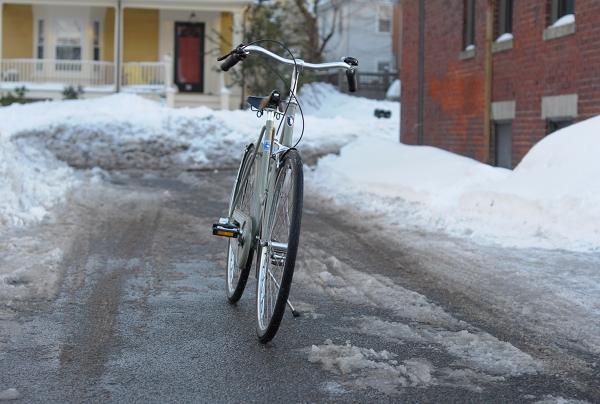
While side streets are quieter than main roads, the drawback is that they are not plowed as thoroughly. Here you can see that even the narrow space in the middle of the street is covered with a layer of snow. The car and the cyclist ahead must carefully navigate around each other in sharing this space, ideally at low speeds.
In addition to the limited space, there is also a greater number of obstacles in the road than usual: There are newly formed pot holes, which are not infrequently iced over, and also just chunks of snow and ice strewn all over. Cycling can feel like a technical trial, where the cyclist is forced to do a little dance to avoid ice chunks on one side and potholes on the other - all while remaining keenly aware of the presence of cars behind them.
I am not one to sensationalize the supposed dangers of cycling. But when the roads start to look like this, I think it is important to be aware of the potential pitfalls. All the things you took for granted earlier - from the texture of the asphalt, to the way your bike handles, to the availability of bike lanes, no longer hold true.
When the weather is like this, all you can do really is know what to expect - and use your judgment to determine whether you can handle it. While the presence of bike lanes is not particularly important to me, the loose chunks of hard snow and ice are what deters me from cycling just now. It's too stressful to navigate around them while dodging cars, so I will wait it out. The Co-Habitant, on the other hand, is delighted to ride in these conditions. To each their own!
Thursday, January 13, 2011
A Functional Blizzard
Yesterday's blizzard delivered even heavier snowfall than the first one we had, but our neighbourhood was a lot more functional and lively this time.
Lots of bikes buried in the snow, but I saw only two on the roads.
Mountain bikes are useful in these conditions - though the Co-Habitant says his Pashley handled fine as well. Apparently people photographed and videotaped him as he cycled to work.
Given the conditions outdoors, I was truly impressed with the relative normality of everything. Many businesses and institutions were open, people were out and about, and fewer things were cancelled than last time. In the morning, the electricity went out on our street for a few minutes, but then came right back on. And the lock on the outside door was frozen when I came home, so I had to work on it for a while before I could fit the key in. But other than that, we had no blizzard-related disturbances.
The Co-Habitant cycled to work as usual, but I set off on foot. Upon reaching the main road, I was surprised to see many other pedestrians trekking along it. There are some small grocery stores and restaurants along this street, so the trekkers must have been heading to and from these establishments.
This particular place of business was especially popular!
Lots of bikes buried in the snow, but I saw only two on the roads.
Mountain bikes are useful in these conditions - though the Co-Habitant says his Pashley handled fine as well. Apparently people photographed and videotaped him as he cycled to work.
Given the conditions outdoors, I was truly impressed with the relative normality of everything. Many businesses and institutions were open, people were out and about, and fewer things were cancelled than last time. In the morning, the electricity went out on our street for a few minutes, but then came right back on. And the lock on the outside door was frozen when I came home, so I had to work on it for a while before I could fit the key in. But other than that, we had no blizzard-related disturbances.
It is fascinating to me, that after only a few weeks of heavy snowfall my neighbourhood has already adapted to the new circumstances and normalised them - human beings are resilient! The atmosphere felt relaxed and not at all apocalyptic; it was a functional blizzard. And if this sort of thing continues, I will have to reconsider snow tires: Even the plowed parts of the roads were covered with at least a thin layer of snow. Turning the bike lanes into ski lanes would also work for me, but somehow I don't see that happening quite yet.
Friday, January 7, 2011
On Winter Skies and the Solace of Open Spaces
In a high school English class, we were once made to read an essay, called "The Solace of Open Spaces" by Gretel Ehrlich. I remember the piece only vaguely and don't want to spoil my memory's version of it by re-reading it today. It was about the great plains of Wyoming - or rather, about the author's reaction to their overwhelming vastness. I have never been to that part of the US and have not seen the landscape she describes. But I recall vividly the flash of self-recognition I experienced when reading her words. The solace of open spaces. Yes, that is how I feel.
Even as a child, I had the habit of wandering, of exploring - in a way that was driven not so much by curiosity or desire to conquer, but by what I can only describe as an emotional response to the act of moving through natural space. As a teenager I spent hours after school walking around the lakes near our house. And when I lived in England as a university student, there were these meadows that began just outside town and went on forever. I would walk through them, then turn around after an hour and lose myself in the views that surrounded me: The meadows stretched endlessly in all directions and the sky was close enough to touch. Just as the author of "The Solace of Open Spaces" describes, the vastness in itself felt sheltering - the outlines of the horizon creating the illusion of a domed structure.
In Boston, as in most cities, there is not much opportunity to experience vastness. I can cycle to the Harbor to get my fix, but somehow that only reminds me of how far removed I normally am from such a landscape; it is not part of my everyday existence.
And then yesterday, I was crossing a bridge over the Charles River and looked up at the sky. The sky was everywhere. And it was a winter sky - such a surreal, piercing shade of blue can only manifest itself this time of year. The black branches of the bare trees almost looked like bits of lace trim against the satin-white ribbon of the icy river, and the expanse of the sky itself seemed otherworldly. I felt light-headed and comforted at the same time, and the speed of the bicycle, with the icy wind against my face, accentuated the experience. While I know that this is just my way of dramaticising daily existence, I am nonetheless thankful for it. Life in general happens mostly in our minds, and now my mind is filled with winter sky, the sensation of speed, and the solace of open spaces.
Even as a child, I had the habit of wandering, of exploring - in a way that was driven not so much by curiosity or desire to conquer, but by what I can only describe as an emotional response to the act of moving through natural space. As a teenager I spent hours after school walking around the lakes near our house. And when I lived in England as a university student, there were these meadows that began just outside town and went on forever. I would walk through them, then turn around after an hour and lose myself in the views that surrounded me: The meadows stretched endlessly in all directions and the sky was close enough to touch. Just as the author of "The Solace of Open Spaces" describes, the vastness in itself felt sheltering - the outlines of the horizon creating the illusion of a domed structure.
In Boston, as in most cities, there is not much opportunity to experience vastness. I can cycle to the Harbor to get my fix, but somehow that only reminds me of how far removed I normally am from such a landscape; it is not part of my everyday existence.
And then yesterday, I was crossing a bridge over the Charles River and looked up at the sky. The sky was everywhere. And it was a winter sky - such a surreal, piercing shade of blue can only manifest itself this time of year. The black branches of the bare trees almost looked like bits of lace trim against the satin-white ribbon of the icy river, and the expanse of the sky itself seemed otherworldly. I felt light-headed and comforted at the same time, and the speed of the bicycle, with the icy wind against my face, accentuated the experience. While I know that this is just my way of dramaticising daily existence, I am nonetheless thankful for it. Life in general happens mostly in our minds, and now my mind is filled with winter sky, the sensation of speed, and the solace of open spaces.
Tuesday, January 4, 2011
Winter Starts without the Car
Sometime in December, the car which I don't myself drive but share with the Co-Habitant, announced to us that it needs some work. It's not a big problem, but it's quirky. Unable to agree on how to go about getting it resolved, our solution was to put off the decision until we have more time and can think clearly. In the meanwhile, we have been automobile-free for about two weeks - just in time for the snow!
As far as everyday necessities go, we have felt no adverse effects so far from the lack of car. The Co-Habitant typically cycles to work anyhow, and I always cycle to my meetings and errands. We can (though normally don't always) go grocery shopping by bike. And other crucial destinations - post office, bank, hardware store, art supply store, etc. - are within manageable distance as well. When the streets were un-cyclable during the blizzard, we worked from home and walked to the grocery store. If anything, not having a car feels liberating in this respect.
The problematic aspects surface when it comes to long-distance trips. For instance, our photo studio is 14 miles away. It is accessible via the subway system, but the T stop is a considerable walk from our house. That is okay, except that sometimes we transport huge and fragile objects to and from the studio - and that cannot really be done properly other than in our car. We also travel to remote places for photoshoots - and those trips will be suspended until the car is available again. There are other things, like not being able to go to specific supply stores that are in bicycle-unfriendly locations, as well as trips that involve large and heavy cargo. So far we have dealt with these things by either finding alternative (but not ideal) solutions, or postponing them. And while for two weeks that's fine, I wonder how we will feel about it after several more weeks pass.
At the heart of my transportation preferences is a need to feel independent, and most of the time cycling fulfills this need for me better than other options. But sometimes the car is the appropriate tool for the job, and I have nothing but respect for the automobile in that context. I am hoping this carless period will clarify for us, what it is that we actually need from the car given our current lifestyle.
As far as everyday necessities go, we have felt no adverse effects so far from the lack of car. The Co-Habitant typically cycles to work anyhow, and I always cycle to my meetings and errands. We can (though normally don't always) go grocery shopping by bike. And other crucial destinations - post office, bank, hardware store, art supply store, etc. - are within manageable distance as well. When the streets were un-cyclable during the blizzard, we worked from home and walked to the grocery store. If anything, not having a car feels liberating in this respect.
The problematic aspects surface when it comes to long-distance trips. For instance, our photo studio is 14 miles away. It is accessible via the subway system, but the T stop is a considerable walk from our house. That is okay, except that sometimes we transport huge and fragile objects to and from the studio - and that cannot really be done properly other than in our car. We also travel to remote places for photoshoots - and those trips will be suspended until the car is available again. There are other things, like not being able to go to specific supply stores that are in bicycle-unfriendly locations, as well as trips that involve large and heavy cargo. So far we have dealt with these things by either finding alternative (but not ideal) solutions, or postponing them. And while for two weeks that's fine, I wonder how we will feel about it after several more weeks pass.
At the heart of my transportation preferences is a need to feel independent, and most of the time cycling fulfills this need for me better than other options. But sometimes the car is the appropriate tool for the job, and I have nothing but respect for the automobile in that context. I am hoping this carless period will clarify for us, what it is that we actually need from the car given our current lifestyle.
Saturday, January 1, 2011
Some Hopeful Non-Resolutions
I don't know about you, but New Year's resolutions never seem to work for me - my resolve melting away with winter's first snowman. So doing away with the futile ardor of determination, I instead put forth some hopes for this brand-new year:
In 2011 I hope to...
. learn to mount and dismount a bicycle "properly",
. complete my first "century" (100 mile) ride,
. go on my first multi-day trip by bike,
. cycle in Ireland (where I am likely to be in March),
. finally stage some bicycle photoshoots in our studio,
. finish and give away (yes, give away!) my "roadbike for ladies",
. do a good job on my Bella Ciao project,
. have a chance to work on other interesting projects, and
. continue Lovely Bicycle on a close-to daily basis - rain or shine!
Of course, that's only the bicycle stuff, and there are many personal hopes as well. But somehow the bike stuff is easier to focus on - maybe because it is so specific, and at the same time, relatively detached from the stresses of "real life". It is funny that several readers have told me now, that they get the impression I am an organised person from reading the blog. In reality, my world is almost comically disorganised and chaotic. So perhaps Lovely Bicycle is my "wishful thinking" manifestation of how I'd like things to be. Is it time to get my life in order and really focus, as I am able to focus here? Maybe. Or at least something worth considering. What about you and your hopes - or, dare I say, resolutions - for 2011?
In 2011 I hope to...
. learn to mount and dismount a bicycle "properly",
. complete my first "century" (100 mile) ride,
. go on my first multi-day trip by bike,
. cycle in Ireland (where I am likely to be in March),
. finally stage some bicycle photoshoots in our studio,
. finish and give away (yes, give away!) my "roadbike for ladies",
. do a good job on my Bella Ciao project,
. have a chance to work on other interesting projects, and
. continue Lovely Bicycle on a close-to daily basis - rain or shine!
Of course, that's only the bicycle stuff, and there are many personal hopes as well. But somehow the bike stuff is easier to focus on - maybe because it is so specific, and at the same time, relatively detached from the stresses of "real life". It is funny that several readers have told me now, that they get the impression I am an organised person from reading the blog. In reality, my world is almost comically disorganised and chaotic. So perhaps Lovely Bicycle is my "wishful thinking" manifestation of how I'd like things to be. Is it time to get my life in order and really focus, as I am able to focus here? Maybe. Or at least something worth considering. What about you and your hopes - or, dare I say, resolutions - for 2011?
Wednesday, December 29, 2010
Snow Queen!
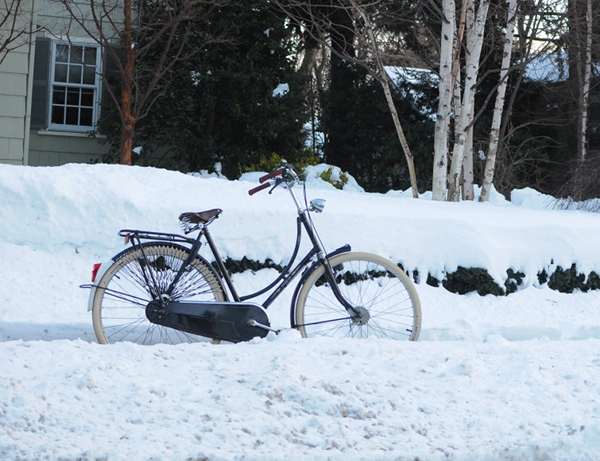
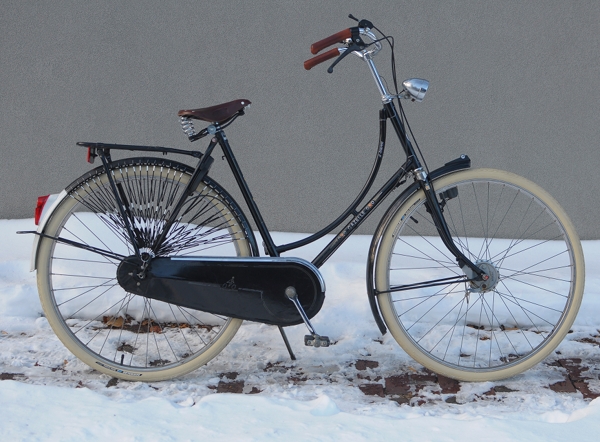
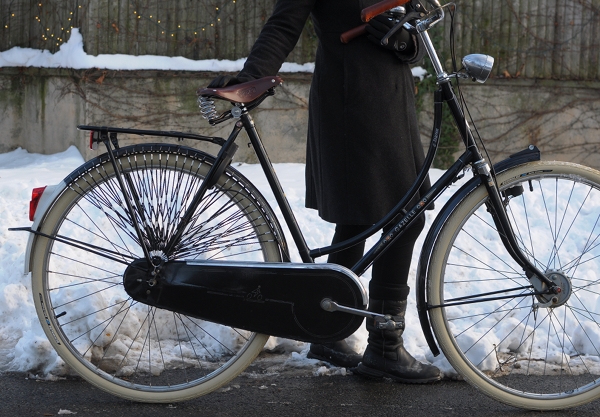
My Gazelle "Linda" has now been updated for the winter, with new tires and woven dress guards. She is a beautiful sight to behold against the snowy landscape!
The tire replacement was something that had to be done anyhow, as the original ones were cracked and I did not want them to fail in the winter. And of course, I was only too happy to replace them with my favourite cream Schwalbe Delta Cruisers. As for the woven dress guards, there was no reason for them what so ever, other than aesthetic caprice. I thought that Linda looked somewhat generic with the solid black vinyl dress guards, and I wanted to personalise her. We purchased the woven dress guards from Mike Flanigan of ANT and installed them by drilling holes directly into the fenders. I have close-up pictures of the installation and will write a detailed tutorial in a separate post, for those interested.
Riding the Gazelle with the new tires, I immediately noticed that she became a bit faster and quicker to accelerate. This echoes my experience with Delta Cruisers on other bikes - which is one reason I love these tires so much. They are the best combination of city/ sporty/ cushy/ all-weather I have found so far. And okay, it does not hurt that they are available in cream!
It was interesting to cycle on the Gazelle after such a heavy snowfall, and to compare her handling to the Bella Ciao - which I rode immediately after the previous snowfall. Somewhat to my surprise, they handle similarly at slow speeds (under 10mph)- which is the speed I stick to under winter road conditions. The Bella Ciao's superior responsiveness and the Gazelle's superior cushiness are considerably less noticeable when cycling gingerly over slush and ice patches. Their common qualities, however, are all the more noticeable: Namely, how well-balanced and stable they both are. The Pashley I rode last year had these same qualities as well - so I think that all three are great winter bicycles.
The Gazelle does have a bit of an edge when cycling over large formations of hardened snow, due to its wider tires. On the other hand, the Bella Ciao has a considerable "winter cyclocross" advantage: It is easier to drag, lift and carry when road conditions necessitate getting off the bike and moving it over heaps of snow or patches of ice. Overall, I am honestly not sure which I prefer, and I see the two bikes as representing different ends of my winter comfort zone spectrum. The Gazelle has a rack and lights, so by default I ride it more. But once I install these on the Bella Ciao, that may change. For those who have tried different upright transportation bicycles in the winter (i.e., Pashley vs Workcycles vs Retrovelo vs Rivendell vs ANT vs Abici, etc.), I would love to know what you think of the handling.
After the first two snow storms of the season, I can already tell that I will have an easier time cycling this winter than I did last year. Nothing has really changed in a drastic way, but maybe my balancing skills have gradually improved and my lungs have grown accustomed to cycling in freezing temperatures. And as far as aesthetics go, I really do think that it helps to have a bicycle that you are excited about as a winter bike, rather than a "beater". This helped me last year and it's helping me now. The winter landscape is so beautiful, that cycling through it on a bicycle I love (and feel safe on) makes it all the more special.
The tire replacement was something that had to be done anyhow, as the original ones were cracked and I did not want them to fail in the winter. And of course, I was only too happy to replace them with my favourite cream Schwalbe Delta Cruisers. As for the woven dress guards, there was no reason for them what so ever, other than aesthetic caprice. I thought that Linda looked somewhat generic with the solid black vinyl dress guards, and I wanted to personalise her. We purchased the woven dress guards from Mike Flanigan of ANT and installed them by drilling holes directly into the fenders. I have close-up pictures of the installation and will write a detailed tutorial in a separate post, for those interested.
Riding the Gazelle with the new tires, I immediately noticed that she became a bit faster and quicker to accelerate. This echoes my experience with Delta Cruisers on other bikes - which is one reason I love these tires so much. They are the best combination of city/ sporty/ cushy/ all-weather I have found so far. And okay, it does not hurt that they are available in cream!
It was interesting to cycle on the Gazelle after such a heavy snowfall, and to compare her handling to the Bella Ciao - which I rode immediately after the previous snowfall. Somewhat to my surprise, they handle similarly at slow speeds (under 10mph)- which is the speed I stick to under winter road conditions. The Bella Ciao's superior responsiveness and the Gazelle's superior cushiness are considerably less noticeable when cycling gingerly over slush and ice patches. Their common qualities, however, are all the more noticeable: Namely, how well-balanced and stable they both are. The Pashley I rode last year had these same qualities as well - so I think that all three are great winter bicycles.
The Gazelle does have a bit of an edge when cycling over large formations of hardened snow, due to its wider tires. On the other hand, the Bella Ciao has a considerable "winter cyclocross" advantage: It is easier to drag, lift and carry when road conditions necessitate getting off the bike and moving it over heaps of snow or patches of ice. Overall, I am honestly not sure which I prefer, and I see the two bikes as representing different ends of my winter comfort zone spectrum. The Gazelle has a rack and lights, so by default I ride it more. But once I install these on the Bella Ciao, that may change. For those who have tried different upright transportation bicycles in the winter (i.e., Pashley vs Workcycles vs Retrovelo vs Rivendell vs ANT vs Abici, etc.), I would love to know what you think of the handling.
After the first two snow storms of the season, I can already tell that I will have an easier time cycling this winter than I did last year. Nothing has really changed in a drastic way, but maybe my balancing skills have gradually improved and my lungs have grown accustomed to cycling in freezing temperatures. And as far as aesthetics go, I really do think that it helps to have a bicycle that you are excited about as a winter bike, rather than a "beater". This helped me last year and it's helping me now. The winter landscape is so beautiful, that cycling through it on a bicycle I love (and feel safe on) makes it all the more special.
Tuesday, December 28, 2010
Get in the Bunker, It's Snowing Out! Our Relationship with 'The Elements'
The blizzard that has swept over the East Coast in the past couple of days has left everyone stunned. After Boston received over a foot of snow within a 24-hour period and another half a foot the next day, life came to a halt. The street plows were quickly overwhelmed, a snow emergency was declared, public transportation ceased, and drivers were asked to stay off the roads. What had been a perfectly functional city only a day earlier quickly turned into a desolate snow-covered landscape. Our Cambridge/Somerville neighbourhood in particular resembled a Siberian village by Sunday evening, with only the rooftops and the tips of pine trees peaking out under a thick blanket of white, as the darkened sky continued to dump more powder onto the abandoned streets.
Our family phoned to ask how we were coping. Did we have enough food and was our heating working? I had to giggle at the imagery of being trapped in our home, eating canned food next to a space heater. After all, I had just returned from a mile-long trek to the grocery store, somehow managing not to perish in the process. I sympathise deeply with those whose travel plans were derailed because of the storm, and even more so with those who are stuck in airports. But I am surprised by the mass panic and the "hide in the bunker" sentiment of those who are merely staying at home in the city. We are not being bombed. The snow is not radioactive or poisonous (well, at least not significantly so). We can conquer it by... walking! and by wearing really warm clothing!
It seems to me that at least part of the problem, is that "dressing for the weather" has become a novel concept for so many people after years of driving. Despite living in a cold climate, a number of my friends simply do not own warm clothing. A thick wool coat and proper winter boots are not necessary for getting in and out of the car and walking across a parking lot, so why spend money on them? It makes sense, given an automobile-reliant lifestyle. But as soon as the car is unavailable or non-functional, you are trapped - and that is a horrible feeling for those who like to be independent.
Subscribe to:
Posts (Atom)