Showing posts with label drop bars. Show all posts

Friday, February 4, 2011

Cycling Indoors: the Kurt Kinetic Trainer

Last month I asked for advice about bicycle trainers, but after reading all the comments decided not to get one after all. It was the promise of horrific boredom that dissuaded me: I didn't want to get a trainer and then end up never using it. But several blizzards and several yards of snow later, I once again found myself climbing the walls and thinking that any way to be on my roadbike would surely do. My birthday is coming up, and so I asked the Co-Habitant to get me a trainer as an early gift - requesting that he do all the obsessive gadget research himself, and just present me with it as soon as possible.

He was suspicious at first. "You want a trainer. For your birthday? Are you sure that's a sufficiently ...romantic gift?"

"It's a fine gift. Totally romantic. Just get it for me, please."

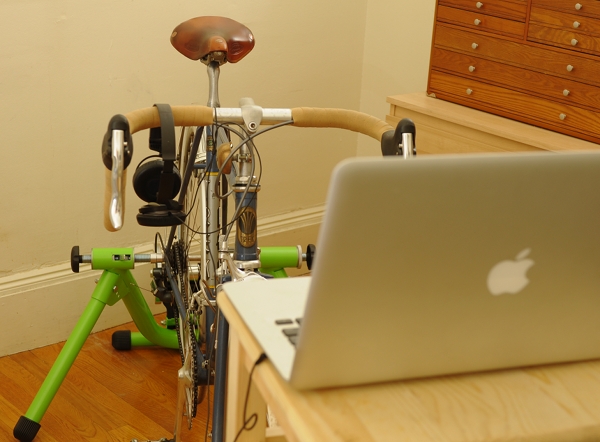
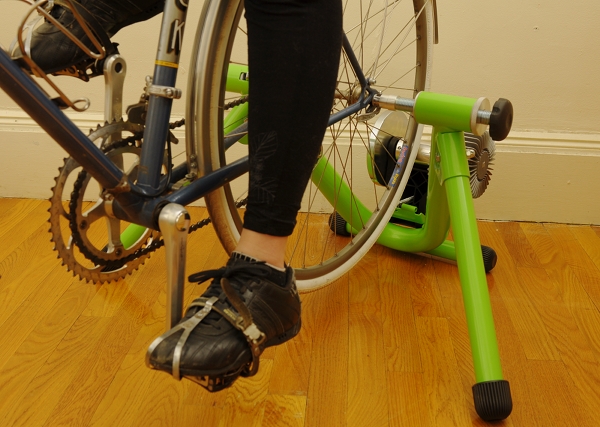
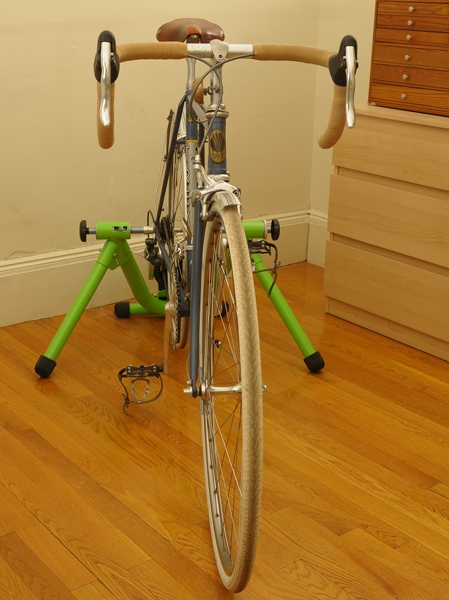
And so, since last week I have been the owner of a Kurt Kinetic Road Machine Fluid Trainer. The 2010 model was on sale at the Wheelworks in Somerville, MA (they had four left as of last week), and the opportunity was ceased. It is lime green and in no way blends in with any normal household decor. It is a good thing we have a "bohemian" apartment where pretty much anything goes, including a bike plugged into a neon contraption in the middle of the bedroom.

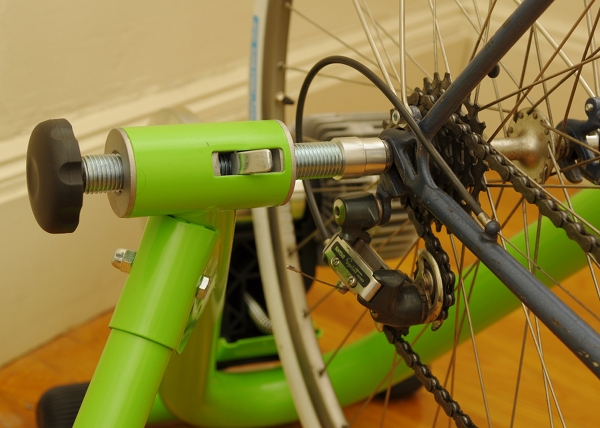
To set up the trainer, you have to attach the rear wheel of the bicycle using a special skewer, so that the tire rests firmly against the mechanism which provides resistance. I would describe the set-up process as somewhat tricky: You have to align the wheel just right and tighten everything just so.

As you pedal, the resistance from the trainer is similar to the resistance you feel when cycling on the road. Beyond that, I admit that I have no idea how it works, and am not particularly curious as long as it does the job. Some prefer to put a block or a riser under the front wheel, but I feel fine without it.

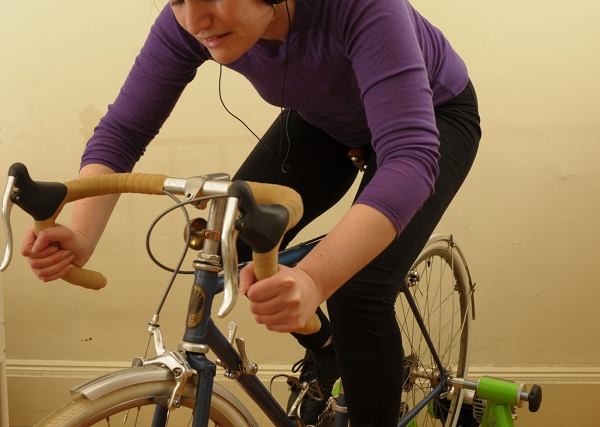
To me, using the trainer emulates the cycling experience realistically insofar that I am on an actual bike, and that the sensation of pedaling really does feel like being on the road. What's different, is that the bicycle doesn't lean, as would have been natural on the road, and - oh yes - that I am in my bedroom, staring at a wall and going absolutely nowhere. After the first time I used the trainer, it became clear that I needed visual stimuli - music alone was not sufficient to counteract the mind-numbing effect of looking at nothing.

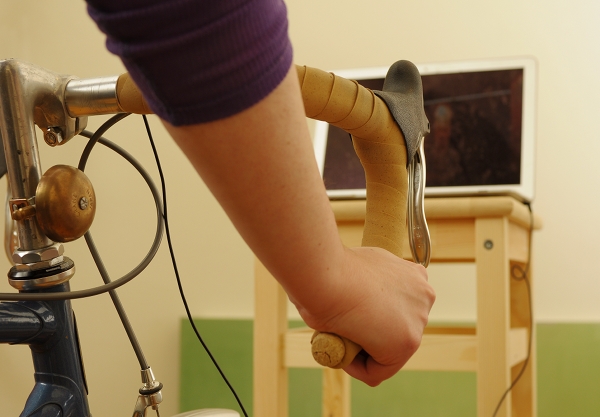
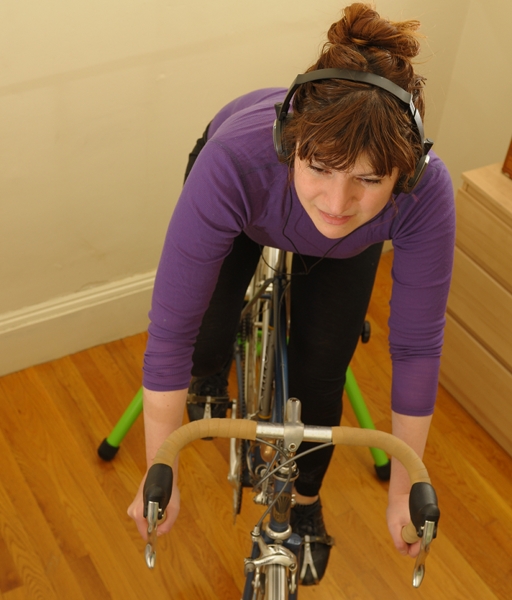
So I rigged up this "tower" using two wooden chairs (don't worry, they are very stable), which allowed me to place my laptop at eye level.

Thank goodness for Netflix and enormous earphones. The trainer is fairly quiet to begin with (the sound it makes is a sort of low hum - not high pitched or annoying), and if I had a TV rather than a tiny laptop, I don't think earphones would even be necessary. But the nice thing about using them, is that they drown out the sound of the trainer entirely, making it easier to get absorbed in the film and put my legs on autopilot.

It took me a couple of days on the trainer to learn how to pace myself. I guess on the road, there are factors that control my speed - traffic lights, obstacles, turns, and even just fear. With these factors gone, I had to keep forcing myself to slow down, so as not to get exhausted immediately. Watching a movie helps, because my pedaling starts to sync up with the highs and lows of the film - slowing down during the quiet parts and speeding up during the exciting parts. At the moment, I am able to keep going for 40 minutes at a time before needing to stop, but I am hoping to make it an hour by next week.

I don't want to give the impression that the trainer is anything other than what it is - a device that allows you to pedal your own bicycle as it remains stationary. The experience does not even begin to compare to "real" roadcycling, which to me is much more about exploration than about exercise. But if I approach it from the other end, and start with the given of wanting indoor exercise that emulates cycling, this trainer pretty much fits the bill. Having never tried others I can't compare, but the Kurt Kinetic trainer does everything I imagined a trainer doing, and it is quieter than I had hoped.

I think I have to face it that something in me has changed over the past year, and I now feel that my body "needs" strenuous exercise. I never thought that would happen to me, and I don't understand human physiology well enough to know how that works. All I know is, that I've been on a roadbike every day for the past week and I am feeling a little more like myself again. It's indoors, it's stationary and it's not real cycling - but I'll take it.

Sunday, November 7, 2010

Born for the Hills! A Review of the Rivendell Sam Hillborne

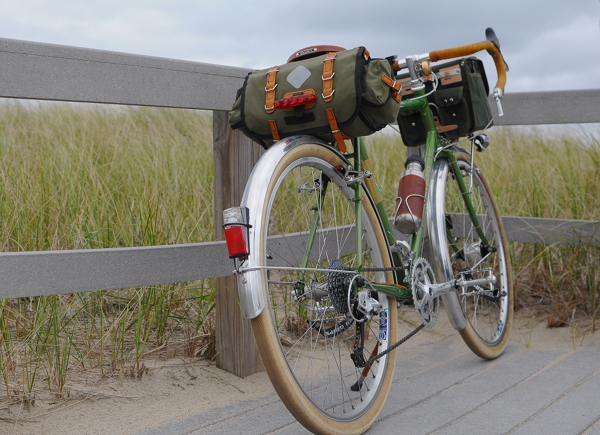
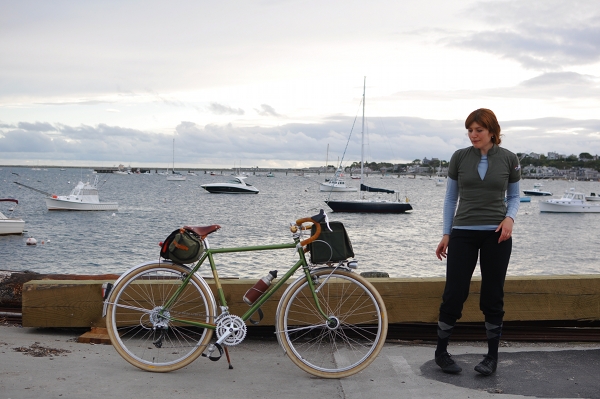
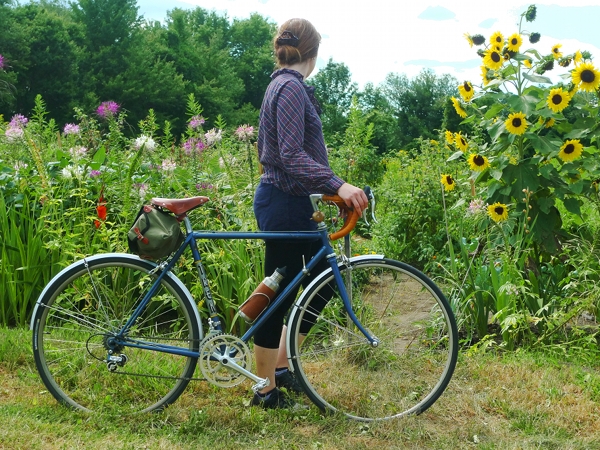
I have owned my Rivendell Sam Hillborne ("Graham Greene") for 6 months now, and have ridden it for 1,800 miles, which makes it long overdue for a review. The short version is: "I love it. I love it so much!" For the long version, read on.

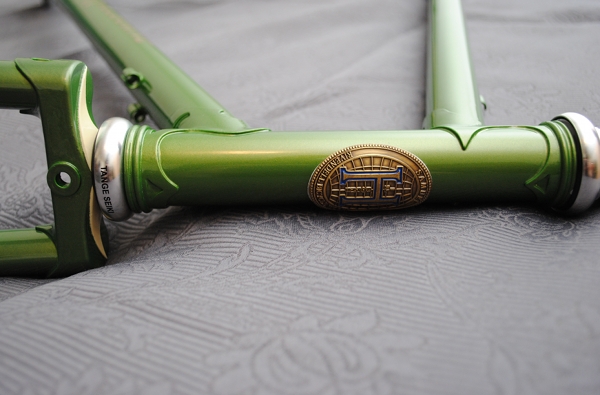
I received a Rivendell Sam Hillborne frame as a holiday gift in December 2009, purchased from Harris Cyclery in West Newton, MA. We were not yet comfortable building up a bike on our own, so the build was done at Harris as well. It took me a few months to save up for the components, and the bicycle was ready in the end of April. Note that Harris Cyclery was not a sponsor at the time, and that everything in relation to this bicycle was a standard purchase.

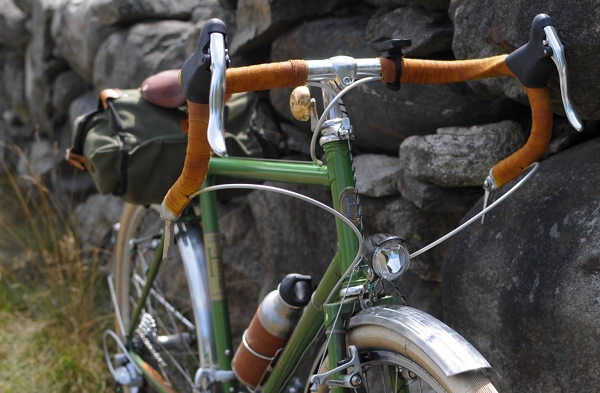
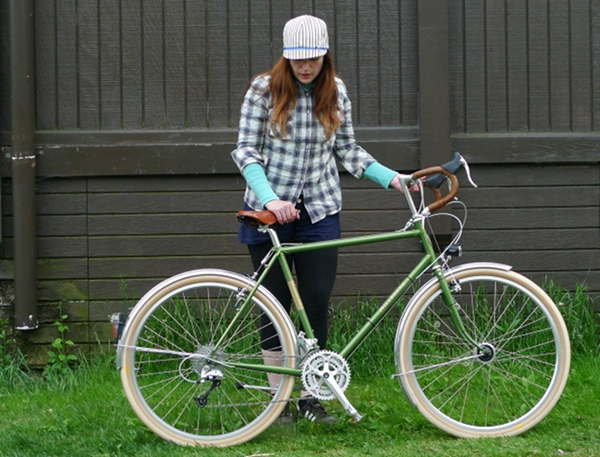
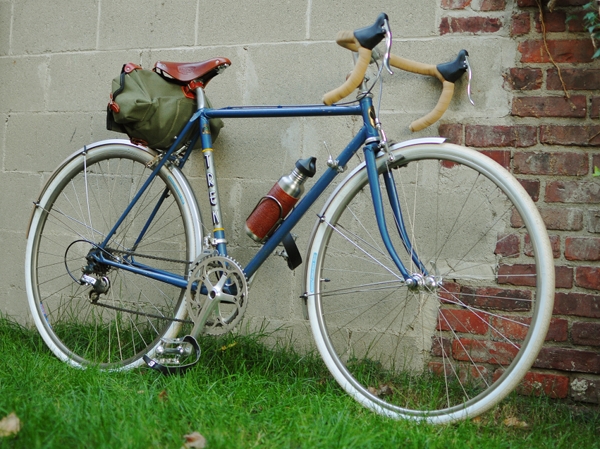
My choice of build for the Hillborne was informed by test-riding a floor model in my size. Since I had no real experience riding a roadbike at that point, I mostly went with recommended specs. These included a 3x8 drivetrain, Sugino cranks, Nitto Noodle handlebars with Silver bar-end shifters, and a Brooks B17S saddle. My 52cm frame was built for 650B wheels and cantilever brakes.

The three things I specifically chose for this bicycle were handbuilt wheels with dynamo lighting (see details here), Grand Bois Hetre tires (see review here), and Tektro short reach brake levers. The discovery of these brake levers was crucial for me. One thing that had hitherto prevented me from riding bicycles with drop bars, was my inability to squeeze the brake levers - especially from the hoods. I have small hands and I have damaged nerves in my hands. The combination made squeezing this type of lever impossible. When I described the problem to Elton at Harris Cyclery, we went through different brake levers to see whether any existed that I was able to squeeze. The Tektro levers were it and I am extremely happy with them. Elton also showed me some methods of hand and finger placement that work well for me and do not send electric currents through my fingers. I cannot stress enough what a break-through this was in terms of understanding why I was having problems riding with drop bars before.

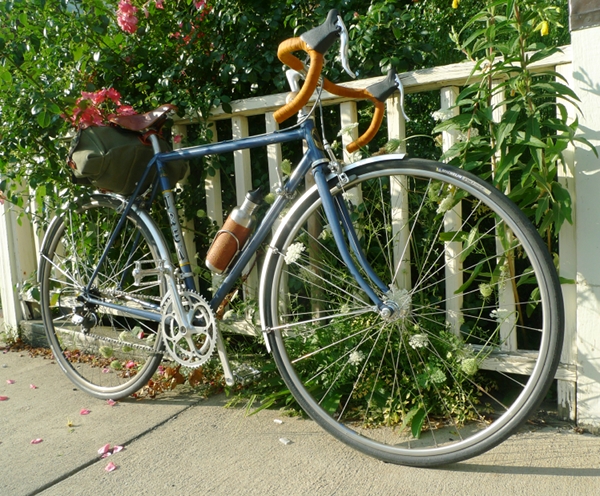
Over time, I added other personal touches to the bicycle. These include a Carradice saddle bag,

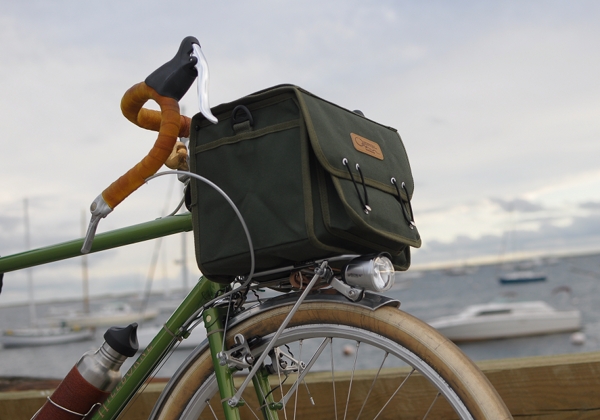
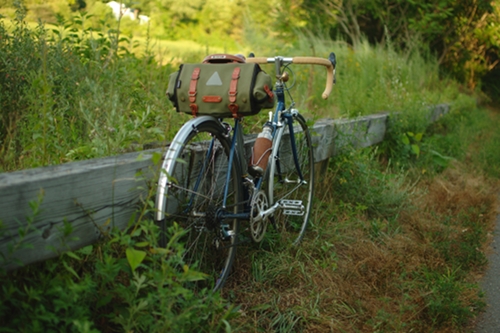
a Nitto M-18 front rack from Renaissance Bicycle (a sponsor), an Ostrich handlebag bag from Velo Orange which I use on long trips,

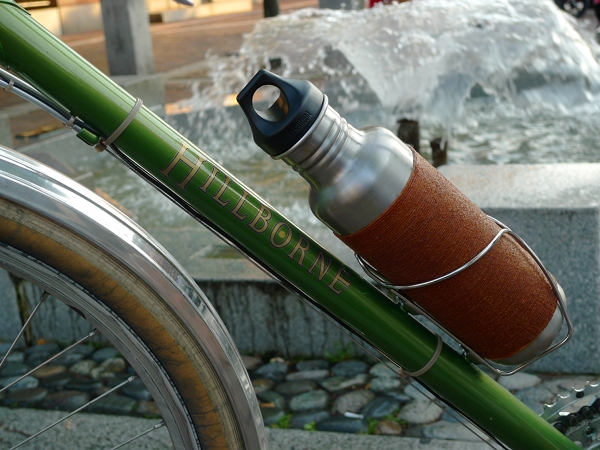
a twined and shellacked Klean Kanteen water bottle,

and my beloved Power Grips (see here for my initial review of them).

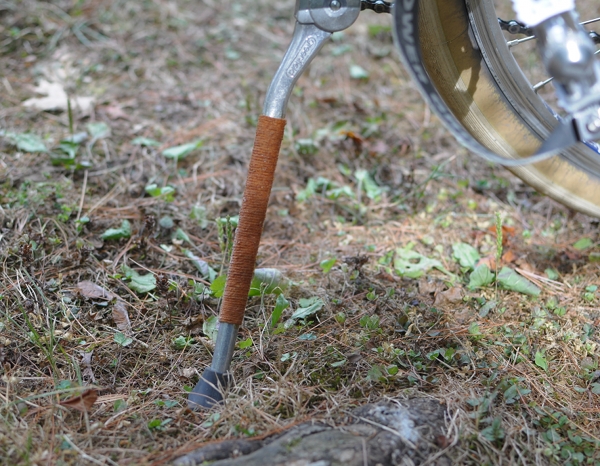
I have also twined and shellacked the kickstand (to prevent it from scraping against the pedal when the bike is parked),

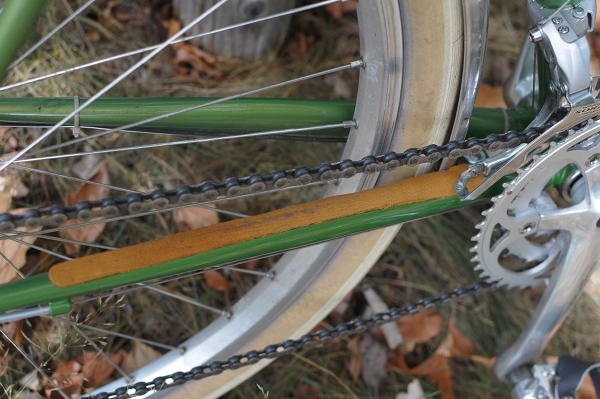
and added a leather Velo Orange chainstay protector. This product is great for preventing the paint on the right chainstay from getting nicked by the chain slapping against it when the bicycle goes over bumps - which began to happen to my Rivendell within the first few rides I went on.

There are a few additional little details that I enjoy, but no one else probably notices - like these green cable endcap crimps,

and the "taupe" zipties (see top right, under the waterbottle) for routing the dynamo lighting that I find to be less noticeable than black ones.

Over the time I have owned him, I feel that Graham has attained an appearance that is distinctly personalised. Looking at him reminds me of the many "firsts" I experienced on this bicycle: from learning to ride with drop bars to going downhill at 30 miles per hour, while cornering, with a full handlebar bag.

These experiences certainly did not happen all at once. After I first brought the complete bicycle home, I had a minor hysterical breakdown when the reality of owning it hit me. What on Earth would I do with such an expensive bike with drop bars? What if I wasn't able to ride it? The bike would end up standing in my livingroom as a beautiful, ridiculous testament to the gap between my imagination and my abilities.

This emotional self-flogging lasted for a couple of days, but then I began to ride the bike. I took it slow and started by setting the handlebars quite high, so that I could get used to the drop bars. The Hillborne has what I would say is a long top tube, and I have a short torso - so the degree of lean this placed me in required some adjustment on my part.

Over the course of the first month I owned the bike, I rode it almost daily and lowered the handlebars weekly - until eventually I was comfortable with them being at the level of the saddle. I would recommend this method to those who find dropbars intimidating.

I love pretty much everything about this bicycle and find it difficult to muster up any words of criticism. It may be worth noting that some dislike the slight upward slope to the top tube on the Hillborne, but I have no problem with it. If I have to find something bad to say, then maybe it's that the paint seems to be a bit delicate - but then I am used to powdercoat, and it's just a fact that liquid paint is easier to nick. I am equally happy with my choice of components - perhaps with the exception of the Shimano Deore rear derailleur, which I have managed to bang up pretty badly in the course of ownership. Next spring, I may replace it with the Shimano XT "Shadow," which seems more immune to abuse. Otherwise, everything is perfect.

I don't know how to describe the ride quality of the Sam Hillborne in technical terms, but in non-technical terms I feel as if I could live on it. Nothing hurts, ever. The bicycle is miraculously cushy over bumps.  There is no "toe overlap" with the front tire when turning. The seat tube angle is just right: relaxed enough to be comfortable without having to shove the saddle back on the rails, but not so relaxed as to stand in the way of "performance." I can keep up with the Co-Habitant just fine on the Hillborne, and he is a fast cyclist. The most challenging ride I have gone on so far has been a very hilly metric century (64 miles), and I felt great afterwards. No weight on my hands, no strain on my neck, no knee pain, just comfy cycling goodness. The bicycle seems equally stable at both high and low speeds. I can go over 20 miles per hour while feeling as if I am going 10 and I can plummet downhill while enjoying the view instead of panicking. It is also fantastic on climbs and seems to carry momentum well.

As I have mentioned at the start, I have now cycled 1,800 miles on this bike - which may be more than I have cycled on all my other bicycles combined. I had never imagined that I would be doing this much cycling, let alone on a roadbike. I know that it is all supposed to be about the cyclist and not about the bicycle, but I honestly do not think I would have come this far in my road cycling skills on a different bike, no way. I would even credit the Sam Hillborne with how well I took the track bike I rode in Vienna and to the Italian racing bike I subsequently built up as a fixed gear. Once I learned the skills on the Rivendell, I felt comfortable on other types of roadbikes as well - but I would not have been able to learn on them.

While the Sam Hillborne was great for me as a beginner, I am nowhere close to "outgrowing" it. If anything, I feel as if I am slowly growing into it and am only starting to appreciate its full potential. Next summer I am looking forward to doing some more extensive touring and attempting more challenging hills. After all - my bike was born for them.

Friday, August 27, 2010

Seymour Blueskies

As some have already noticed, I recently acquired one more bicycle that I have not yet written about. It is a vintage Trek roadbike - fast and aggressive, with super-responsive handling. Don't ask how I got the bike; sometimes these things just find you. It was in exactly my size, and came along at a time when I had begun to experiment with more aggressive road cycling. I wanted to try a "real" roadbike without spending more money, and here was my chance.

So please allow me to introduce Seymour Blueskies. He is a Trek 610, built in 1982. The lugged steel frame is made with Reynolds 531 tubing, and cro-moly fork and stays. The frame is 52cm, with 700C wheels. It is an interesting blue-gray colour that Trek called "gunmetal"in its catalogues.

The 610 was a higher-end model, and the previous owner built it up with nice components - though over the years they had become somewhat of a medley.

The wheels were handbuilt using Rigida racing rims with a gunmetal finish, a Campagnolo rear hub, a Suntour XC 9000 front hub, and double butted spokes. The drivetrain is Suntour Sprint 9000, with Suntour downtube shifters. The stem is vintage Nitto and the handlebars are ITM. The bicycle also came with a Brooks Finesse Titanium(!) women's saddle.

I have kept all of the components as they were, except for the brakes and brake levers, which we replaced with new Tektros. We also added cork bar tape, installed SKS fenders and a bottle cage, replaced the original clipless pedals with MKS Touring pedals (with Powergrips), and attached my Zimbale bag and a Crane bell from another bike.

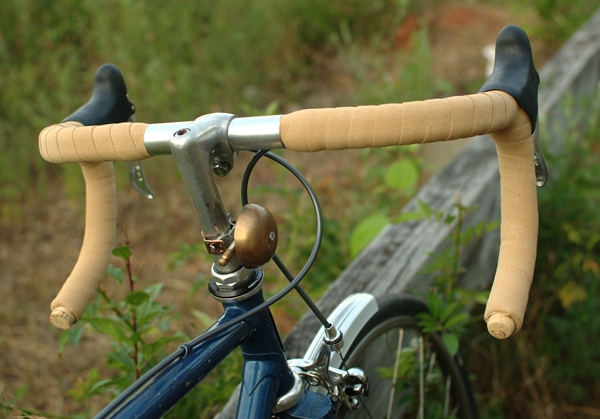
I prefer cloth tape on handlebars, but these bars have a weird, squared-off shape to them with a carved-out channel for cable routing. This can all be felt though cloth tape, making the bars uncomfortable to hold without a layer of cork. They are also a bit too narrow for me, and if the Trek ends up being a keeper I would like to replace them with something like Nitto Noodles, or a vintage equivalent.

The reasoning behind the SKS fenders was initially budget-driven, but I am very happy with this choice. They are quieter and less fussy than Honjos; I hardly even notice them. The Co-Habitant hates SKS fenders, because he thinks they are "ugly". I do not find them "ugly";  just more sporty than Honjos - which was exactly the look I was going for here. Incidentally - even with the fenders, saddlebag and waterbottle, the Trek is the lightest bicycle I own.

After a few weeks of ownership, I have also just replaced the original Michelin 25mm tires with 28mm Panaracer Paselas in white. The Michelins that came with it are supposed to be fantastic, but they felt hard as rocks and made for a very harsh ride. The Paselas, on the other hand, feel as if I am riding on a cloud. 28mm tires are probably the widest this bicycle will fit with fenders, and that is fine with me.

Now, for the ride quality... The vintage Trek handles very differently from the Rivendell Sam Hillborne. The best way I can describe this bike's behaviour, is that it wants to go fast and does not like to go slow. At slow speeds the Trek feels unstable and difficult to maneuver, especially when cornering. It took me a few rides to learn how to handle this without panicking, but eventually I got used to it. By the same token, it becomes amazingly stable and precise at fast speeds: Once I exceed 16mph, it seems to magically "relax" and almost floats above the asphalt. Accelerating is easy - almost too easy! One turn of the pedals, two turns - and before I know it, I am flying.  This is great fun now that I am more or less comfortable on a roadbike, but even a couple of months ago I would not have been able to handle this kind of cycling. When riding the Hillborne, I feel that I am exploring - I can go fast, or I can go slow. Riding the Trek, I feel that I preparing for a race - going slow is not really in the cards.

All other factors remaining equivalent (road and traffic conditions, my energy levels, etc.), the Trek is a faster ride than the Rivendell. I cannot tell how much faster exactly, because conditions are never identical on any two rides - but when the Co-Habitant accompanied me, he said the difference in my speed on the two bikes was noticeable. One explanation for this could be that the Trek's handlebars are set lower, but it could also just be that the bike is designed to be a bit racier. On the flip side of the speed advantage, the Trek is not as comfortable as the Rivendell (which is insanely comfortable) and encourages over-exertion - leaving me feeling far more exhausted after a ride. One curious thing about how I feel on the Trek, is that my hands always hurt at the beginning of a ride - but stop hurting as the ride progresses and I pick up speed. This is surprising, because when something hurts at the start of a ride, it typically only gets worse the longer I cycle - so each time I get on the bike I have to suspend disbelief and remind myself that my hands will stop hurting in a few minutes. And thankfully, they always do. I also find it challenging to hold the drop portions of the bars on the Trek (something I have already mastered on the Rivendell) without losing some control of the bike or at least weaving a bit. I am sure this will feel comfortable eventually, but I am not there yet. Just yesterday, I was finally able to use the downtube shifters for the first time - after having tearfully declared that they were "impossible" time after time on previous rides. Everything takes practice.

When I first got the Trek, I was not at all sure that I would be keeping it. We modified it just enough to make me comfortable, and it would be easy to resell this bike at no loss. I wanted to experience a "real" roadbike without the coddling qualities of the Rivendell, and now I have. So what next? Well, I don't know yet, but I don't really want to let it go. It has been bewildering to discover that I kind of, sort of might actually be good at road cycling, and I would like to see this discovery through. Depending on how much time I have in a day for a ride, I take either the Rivendell (for long rides), the Trek (for medium, but fast paced rides), or the fixed gear Moser (for shorter, intense rides) - and together they are helping me understand my potential.

Wednesday, August 18, 2010

Cycling Clothes for the Lycra-Averse, Take 2

Last summer I wrote a post called Cycling Clothes for the Lycra-Averse, in which I explained my inability to wear synthetic fabrics (including lycra) and described my alternatives for sporty rides.  These included leggings, gauzy tops and breezy mini-dresses made of natural fabrics. Those outfits worked for the gently paced and mostly flat 20 mile rides I did at the time. But this year, as my rides grew longer and more intense, these outfits soon became unsuitable. At this point I feel that I need proper cycling clothes, and here is why:

1. Seams: The "normal" cotton leggings I love so much have seams at the crotch. The seams are fine when cycling upright, or semi-upright, or even partly leaned over. But once I adopt a more aggressive cycling posture and travel that way for over 40 miles... let's just say the seams are not a friend to a lady's anatomy. Not at all. I do not necessarily need padded shorts, but I do need something with a generous placket down there that will re-route the seams away from the sensitive areas.

2. Fluttering: Breezy tops are great for letting air circulate. But at speeds over 16mph or so, they begin to flutter against my skin in a way that feels like Chinese water torture and drives me nuts. I want something that is tighter around my body and will not flutter.

3. Stuff getting caught on/in the bike: I know that there are ladies out there who wear cute little dresses and "skorts" on diamond-frame roadbikes. Bravo to you, I mean that!  I, however, seem to have a talent for getting the hems of skirts, the tails of long shirts, and even the bottoms of loose shorts, stuck in various bicycle components and on the nose of the saddle when I mount or dismount a diamond frame roadbike. Therefore I have been moving towards wearing tighter clothing when doing this kind of cycling.

4. The "wet rag" effect: If I wear tighter cotton clothing to prevent the fluttering and the catching issues, I am faced with another problem. Cotton dries very slowly once it is wet, which means that if the clothing is snug and you sweat on a long and intense ride, it will plaster itself all over you like a heavy wet rag.  This becomes extremely uncomfortable, especially when there are temperature variations. Just imagine cycling wrapped in a wet washcloth!

In short, I understand that tight, seamless, moisture-wicking lycra cycling clothing were created for a reason. But while I understand that, I still cannot wear it due to my skin's rejection of synthetic fabrics (before anybody asks, I did give it a try). Many have suggested wool as an alternative, but after having already spent money on the lycra, I needed to recover and save up before giving the wool stuff a try. Last time I tried to wear wool next to my skin, it felt itchy and the memory of that is still strong. I am told the new merino is different, and I am slowly working up to believing that. In the meantime, my solution has been silk tops, and partly synthetic running tights.

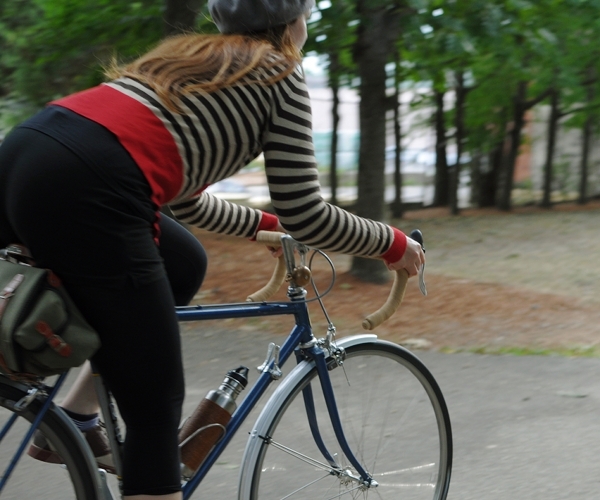
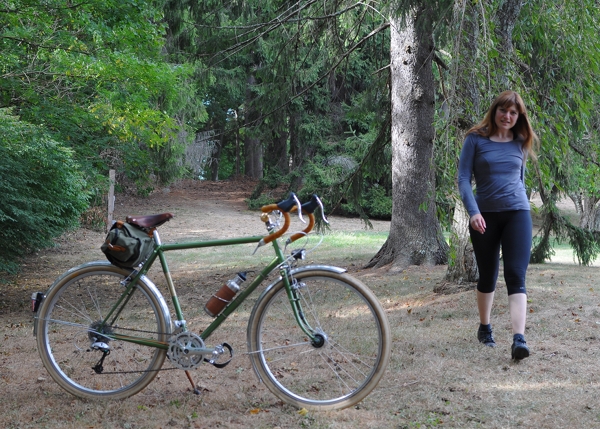
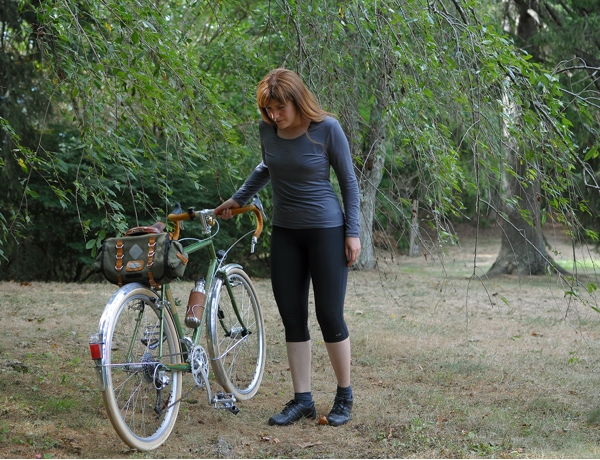
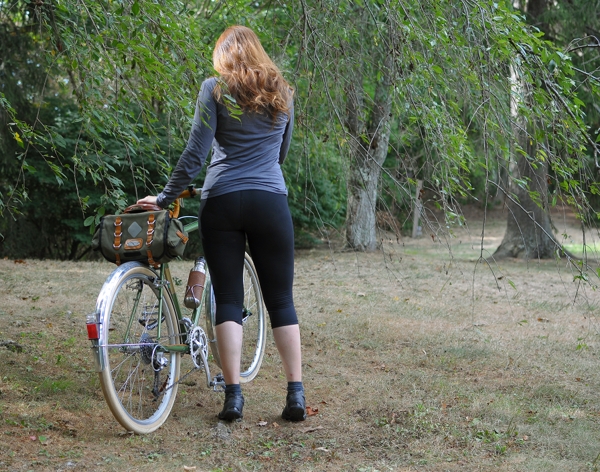
Silk has similar temperature regulating and moisture wicking properties as wool, and it dries almost instantly when you sweat. I have several long sleeve silk tees, as well as a silk sports-bra (from Wintersilks), and that is what I've been wearing. When we think of silk, we tend to imagine a slippery satiny material, but in actuality it exists in "normal" textures as well. The top I am wearing here feels like a jersey-knit long-sleeve tee. It has been great in the oppressive heat and humidity so far, and it almost does not flutter. The bottoms are Champion leggings designed for running. They are made from a cotton-spandex-lycra mix that is not quite as bad against my skin as 100% lycra, but still has wicking properties and, most importantly a seamless placket around the crotch. The placket is not as large as I would ideally like, but it's been all right for now.

This iteration of my "lycra-averse" outfit has been working on rides of up to 50 miles at a time so far, but I suspect that I will need something even more serious for longer rides. So there will probably be a Cycling Clothes for the Lycra-Averse, Take 3 when I finally get real cycling shorts and jersey in wool.

Sunday, August 15, 2010

Ladies Leading Double Lives: Sport vs Transport

Just as I have been experimenting with road cycling in parallel to using my bicycle for transportation, so have several other ladies with prominent bicycle blogs. 

[image via Simply Bike]

S. from Simply Bike normally looks like this when she cycles.  But above she is pictures riding across Iowa while taking part in RAGBRAI.  This was her first time on a roadbike! 


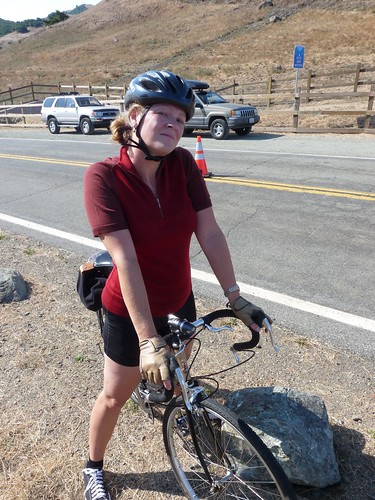
Adrienne Johnson of Velo Vogue dons bike shorts and a (surprisingly attractive) jersey as she cycles in the Marin Century.

[image via Meligrosa]

And here is Meligrosa, of Change Your Life Ride a Bike, who does not allow a mere 100 miles get between her and her Style (yes, with a  capital S!). 

[image via Suburban Bike Mama]

One of my favourite sporty cycling pictures is this one of Vee from Suburban Bike Mama, who normally rides a cargo trike, completing a triathlon last summer. 

[image via Chic Cyclist]

Of course the queen of the velo double life is Charlotte, of Chic Cyclists - who is as comfortable cycling to work on her upright city bicycle, as she is touring around France on her roadbike. Sigrid of My Hyggelig similarly alternates between her Pashley Princess and her Trek roadbike. And Justine,  of Midlife Cycling, cruises around New York City on her mixte and takes regular roadtrips to neighboring states. 

Over the past year I have noticed an increasing number of women who, after growing comfortable riding an upright bicycle for transportation, have begun to venture into sportier cycling, including club rides and touring. Being in this category myself, I have wondered whether this is a natural progression that will "stick," or whether it's the novelty of the bicycle that compels us to seek out different ways of using it in our lives. And if the latter, will we tire of it once the novelty wears off?  I also find it ironic that, after having cited "seeing roadies wearing special clothing" as a major reason why we were turned off from cycling in our pre-bike days,  many of us are now inching into that category ourselves. Not ironic as in "bad" or that I am critical of it, but ironic as in "something to think about". 

I am still not sure what I think about it myself. I have been spending a lot of time on my roadbikes (yes, plural now!) this summer, but I am conflicted in my attitude about this type of cycling. Since the start of summer, I have been flirting with the idea of joining some women's training rides that are offered to the public by a local cycling team. Given their criteria for minimum speed and skill level, I qualify. I have thought about it countless time, but have not joined - and the summer is nearly over. Maybe it's my general dislike of teams, authority, and group activities, or maybe I just don't want to admit that I am now that kind of cyclist. But am I? Maybe I should give it some time and see if it "sticks". 

Tuesday, August 10, 2010

Meet My New Cycling Coach - Francesco!

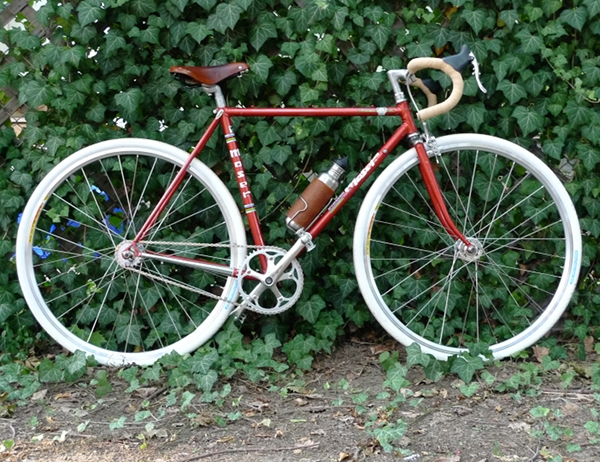
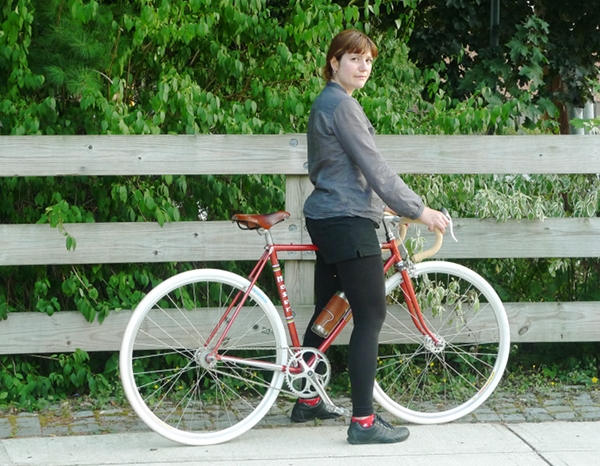
I had mentioned in passing that I brought a vintage frame with me from my last stay in Austria to build up as a fixed gear road bike... Well, here is the result:

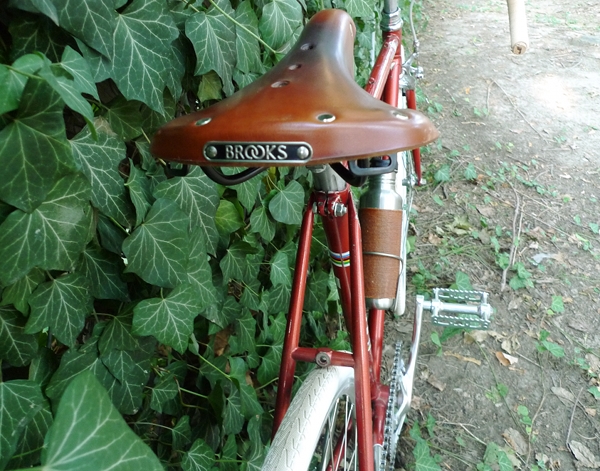
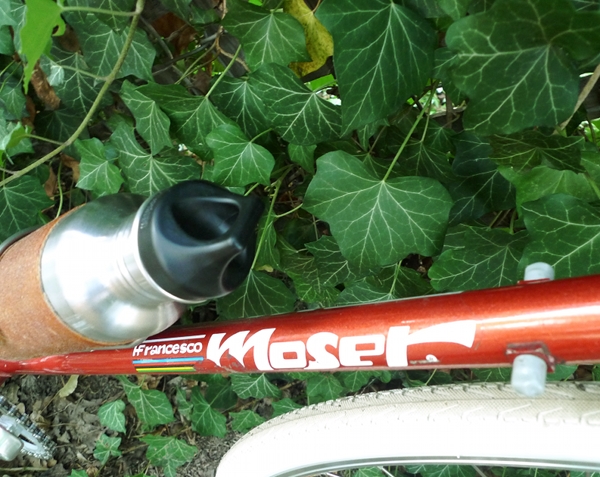
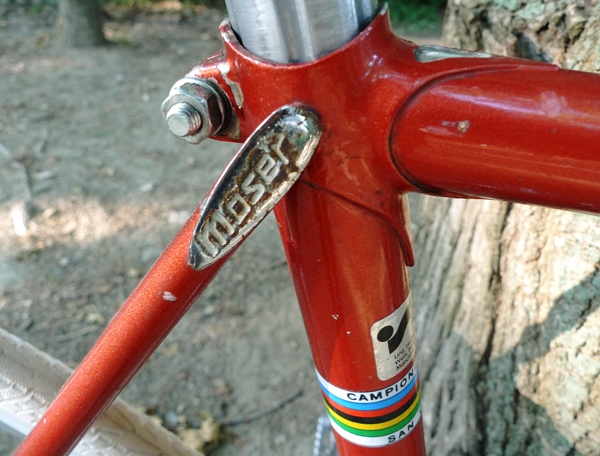
The frame is from a Francesco Moser "San Cristobal" roadbike, circa (I think) 1978. I got the frame from a friend of a friend and had a chance to try it when it was still a complete bike, so I knew it would fit me comfortably. The previous owner then stripped the frame of components and I mailed it to myself from Vienna, as this was by far the easiest option. It cost 20 Euros to send the frame from Vienna to Boston via the Austrian post. They instructed me to "wrap it so that it looks like a bike frame" rather than packing it in a bike box, and that is what I did. I wrapped the frame in bubble wrap, then in brown wrapping paper, and attached the address in several locations directly onto the wrapping. The package arrived at my door just over 2 weeks after I mailed it.

As you may have noticed, the Co-Habitant has turned into a bicycle mechanic this summer - to my appreciative delight, as I have neither the aptitude nor the time for it. He bought a bike stand, has accumulated the necessary tools for most jobs, and has been enjoying learning the ins and outs of bicycle repair. This was his first complete bike build, after he practiced with the fixed gear conversion on Marianne. As a mechanic he is meticulous, and this is reflected in the quality of the results. The bicycle is tight and smooth and noiseless and just the way I wanted it.

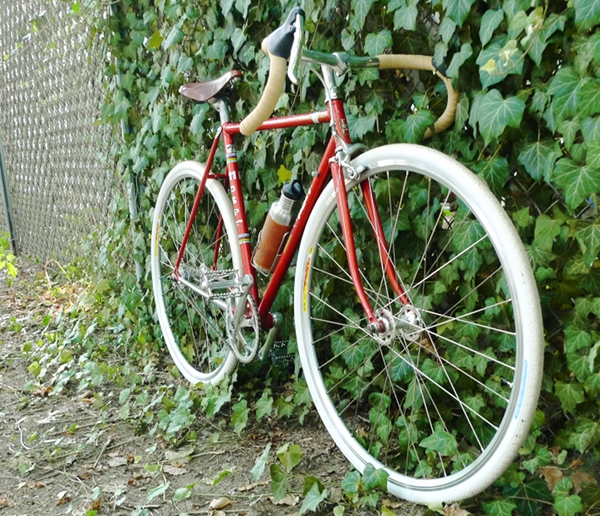
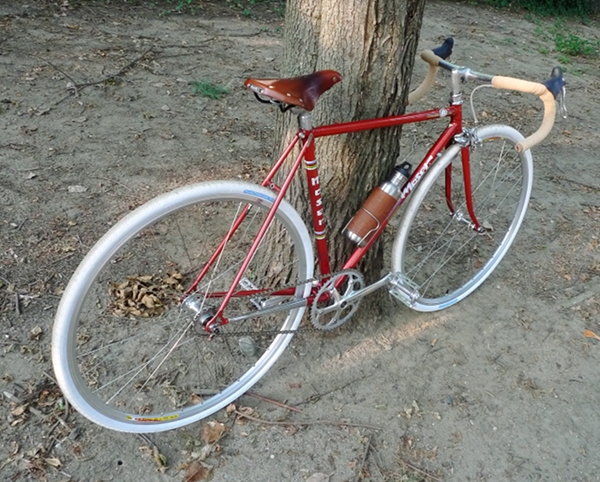
If you are interested in components, they include a Sugino RD2 crankset, a Mavic CXP2 wheelset, and white Panaracer Pasela tires (700x28C). The seat post (manufacturer unknown), stem (Nitto), handlebars (GB) and brake (Shimano, model unknown) were recycled from various used/vintage sources. The brake levers are the same Tektro short reach I have on my Rivendell, and these are pretty much the only roadbike brake levers that I am actually able to squeeze with my poor hands. I have both brake levers despite there only being a front brake, because I like to keep my hands on the hoods. The right lever activates the brake; the left lever is inactive. Though I find it silly to have a "blank" brake lever, I cannot think of a better solution.

As for the lack of rear brake, the reason is two-fold. First, a rear brake in unnecessary on a fixed gear bike. And second, our tire choice made the rear clearance too tight to allow one. It looks in the picture as if the bridge is actually touching the tire, but I assure you it is not. There is enough clearance so that it is perfectly fine to ride, just won't fit a brake.

This bicycle originally came with tubular wheels and narrow tires, so fitting it with 700C wheels and the cushy white 28mm Paselas was really pushing the limits of its clearances. But we decided to go with them, because these tires are just a spectacular ride, as well as a safer choice for my pothole-ridden "training route".  The larger wheels and tires also have the positive effect of raising the bottom bracket - which is a good thing for a fixed gear bike, as pedaling while leaning on a turn can potentially result in hitting the ground with the edge of a pedal. Needless to say, there will not be room for fenders on this bike. That is fine with me in this case, as the bicycle's purpose is entirely athletic. (Also, I think the "naked" white tires look quite good with the red frame.)

I should also mention, that while we built this bike up as a fixed gear, we did not file off any of the braze-ons or bosses. The rear derailleur hanger and the rear brake routing have been left as they were, and the downtube shifter bosses have been covered with these rubber "boss cozies" for safety and aesthetics.

Francesco Moser frames are quite nice, and are well-regarded in Austria. I am told that this model is made of Columbus tubing, though there is no longer a decal testifying to this.

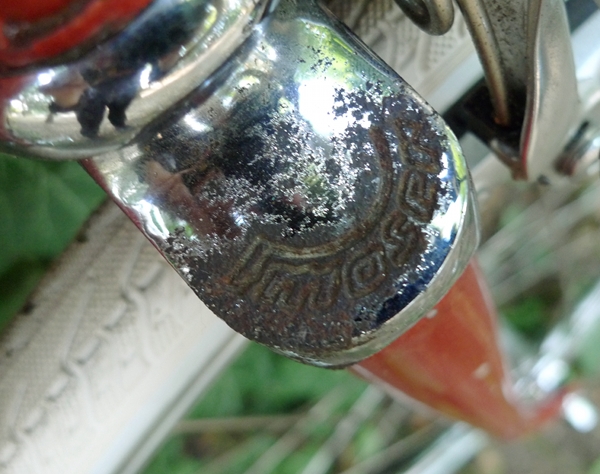
The frame is in great condition, except for some rust on these chrome parts. I plan to clean that up as soon as I determine what the safest method is.

Now that I have given all the excruciating details regarding the bike, some are probably wondering why in God's name I needed a fixed gear roadbike. Well, I'll tell you. I had been planning this ever since having ridden that trackbike in Vienna and discovering that riding a fixed gear bike helps me build up my road cycling skills. It does that by addressing my biggest frustrations, which are balance and coordination. I have plenty of endurance to cycle fast for relatively long periods of time, but I suck at pretty much every other aspect of cycling (for instance, making turns and cycling closely to others at high speeds). The aspect of fixed gear cycling that most people find difficult (the constant pedaling) I am fine with, which makes it the perfect tool to help me with the other stuff.

I have gone on two long rides on Francesco so far: a 26 mile ride with only very mild hills, and another 26 mile ride with steeper hills. Though the hilly ride was challenging, I have not experienced any pain or discomfort, despite this bicycle's aggressive geometry.  Francesco seems like he will be a great cycling coach, and I look forward to getting to know him better.