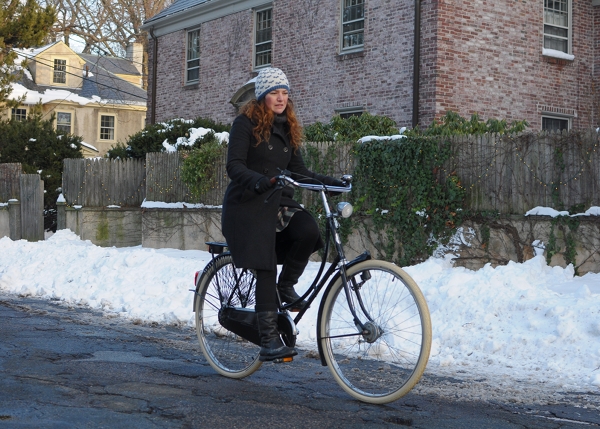
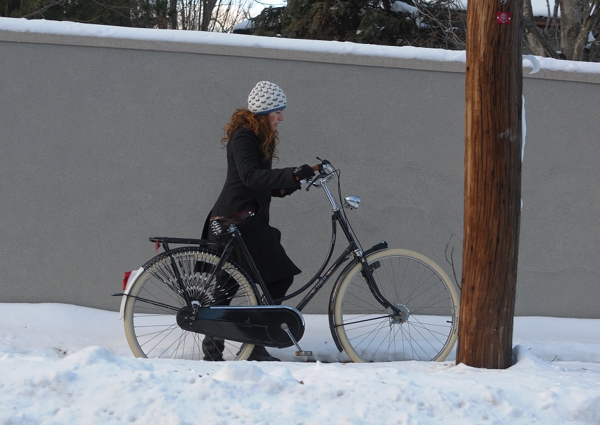
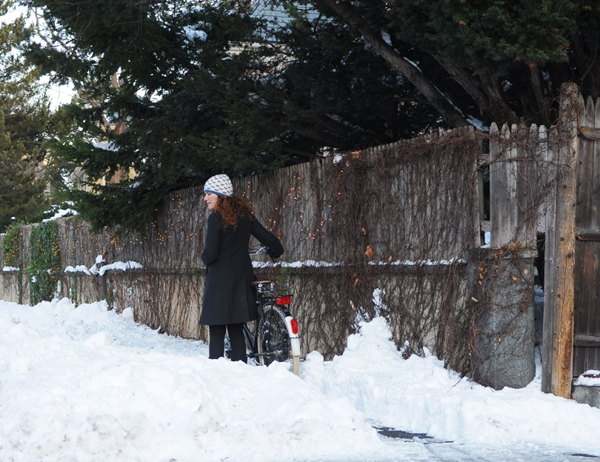
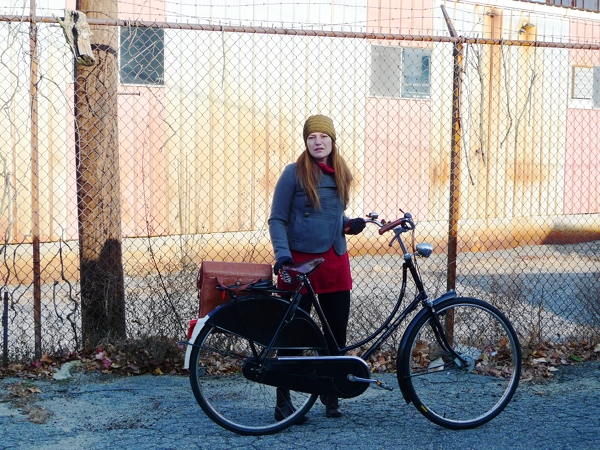
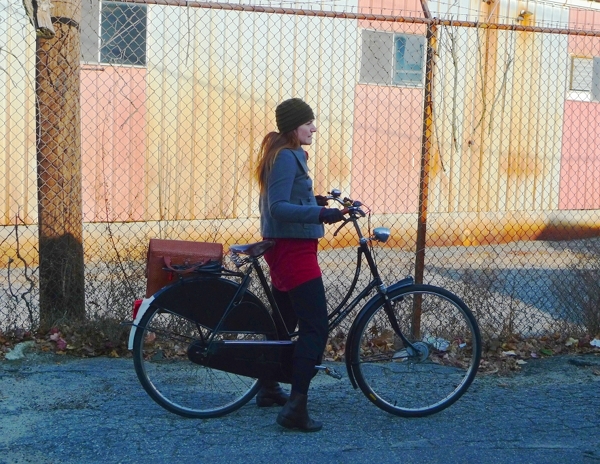
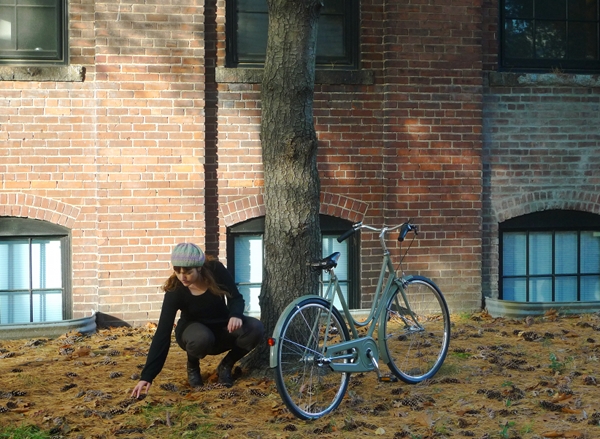
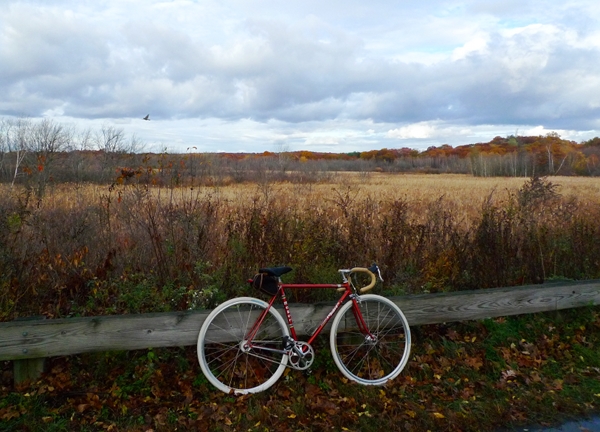
As someone who is interested in experiencing a variety of bicycles and sharing my impressions with others, I find myself constantly re-examining the question of how long it takes to get a "proper" impression of a bike. When I test ride a bicycle, the experience is different on so many levels from when I own the bicycle and ride it in on a daily basis. There are discoveries I make about bikes months into owning them.
Also, when I own a bicycle - even if it's one of my "experimental bikes" and I know from the start that I will probably end up selling it eventually, there is something about the personal responsibility of ownership that makes me more comfortable forming impressions of its characteristics.
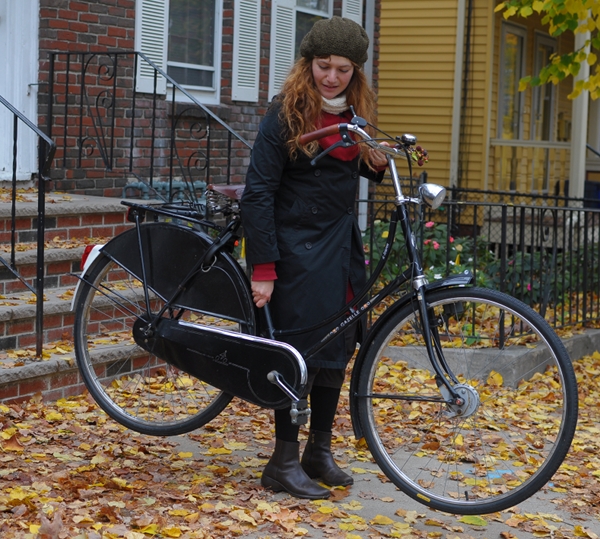
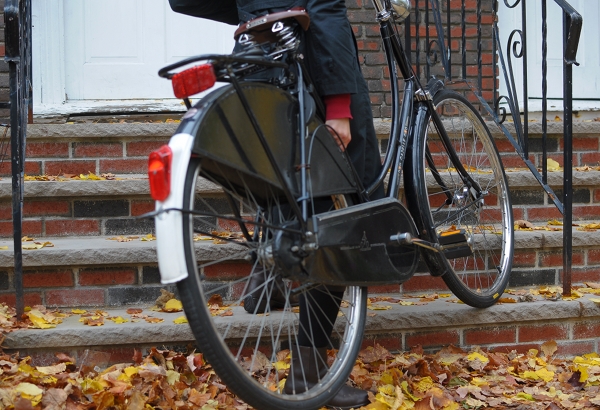
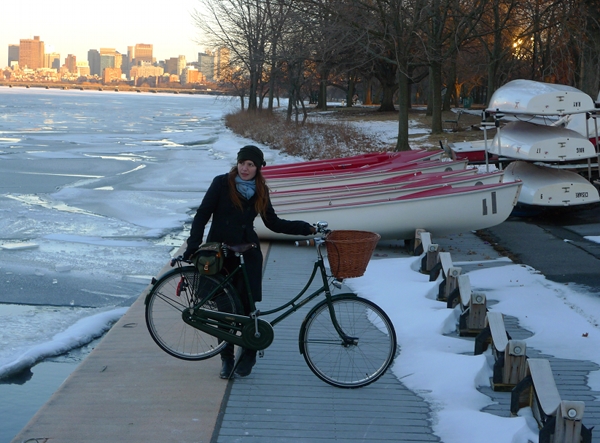
These are all reasons why I differentiate "bicycle reviews" - which I limit to the bikes I own, from "test ride reports" of the bikes I try. And I also mention how long I'd ridden the bike at the time of the review, so that the reader can factor that in. For instance, riding the Abici for an entire afternoon around the city and riding my friend's Retrovelo for a good portion of our long trip through the countryside, were quite different experiences than riding the Trek Belleville for 10 minutes on the side streets adjacent to the bike shop. And, riding my own Gazelle, Bella Ciao and Pashley were different experiences still, and my impression of these bikes takes hundreds of rides into account.
Ultimately, I feel more comfortable offering an opinion about bikes I have owned, however briefly, than on bikes I have merely test ridden or borrowed. And I am considering what that means in terms of Lovely Bicycle. Should I try to make it a point to own the bikes I feel would be especially interesting to review, and then later sell them, accepting the loss as part of the costs of running this blog? It's a neat idea, but probably not financially feasible. Extended borrowing would be the next thing, but there are all sorts of logistic and conflict-of-interest problems when it comes to that as well.
How long does it take you to get to know a bicycle? Is a test ride enough, or do you have to own it for a couple of months before you really feel familiar with it? When you read reviews and test ride reports, do you pay attention to how long the author has been riding the bike and factor that into your impressions? Finally, what do you think is the optimal time period to wait before writing a review?
Showing posts with label loop frame. Show all posts
Saturday, February 12, 2011
Thursday, February 10, 2011
Step-Throughs: an Advantage in Traffic?
There was an interesting post on ecovelo yesterday, where the author compared how he uses his three transportation bikes: a Rivendell Sam Hillborne, a Surly Long Haul Trucker, and a Civia Loring. All three bicycles are set up with upright handlebars and decent load carrying capacity, but the Civia differs from the other two in that it has a fairly low stepover. And according to the author, the combination of its "upright riding position, step-through frame, and internal gear hub make[s] the Loring exceptionally confidence inspiring for riding slowly when in close proximity to pedestrians and automobile traffic." Initially, I read past that sentence with the kind of matter-of-fact acceptance that goes with processing what you already consider to be a given. But then later I mentally "rewound" and thought "Wait a minute, he is saying that he finds it more comfortable to ride a step-through in traffic than a diamond frame - Is this a generally accepted notion?"
All factors remaining equal (upright handlebars, ride quality, load capacity), what, if anything, would make a step-through bike an advantage in traffic?
Tuesday, February 1, 2011
The 'Lady's Bicycle': Descriptive, Offensive, or Merely Obsolete?
There has been some discussion lately about how appropriate it is to refer to diamond and step-through frame bicycles as men's and ladies' bikes. After all - gender roles are flexible these days, women are no longer expected to wear elaborate skirts, and a low standover height can be convenient for everyone. So why use gender specific terminology? Am I just intentionally being quaint?
Well, not exactly. You see, when a bicycle model exists in both diamond frame and step-through designs, the latter is usually not just about lowering the standover height. It is also about taking the female anatomy into account. For example, have a look at the pictures below and see whether you notice anything interesting.
These are the Oma and Opa versions of the current production Gazelle Toer Populair bicycles. If you look closely, you will notice that the Oma on the left has a considerably higher headtube than the Opa on the right. This is done in order to set the Oma's handlebars higher, so as to accommodate the typically shorter torsos and arms of female cyclists. The bikes are named "Grandma and Grandpa," because they are, in fact, gender-specific. The expanded headtube tactic is used by many manufacturers on their step-through models, while others use the alternative tactic of shortening the virtual top tube. Either way, more often than not the step-through version of a given bicycle model is designed for the female body. This is not to say that men cannot or should not ride step through frames, but only that step-through frames are typically optimised for female proportions.
Of course, one could ask: Why confound gender-based anatomical differences with preferences for standover height? After all, some women may prefer diamond frames, while some men may prefer step-throughs. That is where statistics and market research come in. Most manufacturers cannot afford to make two versions of diamond frames and two versions of step-through frames within the same model. And statistically, women are considerably more likely to wear skirts and are thus more likely to prefer a step-through transportation bike. Therefore, it makes more sense to optimise the step-through design for the female anatomy, while optimising the diamond frame design for the male anatomy. Naturally, there will be some females who prefer the diamond frame and some males who prefer the step-through. Furthermore, not every woman has a short torso and not every man has a long torso. But when it comes to manufacturing decisions, it's all about tendencies and probabilities - not about individuals.
And speaking of statistics, perhaps we could indulge in another poll (a weekly tradition?). No purpose for this other than my own curiosity, and possibly yours:
In my own vocabulary, I use terms like "lady's bike" or "woman's frame" when I am referring specifically to the bicycle's suitability for females - be it anatomically, or in terms of their ability to accommodate skirts. On the other hand, I use terms such as "step through," "loop frame," "mixte," and "shortened top tube," when I am describing frame geometry. And while some worry that referring to bicycles as "women's bikes" makes them seem inferior or less valuable, I am not on board with that line of thinking. After all, what is considered "standard" frame geometry in the industry, is in fact optimised for the male anatomy. We are female, we are wonderful, and we need bicycles designed for us. To me, that is neither offensive nor obsolete - it's just common sense.
Wednesday, January 19, 2011
Bicycle Portraits in Ambrotype and Tintype
I've been helping a Lovely Bicycle reader with the process of ordering a custom bike, and he sent me something rather wonderful as a Thank You gift.
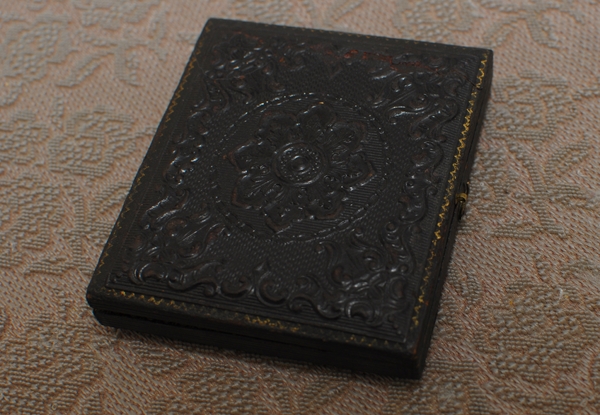
It's a beautiful little antique case, about 4x3", with the tiniest, delicate latch closure. And inside of it, there is this:
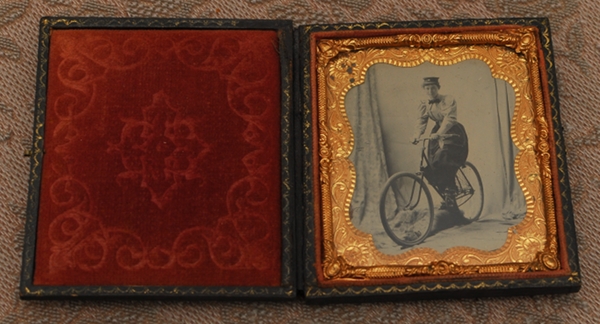
An ambrotype portrait of a young lady on her bicycle, c.1893-94. The ambrotype is one of the oldest methods of photography, where the image is captured as a positive on glass using a wet plate process. Being on glass, ambrotypes are extremely fragile, which is why they were preserved in these enclosed, padded cases. And even with these careful storage methods, not many of them remain. This is a fine gift indeed, to say the least - especially for one obsessed with both bicycles and photographic processes.
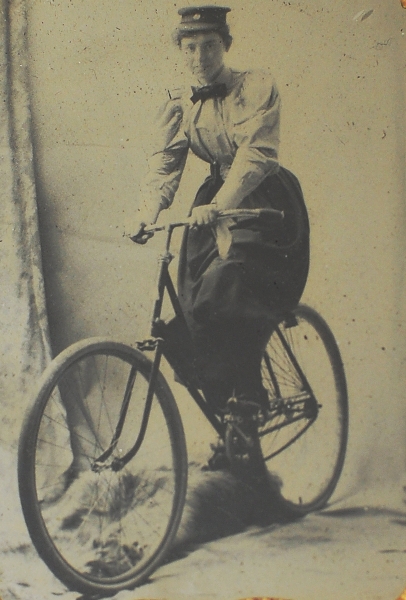
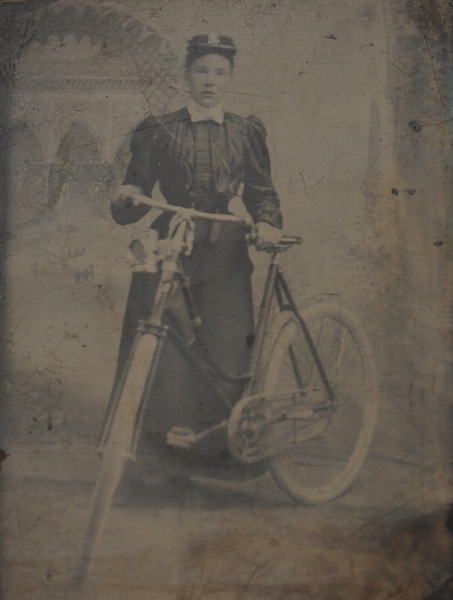
Here is a close-up of the image itself. I cannot remove it from its case, so excuse the murkiness. Notice that it is a mirror image - the drivetrain is on the wrong side. The first commercial freewheel was produced by Sachs in 1898, which means that this lady and others of her era were riding fixed gears. Also, notice the absence of fenders, but the presence of dress guards - at least her muddy skirt would not get stuck in the spokes? Otherwise, the bicycle is a fairly classic lady's Roadster (and apropos the earlier gender discussion - yes, these were made specifically for ladies).
The encased ambrotype came in a set with a free-standing tintype - another positive photographic process, this one created on a sheet of blackened iron. Just amazing. Again, there is the mirror image effect. The bicycle here is similar, but with a fancier chaincase and with a headlamp. The person who sent me these pictures believes the women might be bicycle messengers, though it is also possible that the caps represent cycling clubs that were popular at the time. I must admit that I liked the image of them cycling on fixed gear loop frames through the city delivering letters.
With the rising popularity of flickr, many vintage bicycle photos have been getting scanned and placed on the web in the course of the past several years. And it always amazes me to see specifically the portraits of young ladies posing with their bicycles in a proud and stately manner. Getting one's photo taken was a special occasion in the 1890's, something that was only done once in a great while. And opting to pose with a bicycle in one of the few photos that would ever exist of you, seems telling of the relationship the person in the portrait had with their machine. The word ambrotype means "immortal impression" in Greek, and these ladies wanted to be together with their bicycle for eternity. Was it a status symbol, or an object of obsession? Probably both. And I wonder how the digital bike portraits of today will be interpreted 120 years from now - that is, if they remain at all.
It's a beautiful little antique case, about 4x3", with the tiniest, delicate latch closure. And inside of it, there is this:
An ambrotype portrait of a young lady on her bicycle, c.1893-94. The ambrotype is one of the oldest methods of photography, where the image is captured as a positive on glass using a wet plate process. Being on glass, ambrotypes are extremely fragile, which is why they were preserved in these enclosed, padded cases. And even with these careful storage methods, not many of them remain. This is a fine gift indeed, to say the least - especially for one obsessed with both bicycles and photographic processes.
Here is a close-up of the image itself. I cannot remove it from its case, so excuse the murkiness. Notice that it is a mirror image - the drivetrain is on the wrong side. The first commercial freewheel was produced by Sachs in 1898, which means that this lady and others of her era were riding fixed gears. Also, notice the absence of fenders, but the presence of dress guards - at least her muddy skirt would not get stuck in the spokes? Otherwise, the bicycle is a fairly classic lady's Roadster (and apropos the earlier gender discussion - yes, these were made specifically for ladies).
The encased ambrotype came in a set with a free-standing tintype - another positive photographic process, this one created on a sheet of blackened iron. Just amazing. Again, there is the mirror image effect. The bicycle here is similar, but with a fancier chaincase and with a headlamp. The person who sent me these pictures believes the women might be bicycle messengers, though it is also possible that the caps represent cycling clubs that were popular at the time. I must admit that I liked the image of them cycling on fixed gear loop frames through the city delivering letters.
With the rising popularity of flickr, many vintage bicycle photos have been getting scanned and placed on the web in the course of the past several years. And it always amazes me to see specifically the portraits of young ladies posing with their bicycles in a proud and stately manner. Getting one's photo taken was a special occasion in the 1890's, something that was only done once in a great while. And opting to pose with a bicycle in one of the few photos that would ever exist of you, seems telling of the relationship the person in the portrait had with their machine. The word ambrotype means "immortal impression" in Greek, and these ladies wanted to be together with their bicycle for eternity. Was it a status symbol, or an object of obsession? Probably both. And I wonder how the digital bike portraits of today will be interpreted 120 years from now - that is, if they remain at all.
Wednesday, December 29, 2010
Snow Queen!
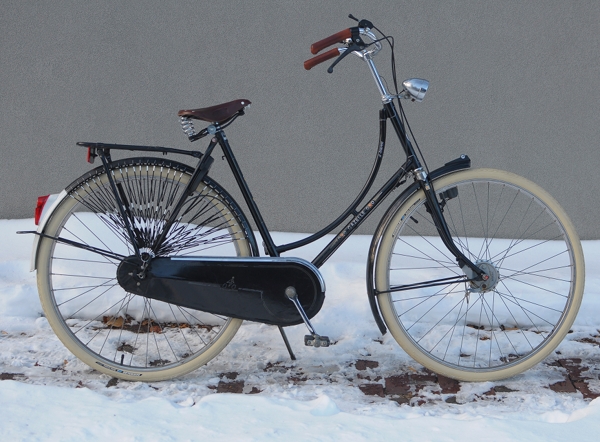
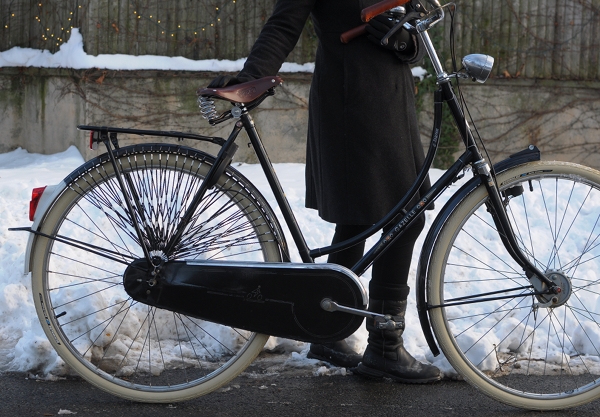
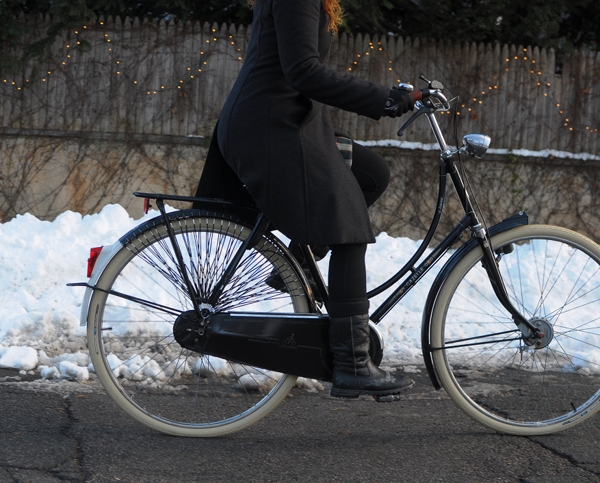
My Gazelle "Linda" has now been updated for the winter, with new tires and woven dress guards. She is a beautiful sight to behold against the snowy landscape!
The tire replacement was something that had to be done anyhow, as the original ones were cracked and I did not want them to fail in the winter. And of course, I was only too happy to replace them with my favourite cream Schwalbe Delta Cruisers. As for the woven dress guards, there was no reason for them what so ever, other than aesthetic caprice. I thought that Linda looked somewhat generic with the solid black vinyl dress guards, and I wanted to personalise her. We purchased the woven dress guards from Mike Flanigan of ANT and installed them by drilling holes directly into the fenders. I have close-up pictures of the installation and will write a detailed tutorial in a separate post, for those interested.
Riding the Gazelle with the new tires, I immediately noticed that she became a bit faster and quicker to accelerate. This echoes my experience with Delta Cruisers on other bikes - which is one reason I love these tires so much. They are the best combination of city/ sporty/ cushy/ all-weather I have found so far. And okay, it does not hurt that they are available in cream!
It was interesting to cycle on the Gazelle after such a heavy snowfall, and to compare her handling to the Bella Ciao - which I rode immediately after the previous snowfall. Somewhat to my surprise, they handle similarly at slow speeds (under 10mph)- which is the speed I stick to under winter road conditions. The Bella Ciao's superior responsiveness and the Gazelle's superior cushiness are considerably less noticeable when cycling gingerly over slush and ice patches. Their common qualities, however, are all the more noticeable: Namely, how well-balanced and stable they both are. The Pashley I rode last year had these same qualities as well - so I think that all three are great winter bicycles.
The Gazelle does have a bit of an edge when cycling over large formations of hardened snow, due to its wider tires. On the other hand, the Bella Ciao has a considerable "winter cyclocross" advantage: It is easier to drag, lift and carry when road conditions necessitate getting off the bike and moving it over heaps of snow or patches of ice. Overall, I am honestly not sure which I prefer, and I see the two bikes as representing different ends of my winter comfort zone spectrum. The Gazelle has a rack and lights, so by default I ride it more. But once I install these on the Bella Ciao, that may change. For those who have tried different upright transportation bicycles in the winter (i.e., Pashley vs Workcycles vs Retrovelo vs Rivendell vs ANT vs Abici, etc.), I would love to know what you think of the handling.
After the first two snow storms of the season, I can already tell that I will have an easier time cycling this winter than I did last year. Nothing has really changed in a drastic way, but maybe my balancing skills have gradually improved and my lungs have grown accustomed to cycling in freezing temperatures. And as far as aesthetics go, I really do think that it helps to have a bicycle that you are excited about as a winter bike, rather than a "beater". This helped me last year and it's helping me now. The winter landscape is so beautiful, that cycling through it on a bicycle I love (and feel safe on) makes it all the more special.
The tire replacement was something that had to be done anyhow, as the original ones were cracked and I did not want them to fail in the winter. And of course, I was only too happy to replace them with my favourite cream Schwalbe Delta Cruisers. As for the woven dress guards, there was no reason for them what so ever, other than aesthetic caprice. I thought that Linda looked somewhat generic with the solid black vinyl dress guards, and I wanted to personalise her. We purchased the woven dress guards from Mike Flanigan of ANT and installed them by drilling holes directly into the fenders. I have close-up pictures of the installation and will write a detailed tutorial in a separate post, for those interested.
Riding the Gazelle with the new tires, I immediately noticed that she became a bit faster and quicker to accelerate. This echoes my experience with Delta Cruisers on other bikes - which is one reason I love these tires so much. They are the best combination of city/ sporty/ cushy/ all-weather I have found so far. And okay, it does not hurt that they are available in cream!
It was interesting to cycle on the Gazelle after such a heavy snowfall, and to compare her handling to the Bella Ciao - which I rode immediately after the previous snowfall. Somewhat to my surprise, they handle similarly at slow speeds (under 10mph)- which is the speed I stick to under winter road conditions. The Bella Ciao's superior responsiveness and the Gazelle's superior cushiness are considerably less noticeable when cycling gingerly over slush and ice patches. Their common qualities, however, are all the more noticeable: Namely, how well-balanced and stable they both are. The Pashley I rode last year had these same qualities as well - so I think that all three are great winter bicycles.
The Gazelle does have a bit of an edge when cycling over large formations of hardened snow, due to its wider tires. On the other hand, the Bella Ciao has a considerable "winter cyclocross" advantage: It is easier to drag, lift and carry when road conditions necessitate getting off the bike and moving it over heaps of snow or patches of ice. Overall, I am honestly not sure which I prefer, and I see the two bikes as representing different ends of my winter comfort zone spectrum. The Gazelle has a rack and lights, so by default I ride it more. But once I install these on the Bella Ciao, that may change. For those who have tried different upright transportation bicycles in the winter (i.e., Pashley vs Workcycles vs Retrovelo vs Rivendell vs ANT vs Abici, etc.), I would love to know what you think of the handling.
After the first two snow storms of the season, I can already tell that I will have an easier time cycling this winter than I did last year. Nothing has really changed in a drastic way, but maybe my balancing skills have gradually improved and my lungs have grown accustomed to cycling in freezing temperatures. And as far as aesthetics go, I really do think that it helps to have a bicycle that you are excited about as a winter bike, rather than a "beater". This helped me last year and it's helping me now. The winter landscape is so beautiful, that cycling through it on a bicycle I love (and feel safe on) makes it all the more special.
Monday, December 20, 2010
The Drop Frame Bicycle - The 'Queen of Safeties' Returns
Browsing through my favourite vintage bicycle posters, I've always noticed something unusual about the ones of the Boston-based Overman Wheel Co.: The lady's bicycle appeared to have only a single curved tube - rather than a down tube and a top tube, like the vintage loop frames we are accustomed to seeing. Could this be artistic license for the sake of making the graphics simpler, or did bicycles like this really exist? Several times I had tried to investigate, until finally I found what I was looking for:
The Overman Wheel Co. "Victoria" - a "drop frame woman's safety bicycle," according to the Smithsonian. It had 28" wheels, rod-like brakes, what appears to be some sort of suspension contraption on the fork, an enormous saddle, high handlebars, and a chainguard. Finally, confirmation that the bicycle hinted at in the posters was a real model. And for a machine that was manufactured in 1889, the Victoria looks awfully familiar...
And you thought this design was funky and new, eh? Bicycles in this style have been popping up in Europe with increasing frequency over the past 5 years, and have recently made their way to the US as well: A single, oversized curved tube connecting the head tube and the seat tube - sometimes with reinforcements and sometimes without, combined with a suspension fork, suspension seat post, plush saddle and high handlebars.
The reasoning behind the single curved tube design, is that it allows for extra low step-over height, making the bicycle especially accessible for those who wear long, loose clothing, as well as for those who have balancing problems when mounting even the standard step-through frames. And the funny thing is, that while everyone agrees that the low step-over is beneficial, many also complain about how "ugly and modern" it is. I wonder how many are aware that the "drop frame" design is in fact 120 years old!
[image via The Daily Postcard]
I think the modern reincarnation of the drop frame is a great idea in principle, if only it could be made more elegant. What do you think of the vintage and modern versions? - could you benefit from the low step-over, or do you find the regular step-through designs sufficient?
As I've mentioned here earlier, I think that any design that makes the bicycle more accessible to those who would otherwise be intimidated by it, is a good design. With its super-low step-over, the drop frame is inviting and safe-looking - no wonder the original was described as "the queen of safeties". Having ridden a few modern versions of these bikes in Austria a couple of years ago, I found them easy to deal with. But I wish there was a way to make them look and feel a little nicer. The suspension fork on the modern bikes is probably there because the aluminum frame makes them painful to ride over bumps. But the suspension has the side-effect of creating a "bouncy" feeling that does not give the cyclist optimal control of the bicycle. I wonder how the original Overman bicycles were made: Were the frames lugged? Was the ride comfortable? I suppose we will never truly know how these compared to today's bikes.
Wednesday, December 15, 2010
User Friendly Interface
Now that it's winter, I find that strangers talk to me more than usual about cycling - typically when they see me locking up my bike. Over the past couple of weeks, several women have told me that they'd love to ride a bike, but find the logistics daunting: having to buy lights and figure out how to mount them; constantly getting flats (something they remember from previous cycling experiences); having to figure out how to carry their handbag, struggling to mount the bike in business attire, and other similar concerns. Their misgivings are fueled by the perception that cycling will complicate their lives - compared to walking, or taking public transportation, or driving.
What frustrates me about this, is that all of their concerns can be addressed with the right bike. As I explain about step-through frames, dynamo lighting, tires with puncture-protection, dress guards, chain cases, and panniers that attach to the bicycle's rack in seconds, I can see the ladies' faces light up as they eye these features hungrily.
One woman tried to step through my frame in her skirt-suit and squealed with delight when she was able to do it. She had never tried anything other than a mountainbike before. She said: "I knew you had a special type of bike! It's got this... user-friendly interface!" That phrase echoed in my mind for some time.
Even though I enjoy learning about bicycle design and own multiple bikes on which I constantly experiment, I am first and foremost a "transportation cyclist." My main priority is to have that one bike that is reliable, comfortable, and as low-maintenance as possible. The bicycle I use for transportation needs to make life easy for me. It needs to minimise the extent to which I think about it and tinker with it - so that I can focus on work and life itself, not on the bicycle. Skirt suit? Heavy bag? Dark outside? Raining like crazy? The "user friendly interface" on my machine accommodates all of these scenarios.
Many manufacturers are making what they are calling "transportation bicycles" nowadays, but not all of these bikes work for everyone. When a woman wearing a skirt suit walks into a bike store and says she would like to start cycling to work, my hope is that the salesperson will point to the section with the right kind of bicycle for her - rather than saying "Well, you won't be able to do it wearing that!" A user-friendly interface means that we should all be able to do it. Holiday wish: more elegant, practical, comfortable bicycle options for the women in skirt-suits who feel out of place in bike shops. It's getting better, but we aren't there yet.
What frustrates me about this, is that all of their concerns can be addressed with the right bike. As I explain about step-through frames, dynamo lighting, tires with puncture-protection, dress guards, chain cases, and panniers that attach to the bicycle's rack in seconds, I can see the ladies' faces light up as they eye these features hungrily.
One woman tried to step through my frame in her skirt-suit and squealed with delight when she was able to do it. She had never tried anything other than a mountainbike before. She said: "I knew you had a special type of bike! It's got this... user-friendly interface!" That phrase echoed in my mind for some time.
Even though I enjoy learning about bicycle design and own multiple bikes on which I constantly experiment, I am first and foremost a "transportation cyclist." My main priority is to have that one bike that is reliable, comfortable, and as low-maintenance as possible. The bicycle I use for transportation needs to make life easy for me. It needs to minimise the extent to which I think about it and tinker with it - so that I can focus on work and life itself, not on the bicycle. Skirt suit? Heavy bag? Dark outside? Raining like crazy? The "user friendly interface" on my machine accommodates all of these scenarios.
Many manufacturers are making what they are calling "transportation bicycles" nowadays, but not all of these bikes work for everyone. When a woman wearing a skirt suit walks into a bike store and says she would like to start cycling to work, my hope is that the salesperson will point to the section with the right kind of bicycle for her - rather than saying "Well, you won't be able to do it wearing that!" A user-friendly interface means that we should all be able to do it. Holiday wish: more elegant, practical, comfortable bicycle options for the women in skirt-suits who feel out of place in bike shops. It's getting better, but we aren't there yet.
Saturday, December 4, 2010
Just Three for Me! In Praise of the Humble 3-Speed
When I was first shopping for an upright bicycle with an internally geared hub, I made the natural assumption that the more gears on the hub, the better. But to my surprise, over time I changed my mind and developed a strong preference for the simple 3-speed. No more, no less: Three gears feel just right. I have been trying to make sense of why I prefer 3-speed hubs to the seemingly more advantageous 7-speeds and 8-speeds, and have a couple of ideas.
Internally geared hubs allow for a narrower range of gearing in comparison to derailleurs. And the overall range of the hub does not increase in direct proportion to the number of speeds.
For example:
The Shimano Nexus 3-speed hub has a 186% overall gearing range.
The Shimano Nexus 7-speed hub has a 244% overall gearing range.
The Shimano Alfine 8-speed hub has a 306% overall gearing range.
The typical 7 and 8 speed hubs do not give you more than double the gearing range of the 3-speed. They give you more than double the notches to click, while the overall gearing range is only somewhat greater. The more speeds on the hub, the smaller the differences between clicks. This requires changing gears back and forth more frequently, just to stay in the same range as the 3-speed hub would give you with less clicking. This could be why I feel that with a 7 and 8 speed hub, I am always switching gears back and forth unnecessarily.
My choice of transportation bicycles plays a huge role in the usefulness of the hubs as well. In my experience, bicycles that are heavy and put the cyclist in a bolt-upright position are simply not the best choice for trips with prolonged hills, regardless of how many gears are on the hub. If I max out a 3-speed hub going uphill on a heavy upright bike, chances are that I will also max out a 7 or 8 speed hub - in which case there is no real benefit to having those additional gears. If a route is too tough for a 3-speed, then what I prefer is a lighter and more sporty bike, ideally with derailleur gearing. A bigger hub on the same heavy upright bike does not do me much good.
While modern bicycles are commonly available with 7 and 8 speed hubs, for me the simpler 3-speed just seems to be a better solution. Your experience may differ - but before you choose a hub with many gears, try a 3-speed and compare for yourself. You might be as surprised as I was to discover which you prefer.
Internally geared hubs allow for a narrower range of gearing in comparison to derailleurs. And the overall range of the hub does not increase in direct proportion to the number of speeds.
For example:
The Shimano Nexus 3-speed hub has a 186% overall gearing range.
The Shimano Nexus 7-speed hub has a 244% overall gearing range.
The Shimano Alfine 8-speed hub has a 306% overall gearing range.
The typical 7 and 8 speed hubs do not give you more than double the gearing range of the 3-speed. They give you more than double the notches to click, while the overall gearing range is only somewhat greater. The more speeds on the hub, the smaller the differences between clicks. This requires changing gears back and forth more frequently, just to stay in the same range as the 3-speed hub would give you with less clicking. This could be why I feel that with a 7 and 8 speed hub, I am always switching gears back and forth unnecessarily.
My choice of transportation bicycles plays a huge role in the usefulness of the hubs as well. In my experience, bicycles that are heavy and put the cyclist in a bolt-upright position are simply not the best choice for trips with prolonged hills, regardless of how many gears are on the hub. If I max out a 3-speed hub going uphill on a heavy upright bike, chances are that I will also max out a 7 or 8 speed hub - in which case there is no real benefit to having those additional gears. If a route is too tough for a 3-speed, then what I prefer is a lighter and more sporty bike, ideally with derailleur gearing. A bigger hub on the same heavy upright bike does not do me much good.
While modern bicycles are commonly available with 7 and 8 speed hubs, for me the simpler 3-speed just seems to be a better solution. Your experience may differ - but before you choose a hub with many gears, try a 3-speed and compare for yourself. You might be as surprised as I was to discover which you prefer.
Budget Bikes: What's Your View?
As more beginner cyclists are in the market for new bicycles, I receive more and more questions from readers asking what I think about various makes and models listed on the Budget Options page. People want nice bikes, but, understandably, they also want to save money - and my vintage bicycle recommendation is not for everyone. What about a simple, basic new bike that is classic and comfortable, at a reasonable price? After all, it seems that more and more manufacturers are starting to offer exactly that.
The latest that has been brought to my attention in that regard, is this promotional video from Bikes Direct - an online seller of extremely inexpensive mass-produced bicycles. The video shows cyclists riding colourful mixtes along a path lined with palm trees. The caption reads: "single and 3speed Windsor retro city bikes, style which was popular in the 50s, 60s and early 70s". These are not on the Bikes Direct website yet, but I imagine they soon will be - most likely priced in the $300s. What do you think - Do they look good to you and would you consider ordering?
I am always torn when asked for my own opinion: While I want to be objective, I simply don't like most of the lower-priced bikes that are out there at the moment. I have tried 80% or so of the bicycles on my Budget Options list, and so far very few of them have made me feel that they are worth the price. It's one thing to spend a couple hundred dollars on a bike and not care, but a price tag in the range of $500-600 is a lot of money to me - too much money to spend on something that I believe is shoddily made, will likely require upgrades, will not feel entirely comfortable even with those upgrades, and may fall apart on me within a year. In the long run, I believe that such a bicycle may cost more than an "expensive" bike. And I am especially surprised to hear of people choosing the lower-end bikes, and then buying Brooks saddles, leather grips, fancy lighting and expensive pannier systems to go with them. By the time they are done upgrading, the cost of the bike can reach a price point at which they could have gotten a higher-end bicycle - with many of those upgrades already included, not to mention with a better frame and higher quality components.
Beyond that, I am not really sure what to say when asked for suggestions. I believe that a well-made, comfortable bicycle can be mass-produced at a reasonable price in the Far East. But I don't think it's happening yet. What has your experience been and what are your views on "budget bikes"?
Friday, November 12, 2010
Heavyweights, Middleweights, and Lightweights: a Loop Frame Taxonomy
The "Manufacturer Profiles" page linked in the upper left corner lists popular manufacturers that produce quality ladies' bicycles which I believe to meet the urban commuting criteria described here. Fairly often, I am asked about the differences between the bicycles featured on this page - particularly in terms of weight, speed, and their ability to handle hills. Happily, I have now ridden almost all of these bikes, and am able to provide this type of feedback. If I had to classify the higher-end loop-frame bicycles currently available on the market, I would say there are three main categories: the heavyweights, the middleweights, and the lightweights. Each category has its strengths and weaknesses, its benefits and its drawbacks. I will try to describe my experience of them here.
In this category I place the traditional Dutch bikes: the classic models produced by Gazelle, Azor/Workcycles, Achielle, and Batavus. They have long, super-relaxed frames, high handlebars and 28" wheels. They are very heavy. They have heavy-duty racks and are designed to haul serious weight. They place the cyclist in a bolt-upright position. And their basic design has remained unaltered for nearly a century.
Conclusion: These bicycles will give you unparalleled comfort and stability at the expense of weight and maneuverability.
The Lightweights
At the moment, the only loop frame bicycles in this category are the Italians: Abici and Bella Ciao. They are more nimble and sporty than their heftier cousins, with smaller frames and large-ish 700C wheels (a size typical of roadbikes). With their distinct curvature and clean lines, these bicycles are elegant, coltish and fast.
The benefit of the Italian lightweights, is that they are as light and zippy as you can possibly get on this type of city bicycle. Typical weight is 30-35 lb depending on gearing and lights. They do well on hills, they are easy to lift and carry, they are maneuverable.
On the downside, the ride quality is not quite as smooth as on the Dutch bikes. You will feel the road to a greater extent and you will not be as oblivious to the potholes and bumps. Because of their light weight and sportier geometry, these bicycles also have a limited load-carrying capacity. You can carry your bag and panniers, but you probably won't be able to wheel around your boyfriend and your toddler as you would on a Dutch bike. I am not even sure about the toddler alone.
Conclusion: These bicycles will give you lightweight speed and agility, at the expense of extra cushioning and hauling capacity.
The Middleweights
As you may have guessed, bicycles in this category are somewhere in between. They include the English Pashley, the Danish Velorbis, the Swedish Skeppshult and the German Retrovelo. Their frames are not as relaxed as the Dutch bicycles, but not as sporty as the Italians. They are typically fitted with 26" wheels. Sometimes these bicycles are specifically marketed as lighter-weight "improvements" compared to Dutch bikes or classic Roadsters.
I am going to combine the benefits and drawbacks of this category into one narrative, because they are not quite so clear-cut. In a very general sense, the benefit of these bicycles is that they are somewhat lighter than the Dutch bikes (40-45lb+), while also being somewhat sturdier than the Italian bikes. As for smoothness and cushiness of the ride, there is variability. I have found the Pashley and the (non-balloon tire) Velorbis to be about the same in terms of cushioning as Bella Ciao, while also being nearly as heavy and just as difficult on uphills as some of the Dutch bikes. So in the case of these two, I do not feel as if the decrease in cushiness (in comparison to Dutch bikes) is adequately balanced by an equally significant decrease in weight. On the other hand, in the Retrovelo this problem seems to have been solved with the Fat Frank balloon tires - the ride is almost as cushy as on a Dutch bike, with some of the weight shaved off and some maneuverability added. I have not tried the Velorbis balloon-tire bikes and cannot say how they compare. And I have not tried the Skeppshult at all.
Conclusion: Overall I am not sure what to make of these bicycles. Having ridden the Pashley, the Velorbis, and the Retrovelo, I would say that Retrovelo has the nicest ride quality of the three and Pashley the second nicest. But to me the bikes in this category do not feel that much lighter than Gazelle or Batavus.
While this method of classification cannot begin to compete with the benefit of firsthand experience, I hope that it at least very generally suggests what to expect. The Dutch bicycles are obscenely comfortable, but cumbersome. The Italian bicycles are light and nimble, but do not offer the same sprawling sense of luxury. And the bicycles in between are a mixed bag. When considering which bicycle is right for you, the closest to "advice" I can give is to take very seriously your priorities and your limitations. It's not just about the weight and handling of the bicycle - but about what you need those factors to be like. We all need something different, and each of these bicycles is perfect for the right owner.
Wednesday, November 10, 2010
Reaching a Non-Cycling Audience
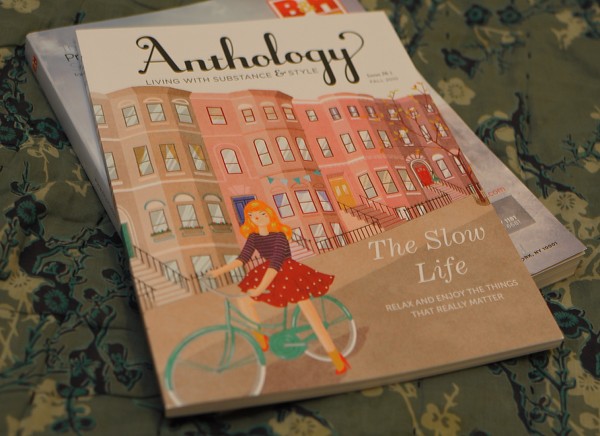
I received a copy of the first issue of Anthology magazine in the mail today - sent to me, because they ran a feature on Lovely Bicycle. I knew they'd made some illustrations based on my photos, but I did not expect to see a cartoon version of myself and the Pashley Princess (depicted complete with cream tires!) cycling through a cartoon version of Boston. Funny! Unlike the real me, my cartoon self likes to cycle in high heels - so perhaps she can teach me a thing or two!
The story they ran included an edited version of my "Bicycles for Everyday Cycling" page, which I hope will be helpful to readers of the magazine who are considering purchasing their first bike.
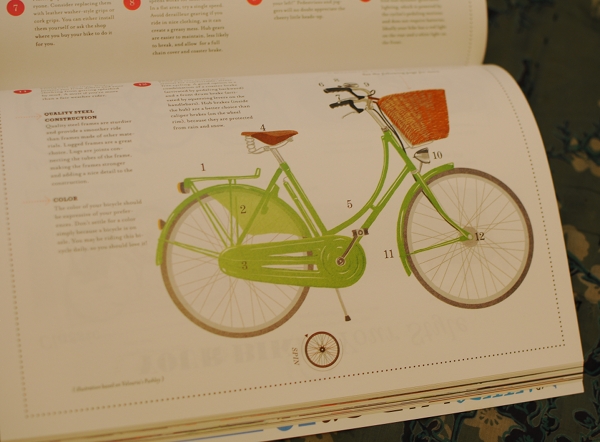
I think it's neat that Anthology presented the information as an "anatomy lesson" and made its own hand-drawn illustrations (by Kris Atomic). This makes the text a lot more engaging than my original version (I read it with interest!) - and achieving that is important for print publications trying to compete with online media. I can imagine somebody who is not into cycling at all picking up this magazine in their local coffee shop or book store and getting drawn into the article, becoming curious about bicycles as a result.
In addition to the "Anatomy of a Lovely Bike" article, there was also a beautiful feature on Meligrosa of Bikes and the City with her cool mixte, as well as a helpful piece on shopping for bicycles and accessories.
One reason I am pleased to be featured in Anthology, is because they are not a cycling publication, but a more general lifestyle magazine. Before I began Lovely Bicycle, there was a period of a year or so when I vaguely wanted a bike but did not know how to even begin looking for one that was right for me. There was a disconnect between the sort of bicycle I wanted and what was available in most bike shops at the time, and I simply did not know where else to get information. A series of bike-related articles like the ones Anthology published would have helped me, and I hope that they can now help others. Besides, I just love the idea of things like dress guards, chain cases and "lugged steel construction" being presented as standard features. I hope that women walk into bike shops and ask for them, as casually and matter-of-factly as they would ask for cake in a bakery.
The story they ran included an edited version of my "Bicycles for Everyday Cycling" page, which I hope will be helpful to readers of the magazine who are considering purchasing their first bike.
I think it's neat that Anthology presented the information as an "anatomy lesson" and made its own hand-drawn illustrations (by Kris Atomic). This makes the text a lot more engaging than my original version (I read it with interest!) - and achieving that is important for print publications trying to compete with online media. I can imagine somebody who is not into cycling at all picking up this magazine in their local coffee shop or book store and getting drawn into the article, becoming curious about bicycles as a result.
In addition to the "Anatomy of a Lovely Bike" article, there was also a beautiful feature on Meligrosa of Bikes and the City with her cool mixte, as well as a helpful piece on shopping for bicycles and accessories.
One reason I am pleased to be featured in Anthology, is because they are not a cycling publication, but a more general lifestyle magazine. Before I began Lovely Bicycle, there was a period of a year or so when I vaguely wanted a bike but did not know how to even begin looking for one that was right for me. There was a disconnect between the sort of bicycle I wanted and what was available in most bike shops at the time, and I simply did not know where else to get information. A series of bike-related articles like the ones Anthology published would have helped me, and I hope that they can now help others. Besides, I just love the idea of things like dress guards, chain cases and "lugged steel construction" being presented as standard features. I hope that women walk into bike shops and ask for them, as casually and matter-of-factly as they would ask for cake in a bakery.
A Cruel Transition
Particularly in New England, November has always struck me as a cruel month. At the beginning, the fiery foliage and the azure skies carry over from October.
The crisp, but still warm air is charged with just the right amount of electricity to gently stir our emotions. And we are lulled into a state of self-willed denial that soon it will all be yanked away from us in one fell swoop - replaced with desolate landscapes, freezing temperatures and perilous road conditions... for the next 4 months.
As far as cycling goes, I must admit the memories of how difficult last winter was fill me with dread. I am trying not to panic, but to be prepared instead. And part of that is just being mentally prepared for what's to come.
My biggest disappointment last winter was discovering that any kind of sporty cycling was out of the question after temperatures dropped below freezing, because I had trouble breathing at speeds over 10-12 mph. The science of that is still a mystery to me, especially since I can cross-country ski in the winter without experiencing the same problem. And I know that other cyclists have trouble with this as well - it might just be a genetic difference in how our lungs are structured, whereby for some it is a problem and for others not. This year I will try some tricks that have been suggested to deal with the breathing issue, but if it doesn't work I am prepared to accept things as they are and hang up my roadbikes until spring. Or so I tell myself.
But as far as transportation cycling goes, I do not anticipate any great changes in my routine. Last winter I was able to get anywhere I needed to go on my Pashley, taking it slowly and enjoying its stability and winter-proofness (wide tires, internally geared hub, full chaincase). This winter I am looking forward to seeing how the Gazelle and Bella Ciao perform in comparison. Most likely I will ride the Gazelle for local trips, and the Bella Ciao (after I get a rack and lights for it) for more hilly, long-distance trips. And the rest of my bicycles will be put away, including my custom mixte - which I just cannot bring myself to ride in the winter, yet.
But all this is still in the future. For now November has been good, and the increasingly desolate landscape has a romantic charm to it that I hope it will retain for at least another few weeks. It's a cruel transition, but a trusty bicycle is a good ally to have.
The crisp, but still warm air is charged with just the right amount of electricity to gently stir our emotions. And we are lulled into a state of self-willed denial that soon it will all be yanked away from us in one fell swoop - replaced with desolate landscapes, freezing temperatures and perilous road conditions... for the next 4 months.
As far as cycling goes, I must admit the memories of how difficult last winter was fill me with dread. I am trying not to panic, but to be prepared instead. And part of that is just being mentally prepared for what's to come.
My biggest disappointment last winter was discovering that any kind of sporty cycling was out of the question after temperatures dropped below freezing, because I had trouble breathing at speeds over 10-12 mph. The science of that is still a mystery to me, especially since I can cross-country ski in the winter without experiencing the same problem. And I know that other cyclists have trouble with this as well - it might just be a genetic difference in how our lungs are structured, whereby for some it is a problem and for others not. This year I will try some tricks that have been suggested to deal with the breathing issue, but if it doesn't work I am prepared to accept things as they are and hang up my roadbikes until spring. Or so I tell myself.
But as far as transportation cycling goes, I do not anticipate any great changes in my routine. Last winter I was able to get anywhere I needed to go on my Pashley, taking it slowly and enjoying its stability and winter-proofness (wide tires, internally geared hub, full chaincase). This winter I am looking forward to seeing how the Gazelle and Bella Ciao perform in comparison. Most likely I will ride the Gazelle for local trips, and the Bella Ciao (after I get a rack and lights for it) for more hilly, long-distance trips. And the rest of my bicycles will be put away, including my custom mixte - which I just cannot bring myself to ride in the winter, yet.
But all this is still in the future. For now November has been good, and the increasingly desolate landscape has a romantic charm to it that I hope it will retain for at least another few weeks. It's a cruel transition, but a trusty bicycle is a good ally to have.
Monday, November 8, 2010
Up-lifting Experiences
While a diamond-frame bicycle can be easily lifted by the top tube, a step-through frame does not have one - posing the question of how to hold the bike when picking it up. This becomes especially important when the bicycle is on the heavy side and frequently needs to be carried up and down the stairs. In the course of owning a number of loop frames, I have found that different bicycles require different approaches in this regard.
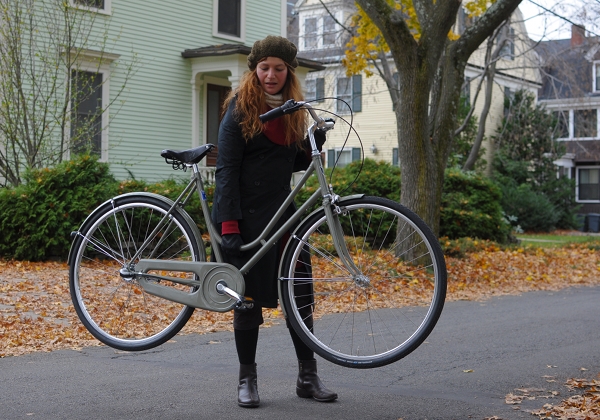
My Bella Ciao bicycle likes to be picked up by the rear portion of the curved top tube. This is such a stable position that I can even carry it with one hand without the bicycle buckling. When held in this manner, I feel that the bike's center of gravity is directly under my hand, which is probably what accounts for the stability of this position. Also, my hand is snugly stuck in that little space between the upward sweep of the curve to one side and the top-downtube connector on the other - an important factor, because this way my hand cannot slip, even if the bicycle is wet from rain.
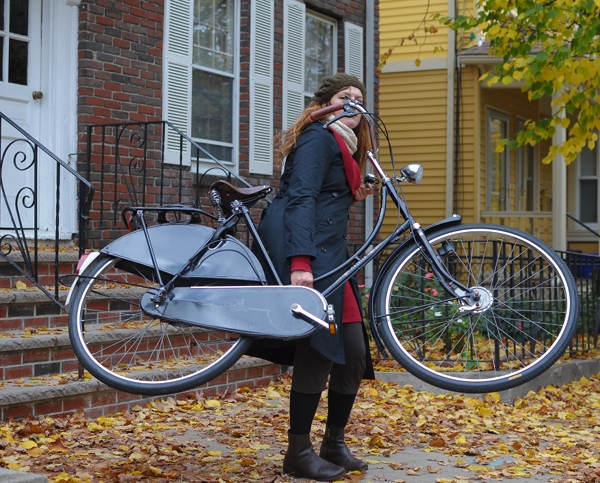
By contrast, this is what happens when I attempt to lift my Gazelle in the same manner. It's not that the bicycle feels too heavy - in fact, lifting it by that loopy spot makes it feel lighter than otherwise. But something is off in the balance, and the Gazelle tries to flip over sideways, onto me, when held in this manner. It feels as if the center of gravity is not under my hand, but somewhere else. With the Pashley Princess I previously owned, this effect was even more pronounced - when lifted by this portion of the frame, the bicycle seemed to twist in my arms and threaten to bring both of us down. On the other hand, the vintage Steyr Waffenrad I rode in Austria was amenable to being picked up by the top tube of its "swan" frame. For reference, my Pashley was somewhere in between the weight of the Gazelle and the Bella Ciao, and the Steyr was as heavy as the Gazelle - so again, it is not merely a matter of weight.
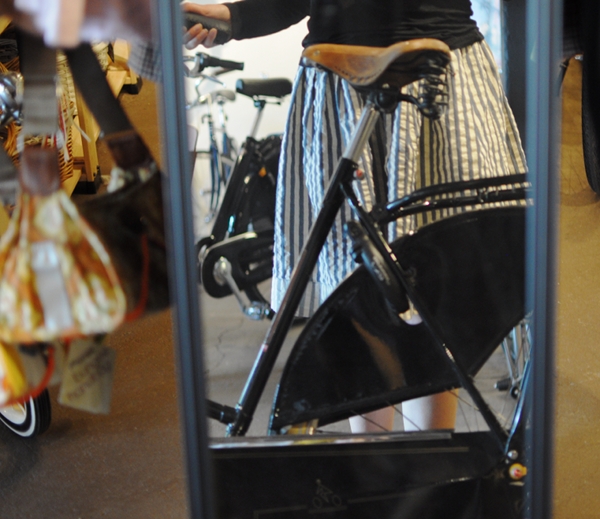
This is how the Gazelle wants to be lifted: by the seat tube. It stays stable and does not buckle when grasped in this position, despite feeling heavier than in the previously shown method. Could it be that for bicycles that prefer this method, the center of gravity is more toward the rear?
To get my bicycles home I must carry them up the porch stairs, through a narrow doorway, and then through another narrow doorway, after turning around in a cramped hallway. That may not seem like a big deal to those who have several flights of stairs to negotiate, but consider that I am a female with limited upper body strength and a bicycle like a Gazelle or a Pashley is half my weight once it's loaded with bags. Getting a good grip on the frame is key if I don't want to drop the bike or, worse, have it fall on top of me. If you own a heavy step-through bicycle, how do you lift it and how do you carry it up the stairs?
Subscribe to:
Posts (Atom)