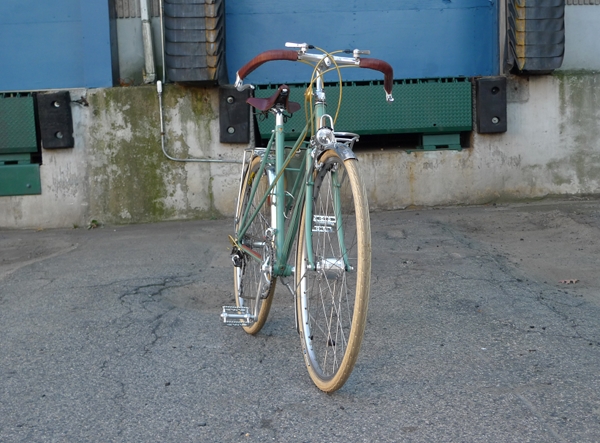
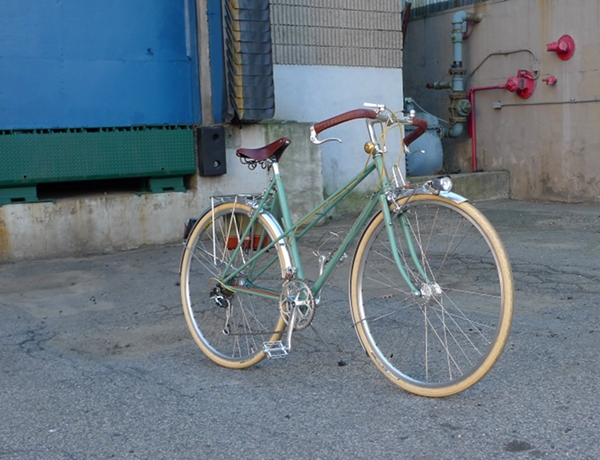
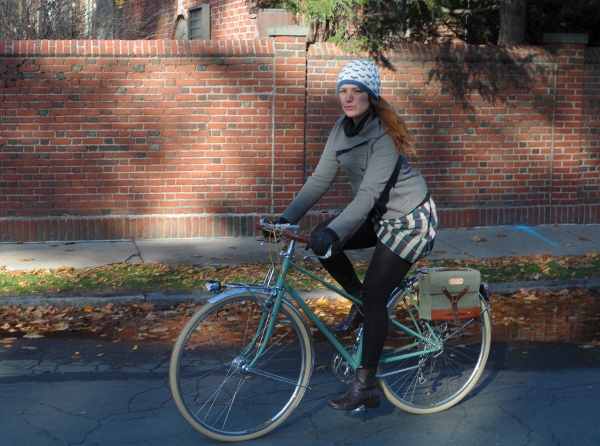
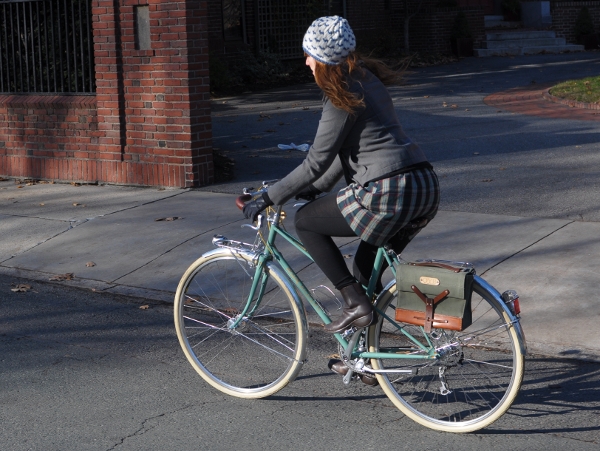
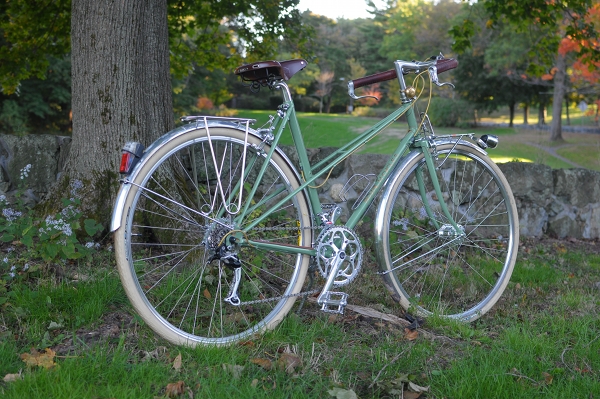
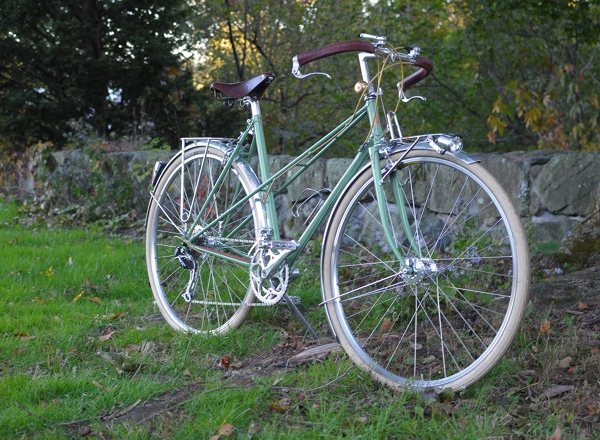
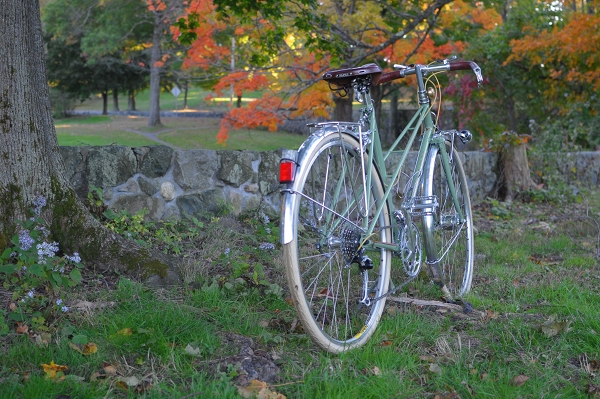
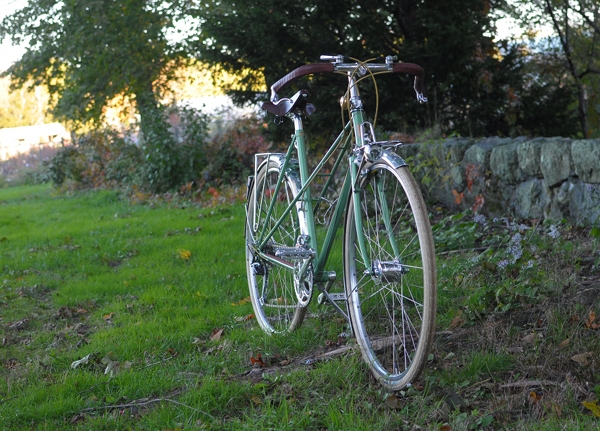
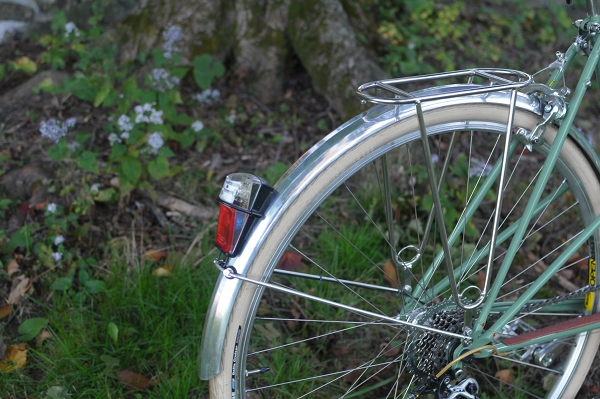
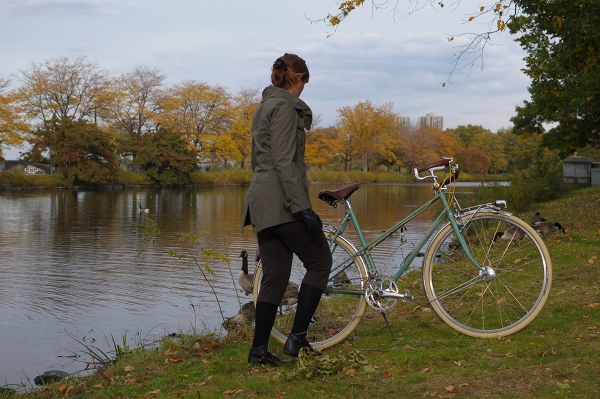
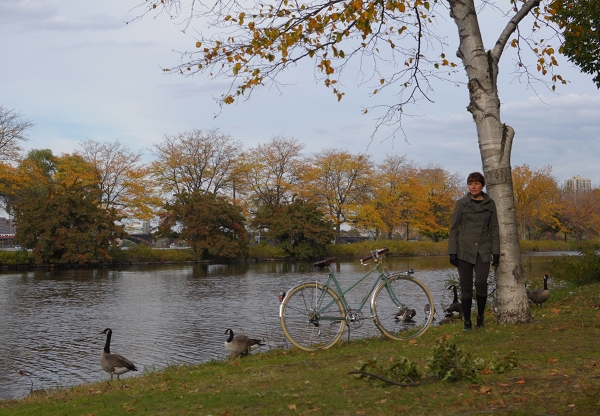
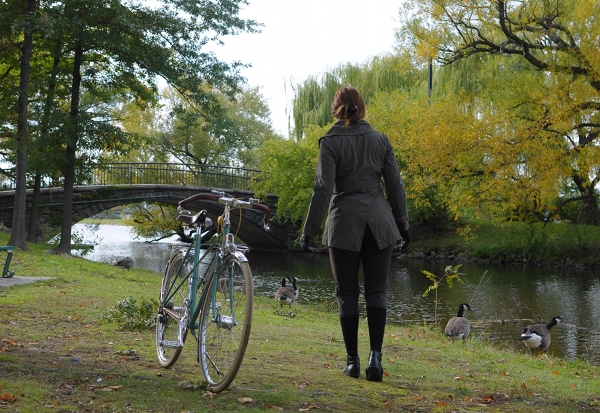
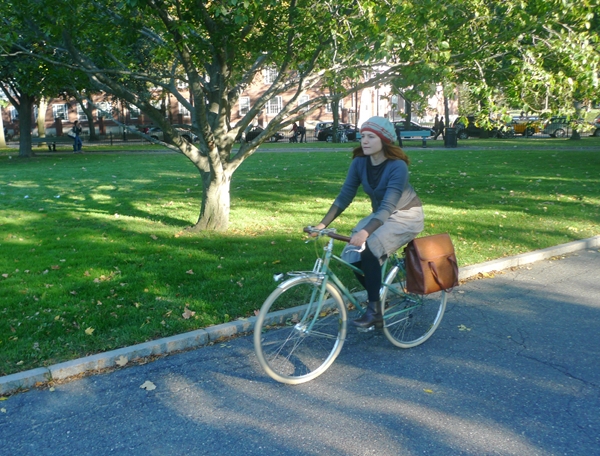
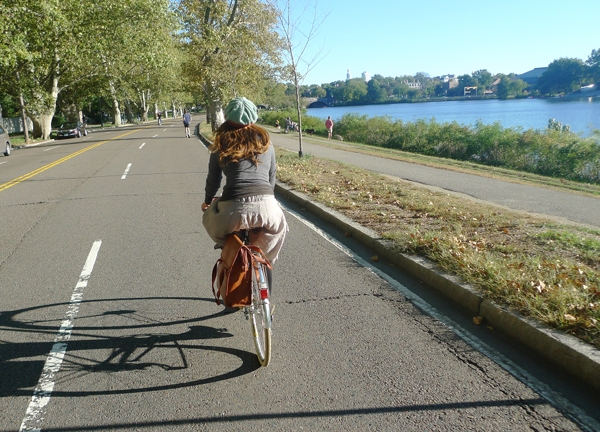
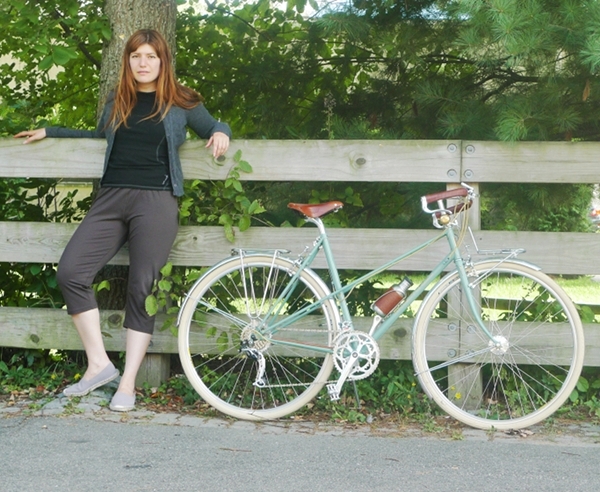
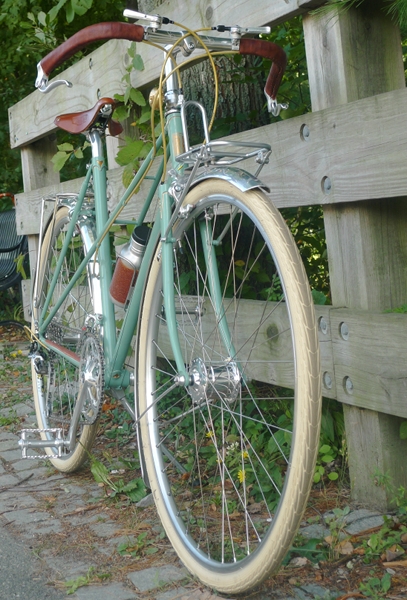
Alternating between the Royal H mixte and the Gazelle for transportation over the past few months, I've realised something funny: I have a minimum weight preference when it comes to commuter bikes. For fast cycling on hilly terrain, I love the feel of a light bike. But when riding for transportation in the city, the mixte is pretty much where I draw the line for how light I'd want my bicycle to be. Does that make me a reverse "weight weenie"?
What I like about commuting on heavier bikes, is that they tend to feel extremely sturdy in traffic. They also seem to have a more solid, commanding presence - useful when mixing it up with cars. I have found that drivers give me more room when I am riding something big and heavy-looking, possibly because they are more worried about damage to their car, should they accidentally clip me. Alternatively, it could be that on a massive bike - combined with an upright posture - I might seem like a more "legitimate" commuter to drivers. Whatever the reasons, I do tend to feel more comfortable and confident on a heavier bike in traffic than on a lighter one.
For me, the most important aspects of ride quality in a city bike are stability, comfort over pot holes and bumps, and the ability to accelerate and slow down while maintaining full control. And heavier bicycles tend to do better in those areas. I am not saying "the heavier the better." But I think it is important to recognise that some of the merits of traditional city bicycles cannot be separated from their traditional heftiness.
The nice thing about my mixte, is that it can go from being laden with bags for commuting, to being light and ready for a fast ride, in a matter of seconds. And, unlike most other light bikes I've ridden, this one is comfortable over bumps - a major plus. For those reasons, I have been riding the mixte for transportation more than I thought I would (the bike was originally intended for long country rides). But she is definitely my lower limit for how light of a bike I enjoy riding in traffic.
Showing posts with label Constance. Show all posts
Thursday, December 9, 2010
Monday, November 29, 2010
OYB Pannier: a Modified Swiss Army Bag for Your Bike
The OYB Pannier is a small Swiss army surplus bag, modified via the addition of rack attachments and other features by Jeff Potter - the owner and author of the project Out Your Backdoor ("indie outdoor lore and more"). I purchased this bag as a smaller alternative to the enormous shopper pannier I normally use. My criteria were durability, classic aesthetics, a trustworthy attachment system, a reasonable price, and a size just large enough to snugly fit my medium format camera equipment or my (very small) laptop. While I am aware that these same bags (without the bike-ready modifications) can be purchased from several other sources, I opted for the OYB version because I wanted the modifications to be made by someone with experience and because I wanted to support the "Out Your Backdoor" project, which provides some great resources for its readers.
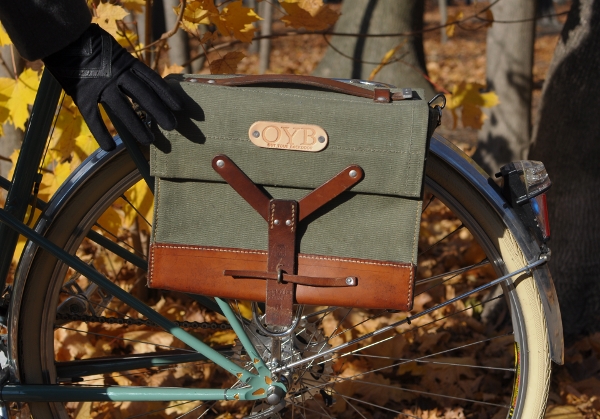
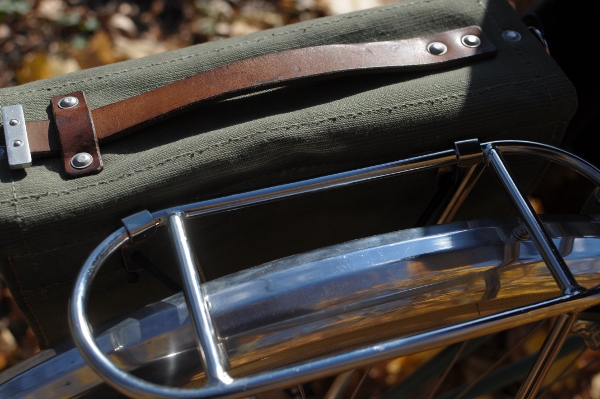
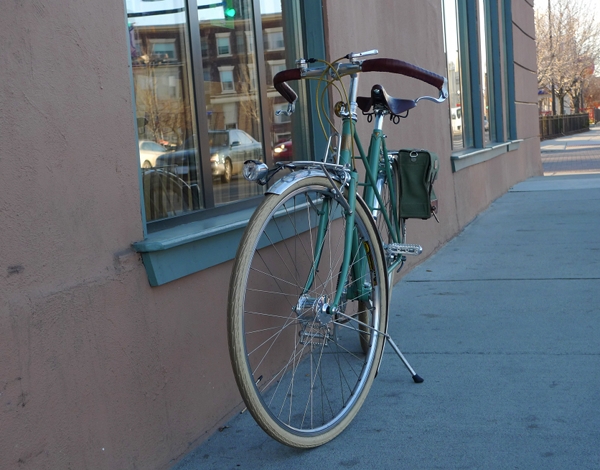
Compact and boxy, the pannier is a Swiss military bag made of a thick, stiff, olive-green waxed canvas with brown leather trim and steel rivets. The OYB leather patch is a lighter shade than the rest of the leather on the bag, but this can easily be changed with a modest application of neatsfoot oil or even Proofide. I am not sure whether this particular bag started out as new-old-stock, or whether it had been used in its previous life, but to me it looks more like the former. The condition is better than I had expected based on the pictures and product description on OYB.
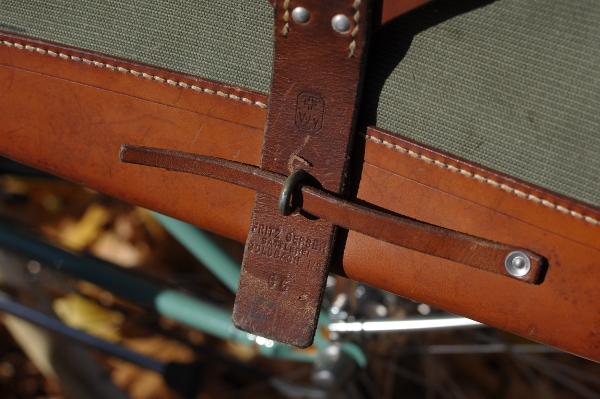
The closure system is simple and secure: That very stiff leather cord pulls out of the metal loop, and the thick leather strap lifts up off the loop to open the bag. For those curious, the imprint on the leather reads "Fritz Gerber Sattlerei, Goldbach."
Here is a close-up of the metal hooks. They are riveted on to the bag.
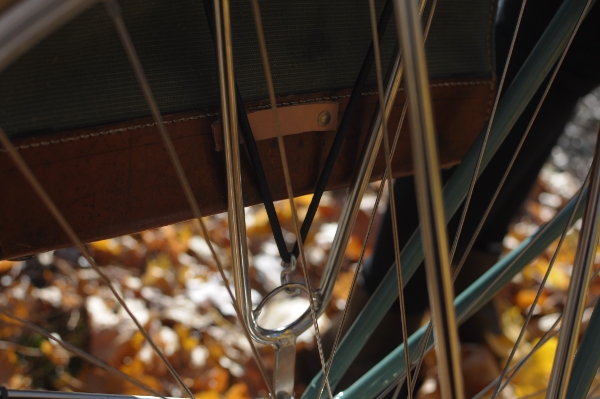
And here is a close-up of the bungee attachment. Together, these two attachment points ensure that the pannier does not sway or bounce against the rack - a good feature when you are planning to carry camera equipment. When the bag is not being used as a pannier, the bungee hook attaches to that small leather strip you see on the back of the bag - so that it does not hang loose. [Edited to add: I am now told that the bungee cord is supposed to go through that leather loop before you hook it to the bottom of the rack - oops.]
In addition to the rack attachments, the OYB pannier can be ordered with a number of other optional features, including shoulder strap attachments with a removable shoulder strap. I asked for the strap, because I pan to carry the bag around when off the bike, and this set-up essentially this gives me a camera bag and pannier in one. Other options include lights mounts, and a variety of other attachments.
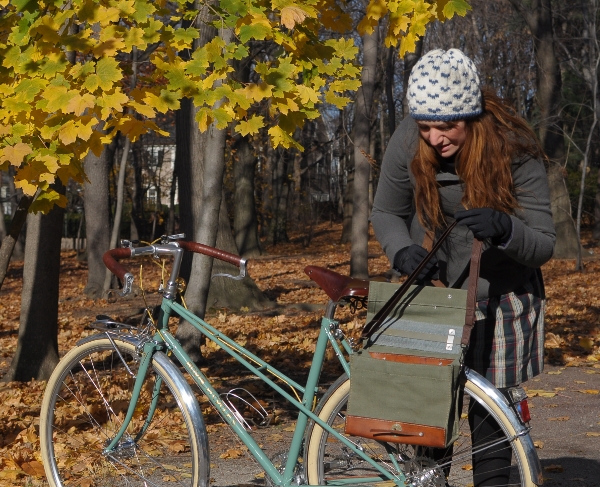
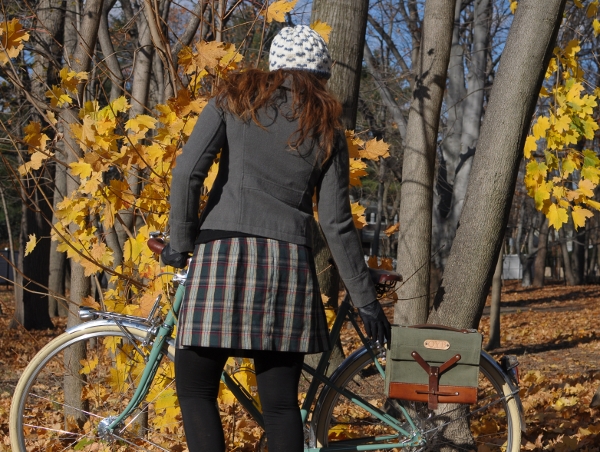
To give you a sense of scale, here is the pannier in relation to me and to the entire bike. It is a small bag. Dimensions are listed as: 8.5" tall, 4" deep, 11.25" wide (5.4 liters). Inside, the length of the bag is listed at 10.75", but I was hoping against hope that it would fit my 8 1/2 x 11" laptop. OYB gives instructions for stretching the bag out with magazines in order to make it fit items of that size, and I will give this a try. If I can get my laptop to fit, I will be thrilled - but I am not getting my hopes up and am prepared to content myself with this being a camera bag only.
If it were not for the laptop fit issue, this would pretty much be my dream pannier. The mil-spec colour scheme is not for everyone, but I love it, and it suits almost all of my bikes nicely. The durability of military surplus items is superb, and I appreciated getting the bag customised by Jeff at OYB. This is a classic, versatile, and reliable little pannier refashioned by someone who loves bicycles.
Compact and boxy, the pannier is a Swiss military bag made of a thick, stiff, olive-green waxed canvas with brown leather trim and steel rivets. The OYB leather patch is a lighter shade than the rest of the leather on the bag, but this can easily be changed with a modest application of neatsfoot oil or even Proofide. I am not sure whether this particular bag started out as new-old-stock, or whether it had been used in its previous life, but to me it looks more like the former. The condition is better than I had expected based on the pictures and product description on OYB.
The closure system is simple and secure: That very stiff leather cord pulls out of the metal loop, and the thick leather strap lifts up off the loop to open the bag. For those curious, the imprint on the leather reads "Fritz Gerber Sattlerei, Goldbach."
The attachment system is a combination of metal hooks and bungee cords, with which the pannier is secured to the rear rack. The rack I have on this bicycle is the Constructeur rack from Velo Orange, which is quite small.
Here is a close-up of the metal hooks. They are riveted on to the bag.
And here is a close-up of the bungee attachment. Together, these two attachment points ensure that the pannier does not sway or bounce against the rack - a good feature when you are planning to carry camera equipment. When the bag is not being used as a pannier, the bungee hook attaches to that small leather strip you see on the back of the bag - so that it does not hang loose. [Edited to add: I am now told that the bungee cord is supposed to go through that leather loop before you hook it to the bottom of the rack - oops.]
To give you a sense of scale, here is the pannier in relation to me and to the entire bike. It is a small bag. Dimensions are listed as: 8.5" tall, 4" deep, 11.25" wide (5.4 liters). Inside, the length of the bag is listed at 10.75", but I was hoping against hope that it would fit my 8 1/2 x 11" laptop. OYB gives instructions for stretching the bag out with magazines in order to make it fit items of that size, and I will give this a try. If I can get my laptop to fit, I will be thrilled - but I am not getting my hopes up and am prepared to content myself with this being a camera bag only.
If it were not for the laptop fit issue, this would pretty much be my dream pannier. The mil-spec colour scheme is not for everyone, but I love it, and it suits almost all of my bikes nicely. The durability of military surplus items is superb, and I appreciated getting the bag customised by Jeff at OYB. This is a classic, versatile, and reliable little pannier refashioned by someone who loves bicycles.
Sunday, November 28, 2010
Winter Hibernators
With temperatures now falling below 40˚F, there is no denying that winter will soon be here. As I rode through a stretch of frozen mud this morning, it finally began to seem real: The snow, the black ice, the heavily salted roads - it's all coming. And once it does, I will be putting most of my bicycles away, keeping around only those equipped to take on winter's fury.
The bicycles destined for "hibernation" are those that have derailleur gearing: my roadbikes, and, sadly my mixte. The ones staying are my 3-speed loop frames with internally geared hubs and chaincases. I will also tentatively keep my fixed gear bike.
Everybody has a different philosophy regarding what makes a bicycle suitable for winter. Having seen countless cyclists struggling with derailleur bikes last winter in Boston - as well as many bikes abandoned, their drivetrains iced over or rusted - I am pretty comfortable with my decision to only ride internally geared hub bicycles once the snow arrives. While I am sad to put away my beautiful mixte after only a few months together, I would be even more sad to ruin her with salt and crud while she is still so new and shiny.
What are your thoughts on "winter bikes" versus "hibernators"? Do you put any of your bicycles away for the season, or ride them all?
Wednesday, October 20, 2010
The One and Only 'Constance'! a Mixte by Royal H. Cycles
Trying to write a definitive post about the completion of my custom mixte (whom I have named "Constance") has been overwhelming, but I am forcing myself to do it before too much time goes by. Perhaps it will help if I try to cut down on the sappy stuff and just write about it briefly, matter-of-factly. After all, it's just a bike forgoddsake... Right!
To start with a basic description of the bicycle, it is a classic, fully lugged mixte frame with twin lateral stays. The tubing is eclectic, designed with comfort and strength as the main priorities: The downtube and seat stays are Columbus. The seat tube is Nova. The chainstays are Vitus. And the twin stays are domestic 4130 straight gauge.
For those interested in numbers, they are as follows: 52cm seat tube, 54cm virtual top tube, 73° seat tube angle, 72° head tube angle, 53mm fork rake, 54.5mm trail, and a bottom bracket drop of 65mm.
The liquid paint and lug outlining were done by Circle A Cycles in Providence, RI - as is standard for a Royal H. frame.
The colour was matched to a swatch I provided. It is somewhere between a mint green and a sage green, depending on the light. I chose it because it is my favourite colour. The Royal H. insignia and lug outlining were done in copper.
As far as construction goes, several nifty features make the bicycle special. To start with, it is nearly impossible to have a fully lugged mixte built nowadays, because the twin headtube lugs are no longer made. These were procured new old stock.
The "bullet" style seat stay caps were the framebuilder's idea and I was not sure I wanted them at first, but they look spectacular.
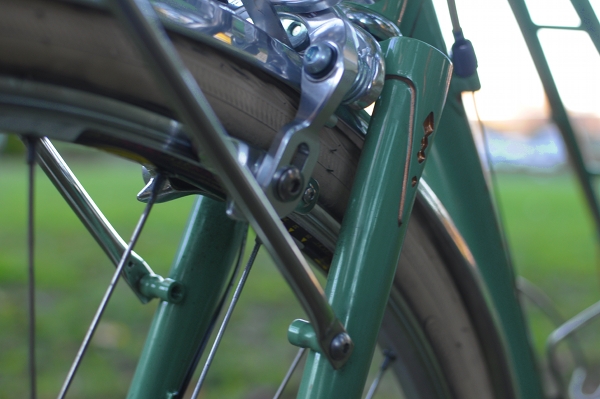
The flat-top fork crown has a small custom embellishment, and notice the little lugged braze-on for the shifter boss. I should mention that this bicycle has clearances for 35mm+ tires plus fenders...
Everything that could possibly be lugged on this mixte, is!
- including these amazing triple sockets on the rear dropouts. Read more about them, and other aspects of the lugwork here (not to mention the custom stainless steel kickstand plate!).
There are braze-ons for both front and rear racks, and the bicycle was built to accommodate reasonable front and rear loads.
If you are interested in a full technical description of the components, you can find that here. But for those who just want the main points of interest, I will describe a few.
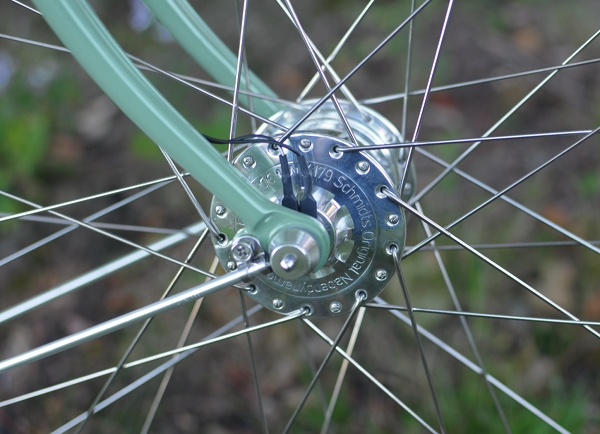
The 700C wheels were built by Peter White, with a Schmidt SON dynohub to power the lights. The headlight and tail light are the same as on my Rivendell, and you can read about them here.
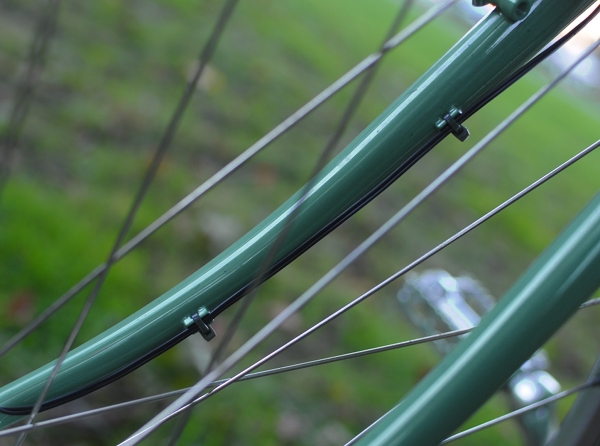
Braze-ons along the inside of the fork accommodate the wiring for the headlight.
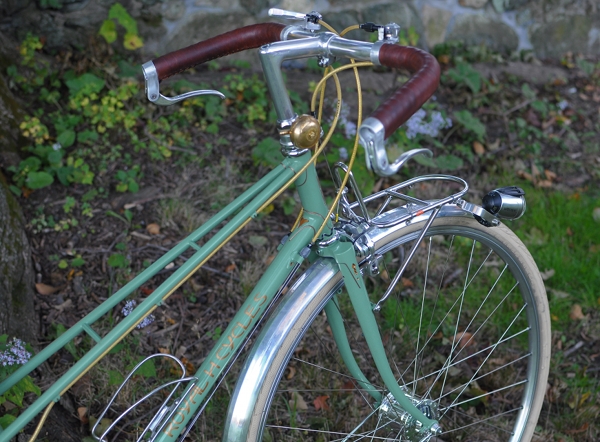
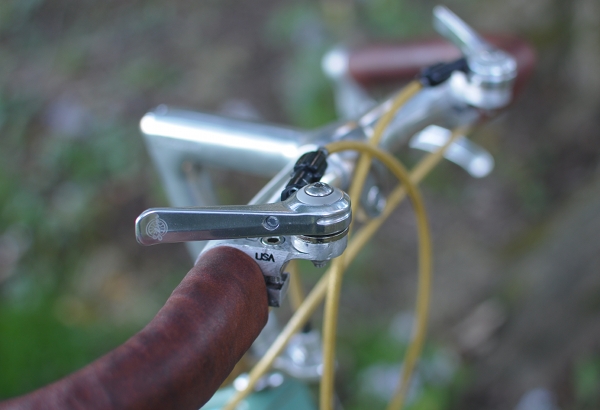
The handlebars are the Velo Orange Porteur bars, used with a 10mm stem, inverse brake levers, and Silver shifters inserted into Paul thumbies - which were heavily modified for the purpose.
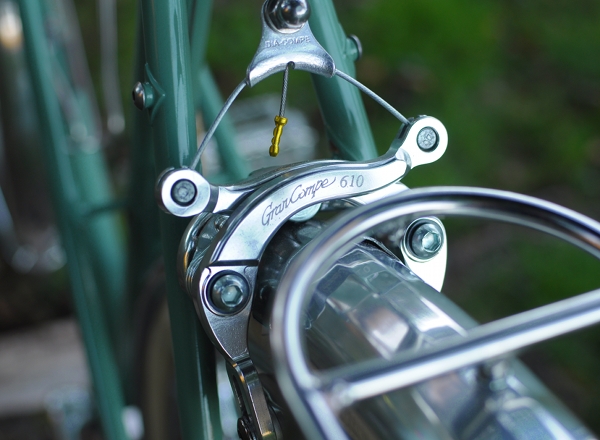
The bicycle was built to accommodate centerpull brakes, as this is my preferred style of brakes. The brakes are Dia Compe centerpulls from VO - which function great, but had to be slightly modified to fit properly (which, as I understand, is a problem other have had as well).
The crankset is a Sugino Alpina double. You can't tell in this picture, but there is a neat braze-on for the front derailleur.
The rear derailleur is the Shimano XT "Shadow". I love this derailleur, because it tucks in closely to the wheel, so that it is less likely to get dinged if you are riding off-road, or even if the bike gets slammed by a door. Given that I have nearly destroyed the rear derailleur on my Rivendell in half a year's time, I think the "Shadow" was made for me. Oh, and if you are wondering what that monstrous-looking cassette is, that is a Sheldon Brown custom touring cassette. Please be honest about this one: how bad does this look? I considered switching the biggest ring (currently a 34t) to a slightly smaller one, so that it blends in with the others visually - though over time the weirdness of it has grown on me.
The bicycle is fitted with the beautiful Honjo "Le Paon" fenders (similar to the VO "Zeppelins" I have on my Rivendell, but shinier and somehow more elegant), and the front rack is a VO Randonneur.
The rear rack is a VO Constructeur, which is small but can nonetheless fit a standard Dutch-size pannier. Oh, and the tires are (big surprise!) Schwalbe Delta Cruisers, 700C x 35mm. And I think I will stop now with the components, before I put everybody to sleep! If you have questions after reading this post and the spec list here, please ask in the comments and I will be glad to answer.
My impression of the mixte is multi-layered, but all the layers can be placed firmly in the category of "love". The bicycle handles differently than I had imagined, but only because I had no way of imagining something I had never experienced before. It is freakishly light, and luxuriously, almost abnormally comfortable while at the same time being faster and more responsive than any upright bicycle I have ever ridden. It is more responsive than the vintage mixte, "Marianne," I used to own, which I had complained was "twitchy". Somehow, on the Royal H. the responsiveness does not feel scary; I can control it. No idea how this all works, but I am certainly happy about it!
The fit of the mixte is just perfect for me, and I can feel that my proportions have been taken into consideration - everything just feels "right". The bicycle handles best with a 10cm stem, with the handlebars close to level with the saddle, and with the saddle pushed back a bit.
I have ridden the mixte all over town since early September, and have taken it on two longish rides (40 miles and 30 miles). Everything is beyond perfect and there is zero pain. I have tried to describe the ride quality here and here if you are interested in the details. One thing I love that I would never have expected to love, is the high bottom bracket. I feel almost majestically tall on this bicycle, even when leaned over and holding the front of the bars.
Given that this is a custom bicycle, I should probably conclude with a few words about the framebuilder. Bryan Hollingsworth is a young builder with considerable experience working for the world-famous Seven Cycles. He is a knowledgeable, enthusiastic, easy-going, and genuinely nice person. I knew that Bryan was the right builder for me, because he immediately understood the kind of bicycle I wanted, and got excited about building it. He was surprisingly pro-active about design solutions and pointed out possibilities that even my detail-obsessed imagination had not considered. As a result, my frame has some unique features that I cannot take any credit for what so ever; they were Bryan's idea! Additionally, now that I am actually riding the bicycle, it is clear that Bryan had put a lot of thought into making it comfortable for me, while, at the same time, giving it a degree of fiestiness that I had not expected.
I will also address price and affordability, since some have already been asking about this. I would rather not disclose the cost of my frame - mainly because that figure will no longer be of use to anyone. When I met Bryan, he had only just begun building custom frames under his own name, and that is how I was able to afford the project. A year later, Royal H. has taken off like a rocket, and, naturally, the price structure has changed somewhat. As for affordability, my advice would be to find a frame builder you like, and then discuss the possibility of breaking up the payment into several installments. This makes paying for the frame considerably easier. Furthermore, no one says that you must buy all the components immediately, and all at once. I saved up for them gradually, which is why it took nearly a year for my bicycle to reach completion. And yes, it was worth it!
I named this bicycle "Constance", because I hope she always remains in my life. Thank you to everyone who made my custom mixte possible, both directly and indirectly.
Tuesday, October 12, 2010
The Mystique of 'Ride Quality'
When describing what we like or dislike about riding a particular bike, we speak of that bicycle's "ride quality". But what exactly is that? In simple terms, it's how a bicycle feels to ride. Is it comfortable? how does it feel over bumps? how does it accelerate? how does it behave when turning corners? how does it feel when loaded? At least to some extent, all of the descriptions we provide under the umbrella of "ride quality" are subjective. And although there are objective, technical factors underlying the subjective experiences, the relationship between these factors is so complex and so sensitive to even the most minuscule variations, that translating sensations into explanations can be tricky.
This is especially true of my Royal H. mixte. Its ride quality intrigues me, because it is like nothing I have experienced before. For one thing, the frame feels oddly soft and springy. Some may suggest it's the tires, but no - the sensation is from the actual metal. It's like riding a bike carved out of a cloud, and the feeling is the exact opposite of the vintage Motobecane I used to own - whose frame felt "painful" and "hard". The other mysterious aspect of the Royal H., is the extent to which it likes to keep its line of travel. You can launch this bicycle across a room without a rider, and it will go straight. When I turn a corner, it goes at the exact trajectory I want it to go. I have never experienced anything quite like it. I know that Bryan (the framebuilder behind Royal H.) chose a delightfully eccentric combination of tubing specifically to combat the discomfort issues I was having with my vintage mixte, and that he built the bicycle with neutral trail so that it would feel stable. But is it really as simple as that? I have ridden other bicycles with good tubing and neutral trail, and they did not handle quite like this. So I prefer to attribute it to magic.
Being an annoying academic by training, I like to analyse everything until I understand it. But sometimes the things we feel are beyond the sum of their parts - things like love, happiness, ennui, longing ...and ride quality.
This is especially true of my Royal H. mixte. Its ride quality intrigues me, because it is like nothing I have experienced before. For one thing, the frame feels oddly soft and springy. Some may suggest it's the tires, but no - the sensation is from the actual metal. It's like riding a bike carved out of a cloud, and the feeling is the exact opposite of the vintage Motobecane I used to own - whose frame felt "painful" and "hard". The other mysterious aspect of the Royal H., is the extent to which it likes to keep its line of travel. You can launch this bicycle across a room without a rider, and it will go straight. When I turn a corner, it goes at the exact trajectory I want it to go. I have never experienced anything quite like it. I know that Bryan (the framebuilder behind Royal H.) chose a delightfully eccentric combination of tubing specifically to combat the discomfort issues I was having with my vintage mixte, and that he built the bicycle with neutral trail so that it would feel stable. But is it really as simple as that? I have ridden other bicycles with good tubing and neutral trail, and they did not handle quite like this. So I prefer to attribute it to magic.
Being an annoying academic by training, I like to analyse everything until I understand it. But sometimes the things we feel are beyond the sum of their parts - things like love, happiness, ennui, longing ...and ride quality.
Sunday, September 5, 2010
Strange Magic! And a Saddle Conundrum
How on Earth can one bicycle handle like a stately city bike one moment, and like a fast touring bike the next? I have no idea, but I have just experienced it.
At slow speeds, the Royal H. mixte rides like a vintage 3-speed: stable, easy, upright. So nicely it performed as a city bike, that I was almost reluctant to take it on a "real ride" - having gotten used to doing those kinds of rides on road bikes with drop bars. But once out of the city, the bicycle was magically transformed into... I don't even know what, because I haven't ridden a bike quite like it before!
This beauty handled the 40 mile ride through the hills of Concord and Lexington as if it were a casual cruise to the beach. We rode fast, but I didn't feel the speed. We climbed hills, but I didn't feel the strain of the climb.
When wrapped as I have them, the Porteur handlebars offer 3 distinct positions: upright when held at the edges, slightly leaned forward when held further down, and more aggressively leaned forward when held at the corners. And the bicycle responds to changes in hand positions very nicely. The Silver shifters installed onto Paul's Thumbies (more about this ordeal later!) are as easy to use as Sturmey Archer trigger shifters. And my positioning on the bike is so utterly perfect that I feel no pressure on my hands whether I am upright or leaned forward. The ride quality - namely its versatility - is strangely magical. I have never met a bicycle that can go from stately to aggressive at the drop of a hat before.
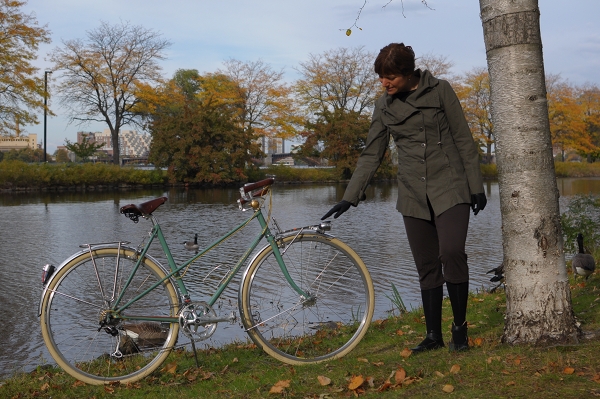
The mixte is not 100% finished yet, though pretty darn close: We still need to install the lights, and the front rack in these pictures is not the one that will ultimately be on it. But most importantly, I am not sure what to do about the saddle: Because my position alternates between upright and leaned over, it's hard to decide whether a more narrow saddle would be appropriate or a wider one, and whether springs or no springs. In the pictures, that is a Brooks B17 S borrowed from one of my roadbikes - but I am not certain that it feels right on this bike. What saddle do you have on your mixte, and how do you like it?
At slow speeds, the Royal H. mixte rides like a vintage 3-speed: stable, easy, upright. So nicely it performed as a city bike, that I was almost reluctant to take it on a "real ride" - having gotten used to doing those kinds of rides on road bikes with drop bars. But once out of the city, the bicycle was magically transformed into... I don't even know what, because I haven't ridden a bike quite like it before!
This beauty handled the 40 mile ride through the hills of Concord and Lexington as if it were a casual cruise to the beach. We rode fast, but I didn't feel the speed. We climbed hills, but I didn't feel the strain of the climb.
When wrapped as I have them, the Porteur handlebars offer 3 distinct positions: upright when held at the edges, slightly leaned forward when held further down, and more aggressively leaned forward when held at the corners. And the bicycle responds to changes in hand positions very nicely. The Silver shifters installed onto Paul's Thumbies (more about this ordeal later!) are as easy to use as Sturmey Archer trigger shifters. And my positioning on the bike is so utterly perfect that I feel no pressure on my hands whether I am upright or leaned forward. The ride quality - namely its versatility - is strangely magical. I have never met a bicycle that can go from stately to aggressive at the drop of a hat before.
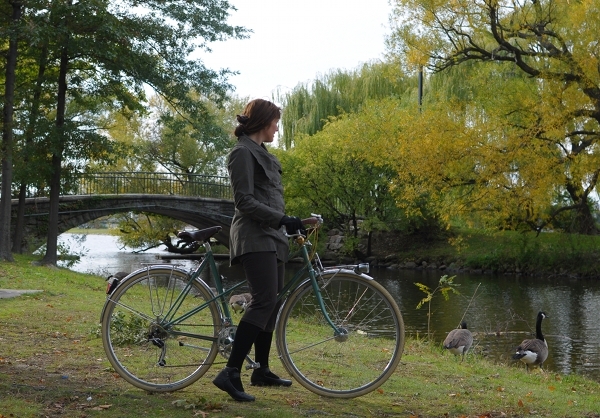
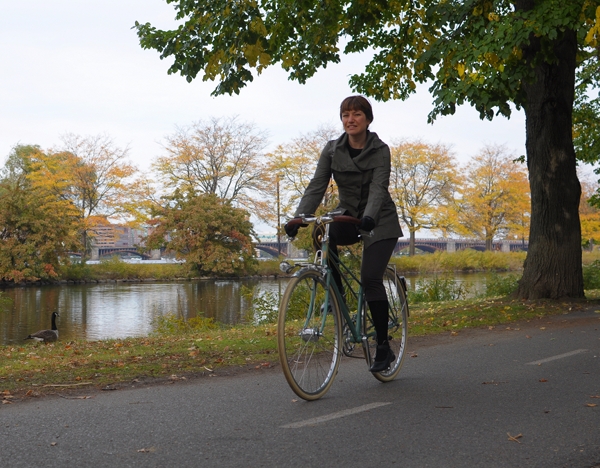
The mixte is not 100% finished yet, though pretty darn close: We still need to install the lights, and the front rack in these pictures is not the one that will ultimately be on it. But most importantly, I am not sure what to do about the saddle: Because my position alternates between upright and leaned over, it's hard to decide whether a more narrow saddle would be appropriate or a wider one, and whether springs or no springs. In the pictures, that is a Brooks B17 S borrowed from one of my roadbikes - but I am not certain that it feels right on this bike. What saddle do you have on your mixte, and how do you like it?
Subscribe to:
Posts (Atom)