Showing posts with label Brooks. Show all posts

Sunday, January 16, 2011

Brooks Colt: New vs Vintage

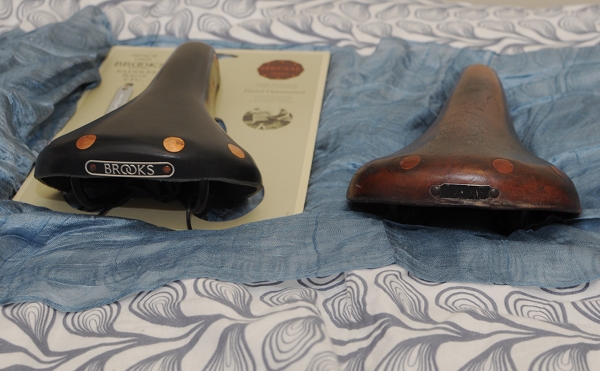
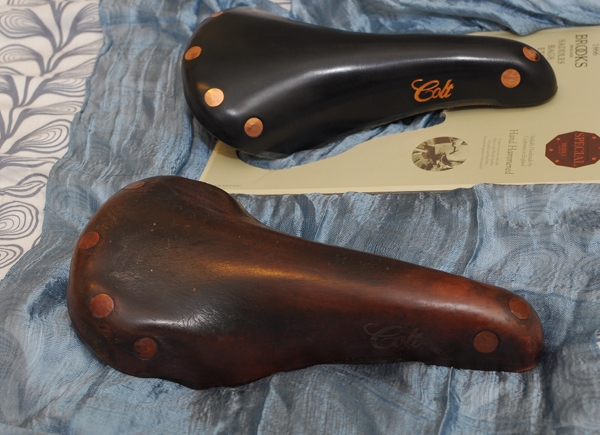
I have a new-release Brooks "Colt" saddle on loan from Harris Cyclery (for comparison with the Gilles Berthoud) and have just received a vintage "Colt" from a reader to try out as well. The weather we've been having has not allowed me to ride either of them just yet, but I thought a side-by-side comparison might be useful for those who are wondering how the re-released version compares to the original (produced 1979-2001).

What attracts me to the "Colt" model, is its shape, which in some ways resembles the Selle Italia "Turbo" and similar models of 1980s Italian racing saddles. Those saddles have fairly narrow (but not too narrow) platforms that gently curve in a way that feels very comfortable to me. But while the foam, plastic and padded leather surfaces of the "Turbo" style saddles start to bother me after a while, the suspended leather of the Brooks "Colt" should solve that problem.

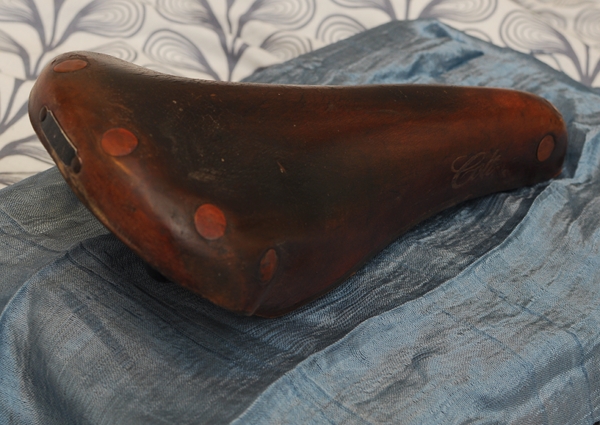
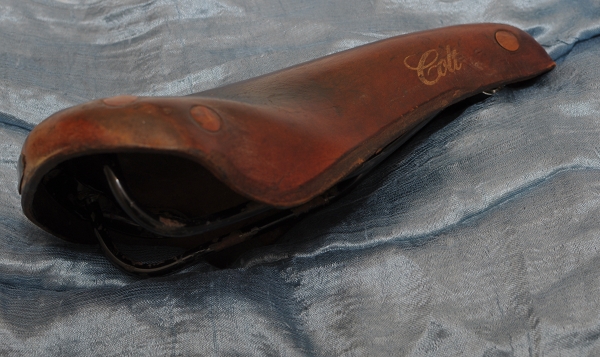
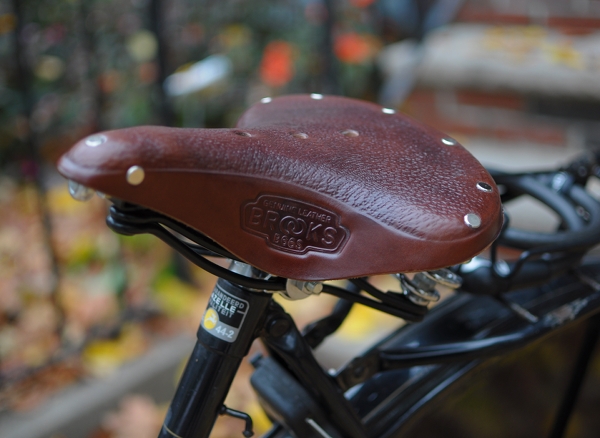
Like the '80s Italian racing saddles, the "Colt" has a fully covered, squarish, down-turned nose. It is the only Brooks model where the nose is styled in this manner, and to me the design holds the promise of anatomical comfort. The new and the vintage versions of the "Colt" appear to be identical in form, dimensions and basic construction - differing only in colour, in the shape of the Brooks placket in the back (see previous picture), and, of course, in the amount of wear.

I have two roadbikes for which I need saddles, and I have more or less decided to keep the Berthoud for one of them. For the other, I would ideally keep the vintage "Colt," and return the new one. One reason I prefer the vintage version is the classic, rich brown colour (the only normal colour the new release comes in, is black - the other options being purple, mustard, turquoise and hot pink). The other reason, is that everyone complains about the "Colt" being difficult to break in, and the vintage version looks like it has most definitely been broken in by the previous owner.

On the other hand, the vintage saddle may in fact be too broken in. The colour variations in the leather make this difficult to capture in pictures, but basically the sit bone indentations from the previous owner are so deep, that a narrow, raised ridge has formed along the center of the saddle. There are several online tutorials that give instructions for re-shaping saddles that exhibit such distortions, and I am considering doing this. The process (as described by Hilary Stone) basically involves getting the saddle wet, then stuffing it with paper and reshaping it as it dries. Curious about the experience of those who have tried it!

Tuesday, November 9, 2010

Choosing an Upright Saddle: Brooks B72 vs Brooks B66

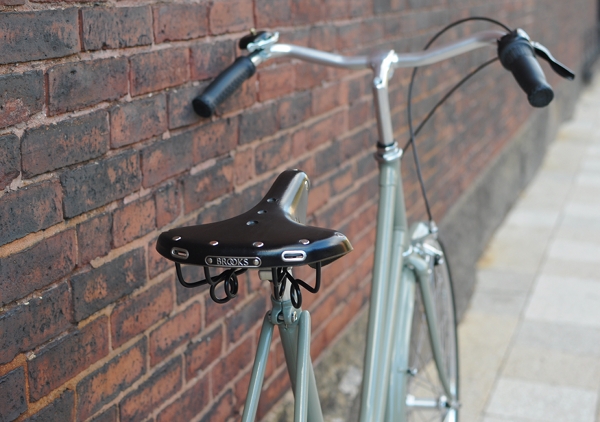
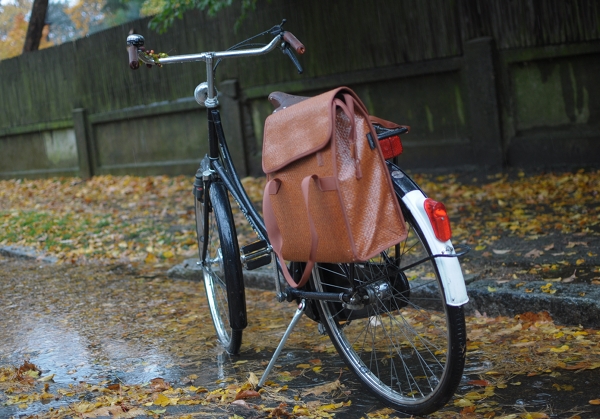
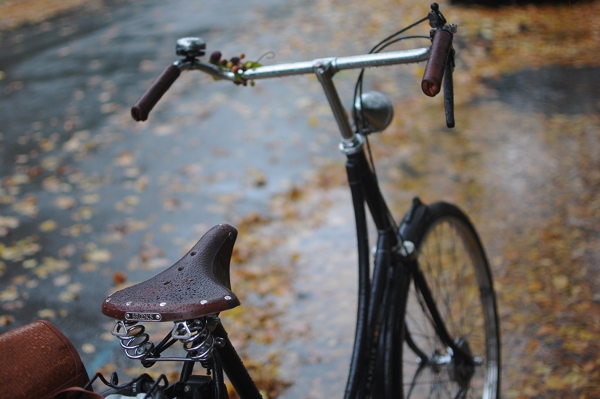
The Brooks saddles most typically fitted on upright bicycles are the B72 and the B66 (the B67 is the same model as the B66, only made for modern seatposts). Having ridden on both, I like each of them very much and cannot say that one is "better" than the other. For me it depends on the bicycle - or more specifically, on my experience of the bicycle. 

I had a brown Brooks B66 S ("S" indicates the shorter, women's version) on my previously-owned Pashley Princess, which I rode for over a year. And I recently bought the same saddle for my vintage Gazelle

I have Brooks B72 saddles on two of my current bicycles: a brown one on my Royal H. mixte, and a black one on my Bella Ciao 3-speed. (I have also owned several vintage B72s, but will leave those out of this discussion). 

[image compiled from brooksengland.com]

To get a good sense of the differences in dimensions, I've compiled the specs from Brooks into a single chart.  You can see that the B72 is very slightly wider than the B66 models (though a 4mm difference is negligible). The B72 is a unisex saddle and does not come in separate male and female versions; its length is in between the male and female B66. The B72 is lighter and has less height to it, because its springs are tighter and smaller than the springs on the B66. Unlike the B66 models, the B72 is available in black and brown only. 

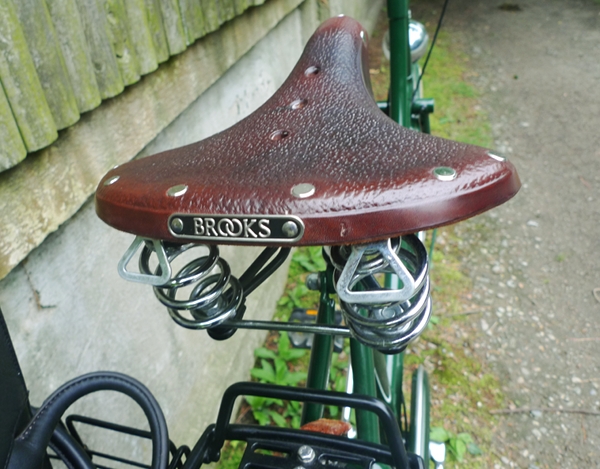
In terms of experiencing the saddles, the main differences are the springs, the shape, and the texture. The B66 has large springs that provide quite a bit of suspension. The texture of the saddle's surface is pebbled. And the edges - including the sides and the nose - are rounded.  To me, these features make the B66 particularly comfortable on a bolt-upright, heavy city bicycle. The substantial springs provide excellent cushiness when most of my weight rests on the saddle. The pebbled texture keeps me from sliding around. And the rounded edges make it easier to slide off the bicycle when dismounting - which is convenient when making frequent stops in the city. On the other hand, when I try the B66 on sportier bicycles (with lower handlebars and steeper geometry), I find some of these comfort features distracting: The springs are too much and the pebbled texture is annoying when I am always shifting on the saddle.

In comparison to the B66, the B72 seems like a more versatile saddle to me. The B72's springs are tighter and smaller - still providing suspension, but not to the extent that it interferes with a more forward lean. The surface of the B72 is smooth and the edges are squarely tapered - which I find more comfortable for long distance cycling, during which I slide around on the saddle more, but get off the bike less frequently. 

While both saddles are great for upright bicycles, for me the B72 works better on the more sporty variety, whereas the B66 works better on the super-relaxed ones. As they say, your mileage may vary.  If you have tried both models and have a preference for one over the other, please share your experiences.

Thursday, November 4, 2010

Water, Water Everywhere

In the morning they did warn me
it would be a day of rain.
But how could I've predicted
such tumult on its way!
Stroke after stroke I pedaled
with a swift and forceful motion,
but water fell upon me
as if amidst a stormy ocean.
Water, water everywhere
and not a drop to drink!
Water, water everywhere,
my bike did nearly sink!

And so November is upon us, and with it the November Rain.  Funny, because I don't remember it being quite this bad last year, but I've probably just blocked it out. Today it rained so hard, that the water not only covered my face, but went inside my nose and mouth. Feeling as if I might drown while cycling was a curious sensation. I could hardly see anything in front of me, but thankfully drivers seemed to all be showing remarkable courtesy. Maybe they just couldn't believe that a cyclist was on the road in such a downpour and felt sorry for me. 

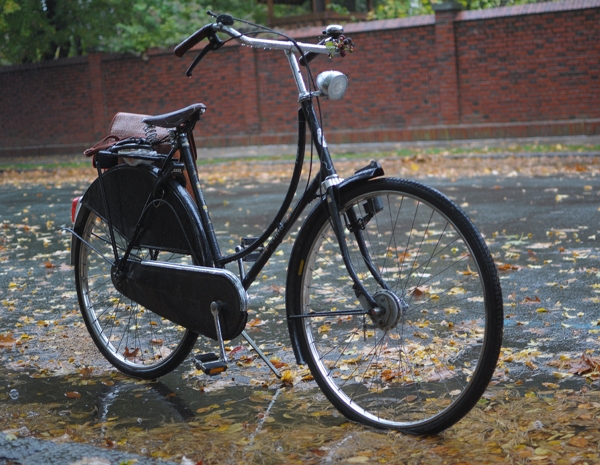
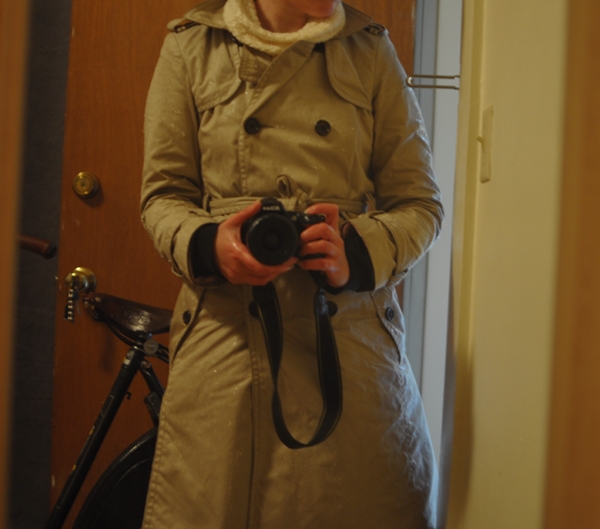
When it is raining this hard, I prefer to be on a heavy, upright, and exceptionally stable bike. When I owned my Pashley, I often talked of how good it was for cycling in the rain. To my relief, the vintage Gazelle is the same, if not better. The handling makes this bike unfellable. The enormous wheels and wide tires part lake-sized puddles, grip slippery surfaces, and float over potholes. The fenders release a mighty spray and keep my beige raincoat beige. Defiant in the downpour, I cycled with dignity even as water streamed down my face. And I arrived at my destinations only slightly worse for wear.

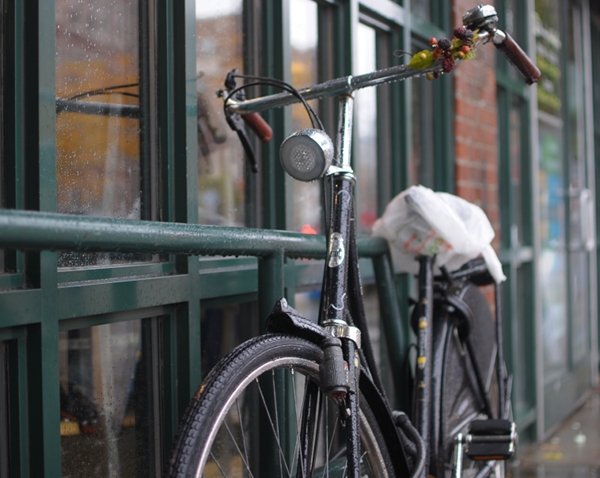
The other two things I like to have when cycling in the rain are good lights and a saddle cover. I was not sure how well the bottle dynamo would function when wet, but it was absolutely fine (I am beginning to develop a  fondness for the bottle) - and my LED-modified headlight made me highly visible. As for the saddle cover, despite having accumulated many Brooks covers at this point, my preferred method is to use a ratty plastic grocery bag. The plastic bag performs two functions: it is more waterproof (gasp!) than a Brooks saddle cover, and it makes the bicycle look considerably less appealing to thieves. Not that many thieves would be tempted to drag away a 50lb clunker with a locked rear wheel in a downpour...

And speaking of dragging: I must say that carrying a wet, slippery 50lb bicycle up the stairs is even more delightful than doing so with a dry one. I have noticed that when it comes to lifting a heavy step-through, it is important to find a comfortable spot to grip - one that is well balanced and will prevent the bicycle from twisting or buckling in my arms as I attempt to maneuver it. Despite being heavier than my previously-owned Pashley, the Gazelle has a better "sweet spot" in this regard, and so I find it easier to carry... just not when the frame is slick from the rain. Still, I managed to wrestle the enormous Dutch creature up the stairs and through the door without either of us taking a spill, after which we had a cup of tea and recited poetry together. It is essential to have a bicycle that is more than a fair weather friend. 

Wednesday, October 27, 2010

A Raven Flies Through the City: The Bella Ciao Corvo Citta Donna

A couple of weeks ago I received a Bella Ciao bicycle as part of a work-related trade. I have never been compensated for anything in bicycle before, but I think I could get used to this if absolutely forced to (at least for the benefit of providing test ride reports for my readers, right?). The bike was assembled with my preferences in mind, and I was invited to offer an honest critique.

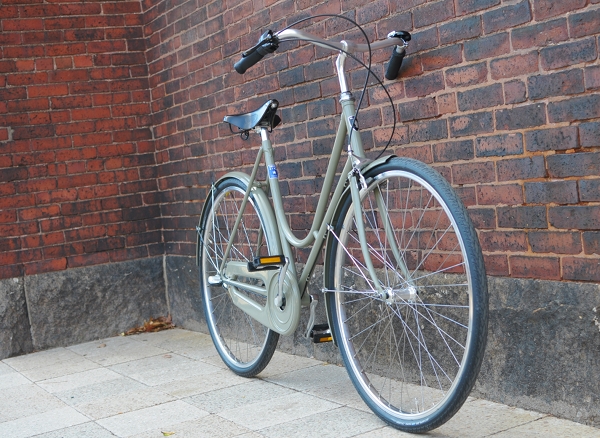
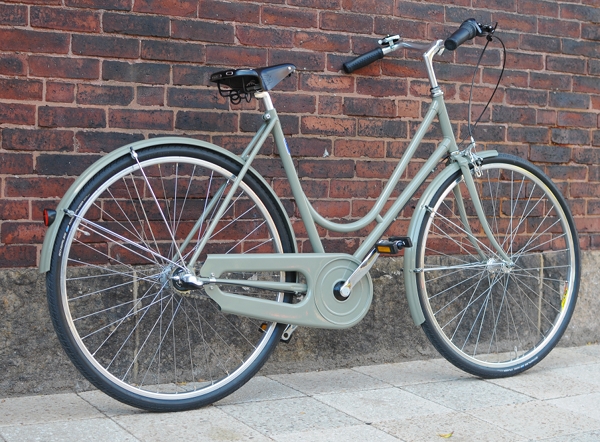
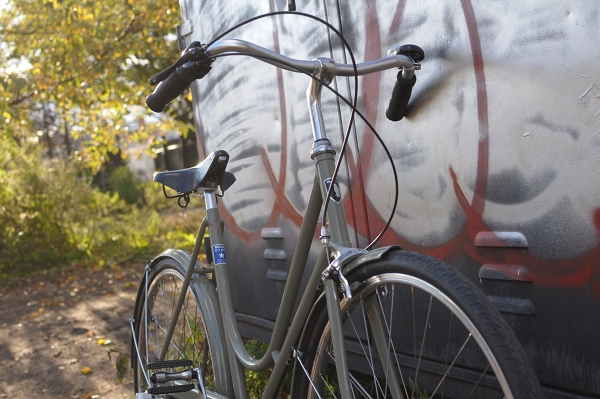
The bicycle is a Bella Ciao "Corvo Citta Donna". The model name translates into something like "urban raven" and donna indicates that it is the lady's version. The colour (chosen by me) is "verde arsenale" - a pastel army green. Half a dozen other colours are available as well. The "Corvo Citta" models can be ordered as single speeds, 3-speeds, or 7/8-speeds, with or without coaster brake. I asked for a 3-speed coasterbrake version.  The accessories are either honey or black, depending on the frame colour, and mine came with the black accessories package.

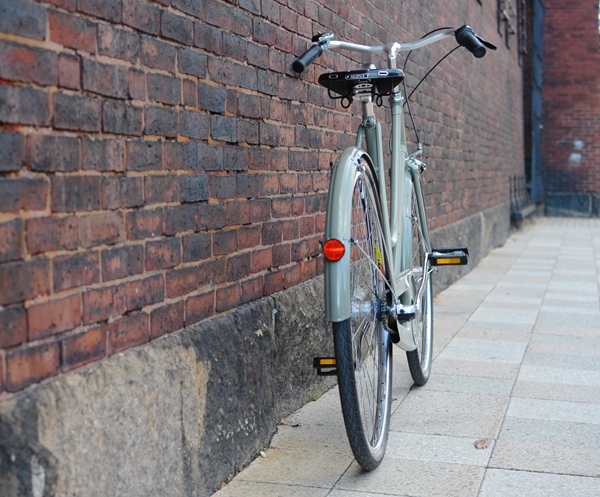
Bella Ciao frames are individually hand-made (brazed and lugged) by a small family-owned manufacturer in Northern Italy that has been building frames for generations. The standard models are cro-moly steel, though there are also limited editions made of Columbus tubing. Standard features on the Corvo Citta Donna include the classic Italian frame construction, 700C wheels with alloy rims, body-coloured fenders, an enclosed chaincase with a rear opening, leather saddle and grips, rear reflector, and a brass bell.

The frame is made in size 54cm (21.5") only, measured the "standard" way. This is an important point, especially if you are trying to compare the Bella Ciao to the Abici, whose sizing is measured differently. I would say that the Bella Ciao frame is slightly larger than the bigger of the two Abici frames.

With its hardy tubing, modest lugwork, and thick powdercoating, the "Corvo Citta" is attractive, but decidedly utilitarian.

It is not a delicate bicycle by any means; the frame feels as if it can take anything that life has to offfer.

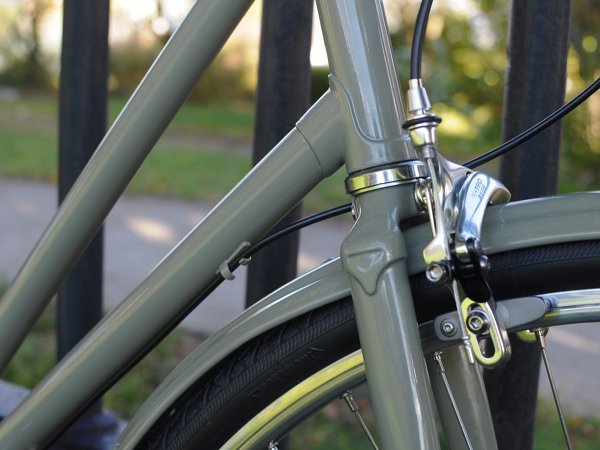
The lugged fork crown warms my heart; very nicely done. And look at the body-coloured cable guide braze-ons.

The only part of the frame that is not lugged, is the connector between the curved top tube and downtube. But if I have to choose between this and the fork crown, the latter is infinitely more important to me. (The connector on my Pashley was not lugged either.)

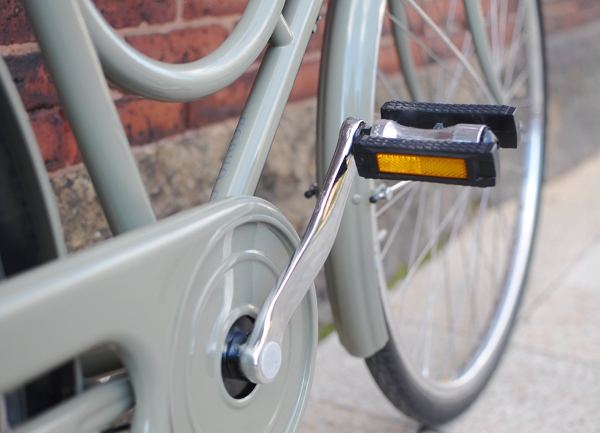
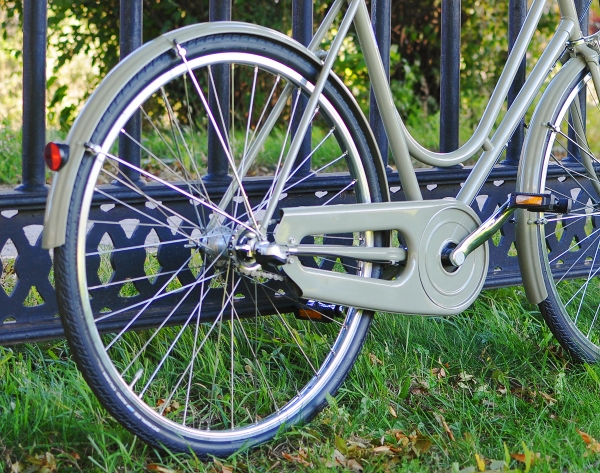
I like the elegant chaincase, and the interesting thing, is that despite being steel it is absolutely silent.

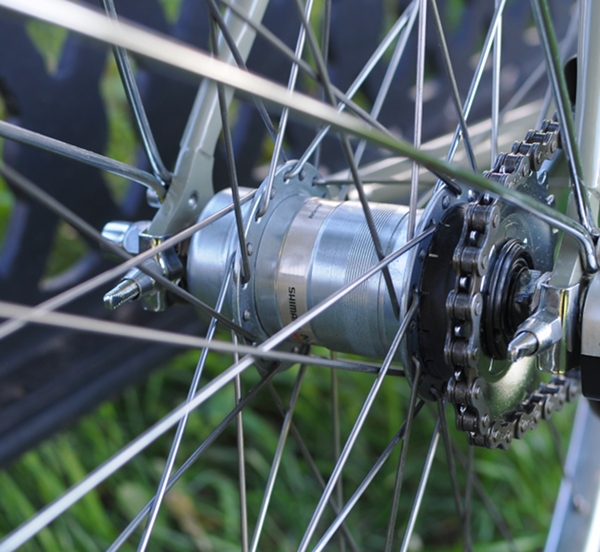
Somewhat disappointing though, was the choice of the Shimano 3-speed hub and gear shifter for such a classic bicycle. The Shimano certainly works fine, but the excruciatingly high-tech looks of the hub and shifter disrupt the bicycle's classic charm. Personally, I feel it would have been better to use the Sturmey Archer hub and shifter on these bikes - though I suspect others will disagree.

The Bella Ciao has straight fork ends, which I prefer on an internally geared hub bicycle. There are also chain tensioners installed - a detail the Co-Habitatant found especially exciting.

The bicycle arrived to me with a Brooks B17S saddle, but I immediately replaced it with a B72. I am not sure why both Bella Ciao and Abici use B17 saddles on their city bikes, but I think they need to rethink this choice - it is not an appropriate model for an upright ride, especially for women. The B72, on the other hand, feels absolutely at home here.

As long as I am doling out criticism, I will also mention my perplexity over the choice of brake lever: I believe it may be an interruptor lever, because it is very short. The Tektro front caliper brake provides excellent stopping power and the lever is squeezable, but it's just not the right one for this type of bicycle. A normal, full-size city lever would be more suitable.

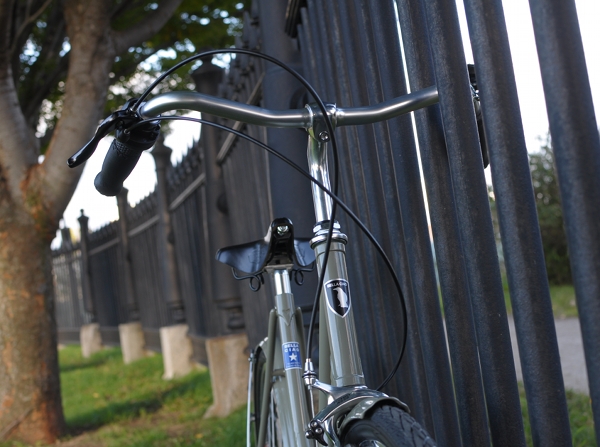
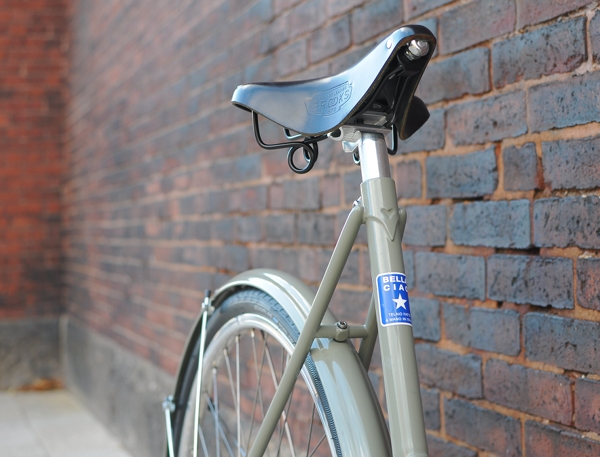
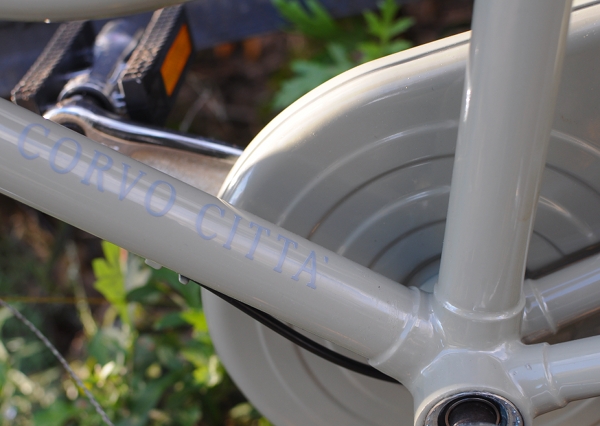
The minimal insignia on the Bella Ciao include a small headbadge on the head tube featuring the black raven logo,  the "Corvo Citta" model name inscription near the bottom bracket, and a "fatto a mano in Italia" sticker on the seat tube.

And one thing I should definitely mention is the handlebars - which are proprietary Bella Ciao. They are shaped similarly to Porteur handlebars, but with just a tad more flare-out to them. The shape is super comfortable for my hands and seems perfectly matched to this bicycle's geometry.

Moving on to ride quality... The most notable sensation I got from the Bella Ciao, was that it did not feel like a new bicycle. It felt very familiar, like an old bike that I have always owned. Lovers of classic bicycles complain that "there is no such thing anymore as a simple, well-made, lugged steel 3-speed bike". Well, I think the Bella Ciao is exactly that. It is easy. It is comfortable. It is uncomplicated. It is not as laid back as a Dutch bike, but definitely not too sporty either (more relaxed than an Abici).  It is maneuverable but unaggressive. It is just a bike. A very nice bike that anybody can ride, and that is light enough for anybody to lift.

When a bicycle is this easy, comfortable and undemanding, you end up riding it all the time... which, ironically, ushers in my next complaint: Where are the lights? And more importantly, where is the rack? I would love to ride the Bella Ciao regularly for transportation, but there is nowhere to attach my bag and all the other stuff I take along, which is frustrating. The design of the bicycle will accommodate the VO Constructeur rear rack, and when I have the money I might get one. But I think that a rack in the style you see on some of these bicycles would be more appropriate. Anybody know where I could source one?

The Bella Ciao "Corvo Citta Donna" might just be the closest I have tried to an "all around, normal" bike out there today among classic lugged bicycles. And that was rather unexpected, given the quirkiness of the manufacturer's self-presentation. Free-association collages, stories of resistance against fascism - it is enough to raise the eyebrows of some and to make others wonder whether Bella Ciao is in reality a contemporary art project rather than a real bicycle company. Well, I suppose there is no reason it can't be both...

Though currently only sold in the EU, Bella Ciao is considering North American distributors and the bicycles may be available for sale in the US sometime in 2011. The Corvo Citta Donna would certainly be welcomed by women looking for more options in classic city bicycles.
Friday, September 24, 2010

Making an Ordinary Vintage Roadbike Extraordinary (a Review of Sorts)

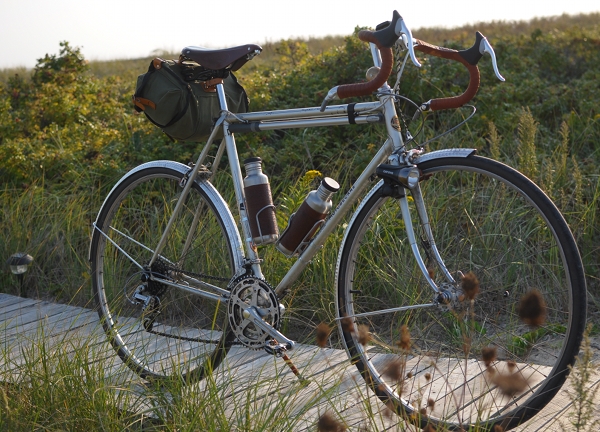
The Co-Habitant's roadbike, Myles, is a 1976 Motobecane Super Mirage, which he acquired in Spring 2009 and has been gradually updating with modern components and personal touches. It is his only roadbike, and he has cycled somewhere between 2,000 and 2,500 miles on it through its various iterations. I wanted to write a review of it (from my perspective), because I think it poignantly illustrates some aspects of owning and customising a vintage roadbike.

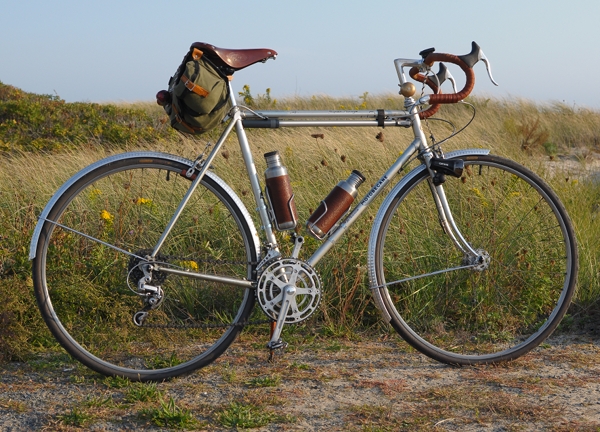
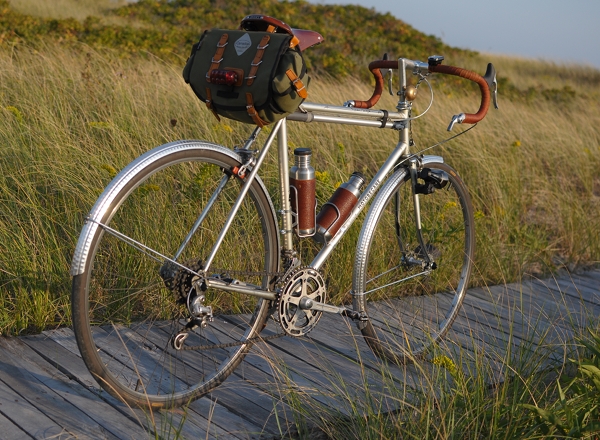
It is always interesting to observe people's reaction to Myles, for he is a real head turner - even more so than my Rivendell. The silver frame, the hammered fenders, the wealth of brown tones in the leather and twine, the frame pump looking almost like a double top tube, and the classic Carradice bag, somehow combine to create a whole that is more magnificent and eye-catching than the sum of its parts.

On closer inspection, those who know bicycles typically exhibit one of two reactions. Some are delighted to see a good, ordinary vintage bicycle salvaged and turned into a thing of beauty. Others are bewildered that we bothered to so elaborately refurbish something so commonplace, rather than searching for a frame with a more impressive pedigree. While the Motobecane Super Mirage was a good, solid bicycle in its time, it was decidedly middle-tier and for that reason unremarkable. The frame is hi-ten steel, the lugs are fairly basic, and the original components (Suntour, Weinmann) are pretty good, but not excellent.

We do not disagree with the point of view that a better frame would have been more deserving of all the DIY lavished on Myles. But sometimes a bicycle just evolves organically, and such was the case here.
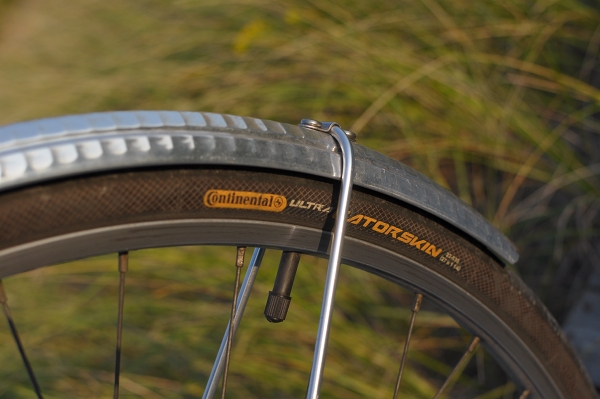
When the Co-Habitant found the bike, used and somewhat abused, the plan was simply to ride it after a few minor changes. He first replaced the tires, after the original ones blew up on his very first ride.  He has ridden these Continental Gatorskins (27" x 32mm) the entire time without incident.

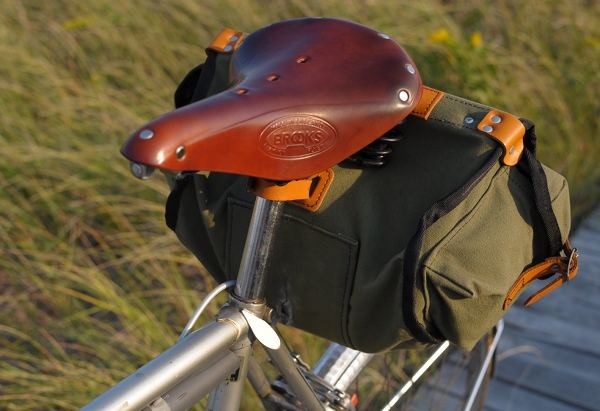
He then replaced the original vinyl saddle with a Brooks Flyer. Early on, he was caught in the rain and the Flyer got wet - which hastened its breaking-in process nicely.

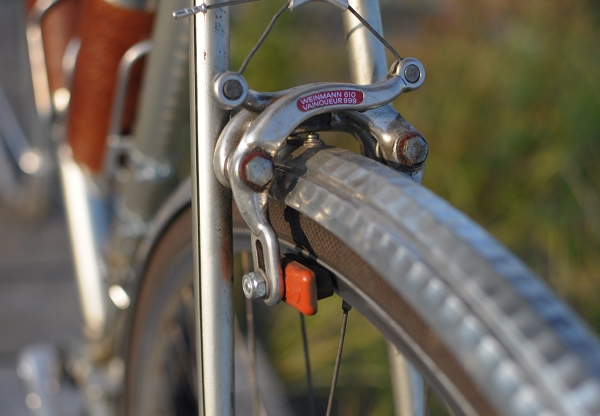
The brakes on the bicycle worked fine after some adjustment, but he did replace the pads with the salmon Kool-Stops.
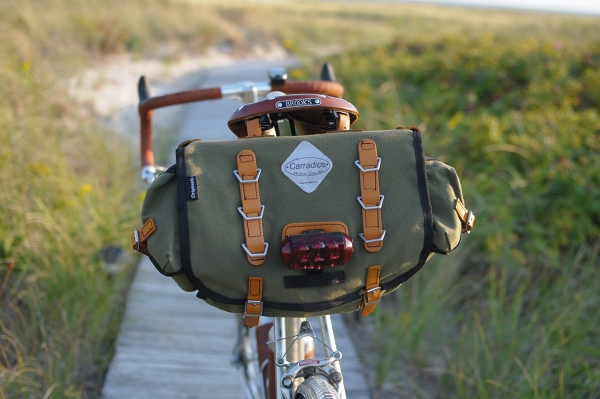
As he began riding the bicycle more and more, he added fenders and a saddle bag. Although I am normally not a fan of hammered Honjos, I think they do look good on silver bikes - providing textural variation where the colour is similar.  Hammered fenders are also a good investment in terms of hiding dents or scratches.
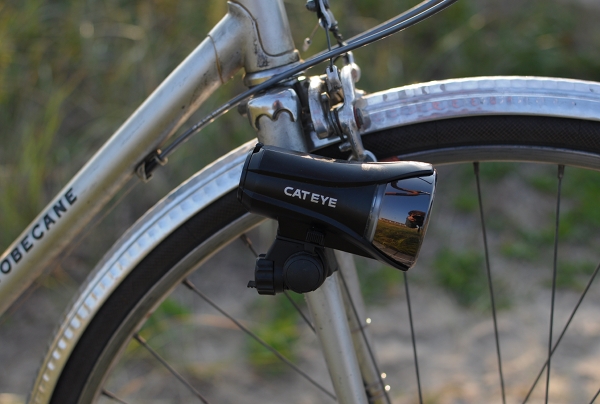
The Carradice Barley bag has been sufficient for carrying anything he needed on this bike, up to our current trip. For the future, he will consider getting a larger bag that can fit laptops, and a rack to support it. Having a saddlebag is also handy for installing a battery-operated tail light, such as his CatEye.

His headlight is mounted on the fork, using a Minoura light mount. While he prefers generator lighting, as far as battery-operated lights go, he likes this system very much.

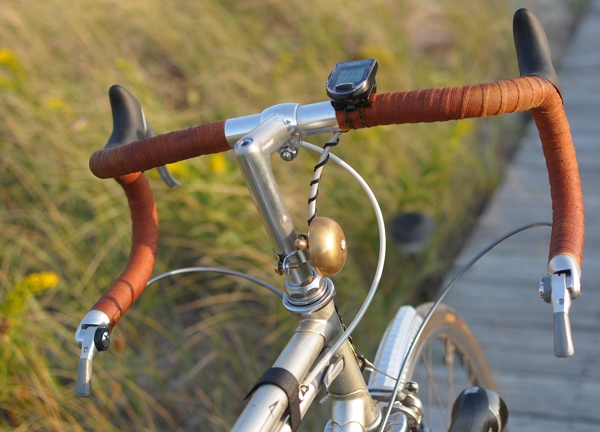
Some months later, he decided to replace the handlebar set-up, as the original one caused discomfort and difficulty operating the brake levers.  He replaced them with 42cm Nitto Noodle bars, which he loves, and the stem with a Nitto Technomic. 

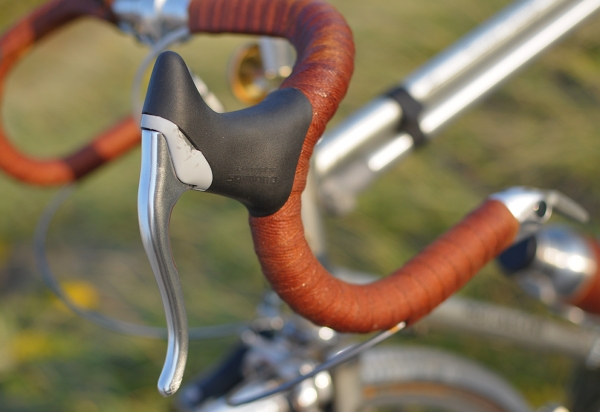
The original non-aero brake levers were replaced with modern Shimano aero brake levers. Personally, I am not a fan of these brake levers, as the hoods have a rather harsh surface and there is a plastic insert that is very easy to damage. The Co-Habitant has dropped and crashed this bike several times, and you can see that the levers look battered.

Almost a year later, a few more changes were made. After complaining that his feet always slipped on the touring pedals at high speeds and that toe clips were a bother, he installed these SPD clipless pedals - much to my shock at the time.  He loves them and now says that he would not go back to non-clipless on a roadbike, vintage or not.

Around the same time, he also installed a CatEye computer to keep track of his speed and mileage,

a Topeak frame pump,

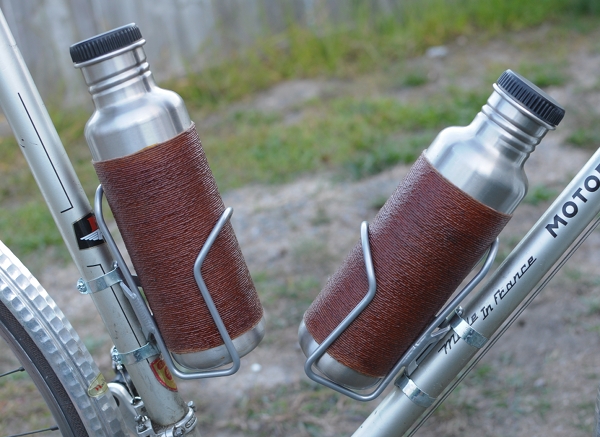
and two bottle cages, bolted onto the frame - into which he places his twined and shellacked Klean Kanteen bottles.

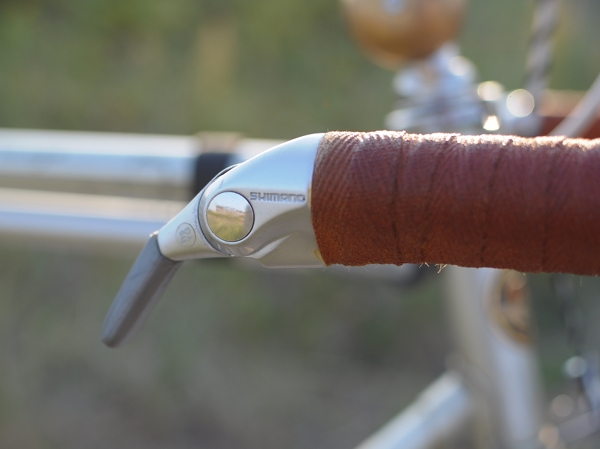
And the final update - completed just a couple of weeks ago in our yard  - was the replacement of the original stem shifters with these Shimano bar-ends. Since the bike is a 10-speed, it isn't possible to get indexed shifting, but these work just as well in friction mode. After having used a shifting method that sounded like a tractor for over a year, the Co-Habitant is absolutely delighted with these - they are fast and quiet, and he is convinced that they are superior even to my Silver shifters (although I disagree).

And so that is the story of Myles's slow but steady transformation from a plain '70s French 10-speed to a glorious and shamelessly eccentric dandy. Was it worth it? It certainly helped the Co-Habitant learn about classic roadbikes - both riding them and working on them. It is difficult to get a straight answer from him about how comfortable the bike is, especially as he is more tolerant of discomfort and pain than I am and to some degree even thinks these are "normal" to experience on a roadbike. But from what I can surmise, the bike is more or less comfortable in its current state, except that it places a bit too much weight on the hands and is over-responsive to the point of being "squirrely". Also, the frame size would ideally be larger, and he could do with better gearing.

All of these comments, however, are made only in response to my direct questioning; he never complains about the bike on his own accord. On the contrary, he is extremely fond of Myles, smiling and shaking his head quietly at any suggestion that such components ought to be placed on a new frame instead.

Sunday, September 5, 2010

Strange Magic! And a Saddle Conundrum

How on Earth can one bicycle handle like a stately city bike one moment, and like a fast touring bike the next? I have no idea, but I have just experienced it.

At slow speeds, the Royal H. mixte rides like a vintage 3-speed: stable, easy, upright. So nicely it performed as a city bike, that I was almost reluctant to take it on a "real ride" - having gotten used to doing those kinds of rides on road bikes with drop bars. But once out of the city, the bicycle was magically transformed into... I don't even know what, because I haven't ridden a bike quite like it before!

This beauty handled the 40 mile ride through the hills of Concord and Lexington as if it were a casual cruise to the beach. We rode fast, but I didn't feel the speed. We climbed hills, but I didn't feel the strain of the climb.

When wrapped as I have them, the Porteur handlebars offer 3 distinct positions: upright when held at the edges, slightly leaned forward when held further down, and more aggressively leaned forward when held at the corners. And the bicycle responds to changes in hand positions very nicely. The Silver shifters installed onto Paul's Thumbies (more about this ordeal later!) are as easy to use as Sturmey Archer trigger shifters. And my positioning on the bike is so utterly perfect that I feel no pressure on my hands whether I am upright or leaned forward. The ride quality - namely its versatility - is strangely magical. I have never met a bicycle that can go from stately to aggressive at the drop of a hat before.

The mixte is not 100% finished yet, though pretty darn close: We still need to install the lights, and the front rack in these pictures is not the one that will ultimately be on it. But most importantly, I am not sure what to do about the saddle: Because my position alternates between upright and leaned over, it's hard to decide whether a more narrow saddle would be appropriate or a wider one, and whether springs or no springs. In the pictures, that is a Brooks B17 S borrowed from one of my roadbikes - but I am not certain that it feels right on this bike. What saddle do you have on your mixte, and how do you like it?