Showing posts with label urban cycling. Show all posts

Thursday, February 10, 2011

Step-Throughs: an Advantage in Traffic?

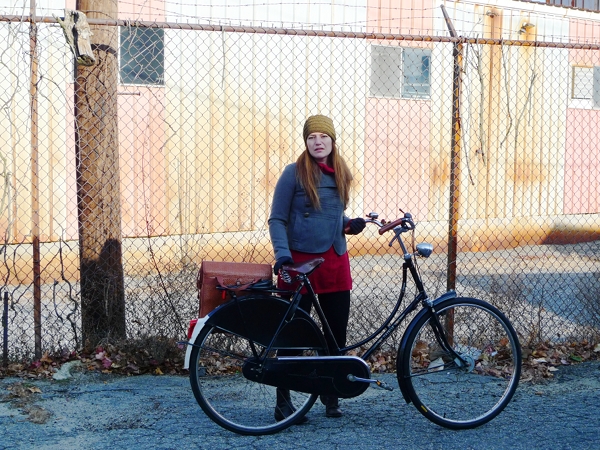
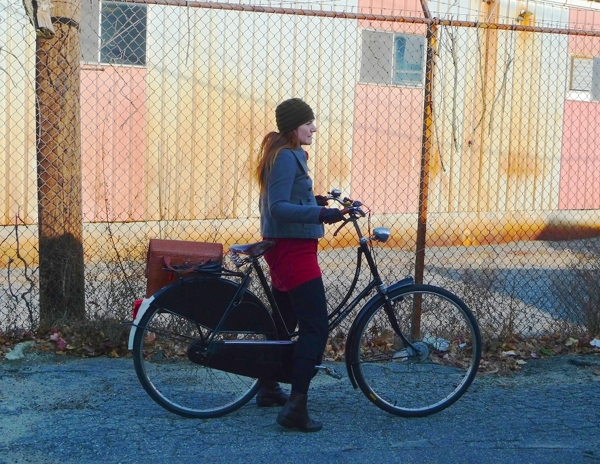
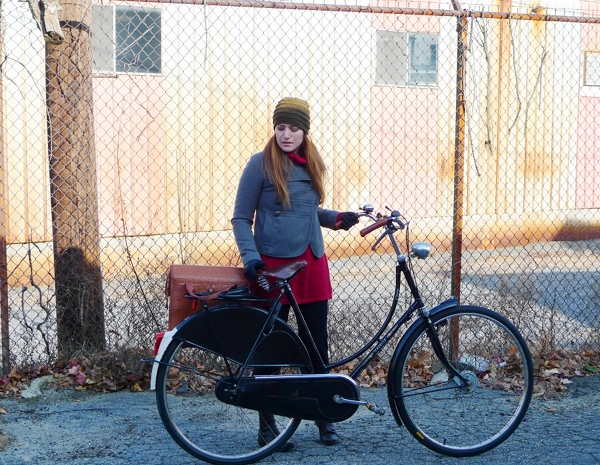
There was an interesting post on ecovelo yesterday, where the author compared how he uses his three transportation bikes: a Rivendell Sam Hillborne, a Surly Long Haul Trucker, and a Civia Loring. All three bicycles are set up with upright handlebars and decent load carrying capacity, but the Civia differs from the other two in that it has a fairly low stepover. And according to the author, the combination of its "upright riding position, step-through frame, and internal gear hub make[s] the Loring exceptionally confidence inspiring for riding slowly when in close proximity to pedestrians and automobile traffic." Initially, I read past that sentence with the kind of matter-of-fact acceptance that goes with processing what you already consider to be a given. But then later I mentally "rewound" and thought "Wait a minute, he is saying that he finds it more comfortable to ride a step-through in traffic than a diamond frame - Is this a generally accepted notion?" 

I used to think the reason I prefer step-throughs for transportation, is that I often wear skirts. But having read the ecovelo post, I realise that even when wearing trousers I feel better on a step-through in traffic. And, assuming that Alan of ecovelo mostly wears trousers, for him there must be other factors involved as well. Maybe for me it's the promise of the easy "hop off sideways" dismount should I need to bail, that makes me feel more secure. But to tell the truth, I am not sure what it is, and whether my preference is entirely logical.

All factors remaining equal (upright handlebars, ride quality, load capacity), what, if anything, would make a step-through bike an advantage in traffic?

Thursday, February 3, 2011

Cycling and Statistics

As someone with a background in the social and natural sciences, I was "raised" on statistics by the academic system. If we compare academia to religion, then making claims without statistical evidence is akin to taking the Lord's name in vain. But even beyond academia, we have an inherent faith in statistics as a culture. We respect numbers and charts, and we turn to them for comfort at times of uncertainty. Consider, for instance, this beautiful bar graph:

Now, some of us may have suspected that diamond frames tend to be ridden by men, whereas step-throughs and mixtes tend to be ridden by women, but only numbers and graphs have the power to lift us from the murky waters of speculation. We can now say that, in a recent poll conducted by Lovely Bicycle, of the 221 respondents who claimed to ride mainly diamond frame bikes for transportation, 76% were male. Of the 95 respondents who claimed to ride mainly step-through bikes for transportation, 80% were female. And of the 39 respondents who claimed to ride mainly mixte bikes for transportation, 66% were female. This numerical evidence we can wield like a mighty weapon the next time someone contradicts these tendencies.

Of course the one little problem with Statistics, is that it's mostly BS. In the words of comedian Vic Reeves, "88.2% of Statistics are made up on the spot" - which may very well be the case. But numbers need not be maliciously forged in order to misrepresent reality. There are multitudes of ways in which a study can be flawed or biased from the start, set up so as to elicit particular responses. Often this is done unintentionally, or at least unconsciously, by researchers eager to find evidence for their pet theories. Other scenarios can include how data is processed, or even how the final results are presented. Statistics are highly prone to human error and bias, which means that they are inherently subjective. This, combined with the fact that we respect them so much, makes our statistics-loving culture susceptible to misinformation.

[image via NHTSA]

The idea of statistics and misinformation brings me to what I really wanted to talk about here, and this is something I've been trying to make sense of for a while. I am puzzled by the use of safety statistics in bicycle advocacy, and I am hoping that someone could explain them to me. For example, many bicycle advocacy talks and internet presentations stress that it is safer to ride a bike than it is to travel in a car. In support of this, they use statistics such as this data from the National Highway Traffic Safety Administration (NHTSA), according to which there were about 30,000 motor vehicle traffic fatalities, and about 600 bicycle fatalities in the USA in 2009. These numbers are used by cycling advocates to point out how much safer it is to cycle than to drive. But unless I am missing something, the figures mean just the opposite.

Yes, the NHTSA numbers suggest that in 2009 there were 50 times more motor vehicle fatalities than there were bicycle fatalities in the US. But those numbers mean nothing until they are weighed against how many cars vs bicycles there are on the roads at large. If there were 50 times more cars on the road than bicycles, than the risks of fatal traffic accident would be equal for each mode of transportation. But I believe that in actuality, there are more like 1,000 more cars on the roads than bicycles... which means that the number of cycling fatalities is disproportionately high.

Obviously, I am not trying to prove that cycling is unsafe. But I do want to understand the reality of the situation. After all, if cycling advocates use statistics incorrectly, they open themselves up to some very harsh critique from unfriendly forces. Where could one go to obtain accurate statistics about the number of cars vs bicycles on the roads, and the number of traffic accidents for each?

Monday, January 10, 2011

The Mary Poppins Effect?

Lately, there has been some discussion in the comments about whether drivers display more courtesy when cyclists ride upright bicycles and dress in "regular" clothing. One reader wrote that "the uprightness [is] more visible and [the clothing] maybe less offensive to your average driver... The images generated revolve around Mary Poppins. Only a monster would do anything mean to Mary Poppins" (Christopher Fotos, December 10, 2010). Do you agree?

When Bike Snob NYC poked fun at the Tweed Ride last week in his typically colourful manner, I was laughing my head off about the associations with colonialism and Civil War re-enactments: I never found Tweed Rides appealing for precisely those reasons. But I disagree with his conclusion that nice clothes on a bike are generally "not traffic calming." It's one thing to be dressed in what appears to be period costume, joined by dozens of others who have done the same while taking a joyride through the city. It's another thing entirely to be cycling to work in a suit and a wool overcoat, because that is what you normally wear to work.

Speaking solely from my own experience, I'd noticed as soon as I started cycling for transportation that drivers are nicer to me when I dress "normally." And since having begun to ride a roadbike recreationally, the difference between how I am treated on the roads when on a bike with drop bars, wearing "sporty clothing" and my hair tucked away, in comparison to how I am treated when on an upright bike in "city clothing," with my work bag in the basket and my hair visible, is notable. The majority of the time, when a driver is rude to me or impatient with me, I am on my roadbike - which is odd, since I am faster on a roadbike than I am on an upright bike, and thus should be less "in the way."  To me, this just confirms that drivers' perceptions of how annoying a cyclist is, are entirely subjective. You can be going 10mph and somehow this might be okay, or you can be going 25mph and they might still be annoyed.

In part, I think the idea of not wanting to harm Mary Poppins is valid - in the sense that a cyclist dressed "normally" looks more human to the driver. The way people process each other visually and emotionally is governed by a complicated system of simulation and self-recognition (this is actually my research specialty, so I've spent a lot of time thinking about it!). And from that point of view, it makes sense to speculate that the more "I am human! I am you!" signals we give off when cycling, the more empathy a driver will feel towards us. Dehumanisation, on the other hand, makes it easier to cause harm to another human being - because we fail to simulate their emotional state and relate to their suffering. And dehumanisation is facilitated by things like uniforms (one reason it is easier to kill soldiers and war prisoners, than civilians), or anything else that obscures individuality and hides signs of "humanness".

But in addition to the Mary Poppins effect, I think that there are also implicit "right of way" rules that are present in the driver's mentality, from which "normally" dressed cyclists benefit. I am not suggesting that this is right or justified in any way, but I get the impression that drivers are enraged by the associations with leisure and recreation that a road cyclist's attire evokes. The cyclist is on the road because they are "going for a ride." The driver, however, is on the road because they "need to be somewhere." So the reasoning follows, that the person who needs to be somewhere clearly has more valid reasons to use the limited road space than the person who is going for a ride, which is why the presence of the road cyclist causes annoyance. On the other hand, when the cyclist's appearance suggests that they are also engaging in transportation and "need to be somewhere" just like the driver, their presence on the roads seems more justified. This is just a theory, but the fact that drivers will shout things like "Get a job!" to roadies, but will ask me "How long does it take you to get to work?" at red lights when I am dressed up, gives it some plausibility. They associate the "normal clothes" look with going to work, and they associate the sporty look with recreation.

All of this is, of course, entirely speculative and none of it is to say that cyclists should strive to dress in any particular way in order to secure the driver's compassion. Only the certainty of criminal prosecution can reliably deter a driver from causing harm to a cyclist, and I hope to see that become the norm in the US in the near future. Until then, let's hope that drivers can find a way to see Mary Poppins in all of us, whether we are dressed in lycra, tweed, or something in between.

Wednesday, January 5, 2011

My Concessions to the Bicycle

In the past, I've expressed my view that an effective transportation bicycle is one that "allows us to be ourselves" - meaning that we should not have to change the way we dress or lead our lives in order to ride it. Recently a reader called me on this, asking the following (edited) question over email:
You write that you do not believe in compromising personal style when it comes to cycling for transportation and I am wondering just how far you take this idea. Have you really never made any compromises in your wardrobe in order to commute by bike? 
That is a good point, and I did not mean to imply that I never compromise on my clothing choices in order to cycle for transportation.

For one thing, I have stopped wearing high heels since I began cycling. While I know that many women find it perfectly natural to cycle in heels and I admire this ability, I myself cannot do it in a way that makes me feel safe and comfortable. I was willing to give up heels, because my relationship with them was already waning - the bike was simply the last straw. Throughout my late teens and all of my twenties, I pretty much wore 3-3.5" heels all the time. In fact, my body got so trained to the resulting posture, that my lower back would hurt when I would attempt to wear flat shoes! The wisdom of having done that for so many years is a separate topic, but either way - I somehow grew out of it, or maybe just became more messy/natural over time, and gradually lost the addiction to towering footwear. My point being, that by the time I gave them up altogether in order to feel safe on my bicycle, it no longer felt like a sacrifice. 10 or even 5 years ago it would have been a problem, but not now.

Another wardrobe adjustment since I began cycling, has been my choice of skirts. I wear almost exclusively skirts and dresses, and they vary in design. I have always favoured "a-line" styles, which flare out at the bottom, over "pencil" styles, which fit tightly around the knees. I do own a couple of pencil skirts and skirt-suits that I am fond of, but I cannot wear them on a bicycle at all, as they constrain both my pedaling and my ability to mount the bike. Hiking the skirt up does help, but it wrinkles the fabric, shows my underpants to the world, and is just generally too much hassle for me. So I have mostly stopped wearing pencil skirts, favouring a-line, pleated, flared, fluted and full styles instead. I also cannot wear super-mini skirts on a bike, because somehow the hem tends to catch on the back of the saddle when I dismount. Again, not really a huge sacrifice, as I've mostly stopped wearing mini skirts anyway.

And finally, on the hottest days of summer, I seldom wear solid pastel colours since I started cycling - especially blouses - because they show sweat stains. Instead, I opt for florals, paisleys, stripes, or some other pattern that disguises sweating. It's a useful trick for cycling in extreme heat and humidity while still wearing work clothing.

While I do make some compromises in the way I dress in order to ride a bicycle comfortably, I feel that they are relatively minor and don't sacrifice my sense of individuality. It's one thing for someone like me to stick to a-line skirts and to stop wearing high heels when I was already in the process of abandoning them. But it would be another thing to suddenly start wearing pants, sneakers and neon windbreakers in order to commute on a diamond frame roadbike. It's basically a difference between making compromises "within your stylistic comfort zone" vs. changing your style entirely. So the next question is: What if wearing high heels is super-important to someone and they view it as a crucial part of their identity, yet they cannot cycle in heels? Well, if they are absolutely unwilling to give up the heels, they have two options really: to make an extra effort to get comfortable cycling in them, or to choose other transportation options. Riding a bike is not for everyone and it can't be forced if other priorities overshadow the desire to cycle.

But on a separate note, it is worth considering that style evolves. Our choice of clothing is a function of how we live our lives, and the way we dress can change over time - influenced by a myriad of factors. Who is to say that cycling cannot be one of them? I am curious to see how something like that would play out in the wardrobe of, say, a corporate lawyer or a diplomat. Could be interesting! 

Tuesday, December 21, 2010

First Snow Report

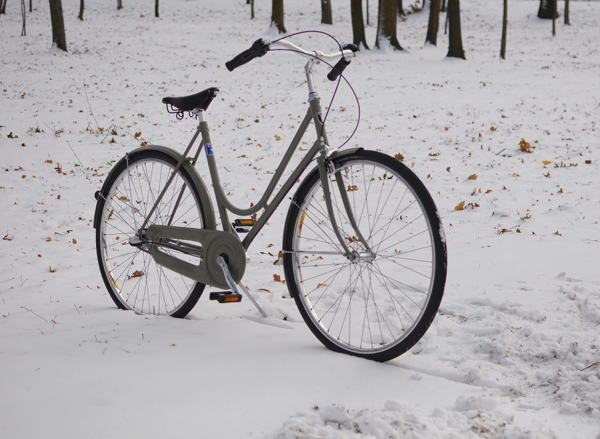
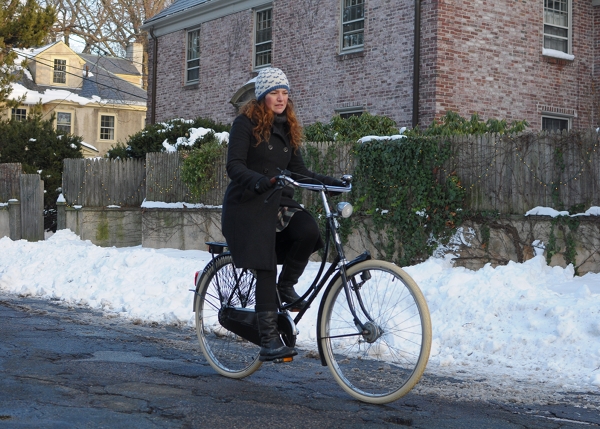
I have been looking forward to testing my Bella Ciao ("Patricia") in winter conditions, and with the arrival of the season's first snow I finally got my chance. Before I go on, I will preface with the disclaimer / mini-announcement that I have begun collaborating with Bella Ciao on a special edition bicycle, which will be sold by Harris Cyclery in Spring 2011. I will have more details about that soon, but just wanted to make that affiliation known in the meantime.

Though I love the way my Bella Ciao "Corvo Citta" model handles, I don't ride it as often as I'd like, because I haven't yet installed a rack and lights. Now that winter has begun in earnest, that will be my next project - I just wanted to first make sure that I'd actually be able to ride this bicycle comfortably in snowy conditions. At just over 30lb, the Bella Ciao is considerably lighter than the likes of Gazelle and Pashley, and - justifiably or not - I am weary of lighter bikes when it comes to cycling in poor weather. To my relief, I had nothing to worry about and Patricia handled just fine after the first snowfall: She remained stable on slush, on slush mixed with salt, and on thin layers of packed snow.

As with other bikes I have ridden in such conditions, I switched to a lower gear and went slower than usual. The bicycle remained sturdy and cooperative. When braking in slush, I used the coaster brake only, which I find easier to modulate on slippery surfaces. The bike also did well cycling on the slippery stretch of brickwork that was part of my route. As far as safety goes, I feel comfortable using the Bella Ciao as a winter commuter in Boston and will get on with the lights/ rack installation so that I can use it more this winter.

While the brave Patricia performed admirably, my first snow commute of the season was not entirely stress-free. Driver behaviour was chaotic and there were few cyclists out on the roads. Several times, I got spooked by a car's ambiguous maneuvers and ended up cycling through a mess of wet snow by the curb. Based on last winter's experience, I know that things will get better once drivers get into their "winter mode". Meanwhile, perhaps there is a reason why most cyclists seem to have chosen to wait it out!

What I found fascinating about the Boston "bike scene" last winter and also noticed yesterday, is that often the only bikes on the streets seem to be those that are least suited for winter cycling - for instance, aggressive roadbikes with narrow tires and no fenders. Where are the fully equipped city bikes? Where are the rugged vintage 3-speeds?

It could be, that the aggressive roadcyclists are the ones most likely to brave these conditions, while, ironically, having the worst possible bikes for doing so. That's too bad, because winter is the time when features like fenders, stable handling, wide tires, internal gearing, and an upright sitting position, really make themselves felt. Last winter, I was extremely appreciative of the Pashley I used to own, and this winter it looks like I will do equally well on the Gazelle and Bella Ciao.

Though Patricia and I did not have many companions on our first snowy commute of the season, we hope that the winter wonderland will coax more cyclists outside soon. Once the drivers calm down, it is really not so bad: Just take it easy, dress warmly, ride a sturdy and properly equipped bicycle, and enjoy the beautiful landscape!

Wednesday, December 15, 2010

User Friendly Interface

Now that it's winter, I find that strangers talk to me more than usual about cycling - typically when they see me locking up my bike. Over the past couple of weeks, several women have told me that they'd love to ride a bike, but find the logistics daunting: having to buy lights and figure out how to mount them; constantly getting flats (something they remember from previous cycling experiences); having to figure out how to carry their handbag, struggling to mount the bike in business attire, and other similar concerns. Their misgivings are fueled by the perception that cycling will complicate their lives - compared to walking, or taking public transportation, or driving.

What frustrates me about this, is that all of their concerns can be addressed with the right bike. As I explain about step-through frames, dynamo lighting, tires with puncture-protection, dress guards, chain cases, and panniers that attach to the bicycle's rack in seconds, I can see the ladies' faces light up as they eye these features hungrily.

One woman tried to step through my frame in her skirt-suit and squealed with delight when she was able to do it. She had never tried anything other than a mountainbike before. She said: "I knew you had a special type of bike! It's got this... user-friendly interface!" That phrase echoed in my mind for some time.

Even though I enjoy learning about bicycle design and own multiple bikes on which I constantly experiment, I am first and foremost a "transportation cyclist." My main priority is to have that one bike that is reliable, comfortable, and as low-maintenance as possible. The bicycle I use for transportation needs to make life easy for me. It needs to minimise the extent to which I think about it and tinker with it - so that I can focus on work and life itself, not on the bicycle.  Skirt suit? Heavy bag?  Dark outside? Raining like crazy? The "user friendly interface" on my machine accommodates all of these scenarios.

Many manufacturers are making what they are calling "transportation bicycles" nowadays, but not all of these bikes work for everyone. When a woman wearing a skirt suit walks into a bike store and says she would like to start cycling to work, my hope is that the salesperson will point to the section with the right kind of bicycle for her - rather than saying "Well, you won't be able to do it wearing that!" A user-friendly interface means that we should all be able to do it. Holiday wish: more elegant, practical, comfortable bicycle options for the women in skirt-suits who feel out of place in bike shops. It's getting better, but we aren't there yet.

Friday, December 10, 2010

A Pedestrian Walking Their Bicycle is Still a Pedestrian

Lately I've felt some hostility from drivers when crossing the street while walking my bicycle. Is it the holiday spirit setting in? Either way, it's as if drivers see the bicycle and are incapable of processing me as a pedestrian, even though I am walking. The reactions have ranged from impatience at crosswalks - including honking, presumably so that I'd cross faster - to downright continuing to drive as if I were not there, even when I am already in the process of crossing the street. I have seen it happen to others as well.

A pedestrian with a bicycle is still a pedestrian. They are not any slower than a person wheeling a shopping cart or a baby stroller, so there is no reason why they should be any more "annoying." Does the mere sight of a bicycle enrage some drivers so such an extent, so as to warrant the extra hostility? That would be a sad state of affairs.

Thursday, December 9, 2010

Reverse 'Weight Weenies'?

Alternating between the Royal H mixte and the Gazelle for transportation over the past few months, I've realised something funny: I have a minimum weight preference when it comes to commuter bikes. For fast cycling on hilly terrain, I love the feel of a light bike. But when riding for transportation in the city, the mixte is pretty much where I draw the line for how light I'd want my bicycle to be. Does that make me a reverse "weight weenie"?

What I like about commuting on heavier bikes, is that they tend to feel extremely sturdy in traffic. They also seem to have a more solid, commanding presence - useful when mixing it up with cars.  I have found that drivers give me more room when I am riding something big and heavy-looking, possibly because they are more worried about damage to their car, should they accidentally clip me. Alternatively, it could be that on a massive bike - combined with an upright posture - I might seem like a more "legitimate" commuter to drivers.  Whatever the reasons, I do tend to feel more comfortable and confident on a heavier bike in traffic than on a lighter one.

For me, the most important aspects of ride quality in a city bike are stability, comfort over pot holes and bumps, and the ability to accelerate and slow down while maintaining full control. And heavier bicycles tend to do better in those areas. I am not saying "the heavier the better." But I think it is important to recognise that some of the merits of traditional city bicycles cannot be separated from their traditional heftiness.

The nice thing about my mixte, is that it can go from being laden with bags for commuting, to being light and ready for a fast ride, in a matter of seconds. And, unlike most other light bikes I've ridden, this one is comfortable over bumps - a major plus. For those reasons, I have been riding the mixte for transportation more than I thought I would (the bike was originally intended for long country rides). But she is definitely my lower limit for how light of a bike I enjoy riding in traffic.

Tuesday, November 2, 2010

Location, Lock-ation...

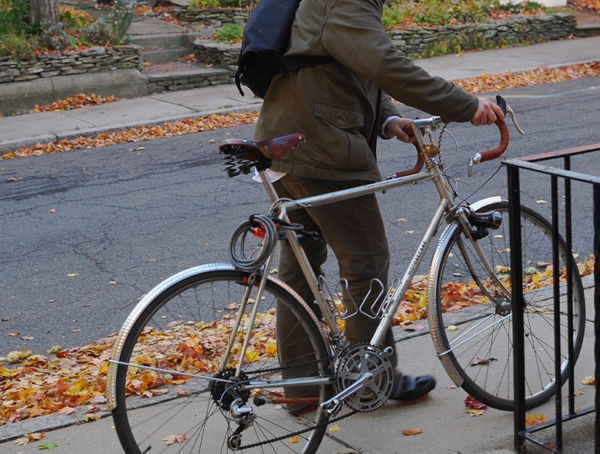
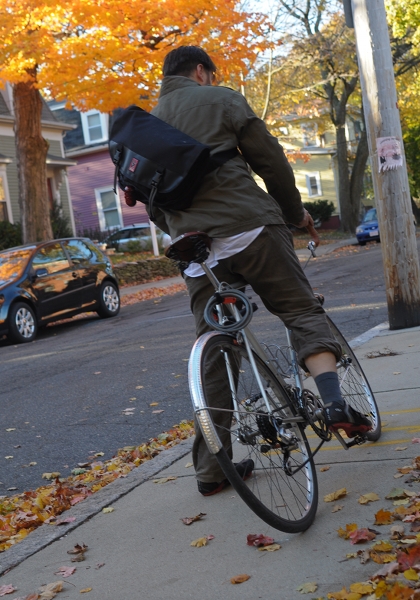
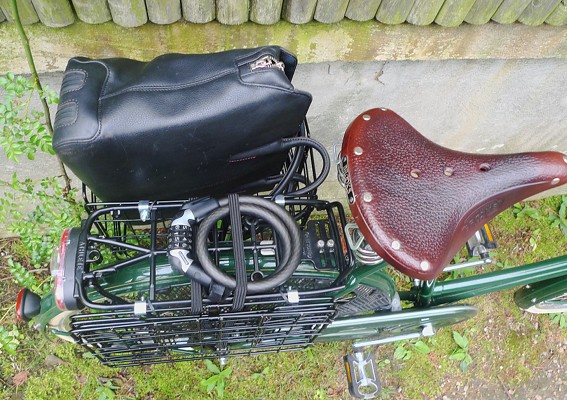
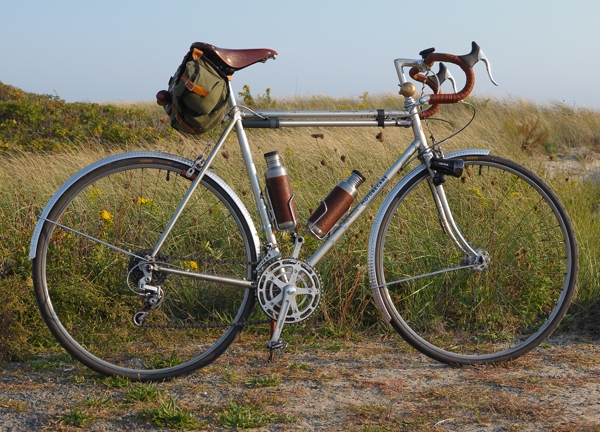
The Co-Habitant started a new job this week, and with it a new commute. The trip is about the same distance as before, but his cycling ritual is much changed. Previously, he rode to work on his fully loaded Pashley Roadster, which he would lock up in the secure bicycle cage inside the building's parking garage. The new job's parking facilities are less secure, and it is in an area where he does not feel comfortable leaving his Pashley on the street all day. So he will now be commuting on his old Motobecane roadbike, which he has stripped down to the bare bones.  This is what Myles looks like in his normal role as touring bike. And above is the new pared-down version: No saddlebag, no twined water bottles, no pump under the top tube. A U-Lock and an extra long cable lock are wrapped around the seat cluster. The battery headlight on the fork is detachable, and the tail light will now be attached to the messenger bag he plans to carry.

The Co-Habitant's response to his new commute underscores the differences in our attitudes toward bicycle security.  His Pashley is a comfortable, upright bicycle and if it were me, I would continue to ride it despite the change of location and the less than ideal parking situation. I would remove the Pashley's luggage, get a detachable pannier for the rear rack, use a U-lock plus long cable combination, lock it up outside and stop worrying about it. But then again, some would say that my own lock-up methods are scandalously lax, because I typically just use a cable lock. In short, the Co-Habitant and I are separate people and often our views on things differ. I respect that he does not want his "nice" bicycle to get stolen, but it just seems like such a shame to ride an aggressive roadbike (with clipless pedals!) to work and carry all his stuff in a messenger bag, when he owns the perfect commuter bike. 

How much of a factor is the location of your job (or residence) in your choice of what bicycle to ride and in your lock-up methods? 

Friday, October 22, 2010

Taking It Personally or Taking It in Stride?

When drivers behave rudely towards us, we tend to perceive them as being "hostile to cyclists".  But what I wonder sometimes, is whether this is a fair assessment given how drivers behave to one another.

Consider that...
Drivers honk at each other all the time.
Drivers cut each other off.
Drivers roll down their windows and shout "learn how to drive, you moron!" at one another while making indecent hand gestures - even if they are the ones at fault.

Is driver behaviour towards cyclists really worse than their behaviour towards other drivers? And if not, should we just take it in stride, rather than taking it personally? One could make that argument.

Of course, the big difference between intimidating other drivers and intimidating cyclists, is that cyclists are considerably more vulnerable - something I am highly aware of when a driver plays "chicken" with me while turning left at full speed as I am trying to go straight through an intersection, on a green light. Bike lanes and protected bike paths do little if anything to solve this problem if there are no cyclist-specific lights at intersections. It is difficult to take things in stride when the competition is stacked against me both in terms of speed and in terms of safety. But I try to remember not to take it personally.

Thursday, October 7, 2010

Upright Mammals

Upon returning to the city and getting on my Gazelle again, I was surprised by how different the cycling experience felt from being on my Rivendell.

Normally, I ride both bicycles regularly, so the switch back and forth does not feel remarkable. But after having cycled solely on a roadbike for three weeks, I almost felt as if I had to forcefully uncurl my spine as I transformed from a quadruped to a biped.

While we were away, the Co-Habitant teased that I would get accustomed to using a roadbike for transportation and would probably just keep doing it when we got home - after all, it's faster. But it soon became clear that when it comes to upright bicycles, absence made the heart grow fonder. (Now, if I can just stop trying to use the non-existent bar-end shifters on my poor Dutch bike!)

I think that as upright mammals, we are accustomed to seeing the world from the vantage point of bipedalism and we feel the most relaxed when adopting that posture. It is only natural that people prefer to remain upright when moving through their environment - whether on foot, or on bike, or on public transport. While upright bicycles may not be appropriate for sport or long distance travel, their importance in the realm of "normal cycling" cannot be overstated. Most people considering a bicycle for transportation do not see themselves as "cyclists". They want to be their usual selves, except on a bike. I think the ability to remain an upright mammal is crucial to retaining one's inherent sense of self while cycling for transportation. 

Sunday, October 3, 2010

Bike Lane Etiquette?

Having just returned from our stay on Cape Cod, I am greeted with a remarkable development: There are now bike lanes on one of the most hated stretches of road near my neighborhood. While normally I avoid this road, today I found reasons to travel along it multiple times just to experience its Disneyfication - for the city has also planted trees and installed decorative streetlights, in attempts to disguise the faded vinyl-siding of the multi-family homes and the peeling storefront signs that say things like "Used Tires". Why if Boston keeps this up, soon the last of the gritty neighborhoods will turn shiny and pleasant and there will be nothing to complain about!

Apparently, we are hardly the only town experiencing such shocking advances in bicycle infrastructure.  A friend from Virginia has written me with the news that there are now bicycle lanes in Harrisonburg, and he - a lifelong cyclist sans lanes - does not quite know how to behave in them.  Where is one supposed to pass? How to deal with joggers in the lane?

While I am by no means an authority, I will contribute my ideas on bike lane etiquette. Please note that although these contain commentary on safety, they are meant as thoughts on polite behaviour and are not safety tips.

1. Positioning within the bike lane
It is a good idea to cycle in the left half of the bike lane, as this positioning places you out of the "door zone" (i.e. you will not get struck by a car's door, should one suddenly fling open). Occasionally, a misguided cyclist or driver may shout at you to scoot over to the right, so that they can pass you easier - but don't allow yourself to be guilted into listening to them. Instead, politely explain about the door zone and why your positioning in the lane is necessary.

Try to keep to a consistent line within the bike lane; don't weave. Drivers and other cyclists can get freaked out by weaving cyclists, and in turn behave irrationally.

2. Passing other cyclists 
Passing other cyclists should be done on the left, never on the right.  If you pass on the right, you endanger both yourself and the cyclist you pass, by nullifying the distance between the two of you and the door zone. Pass the slower cyclist by going around them on the left (into the traffic lane), naturally checking that the lane is clear first.  Should another cyclist attempt to pass you on the right (you can sometimes sense them coming up behind you), I think it is perfectly fine to tell them not to do this ("Please don't pass on the right" or "Please pass me on the left").

3. Yielding to turning vehicles
Yield to turning vehicles in the lane, be they cars or other bicycles, instead of attempting to go around them as they are making the turn. Even if you manage to do this safely, it is disturbing to the vehicle to suddenly see you beside them as they attempt to execute a traffic maneuver.

4. Yielding to pedestrians
If the bike lane intersects a crosswalk, yield to pedestrians in a way that makes them feel safe - don't just cycle around them within inches of their person... And please don't even think of ringing your bell at pedestrians to make them cross faster (I have witnessed cyclists do this in Boston). It is the pedestrian's right to be in the crosswalk and your obligation to yield.

On the other hand, it is not the pedestrian's right to be in the bike lane itself, whether they are jogging or rolling a baby carriage, or whether it is a group of people caught up in chatting. If a pedestrian is blocking a bike lane, I think it is only fair to ring your bell and/or politely say something like "Excuse me, bike lane!" so that they move out of your way. It is rude of them to block the lane; it is not rude of you to point out that they are blocking it and ask them to move.

5. Positioning when stopped at intersections
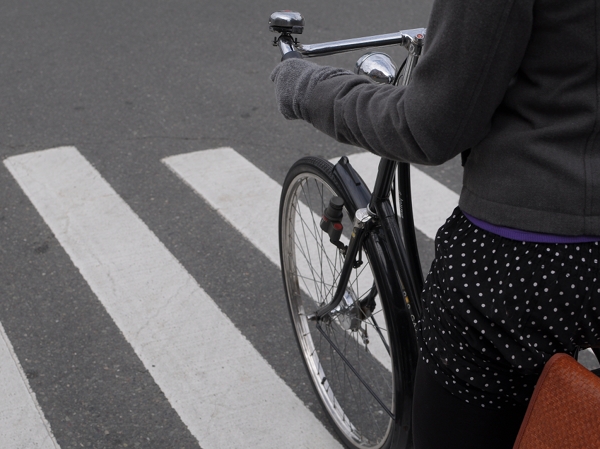
When stopped at an intersection, stop before the crosswalk - as opposed to blocking it (as shown above), as some cyclists do in order to get a head start. It's not very nice to make pedestrians go around you as they attempt to cross the street.

If other cyclists are already stopped at the intersection when you arrive, it is generally considered polite to stop behind them - as opposed to next to them, in an attempt to compete for who goes first when the light turns green.

6. Turning
Communicate your intention to turn by signaling and merging into the turn lane early on, rather than at the last moment, so that drivers are not surprised and can yield to you properly.

Observe the same rules as if you were a motor vehicle: When making a left turn, yield to oncoming traffic; when turning right on red, yield to pedestrians crossing and to cross-traffic.

7. Wrong way in the bike lane?
I think the reason some cyclists engage in this behaviour, is to make an easier left turn.  However, it is wrong and inconsiderate to "salmon" in the bike lanes; please don't do it.  And I think it is perfectly acceptable to ask other cyclists not to do it.

8. Cycling onto the sidewalk
Upon reaching their destination, some cyclists transition onto the sidewalk and continue to cycle - dismounting when they reach the bike rack, or the front door of the building they will be entering.  My view is that cyclists should dismount upon reaching the sidewalk, and walk their bike thereafter.

9. Speed 
As while driving, it is common sense and common courtesy to slow down when executing delicate maneuvers in traffic. It is also common courtesy not to jeopardise the safety of other cyclists, even if you are in a hurry. Sometimes you just have to go with the flow of bicycle traffic, even if technically you are capable of going faster.

10. Interaction with drivers and other cyclists
Please... just be polite. If you are annoyed or frightened by a driver or another cyclist, it is never a good idea to express that sentiment by immediately insulting them or shouting obscenities. An urgent tone of voice does not need to be abusive. "You almost killed me!" in an alarmed voice is more effective than "You almost killed me, you goddamn idiot!" in a hostile voice. While it may be tempting to shout the latter version, consider that doing so can actually escalate conflict and further endanger you.

With more cities across the US creating bicycle lanes, the numbers of new cyclists out on the roads is growing. And while different states have different degrees of regulations when it comes to cycling, I think there are certain aspects of using the bike lanes that are a matter of common sense and courtesy. I hope my suggestions are useful to new users of bike lanes. Your feedback, whether in agreement or disagreement, is welcome.
Saturday, September 4, 2010

Crime vs. Accident?

I was cycling across town with a friend today, who suggested that we take the side streets instead of my usual route along the major roads. We were cycling on one of these quiet streets, when a sedan passed us too closely and hit my friend's bicycle with the side of their car.

The impact was not strong enough to knock the bicycle over, but it did happen - and the driver kept going until forced to stop at a red light. We caught up to the driver, and my friend quickly took a cell-phone picture of the license plate - at which point the driver stopped the car and came out, expressing annoyance. My friend said, "You hit me with your car." The driver replied, "Well, you should have been more careful!" (More careful? We were cycling in a straight line in broad daylight!) At that point my friend took out their phone and called the police - telling the driver that they were going to file a report. Bewildered ("The police? But you're fine!") the driver got back in their car, pulled over to the side of the road, and we all waited.

The officer arrived and asked whether anybody was injured and whether there was any damage to the bicycle. When we replied in the negative, the officer seemed confused: "So there is nothing to do here then." We repeated that the driver hit my friend with their car, to which the officer (politely) replied, "Well, if nobody was injured and there is no damage to your bicycle, that's not a crime. That's an accident." He then proceeded to file a report of the "accident," stressing verbally that there has been no injury or material damage. Both my friend and the driver gave testimony, and I gave testimony as a witness. We were then informed of where and when we could pick up a copy of the report, and everyone went their separate ways.
And this brings me to my question. Is it correct, that unless a driver actually injures a cyclist or damages a bicycle while hitting them, then hitting a cyclist in itself is not illegal? That is basically what the officer was telling us, but it does not sound right to me. What about the "passing no closer than 3 feet" rule? If a driver hits a cyclist while passing, does that not automatically mean that they were closer than 3 feet?  The driver was unapologetic about what happened, and did not deny that they saw us prior to hitting my friend's bicycle. Yet the officer did not even ask the driver why they did not pass us at a safer distance. Perhaps what the officer meant to express, was that there was no way to determine what actually happened without video cameras or tangible evidence (such as injury or damage to the bicycle) - but his words did not come across that way.

Regardless of the outcome, I am glad that my friend filed a report. As I understand it, these things get entered into the DOT statistical data, and can lead to the development of safer infrastructure on that street if enough such incidents are reported. But I remain confused about what type of collision between motor vehicle and bicycle constitutes an illegal act versus what constitutes an accident. Can any of the cycling activists out there fill me in?

Saturday, August 21, 2010

Favourite Cycling Routes

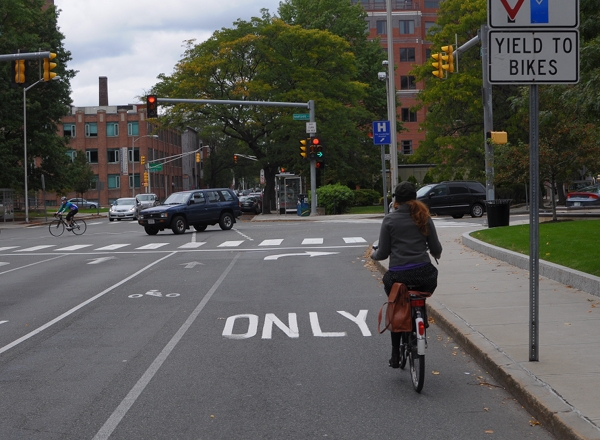
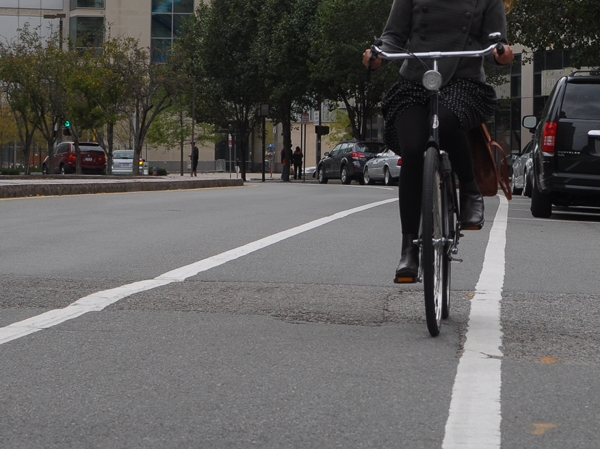
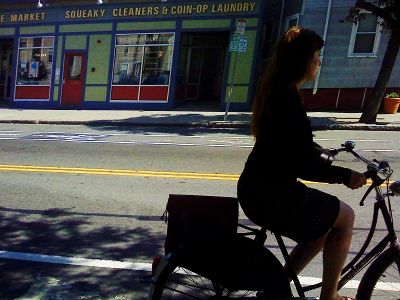
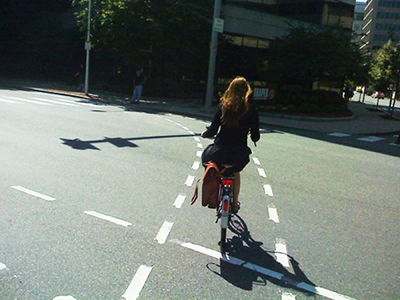
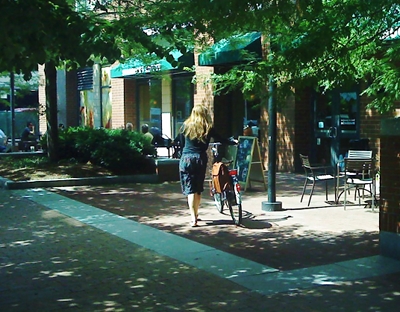
While I ride for transportation on the streets of Cambridge, Somerville, Boston and beyond on a (mostly) daily basis, it is of course physically impossible to photograph myself doing so. But recently the Co-Habitant was with me, and he surprised me by taking some snapshots with his mobile phone. I wanted to share these, because they happen to be of my favourite cycling route.

We cannot always articulate what we like or don't like about cycling in our city. But taking our favourite route as a starting point and examining what is so great about it, can lead us to discover our preferences - as well as our anxieties - when it comes to transportation cycling.

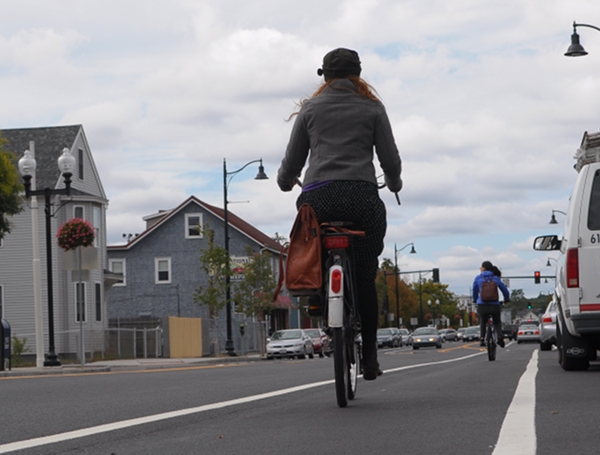
The pictures here document a busy street around the corner from my home that stretches through several neighborhoods along the border of Somerville and Cambridge, winds into MIT territory, and then proceeds directly over the Longfellow Bridge across the Charles River, into the center of Boston.  It is not a traffic-calmed side-street, but a crowded major road, and it is not especially attractive. And yet, it is my favourite cycling route in the area. It goes on forever, gives me easy access to Boston,  and does not make me deal with ambiguous traffic situations.

When cycling in the city, I think it is ambiguity that causes me the most anxiety: left turns from side streets onto busy roads; bicycle lanes that suddenly end; commuter trails that force the cyclist to cross busy intersections without streetlights; roundabouts and stop signs where questions arise about the right of way and I never know whether the car is really letting me go... I could go on. But on this route, none of those things happen. I am basically cycling down an endless avenue, and as long as I abide by street lights, the road will take me where I need to go. This not only eliminates ambiguities, but appeals to my love of the "endless open road." I like knowing that I can get on this road around the corner from my house and end up in downtown Boston, stress-free.

You have probably noticed that this route has a bike lane most of the way. But that is not what I like about it - at least not the lane alone. Unlike most streets with bike lanes in my area, this one is consistent and logical. At no point does it suddenly end in a dangerous spot, and at no point does it place you in the door zone of parked cars. It even takes you through a curve in the road with a left-turn lane specifically for bikes. The bike lane here functions as a bike lane should in my view - a suggestive marking, similar to a bus lane, that signifies a space on the road where bicycles have priority over motor vehicles. It goes without saying that you must still be vigilant of things like occasional double-parked vehicles, and vehicles making right turns at intersections. But overall, the lane - and specifically its consistency - has the effect of legitimising the presence of bicycle traffic. There are quite a few bicycles passing through, and it is just another lane of traffic. Normal. I do not always feel this way about bike lanes, but on this particular route it seems to me that they really do have this positive effect.

When a cycling route feels comfortable and convenient... well, that is pretty much how it ought to be. Cycling for transportation in the city should not feel as if you are going into battle every day; it should feel like the city you live in is open and accessible to you. This is my favourite route, because it does just that. 

Friday, July 16, 2010

It's Like Walking vs Jogging

Imagine that you have just taken up jogging. You find jogging healthy, energising - a good way to clear your mind and exercise your body first thing in the morning or in the evening after work. You put on a pair of sneakers, leggings, a t-shirt, and off you go on your jog. At an intersection you bump into another jogger, who recognises you and exclaims: "Oh, I see you've taken up jogging! Finally smartened up and realised that it's better than walking, eh? And look, you're pretty good at it! Before you know it, you'll be jogging to work with a change of clothing strapped to your back - you'll see how much faster it is than walking and how much more control it gives you!" An improbable and illogical scenario, yes? And yet, it is perfectly normal to encounter the same mentality when it comes to cycling.

The one question I get asked that absolutely puzzles me, is whether I am "moving away from upright bikes" now that I am comfortable riding a bike with drop bars. What?... Are joggers "moving away from walking"? Similarly, I am perplexed when some congratulate me on becoming a "real cyclist", now that I can ride a roadbike and a trackbike. I suppose that means that joggers and track runners are the "real pedestrians"?

Just like there are many forms of pedestrianism, so are there many forms of cycling - each serving its own purpose. The distinction between upright city bicycles, roadbikes and mountain bikes is not so different from the distinction between walking, running and hiking. Walking is a casual form of pedestrianism that is the most natural and low-maintenance way to travel from point A to point B. It is done in one's everyday clothing, while comfortably carrying items on one's person. Taking up jogging or hiking is all well and good, but you'll probably still want to walk to the grocery store.

My upright loop-frame bicycles are my "walking." They are essential to me, no matter what kind of other bikes I ride on occasion for fun or exercise. I am more comfortable than ever now on a roadbike, but when it comes to work or errands or pretty much any kind of city or transport cycling, I will always choose the upright bicycle. As with walking vs jogging, there is no "war" between them. They co-exist, each in their appropriate context.