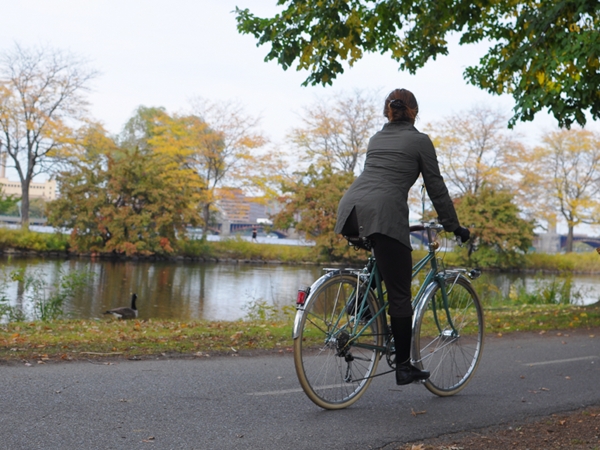
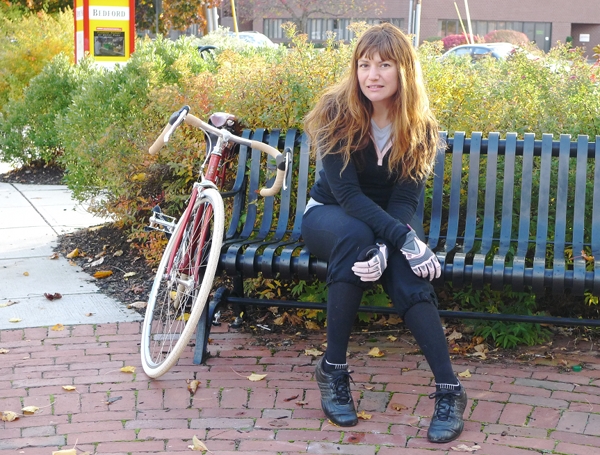
I tend to think of myself as having begun cycling when I got into it as an adult. But technically, that is not so. I learned to ride a bike when I was a child, and rode one all through junior high and most of high school. There was a nice post today on ecovelo, where Alan mentioned having "lived on his bike" as a kid, and in a sense it was similar for me. My friends and I did not race each other through wheatfields or pop wheelies, but we did use our bikes to get around our small town. Even once old enough to drive, most of us somehow still stuck with bicycles: It just seemed easier and even kept us off our parents' radar (for example, they could not look at the odometer to determine whether we had gone out when we were told not to).
But during all those years of riding bikes as a child and teenager, I knew absolutely nothing about "technique." At some point I was given a 2-wheel bike, and I used it as a push-bike for a few laps around the park until suddenly I was able to pedal without the bike falling over. To me, that meant that I was pretty much done learning "technique." In the years that followed, I rode with the saddle low, never learned how to start and stop "properly" or to pedal while standing, and was not aware that turning involved leaning and balancing, rather than using the handlebars. Heck, I never even learned how to shift gears, because the shifters on my low-end bike were jammed!
When I think about how it feels to cycle today - and particularly, how it felt when I first started doing it as an adult - I am confused and frustrated by all those younger years spent riding a bike without knowing how to do it properly. It's odd that I did not naturally pick up any skills what so ever during that time. (How can that be? Surely no one is that unathletic?) Moreover, my friends must have been just as clueless, because no one ever made fun of me or told me I was "doing it wrong." And it's frustrating that those skills were so much easier to learn as a child than as an adult - so by not having learned them early, I am at a disadvantage that may take me some effort to overcome.
I first discovered the concept of leaning on turns by reading about it, and after that it took months before I physically became aware of it enough to gain some control over the process. Of course when I did, I was ecstatic - to the amazement of the Co-Habitant who had not realised the extent to which I never learned these things.
As for saddle height, it is an ongoing fiasco: It took over a year of gradually raising it until I was able to have it at more or less the height where it needs to be for good leg extension... But I still cannot mount a bicycle properly and have to do a graceless little lean-and-hoist maneuver to get myself onto that raised saddle. Terrified of falling, I am highly resistant to being taught, and watching videos of others doing it over and over has not helped. At least I am now finally able to pedal while standing: After months of riding fixed gear, I finally got it (at first I could do it only on the fixed gear, then the skill gradually transferred onto freewheel bikes). I have to say, that was not easy for me to "get". In my head I understood what to do, but my body refused to balance.
It seems absurd to me that I can ride a roadbike at 25 mph, handle long climbs and hilly descents, ride a fixed gear racing bike "for fun" - yet still lack some of the most rudimentary cycling skills after almost two years of trying to master them. Will I ever be able to handle a bike like a "real" cyclist? Who knows - maybe I can still learn. Or maybe I should just accept that my early years of "doing it wrong" ruined me for life. Is the way you cycle now different from how you did it as a child? And if you are a parent, at what age did you teach your children to ride a bike and how did they take to it? I wonder how many others there are who feel this way - as if they are riding a bike without knowing how.
Showing posts with label technique. Show all posts
Tuesday, November 16, 2010
Monday, November 8, 2010
Up-lifting Experiences
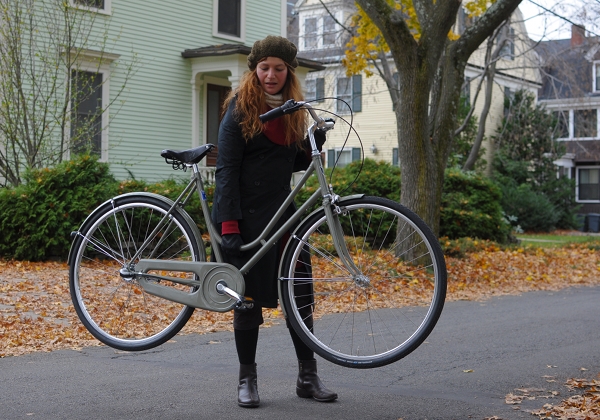
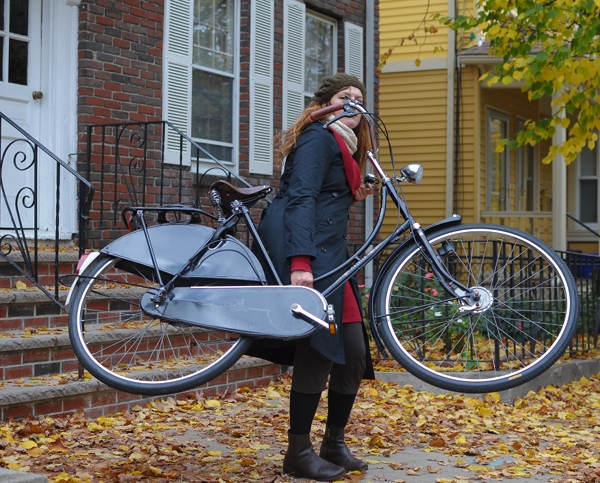
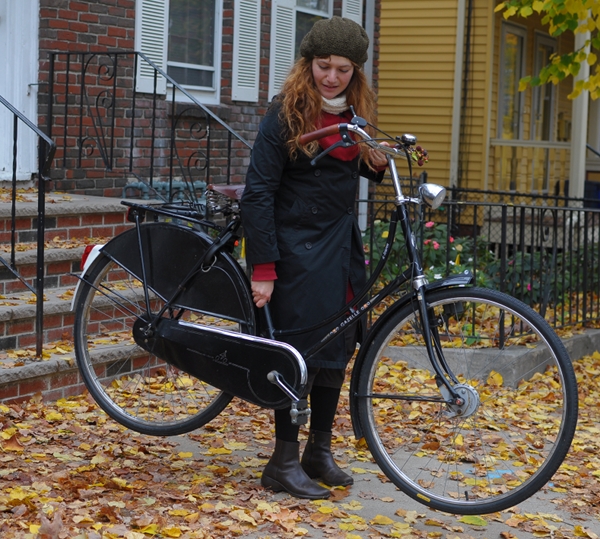
While a diamond-frame bicycle can be easily lifted by the top tube, a step-through frame does not have one - posing the question of how to hold the bike when picking it up. This becomes especially important when the bicycle is on the heavy side and frequently needs to be carried up and down the stairs. In the course of owning a number of loop frames, I have found that different bicycles require different approaches in this regard.
My Bella Ciao bicycle likes to be picked up by the rear portion of the curved top tube. This is such a stable position that I can even carry it with one hand without the bicycle buckling. When held in this manner, I feel that the bike's center of gravity is directly under my hand, which is probably what accounts for the stability of this position. Also, my hand is snugly stuck in that little space between the upward sweep of the curve to one side and the top-downtube connector on the other - an important factor, because this way my hand cannot slip, even if the bicycle is wet from rain.
By contrast, this is what happens when I attempt to lift my Gazelle in the same manner. It's not that the bicycle feels too heavy - in fact, lifting it by that loopy spot makes it feel lighter than otherwise. But something is off in the balance, and the Gazelle tries to flip over sideways, onto me, when held in this manner. It feels as if the center of gravity is not under my hand, but somewhere else. With the Pashley Princess I previously owned, this effect was even more pronounced - when lifted by this portion of the frame, the bicycle seemed to twist in my arms and threaten to bring both of us down. On the other hand, the vintage Steyr Waffenrad I rode in Austria was amenable to being picked up by the top tube of its "swan" frame. For reference, my Pashley was somewhere in between the weight of the Gazelle and the Bella Ciao, and the Steyr was as heavy as the Gazelle - so again, it is not merely a matter of weight.
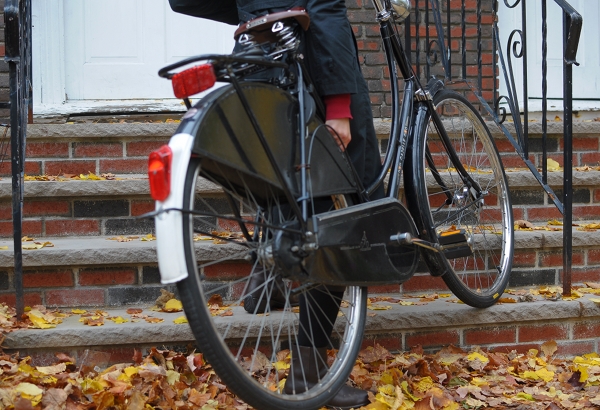
This is how the Gazelle wants to be lifted: by the seat tube. It stays stable and does not buckle when grasped in this position, despite feeling heavier than in the previously shown method. Could it be that for bicycles that prefer this method, the center of gravity is more toward the rear?
To get my bicycles home I must carry them up the porch stairs, through a narrow doorway, and then through another narrow doorway, after turning around in a cramped hallway. That may not seem like a big deal to those who have several flights of stairs to negotiate, but consider that I am a female with limited upper body strength and a bicycle like a Gazelle or a Pashley is half my weight once it's loaded with bags. Getting a good grip on the frame is key if I don't want to drop the bike or, worse, have it fall on top of me. If you own a heavy step-through bicycle, how do you lift it and how do you carry it up the stairs?
Friday, October 29, 2010
Happy Feet
Today was the first time I felt well enough to ride a roadbike since having gotten sick last month. It was only 26 miles, but it felt great to have my full lung capacity and energy back.
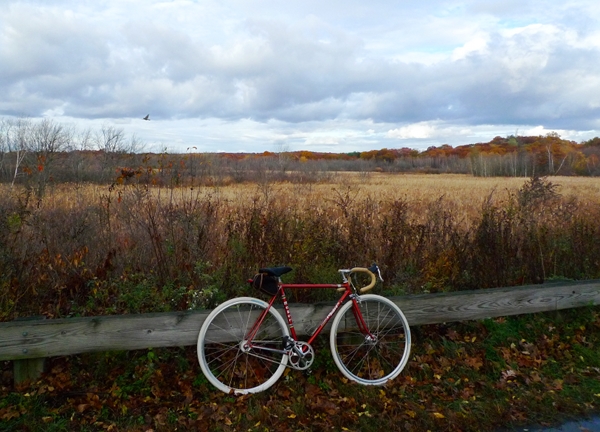
Continuing with the Italian theme, I took Francesco - my fixed gear stallion. How happy he was, basking in the precious minutes of sunshine in between thunderstorms.
Riding a fixed gear roadbike is an experience that fills me with a special kind of enjoyment - I think because it combines the sensations of walking and flying (fly-walking?).
I was worried that I might be too out of shape to make it, but I had forgotten how comfortable Francesco is. The 26 miles of pedaling felt like a stroll in the park. Although, I have learned by now that even if I feel "fine" riding fixed gear while I am actually doing it, it does take more out of me than a free-wheel bicycle. I usually sleep longer after such a ride, and sometimes I am sore the following day.
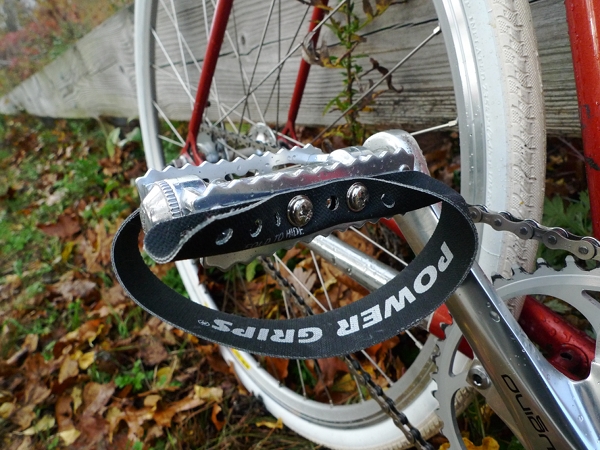
One thing that has improved my comfort level with fixed gear cycling considerably, are these "fixie" Power Grips. I wrote about the standard Power Grips here, and since my initial review I have become addicted to these things. The fixed gear version differs from the standard model, in that it makes it easier to insert and remove your feet while pedals are in motion. I cannot tell what it is about the design that makes this possible, but none the less it seems to work. I insert my right toe at the starting position and start cycling slowly while nudging the left pedal with my left toe - then swiftly insert the toe into the left grip on the first stroke. After some practice this became a familiar and instinctive sequence of movements - though it definitely helped that I was already comfortable using this system on a free-wheel bike prior to trying it on a fixed gear.
Now that I am able to use foot retention on this bicycle, I am no longer apprehensive about cycling over bumps and potholes or going downhill at high speeds. The experience is pretty much perfect and very enjoyable. One thing in particular I have noticed, is how easy it is for me to ride "in the drops" - Francesco almost seems more stable when the handlebars are held this way than higher up. Is that possible?
And another interesting thing: I find it much, much easier to get out of the saddle and pedal standing up on Francesco than I do on my other bicycles. Is it the fixed-gearness that is facilitating this or the geometry? As I've mentioned before, I have a terrible sense of balance, and that is what I believe normally prevents me from pedaling while standing up. But on this bicycle, it seems not to matter.
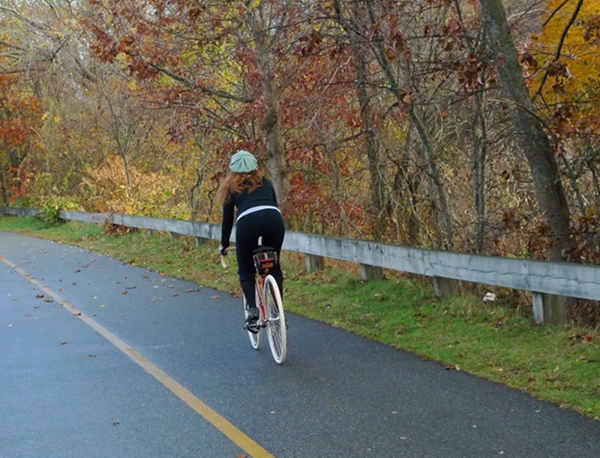
It rained on and off for the duration of our ride, and the colourful leaves strewn over the trail turned into a mess of a slippery carpet. Was I so excited to be riding Francesco that I began to imagine things, or is it easier to ride in slippery conditions on a fixed gear bike? I have read comments about traction before, but I admit that I don't understand them. Could somebody explain it in layman's terms?
As I prepare for some more pruning of my bicycle overgrowth, it is clear to me that I "need" a fixed gear roadbike. So while I am now considering selling my Trek - which has been fun, but not essential - I will definitely be keeping the Francesco Moser.
In the long run, however - maybe a couple of years from now - I will probably want to replace it with a "real" fixed gear bicycle. Mainly, this is because the Moser's bottom bracket is not as high as it should be - and even though my lean on turns is not aggressive enough to warrant worrying about pedal strike yet, it would be better if this wasn't even a potential issue.
But for now, Francesco is my dashing Italian gentleman and I thank him for my happy feet.
Continuing with the Italian theme, I took Francesco - my fixed gear stallion. How happy he was, basking in the precious minutes of sunshine in between thunderstorms.
Riding a fixed gear roadbike is an experience that fills me with a special kind of enjoyment - I think because it combines the sensations of walking and flying (fly-walking?).
I was worried that I might be too out of shape to make it, but I had forgotten how comfortable Francesco is. The 26 miles of pedaling felt like a stroll in the park. Although, I have learned by now that even if I feel "fine" riding fixed gear while I am actually doing it, it does take more out of me than a free-wheel bicycle. I usually sleep longer after such a ride, and sometimes I am sore the following day.
One thing that has improved my comfort level with fixed gear cycling considerably, are these "fixie" Power Grips. I wrote about the standard Power Grips here, and since my initial review I have become addicted to these things. The fixed gear version differs from the standard model, in that it makes it easier to insert and remove your feet while pedals are in motion. I cannot tell what it is about the design that makes this possible, but none the less it seems to work. I insert my right toe at the starting position and start cycling slowly while nudging the left pedal with my left toe - then swiftly insert the toe into the left grip on the first stroke. After some practice this became a familiar and instinctive sequence of movements - though it definitely helped that I was already comfortable using this system on a free-wheel bike prior to trying it on a fixed gear.
Now that I am able to use foot retention on this bicycle, I am no longer apprehensive about cycling over bumps and potholes or going downhill at high speeds. The experience is pretty much perfect and very enjoyable. One thing in particular I have noticed, is how easy it is for me to ride "in the drops" - Francesco almost seems more stable when the handlebars are held this way than higher up. Is that possible?
And another interesting thing: I find it much, much easier to get out of the saddle and pedal standing up on Francesco than I do on my other bicycles. Is it the fixed-gearness that is facilitating this or the geometry? As I've mentioned before, I have a terrible sense of balance, and that is what I believe normally prevents me from pedaling while standing up. But on this bicycle, it seems not to matter.
It rained on and off for the duration of our ride, and the colourful leaves strewn over the trail turned into a mess of a slippery carpet. Was I so excited to be riding Francesco that I began to imagine things, or is it easier to ride in slippery conditions on a fixed gear bike? I have read comments about traction before, but I admit that I don't understand them. Could somebody explain it in layman's terms?
As I prepare for some more pruning of my bicycle overgrowth, it is clear to me that I "need" a fixed gear roadbike. So while I am now considering selling my Trek - which has been fun, but not essential - I will definitely be keeping the Francesco Moser.
In the long run, however - maybe a couple of years from now - I will probably want to replace it with a "real" fixed gear bicycle. Mainly, this is because the Moser's bottom bracket is not as high as it should be - and even though my lean on turns is not aggressive enough to warrant worrying about pedal strike yet, it would be better if this wasn't even a potential issue.
But for now, Francesco is my dashing Italian gentleman and I thank him for my happy feet.
Sunday, October 3, 2010
Bike Lane Etiquette?
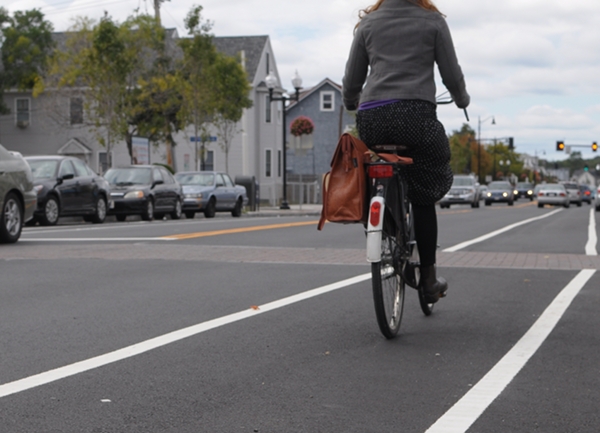
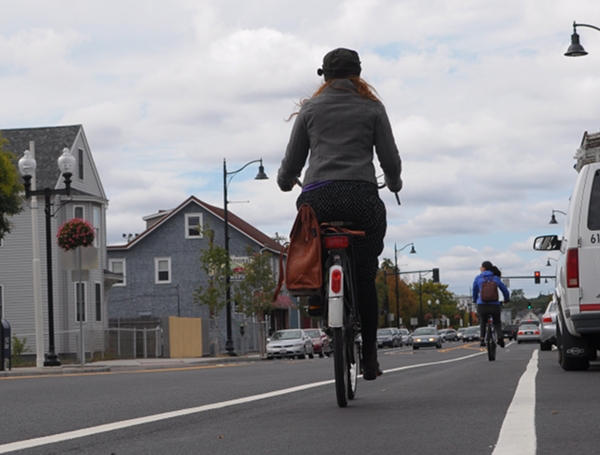
Having just returned from our stay on Cape Cod, I am greeted with a remarkable development: There are now bike lanes on one of the most hated stretches of road near my neighborhood. While normally I avoid this road, today I found reasons to travel along it multiple times just to experience its Disneyfication - for the city has also planted trees and installed decorative streetlights, in attempts to disguise the faded vinyl-siding of the multi-family homes and the peeling storefront signs that say things like "Used Tires". Why if Boston keeps this up, soon the last of the gritty neighborhoods will turn shiny and pleasant and there will be nothing to complain about!
Apparently, we are hardly the only town experiencing such shocking advances in bicycle infrastructure. A friend from Virginia has written me with the news that there are now bicycle lanes in Harrisonburg, and he - a lifelong cyclist sans lanes - does not quite know how to behave in them. Where is one supposed to pass? How to deal with joggers in the lane?
While I am by no means an authority, I will contribute my ideas on bike lane etiquette. Please note that although these contain commentary on safety, they are meant as thoughts on polite behaviour and are not safety tips.
1. Positioning within the bike lane
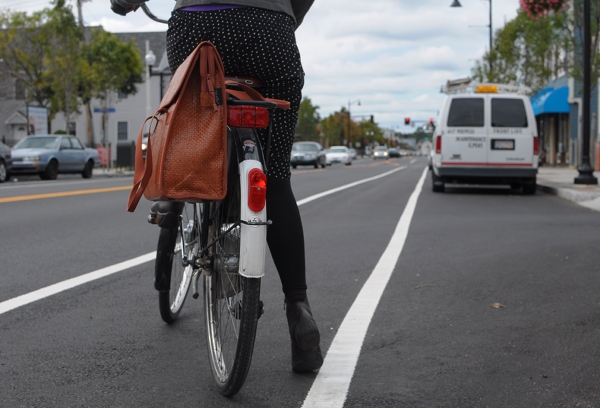
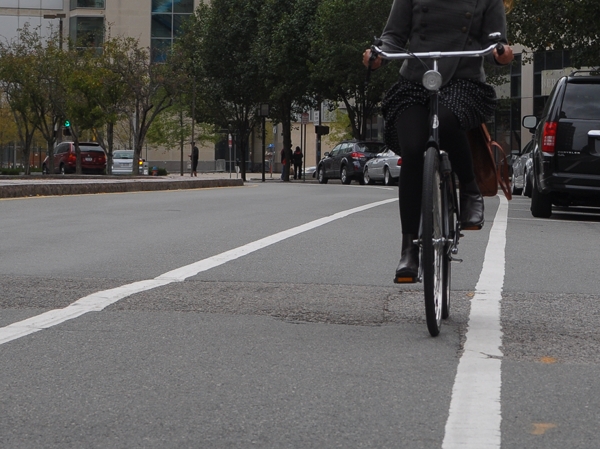
It is a good idea to cycle in the left half of the bike lane, as this positioning places you out of the "door zone" (i.e. you will not get struck by a car's door, should one suddenly fling open). Occasionally, a misguided cyclist or driver may shout at you to scoot over to the right, so that they can pass you easier - but don't allow yourself to be guilted into listening to them. Instead, politely explain about the door zone and why your positioning in the lane is necessary.
Try to keep to a consistent line within the bike lane; don't weave. Drivers and other cyclists can get freaked out by weaving cyclists, and in turn behave irrationally.
2. Passing other cyclists
Passing other cyclists should be done on the left, never on the right. If you pass on the right, you endanger both yourself and the cyclist you pass, by nullifying the distance between the two of you and the door zone. Pass the slower cyclist by going around them on the left (into the traffic lane), naturally checking that the lane is clear first. Should another cyclist attempt to pass you on the right (you can sometimes sense them coming up behind you), I think it is perfectly fine to tell them not to do this ("Please don't pass on the right" or "Please pass me on the left").
3. Yielding to turning vehicles
Yield to turning vehicles in the lane, be they cars or other bicycles, instead of attempting to go around them as they are making the turn. Even if you manage to do this safely, it is disturbing to the vehicle to suddenly see you beside them as they attempt to execute a traffic maneuver.
4. Yielding to pedestrians
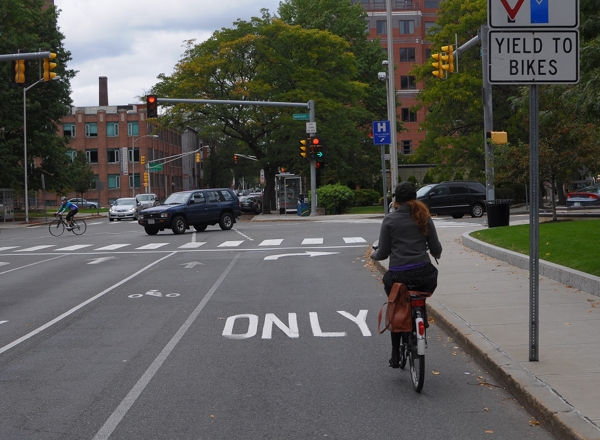
If the bike lane intersects a crosswalk, yield to pedestrians in a way that makes them feel safe - don't just cycle around them within inches of their person... And please don't even think of ringing your bell at pedestrians to make them cross faster (I have witnessed cyclists do this in Boston). It is the pedestrian's right to be in the crosswalk and your obligation to yield.
On the other hand, it is not the pedestrian's right to be in the bike lane itself, whether they are jogging or rolling a baby carriage, or whether it is a group of people caught up in chatting. If a pedestrian is blocking a bike lane, I think it is only fair to ring your bell and/or politely say something like "Excuse me, bike lane!" so that they move out of your way. It is rude of them to block the lane; it is not rude of you to point out that they are blocking it and ask them to move.
5. Positioning when stopped at intersections
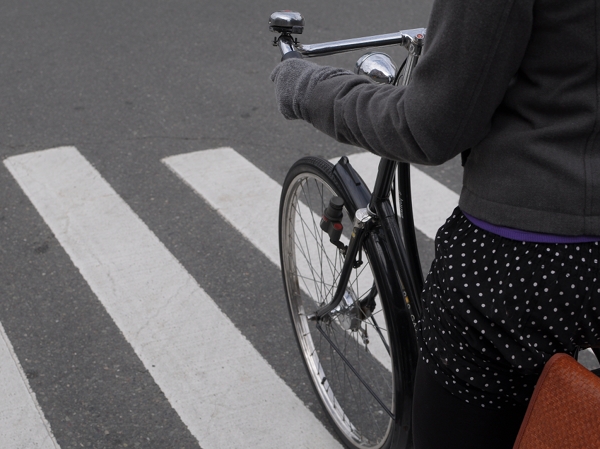
When stopped at an intersection, stop before the crosswalk - as opposed to blocking it (as shown above), as some cyclists do in order to get a head start. It's not very nice to make pedestrians go around you as they attempt to cross the street.
If other cyclists are already stopped at the intersection when you arrive, it is generally considered polite to stop behind them - as opposed to next to them, in an attempt to compete for who goes first when the light turns green.
6. Turning
Communicate your intention to turn by signaling and merging into the turn lane early on, rather than at the last moment, so that drivers are not surprised and can yield to you properly.
Observe the same rules as if you were a motor vehicle: When making a left turn, yield to oncoming traffic; when turning right on red, yield to pedestrians crossing and to cross-traffic.
7. Wrong way in the bike lane?
I think the reason some cyclists engage in this behaviour, is to make an easier left turn. However, it is wrong and inconsiderate to "salmon" in the bike lanes; please don't do it. And I think it is perfectly acceptable to ask other cyclists not to do it.
8. Cycling onto the sidewalk
Upon reaching their destination, some cyclists transition onto the sidewalk and continue to cycle - dismounting when they reach the bike rack, or the front door of the building they will be entering. My view is that cyclists should dismount upon reaching the sidewalk, and walk their bike thereafter.
9. Speed
As while driving, it is common sense and common courtesy to slow down when executing delicate maneuvers in traffic. It is also common courtesy not to jeopardise the safety of other cyclists, even if you are in a hurry. Sometimes you just have to go with the flow of bicycle traffic, even if technically you are capable of going faster.
10. Interaction with drivers and other cyclists
Please... just be polite. If you are annoyed or frightened by a driver or another cyclist, it is never a good idea to express that sentiment by immediately insulting them or shouting obscenities. An urgent tone of voice does not need to be abusive. "You almost killed me!" in an alarmed voice is more effective than "You almost killed me, you goddamn idiot!" in a hostile voice. While it may be tempting to shout the latter version, consider that doing so can actually escalate conflict and further endanger you.
With more cities across the US creating bicycle lanes, the numbers of new cyclists out on the roads is growing. And while different states have different degrees of regulations when it comes to cycling, I think there are certain aspects of using the bike lanes that are a matter of common sense and courtesy. I hope my suggestions are useful to new users of bike lanes. Your feedback, whether in agreement or disagreement, is welcome.
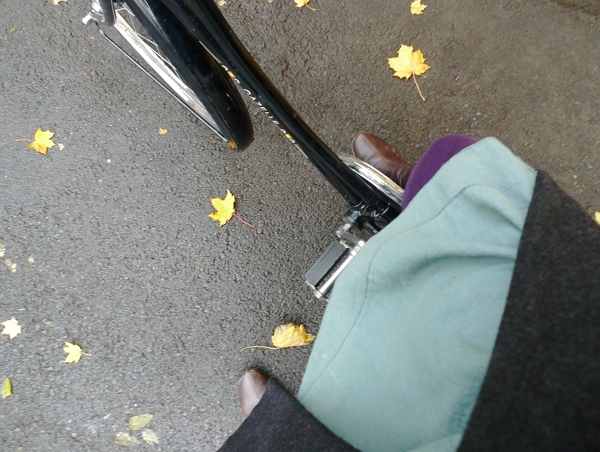
Apparently, we are hardly the only town experiencing such shocking advances in bicycle infrastructure. A friend from Virginia has written me with the news that there are now bicycle lanes in Harrisonburg, and he - a lifelong cyclist sans lanes - does not quite know how to behave in them. Where is one supposed to pass? How to deal with joggers in the lane?
While I am by no means an authority, I will contribute my ideas on bike lane etiquette. Please note that although these contain commentary on safety, they are meant as thoughts on polite behaviour and are not safety tips.
1. Positioning within the bike lane
It is a good idea to cycle in the left half of the bike lane, as this positioning places you out of the "door zone" (i.e. you will not get struck by a car's door, should one suddenly fling open). Occasionally, a misguided cyclist or driver may shout at you to scoot over to the right, so that they can pass you easier - but don't allow yourself to be guilted into listening to them. Instead, politely explain about the door zone and why your positioning in the lane is necessary.
Try to keep to a consistent line within the bike lane; don't weave. Drivers and other cyclists can get freaked out by weaving cyclists, and in turn behave irrationally.
2. Passing other cyclists
Passing other cyclists should be done on the left, never on the right. If you pass on the right, you endanger both yourself and the cyclist you pass, by nullifying the distance between the two of you and the door zone. Pass the slower cyclist by going around them on the left (into the traffic lane), naturally checking that the lane is clear first. Should another cyclist attempt to pass you on the right (you can sometimes sense them coming up behind you), I think it is perfectly fine to tell them not to do this ("Please don't pass on the right" or "Please pass me on the left").
3. Yielding to turning vehicles
Yield to turning vehicles in the lane, be they cars or other bicycles, instead of attempting to go around them as they are making the turn. Even if you manage to do this safely, it is disturbing to the vehicle to suddenly see you beside them as they attempt to execute a traffic maneuver.
4. Yielding to pedestrians
If the bike lane intersects a crosswalk, yield to pedestrians in a way that makes them feel safe - don't just cycle around them within inches of their person... And please don't even think of ringing your bell at pedestrians to make them cross faster (I have witnessed cyclists do this in Boston). It is the pedestrian's right to be in the crosswalk and your obligation to yield.
On the other hand, it is not the pedestrian's right to be in the bike lane itself, whether they are jogging or rolling a baby carriage, or whether it is a group of people caught up in chatting. If a pedestrian is blocking a bike lane, I think it is only fair to ring your bell and/or politely say something like "Excuse me, bike lane!" so that they move out of your way. It is rude of them to block the lane; it is not rude of you to point out that they are blocking it and ask them to move.
5. Positioning when stopped at intersections
When stopped at an intersection, stop before the crosswalk - as opposed to blocking it (as shown above), as some cyclists do in order to get a head start. It's not very nice to make pedestrians go around you as they attempt to cross the street.
If other cyclists are already stopped at the intersection when you arrive, it is generally considered polite to stop behind them - as opposed to next to them, in an attempt to compete for who goes first when the light turns green.
6. Turning
Communicate your intention to turn by signaling and merging into the turn lane early on, rather than at the last moment, so that drivers are not surprised and can yield to you properly.
Observe the same rules as if you were a motor vehicle: When making a left turn, yield to oncoming traffic; when turning right on red, yield to pedestrians crossing and to cross-traffic.
7. Wrong way in the bike lane?
I think the reason some cyclists engage in this behaviour, is to make an easier left turn. However, it is wrong and inconsiderate to "salmon" in the bike lanes; please don't do it. And I think it is perfectly acceptable to ask other cyclists not to do it.
8. Cycling onto the sidewalk
Upon reaching their destination, some cyclists transition onto the sidewalk and continue to cycle - dismounting when they reach the bike rack, or the front door of the building they will be entering. My view is that cyclists should dismount upon reaching the sidewalk, and walk their bike thereafter.
9. Speed
As while driving, it is common sense and common courtesy to slow down when executing delicate maneuvers in traffic. It is also common courtesy not to jeopardise the safety of other cyclists, even if you are in a hurry. Sometimes you just have to go with the flow of bicycle traffic, even if technically you are capable of going faster.
10. Interaction with drivers and other cyclists
Please... just be polite. If you are annoyed or frightened by a driver or another cyclist, it is never a good idea to express that sentiment by immediately insulting them or shouting obscenities. An urgent tone of voice does not need to be abusive. "You almost killed me!" in an alarmed voice is more effective than "You almost killed me, you goddamn idiot!" in a hostile voice. While it may be tempting to shout the latter version, consider that doing so can actually escalate conflict and further endanger you.
With more cities across the US creating bicycle lanes, the numbers of new cyclists out on the roads is growing. And while different states have different degrees of regulations when it comes to cycling, I think there are certain aspects of using the bike lanes that are a matter of common sense and courtesy. I hope my suggestions are useful to new users of bike lanes. Your feedback, whether in agreement or disagreement, is welcome.
Tuesday, September 14, 2010
Happy Trails! Tips for Long Rides
Though not all will agree with this, I believe that in order to honestly say that you are able to cycle a given distance, it has to mean that you are able to do it successfully. In other words, if you managed to complete a long ride, but could not walk the next day as a result, that does not count as "success"!
I consider my first half-century (50 mile) ride to have happened this summer - despite having once cycled that distance in Austria some time ago. That earlier trip was a disaster, and I wish somebody had warned me against it. Emboldened by having gone on a handful of short rides, one day I just kept going and going - and didn't stop despite feeling discomfort and pain. Riding a rental bike with a plush vinyl saddle and sub-optimal geometry, I pushed myself well past my limits, ignoring my body's warning signs. And after the ride was over, I could not cycle for over two weeks.
That incident served as a painful lesson: Being able to handle long rides was not about exceeding my abilities. It was about staying within my abilities - while working to gradually expand them. When I finally did my first "real" 50 mile ride this summer, I was ready for it and it felt fantastic. Only then did I feel that I could truly say "Now I can cycle a half century".
Having received emails asking for advice on taking long rides, I offer some tips based on personal experience. Think of these as food for thought!
1. Build up to it. Even if you think you can do it, don't start with a long ride. Start with short rides and gradually increase the distance. Ideally, a ride should still leave you able to cycle the next day.
2. Make sure your bicycle is comfortable. The only way to do this is to get to know your bicycle, which, once again, can only happen over time and over gradually increased distances. The way a bicycle feels on short rides is not an indicator of how it will feel on a long ride. It also takes time to break in a saddle and to "dial in" your optimal sitting position on a new bicycle.
3. Make informed and practical clothing choices. The very same pants that feel great on a 10 mile ride, can make your crotch bleed by mile 50 - as the seams begin to chafe against the delicate skin in that part of the body. By increasing distance gradually, you will be able to spot problematic tendencies before they turn into actual problems and cause damage.
4. Consider terrain. A hilly ride is far more difficult than the same distance covered on flat terrain. You may be perfectly capable of completing a 50 mile ride in Kansas, yet find it impossible in Vermont.
5. Shift gears. The longer and hillier the ride, the more you should be switching gears. Make it a point to switch to a lower gear when going uphill, even if it feels like you do not "need" to. Otherwise, you will waste your energy on tackling hills and will not have enough left to endure the ride. As a rule of thumb, it is good to aim for pedaling at the same rate throughout your ride. If you find your legs moving slower, because it is difficult to turn the pedals, that is a sign that you need to switch to a lower gear.
6. Expect to make adjustments to your bike, and possibly replacements. If something does not work for you, admit it and do something about it. This may include replacing components such as your saddle, handlebars, grips, gear shifters, etc. - or even your bicycle itself. Sometimes we read great reviews of things, and yet these things turn out not to be right for us. Get something that works for you.
7. Eat and drink. Cycling can suppress your appetite and trick you into thinking that you are not hungry... until you crash and find yourself completely unable to continue. This weird phenomenon can really sneak up on you. If you are going on a long ride, make it a point to snack when you take water breaks. Some people like energy bars and energy drinks, while others believe them to be unhealthy. I prefer trail mix or chocolate to energy bars. And adding some lemon juice and (a pinch of) salt to your water bottle makes for an effective, all-natural electrolyte replacement drink.
8. Most importantly, listen to your body and go at your own pace. Have realistic expectations and be patient. So you envisioned yourself crossing the Alps this summer, yet you can't manage more than 20 miles on your local rail-trail? So what! Enjoy those 20 miles and keep doing them over and over. One day you will surprise yourself.
Autumn is the best season of the year for cycling. Happy trails!
Thursday, September 9, 2010
Maybe Next Year
I may have mentioned before that over the summer I had been considering joining some women's training rides that a local cycling team offers to the public. Well, the summer is gone and I never did get up the nerve to join the rides. Now that the window of opportunity has officially closed until next year, I feel tinges of regret. I see the local teams training on the same exact routes I ride, and I catch myself staring at them with longing. Could that have been me, had I only joined the rides a month or two ago?
But then I mentally smack myself and return to reality: No, that could not have been me. Because there is a world of a difference between merely being able to ride a roadbike and racing.
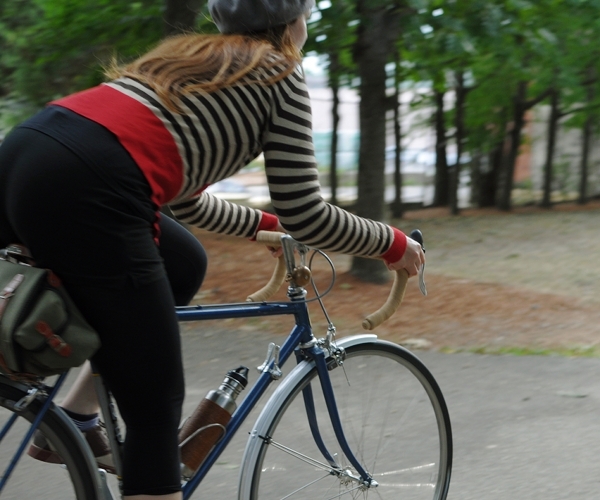
As an academic I get annoyed when acquaintances, having spent a coupe of hours on wikipedia reading about the subject in which I hold a doctorate, decide that they are now experts in it and insist on debating some issue which they do not properly understand. So of course it's funny to catch myself being a hypocrite and exhibiting the same attitude towards cycling. Yes, I like the idea of training rides. But if I can't even ride with clipless pedals and have zero experience cycling in a group, the reality is that it is simply too early to be joining training rides and imagining myself on a team.
So... Maybe next year. Or maybe never. I am not a competitive person and am not usually drawn to anything that involves groups or teams - so it is rather mysterious that something like this would even interest me. Maybe by the time next year rolls around, it will all pass. In the meanwhile, let's see what the next three months of (hopefully) perfect cycling weather will bring.
But then I mentally smack myself and return to reality: No, that could not have been me. Because there is a world of a difference between merely being able to ride a roadbike and racing.
As an academic I get annoyed when acquaintances, having spent a coupe of hours on wikipedia reading about the subject in which I hold a doctorate, decide that they are now experts in it and insist on debating some issue which they do not properly understand. So of course it's funny to catch myself being a hypocrite and exhibiting the same attitude towards cycling. Yes, I like the idea of training rides. But if I can't even ride with clipless pedals and have zero experience cycling in a group, the reality is that it is simply too early to be joining training rides and imagining myself on a team.
So... Maybe next year. Or maybe never. I am not a competitive person and am not usually drawn to anything that involves groups or teams - so it is rather mysterious that something like this would even interest me. Maybe by the time next year rolls around, it will all pass. In the meanwhile, let's see what the next three months of (hopefully) perfect cycling weather will bring.
Tuesday, August 10, 2010
Meet My New Cycling Coach - Francesco!
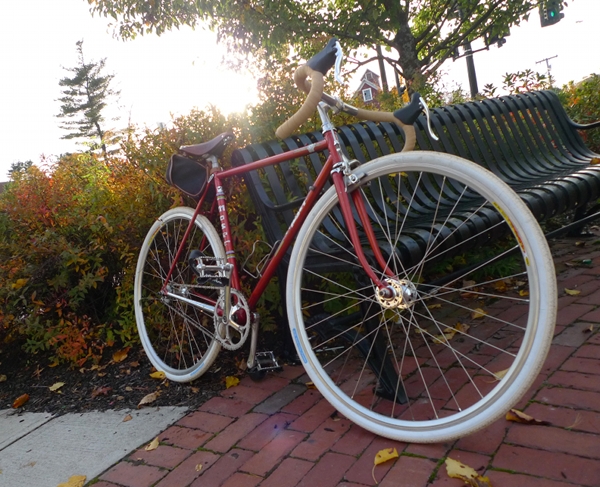
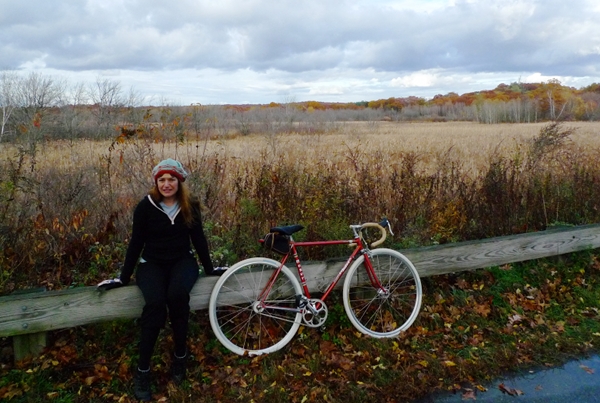
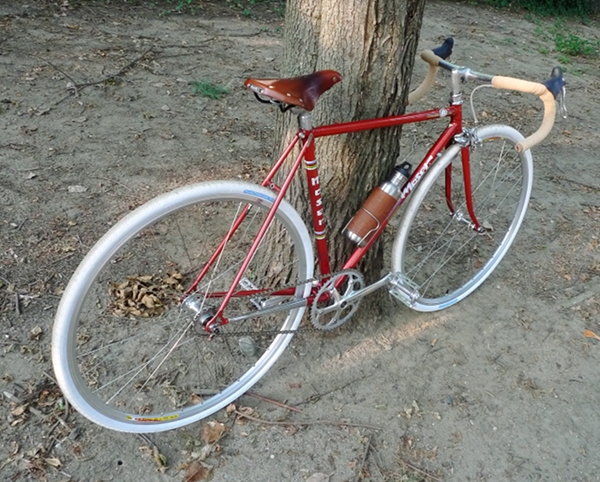
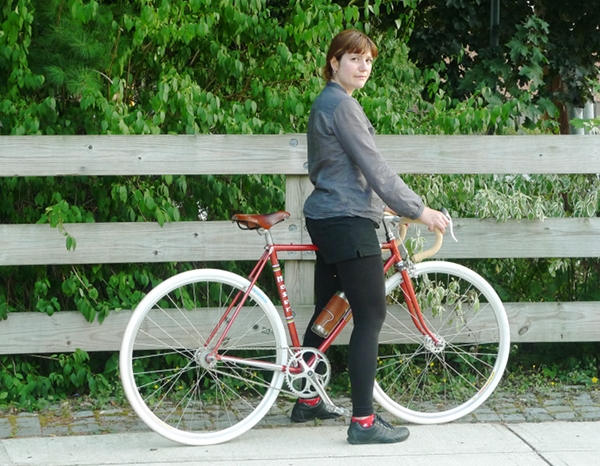
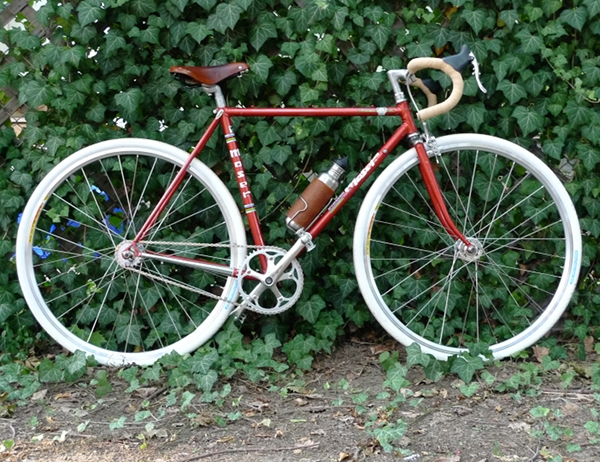
I had mentioned in passing that I brought a vintage frame with me from my last stay in Austria to build up as a fixed gear road bike... Well, here is the result:
As you may have noticed, the Co-Habitant has turned into a bicycle mechanic this summer - to my appreciative delight, as I have neither the aptitude nor the time for it. He bought a bike stand, has accumulated the necessary tools for most jobs, and has been enjoying learning the ins and outs of bicycle repair. This was his first complete bike build, after he practiced with the fixed gear conversion on Marianne. As a mechanic he is meticulous, and this is reflected in the quality of the results. The bicycle is tight and smooth and noiseless and just the way I wanted it.
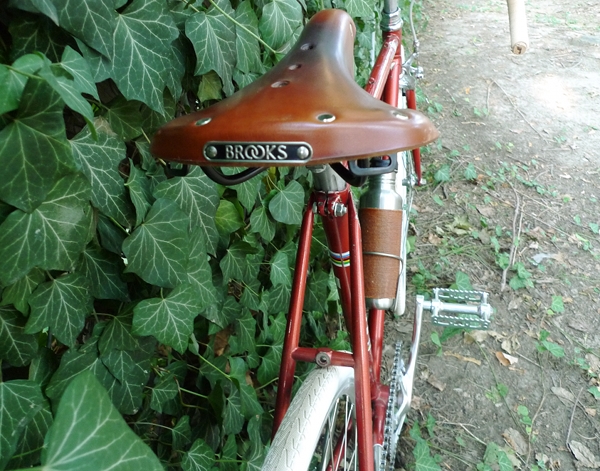
If you are interested in components, they include a Sugino RD2 crankset, a Mavic CXP2 wheelset, and white Panaracer Pasela tires (700x28C). The seat post (manufacturer unknown), stem (Nitto), handlebars (GB) and brake (Shimano, model unknown) were recycled from various used/vintage sources. The brake levers are the same Tektro short reach I have on my Rivendell, and these are pretty much the only roadbike brake levers that I am actually able to squeeze with my poor hands. I have both brake levers despite there only being a front brake, because I like to keep my hands on the hoods. The right lever activates the brake; the left lever is inactive. Though I find it silly to have a "blank" brake lever, I cannot think of a better solution.
As for the lack of rear brake, the reason is two-fold. First, a rear brake in unnecessary on a fixed gear bike. And second, our tire choice made the rear clearance too tight to allow one. It looks in the picture as if the bridge is actually touching the tire, but I assure you it is not. There is enough clearance so that it is perfectly fine to ride, just won't fit a brake.
This bicycle originally came with tubular wheels and narrow tires, so fitting it with 700C wheels and the cushy white 28mm Paselas was really pushing the limits of its clearances. But we decided to go with them, because these tires are just a spectacular ride, as well as a safer choice for my pothole-ridden "training route". The larger wheels and tires also have the positive effect of raising the bottom bracket - which is a good thing for a fixed gear bike, as pedaling while leaning on a turn can potentially result in hitting the ground with the edge of a pedal. Needless to say, there will not be room for fenders on this bike. That is fine with me in this case, as the bicycle's purpose is entirely athletic. (Also, I think the "naked" white tires look quite good with the red frame.)
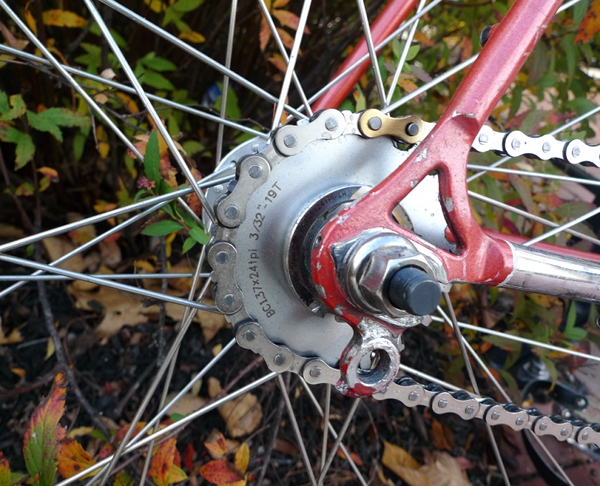
I should also mention, that while we built this bike up as a fixed gear, we did not file off any of the braze-ons or bosses. The rear derailleur hanger and the rear brake routing have been left as they were, and the downtube shifter bosses have been covered with these rubber "boss cozies" for safety and aesthetics.
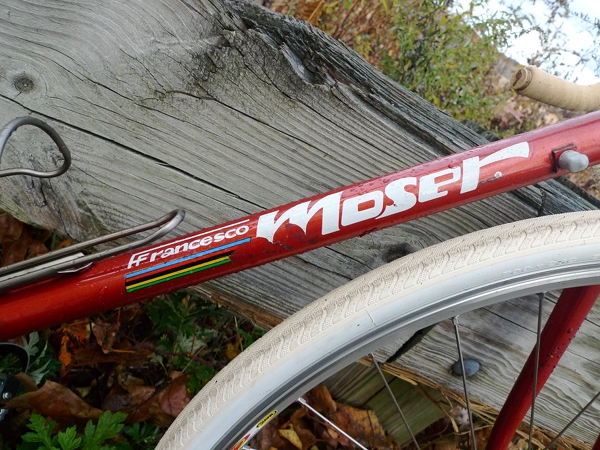
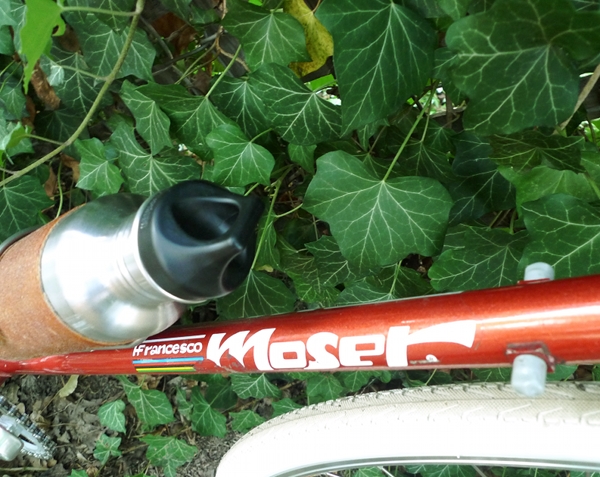
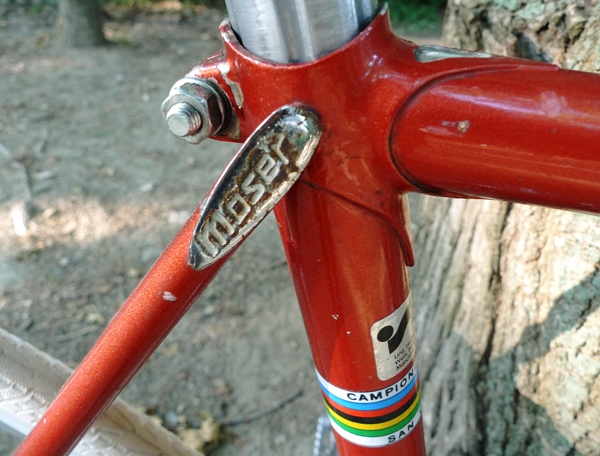
Francesco Moser frames are quite nice, and are well-regarded in Austria. I am told that this model is made of Columbus tubing, though there is no longer a decal testifying to this.
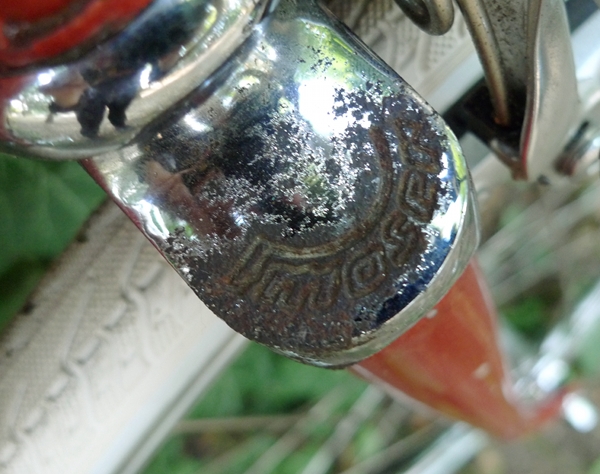
The frame is in great condition, except for some rust on these chrome parts. I plan to clean that up as soon as I determine what the safest method is.
Now that I have given all the excruciating details regarding the bike, some are probably wondering why in God's name I needed a fixed gear roadbike. Well, I'll tell you. I had been planning this ever since having ridden that trackbike in Vienna and discovering that riding a fixed gear bike helps me build up my road cycling skills. It does that by addressing my biggest frustrations, which are balance and coordination. I have plenty of endurance to cycle fast for relatively long periods of time, but I suck at pretty much every other aspect of cycling (for instance, making turns and cycling closely to others at high speeds). The aspect of fixed gear cycling that most people find difficult (the constant pedaling) I am fine with, which makes it the perfect tool to help me with the other stuff.
I have gone on two long rides on Francesco so far: a 26 mile ride with only very mild hills, and another 26 mile ride with steeper hills. Though the hilly ride was challenging, I have not experienced any pain or discomfort, despite this bicycle's aggressive geometry. Francesco seems like he will be a great cycling coach, and I look forward to getting to know him better.
Tuesday, August 3, 2010
Power Grips: Foot Retention That Even I Can Use!
{edited to add: Power Grips was a sponsor of this website September-October 2010. This review was written before that time. I purchased Power Grips on my own accord.}
I do not like the idea of foot retention and generally feel no need for it - whether cycling for transportation or going on long rides. Perhaps it is more accurate to say that the very thought of having my feet connected to the pedals fills me with terror. The problem is, that I will soon be riding a fixed gear roadbike (Marianne's conversion was practice), for which it is advisable to use foot retention: When cycling over bumps or potholes, your feet can fly off the pedals on a fixed gear bike and the pedals can then "chew up your ankles" before you have a chance to brake. So yes, foot retention is recommended.
Some have suggested I try Power Grips if I am too nervous to use toe clips or clipless pedals. I have finally gotten up the nerve to give them a try... and so far they have been more or less a success. We installed these first on my Rivendell Sam Hillborne, so that I could get comfortable with them before putting them on the fixed gear. Here are my impressions so far.
Another nice thing about the Power Grips, is that if you want to pedal without them, you can easily use the other side of the pedal. I do not feel comfortable yet wearing the grips in stop-and-go traffic, so when the traffic gets dense I simply cycle with them upside down and my feet are free. The straps do not hang low enough to scrape against the ground. And even if there is an occasional scrape, it is soft and silent (whereas toe clips make screeching, clunking noises).
Some complain that Power Grips don't look attractive on a bike, but I think they are fine: it is just a strap attached to the pedal. They will soon be moved from my Rivendell to my fixed gear bicycle - though I must say it is tempting to keep them here, too. Unless riding in traffic, it actually feels nice to have my feet in the straps, especially when pedaling fast or going over bumps.
I cannot overstate how scared I am of foot retention: I have tried clips and half clips, and was unable to use them. Power Grips seem easier and safer to me than either of these systems. They are also by far more effective than half-clips or loose toe clips.
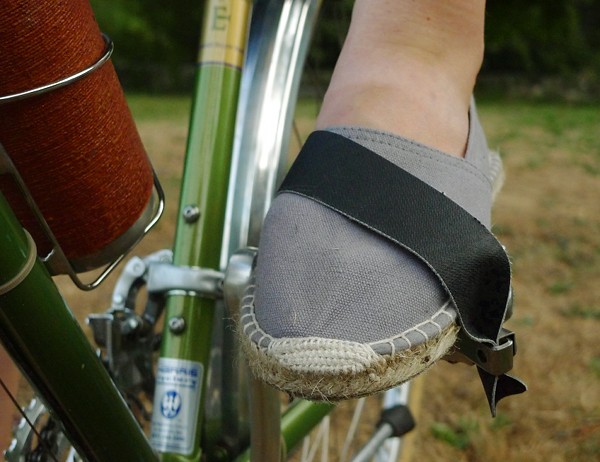
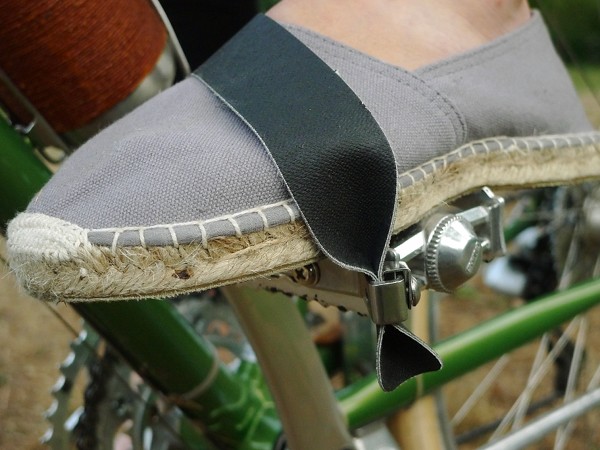
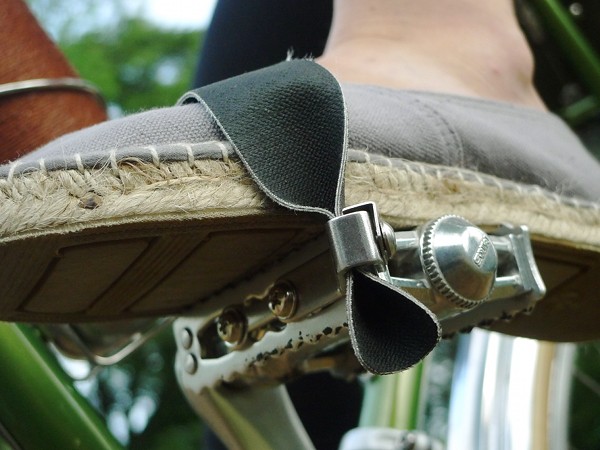
Power Grips are basically straps made of a thick, stiff woven fabric, that mount diagonally on the pedals. It is easy to slide your foot in and out, but the diagonal position grips the foot firmly in place once it is all the way in. Note that we mounted these with the logo on the inside. There is also a beige version with an argyle pattern accompanying the logo.
Even as I write this, it sounds implausible that something can both "grip the foot firmly" and "be easy to slide in and out of," but that is the feeling. Because the band is diagonal, there is a large escape area as soon as you move your foot back a bit. You can also feel the grip getting tighter/looser as you shift your foot forward or backward on the pedal, so there is a natural bodily awareness of the system that works in your favour. When approaching a stop, I simply slide one foot off the pedal and step down on the ground. Initially I would remove the second foot at stops as well, but eventually I discovered that it was easier to just keep it inside the grip.
I am not qualified to say how effective the Power Grips are in terms of pedaling efficiency; I simply would not know. It feels as if with the grips I can pedal with more power, but it may very well be an illusion. However, none of that is important to me, and what really matters is safety. The Power Grips keep my feet firmly in place when going over bumps, yet are easy to get out of whenever I need to.
I should mention also that the straps come in several sizes, and are adjustable to fit over different types of footwear. They do not squeeze or rub the top of the foot, so I am pretty sure you could wear them even with sandals.
Even as I write this, it sounds implausible that something can both "grip the foot firmly" and "be easy to slide in and out of," but that is the feeling. Because the band is diagonal, there is a large escape area as soon as you move your foot back a bit. You can also feel the grip getting tighter/looser as you shift your foot forward or backward on the pedal, so there is a natural bodily awareness of the system that works in your favour. When approaching a stop, I simply slide one foot off the pedal and step down on the ground. Initially I would remove the second foot at stops as well, but eventually I discovered that it was easier to just keep it inside the grip.
I am not qualified to say how effective the Power Grips are in terms of pedaling efficiency; I simply would not know. It feels as if with the grips I can pedal with more power, but it may very well be an illusion. However, none of that is important to me, and what really matters is safety. The Power Grips keep my feet firmly in place when going over bumps, yet are easy to get out of whenever I need to.
I should mention also that the straps come in several sizes, and are adjustable to fit over different types of footwear. They do not squeeze or rub the top of the foot, so I am pretty sure you could wear them even with sandals.
Another nice thing about the Power Grips, is that if you want to pedal without them, you can easily use the other side of the pedal. I do not feel comfortable yet wearing the grips in stop-and-go traffic, so when the traffic gets dense I simply cycle with them upside down and my feet are free. The straps do not hang low enough to scrape against the ground. And even if there is an occasional scrape, it is soft and silent (whereas toe clips make screeching, clunking noises).
Some complain that Power Grips don't look attractive on a bike, but I think they are fine: it is just a strap attached to the pedal. They will soon be moved from my Rivendell to my fixed gear bicycle - though I must say it is tempting to keep them here, too. Unless riding in traffic, it actually feels nice to have my feet in the straps, especially when pedaling fast or going over bumps.
I cannot overstate how scared I am of foot retention: I have tried clips and half clips, and was unable to use them. Power Grips seem easier and safer to me than either of these systems. They are also by far more effective than half-clips or loose toe clips.
Subscribe to:
Posts (Atom)