Showing posts with label bicycle reviews. Show all posts

Saturday, February 12, 2011

Getting to Know You

As someone who is interested in experiencing a variety of bicycles and sharing my impressions with others, I find myself constantly re-examining the question of how long it takes to get a "proper" impression of a bike. When I test ride a bicycle, the experience is different on so many levels from when I own the bicycle and ride it in on a daily basis. There are discoveries I make about bikes months into owning them.

Also, when I own a bicycle - even if it's one of my "experimental bikes" and I know from the start that I will probably end up selling it eventually, there is something about the personal responsibility of ownership that makes me more comfortable forming impressions of its characteristics.

These are all reasons why I differentiate "bicycle reviews" - which I limit to the bikes I own, from "test ride reports" of the bikes I try. And I also mention how long I'd ridden the bike at the time of the review, so that the reader can factor that in. For instance, riding the Abici for an entire afternoon around the city and riding my friend's Retrovelo for a good portion of our long trip through the countryside, were quite different experiences than riding the Trek Belleville for 10 minutes on the side streets adjacent to the bike shop. And, riding my own Gazelle, Bella Ciao and Pashley were different experiences still, and my impression of these bikes takes hundreds of rides into account.

Ultimately, I feel more comfortable offering an opinion about bikes I have owned, however briefly, than on bikes I have merely test ridden or borrowed. And I am considering what that means in terms of Lovely Bicycle. Should I try to make it a point to own the bikes I feel would be especially interesting to review, and then later sell them, accepting the loss as part of the costs of running this blog? It's a neat idea, but probably not financially feasible. Extended borrowing would be the next thing, but there are all sorts of logistic and conflict-of-interest problems when it comes to that as well.

How long does it take you to get to know a bicycle? Is a test ride enough, or do you have to own it for a couple of months before you really feel familiar with it? When you read reviews and test ride reports, do you pay attention to how long the author has been riding the bike and factor that into your impressions? Finally, what do you think is the optimal time period to wait before writing a review?

Sunday, November 7, 2010

Born for the Hills! A Review of the Rivendell Sam Hillborne

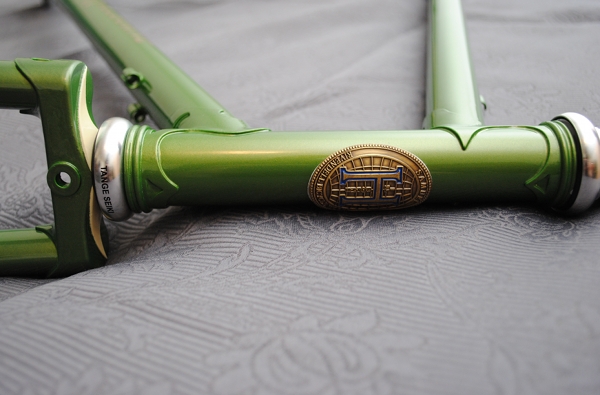
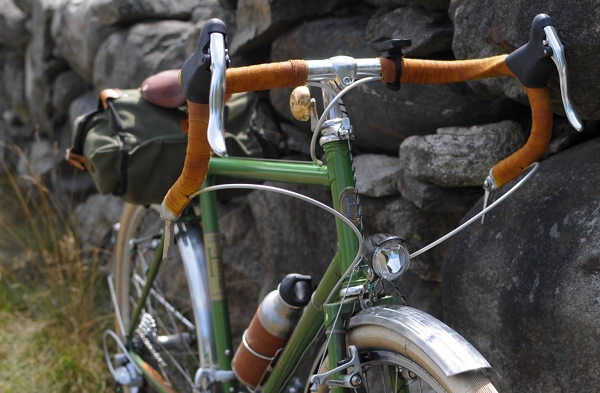
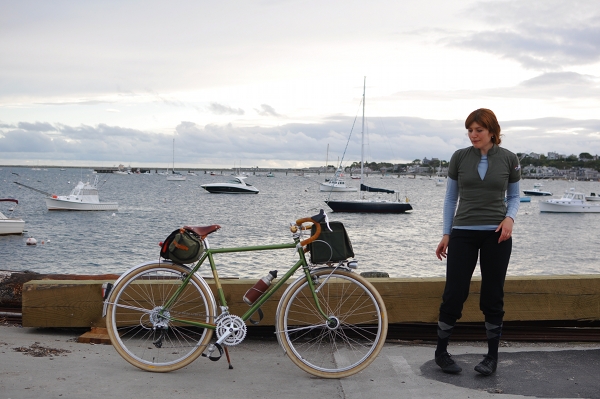
I have owned my Rivendell Sam Hillborne ("Graham Greene") for 6 months now, and have ridden it for 1,800 miles, which makes it long overdue for a review. The short version is: "I love it. I love it so much!" For the long version, read on.

I received a Rivendell Sam Hillborne frame as a holiday gift in December 2009, purchased from Harris Cyclery in West Newton, MA. We were not yet comfortable building up a bike on our own, so the build was done at Harris as well. It took me a few months to save up for the components, and the bicycle was ready in the end of April. Note that Harris Cyclery was not a sponsor at the time, and that everything in relation to this bicycle was a standard purchase.

My choice of build for the Hillborne was informed by test-riding a floor model in my size. Since I had no real experience riding a roadbike at that point, I mostly went with recommended specs. These included a 3x8 drivetrain, Sugino cranks, Nitto Noodle handlebars with Silver bar-end shifters, and a Brooks B17S saddle. My 52cm frame was built for 650B wheels and cantilever brakes.

The three things I specifically chose for this bicycle were handbuilt wheels with dynamo lighting (see details here), Grand Bois Hetre tires (see review here), and Tektro short reach brake levers. The discovery of these brake levers was crucial for me. One thing that had hitherto prevented me from riding bicycles with drop bars, was my inability to squeeze the brake levers - especially from the hoods. I have small hands and I have damaged nerves in my hands. The combination made squeezing this type of lever impossible. When I described the problem to Elton at Harris Cyclery, we went through different brake levers to see whether any existed that I was able to squeeze. The Tektro levers were it and I am extremely happy with them. Elton also showed me some methods of hand and finger placement that work well for me and do not send electric currents through my fingers. I cannot stress enough what a break-through this was in terms of understanding why I was having problems riding with drop bars before.

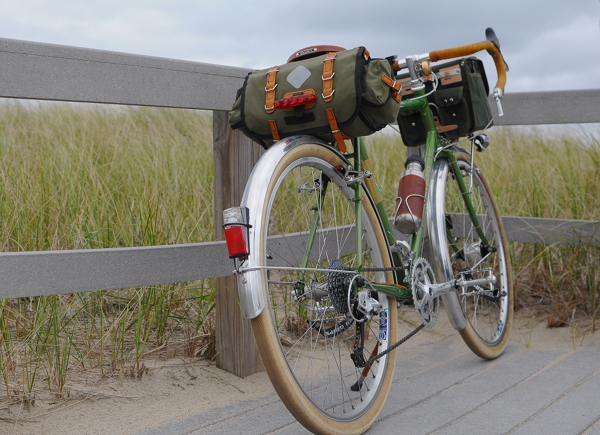
Over time, I added other personal touches to the bicycle. These include a Carradice saddle bag,

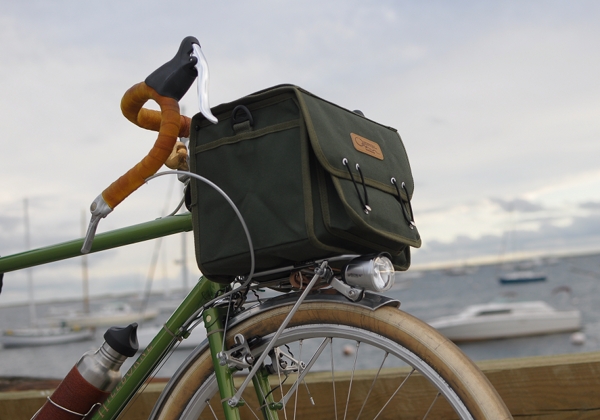
a Nitto M-18 front rack from Renaissance Bicycle (a sponsor), an Ostrich handlebag bag from Velo Orange which I use on long trips,

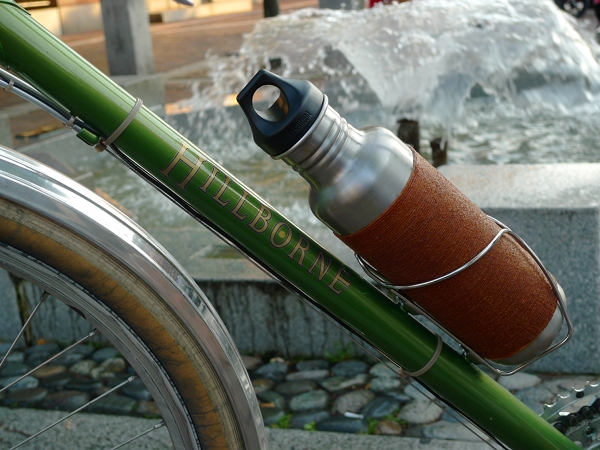
a twined and shellacked Klean Kanteen water bottle,

and my beloved Power Grips (see here for my initial review of them).

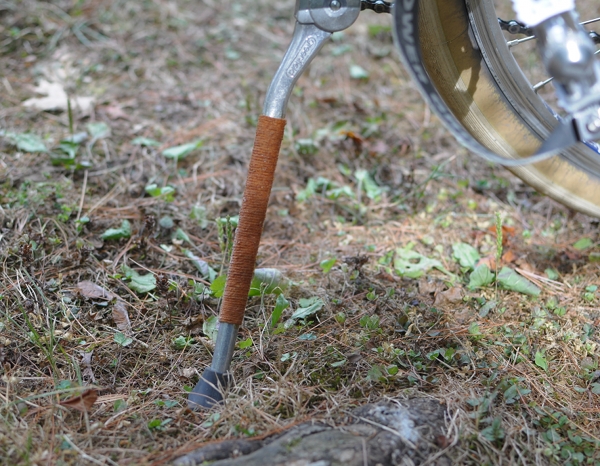
I have also twined and shellacked the kickstand (to prevent it from scraping against the pedal when the bike is parked),

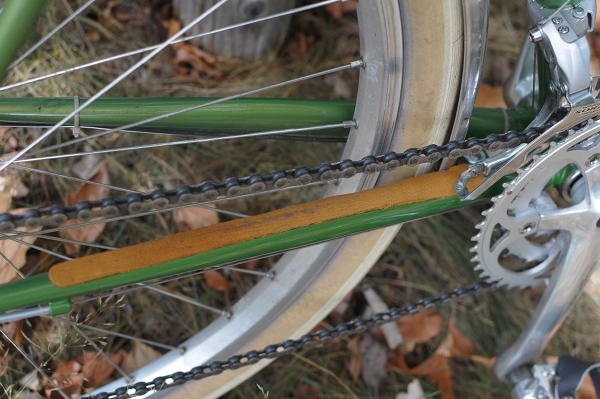
and added a leather Velo Orange chainstay protector. This product is great for preventing the paint on the right chainstay from getting nicked by the chain slapping against it when the bicycle goes over bumps - which began to happen to my Rivendell within the first few rides I went on.

There are a few additional little details that I enjoy, but no one else probably notices - like these green cable endcap crimps,

and the "taupe" zipties (see top right, under the waterbottle) for routing the dynamo lighting that I find to be less noticeable than black ones.

Over the time I have owned him, I feel that Graham has attained an appearance that is distinctly personalised. Looking at him reminds me of the many "firsts" I experienced on this bicycle: from learning to ride with drop bars to going downhill at 30 miles per hour, while cornering, with a full handlebar bag.

These experiences certainly did not happen all at once. After I first brought the complete bicycle home, I had a minor hysterical breakdown when the reality of owning it hit me. What on Earth would I do with such an expensive bike with drop bars? What if I wasn't able to ride it? The bike would end up standing in my livingroom as a beautiful, ridiculous testament to the gap between my imagination and my abilities.

This emotional self-flogging lasted for a couple of days, but then I began to ride the bike. I took it slow and started by setting the handlebars quite high, so that I could get used to the drop bars. The Hillborne has what I would say is a long top tube, and I have a short torso - so the degree of lean this placed me in required some adjustment on my part.

Over the course of the first month I owned the bike, I rode it almost daily and lowered the handlebars weekly - until eventually I was comfortable with them being at the level of the saddle. I would recommend this method to those who find dropbars intimidating.

I love pretty much everything about this bicycle and find it difficult to muster up any words of criticism. It may be worth noting that some dislike the slight upward slope to the top tube on the Hillborne, but I have no problem with it. If I have to find something bad to say, then maybe it's that the paint seems to be a bit delicate - but then I am used to powdercoat, and it's just a fact that liquid paint is easier to nick. I am equally happy with my choice of components - perhaps with the exception of the Shimano Deore rear derailleur, which I have managed to bang up pretty badly in the course of ownership. Next spring, I may replace it with the Shimano XT "Shadow," which seems more immune to abuse. Otherwise, everything is perfect.

I don't know how to describe the ride quality of the Sam Hillborne in technical terms, but in non-technical terms I feel as if I could live on it. Nothing hurts, ever. The bicycle is miraculously cushy over bumps.  There is no "toe overlap" with the front tire when turning. The seat tube angle is just right: relaxed enough to be comfortable without having to shove the saddle back on the rails, but not so relaxed as to stand in the way of "performance." I can keep up with the Co-Habitant just fine on the Hillborne, and he is a fast cyclist. The most challenging ride I have gone on so far has been a very hilly metric century (64 miles), and I felt great afterwards. No weight on my hands, no strain on my neck, no knee pain, just comfy cycling goodness. The bicycle seems equally stable at both high and low speeds. I can go over 20 miles per hour while feeling as if I am going 10 and I can plummet downhill while enjoying the view instead of panicking. It is also fantastic on climbs and seems to carry momentum well.

As I have mentioned at the start, I have now cycled 1,800 miles on this bike - which may be more than I have cycled on all my other bicycles combined. I had never imagined that I would be doing this much cycling, let alone on a roadbike. I know that it is all supposed to be about the cyclist and not about the bicycle, but I honestly do not think I would have come this far in my road cycling skills on a different bike, no way. I would even credit the Sam Hillborne with how well I took the track bike I rode in Vienna and to the Italian racing bike I subsequently built up as a fixed gear. Once I learned the skills on the Rivendell, I felt comfortable on other types of roadbikes as well - but I would not have been able to learn on them.

While the Sam Hillborne was great for me as a beginner, I am nowhere close to "outgrowing" it. If anything, I feel as if I am slowly growing into it and am only starting to appreciate its full potential. Next summer I am looking forward to doing some more extensive touring and attempting more challenging hills. After all - my bike was born for them.

Monday, November 1, 2010

Mixed Impressions: a Look at the Trek Belleville WSD Mixte

Lately, readers have been asking about the Trek Belleville WSD mixte. It has been out for about a year and looks promising in pictures, but what is it like in person? I had noticed this bicycle earlier at one of my local bike shops - the Wheelworks in Somerville, MA - and recently had a chance to try it.

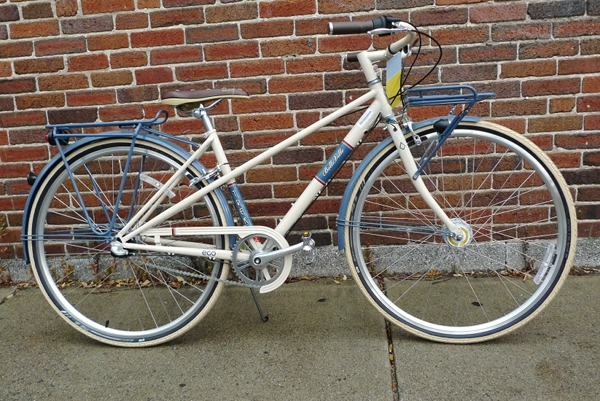
The Trek Belleville mixte is a "real" mixte  - in the sense that it is built with twin lateral stays that extend from the head tube to the rear dropouts. The bicycle reflects the ideas of the French constructeurs (or, more likely, the contemporary builders who emulate the original constructeurs) in that it is fully equipped with fenders, front and rear racks, and dynamo-powered lighting. However, unlike classic mixtes with their elegant lines and lugged steel construction, the Trek Belleville's frame is made of a strangely thick, welded cromoly tubing. The tubing is so chunky in fact, that I was certain the bike was aluminum until I was corrected. In industry photos the chunkiness is easily disguised with good lighting and careful choice of angles. But in person, the bicycle looks like what it is: a somewhat clumsy mass-produced bike fitted with some admittedly impressive extras. Trek also promotes the "eco-design" of this model, which you can read about here.

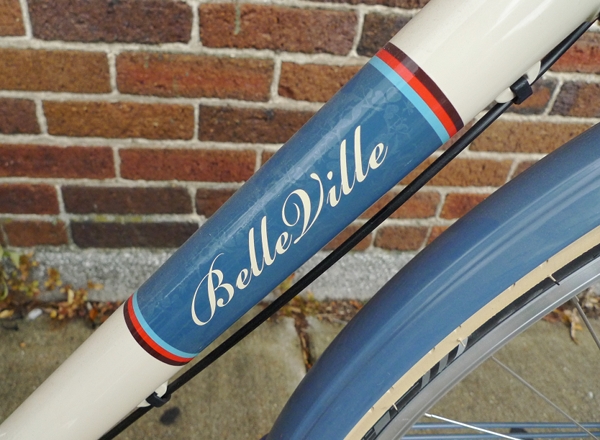
I think that one of the most successful aspects of the Trek Belleville is the colour scheme and graphics. We like to fool ourselves into thinking that this stuff does not influence us, but it does. The slate-blue and cream colour combination with subtle red accents is harmonious, beautiful, and nostalgic. It dominates the aesthetics of the bicycle, distracting the eye from its less appealing aspects.

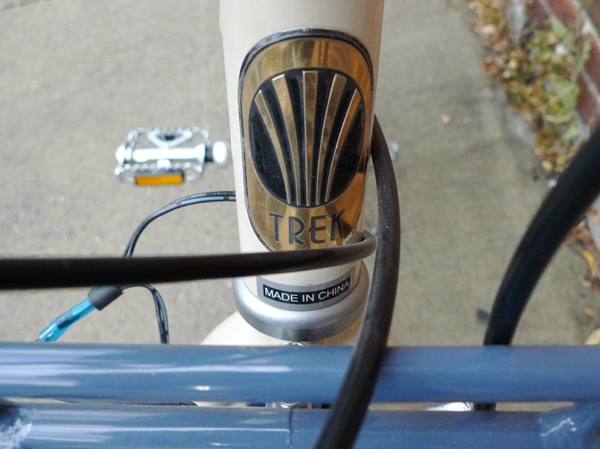
Trek also used a vintage headbadge for the Belleville, which goes nicely with the classic theme.

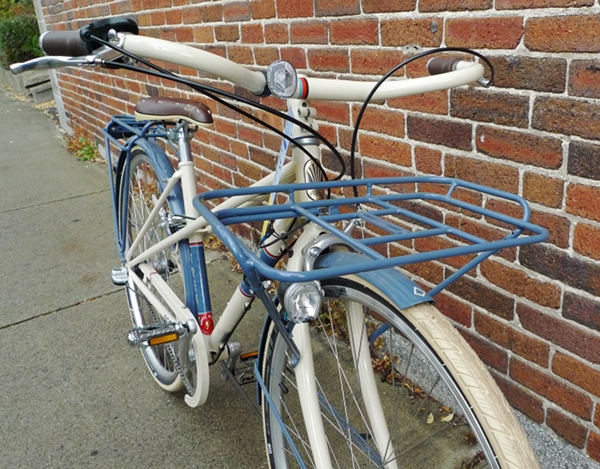
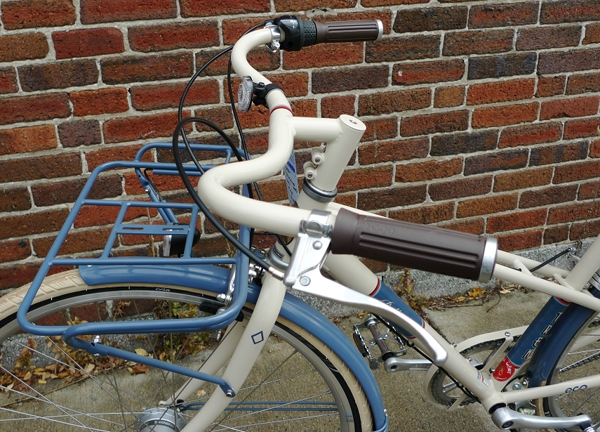
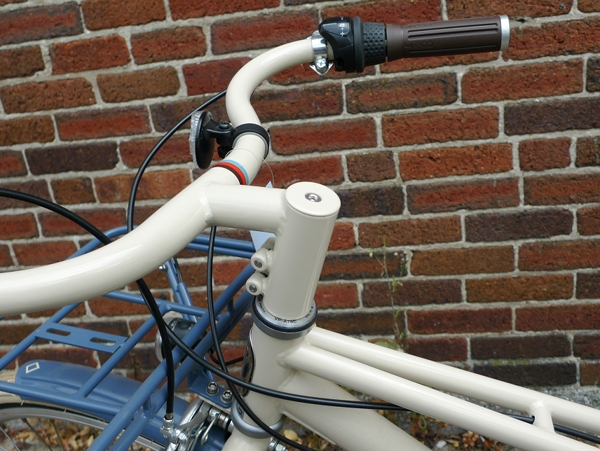
The Trek Belleville uses a threadless stem and Porteur-style handlebars. Both the stem and the handlebars are painted body colour, which is nice. A Porteur-style front rack is attached to the fork.

Close-up of the stem, grips, shifter and the points where the lateral stays attach to the head tube. While I do not normally like threadless stems and integrated handlebars, I think here the look is appealing. However, the design makes it impossible to adjust stem height and the angle of the handlebars, which is problematic.

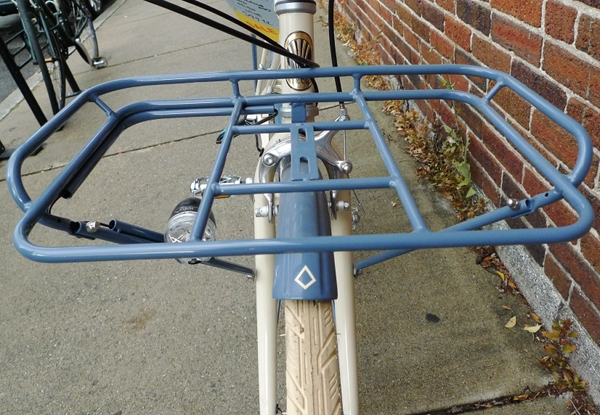
The front rack is quite elegant, as well as smoothly integrated with the body of the bike. The tires are Bontrager, cream with black sidewalls.

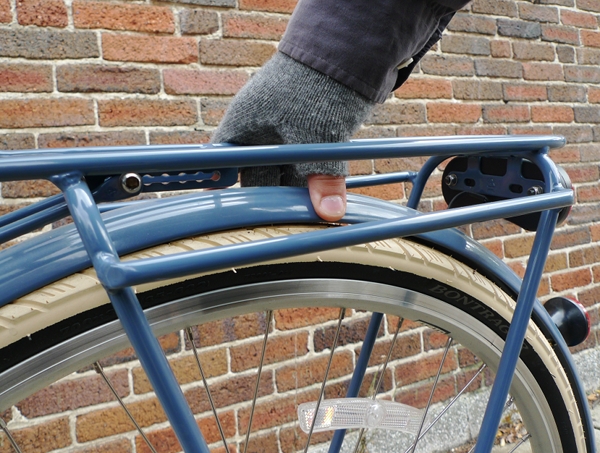
The rear rack is nice as well.  I don't remember the weight rating, but it was considerable. One thing I noticed, is that the attachment points are set back from the rear dropouts - presumably because the chainstays are otherwise not long enough to accommodate a rack?

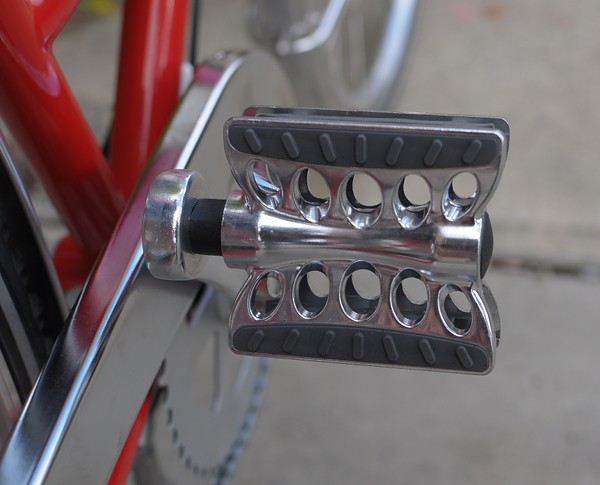
The Trek Belleville is fitted with an internally geared hub (Shimano Nexus 3-speed), caliper brakes, a decent-looking crankset, touring-style pedals, and a body-coloured chainguard.

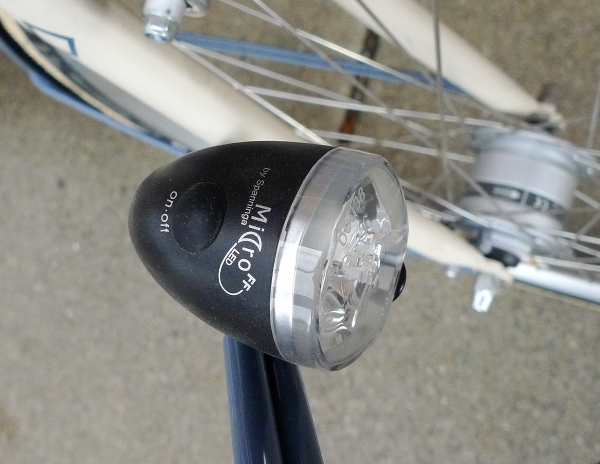
The front dynamo hub is a Shimano (I did not see the model name), and the lights used are Spanniga. The headlight is a Spanniga Micro, mounted on right stay of the front rack.

The tail light is a Spanniga Eclipse, attached to the rear rack. I have not tried the lights, as it was daytime, but I have heard good things about these models.

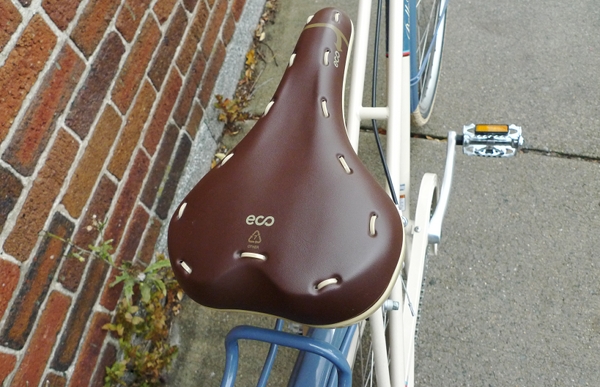
The saddle has a faux-handsewn leather look to it and feels like a typical padded vinyl saddle. I have read that it was designed to be disassembled and recycled after use, though I am not clear on the details.

The Trek Belleville mixte comes in two frame sizes - 43cm (17") and 50cm (20"). I am fairly certain that I tried the smaller frame, because I had to raise the saddle half a foot from its original position in order to ride the bike (note that the pictures here show the original position, not the raised position). However, while the seat tube was short, the rest of the bicycle seemed quite large. The step-over was high and bringing my leg over took some careful negotiating. And the reach from the saddle to the handlebars was characteristic of a larger frame.

I would estimate the weight of the Belleville mixte around 35lbs. Very reasonable, considering the steel tubing and all the extras.

Preparing to test-ride the bike, I walked it off of the sidewalk curb - at which point it made loud clunking noises. Upon investigation, we discovered that the fenders were wobbly - and the cause seemed to be in the design of the attachment points, rather than in the assembly. This could be an issue when riding over bumps or potholes.

I test-rode the Trek Belleville mixte briefly, and I apologise for my disgraceful "salmoning" - it was only done for the photo. As reflected in the picture, the first thing I noted was the unusually generous width of the handlebars - I almost felt as if I were holding the edges of a hula hoop. Maybe this was the cause of the strange feel to the steering, because I found the front end to be "aloof" - almost as if it was receiving its steering instructions via a third party rather than from me directly. I wonder whether it would handle differently with a front load, but that is not something I was able to test. Otherwise, the ride felt okay - with the exception perhaps of too much pressure on my hands despite the upright handlebars.

Of all the other bicycles I have test ridden, the Trek Belleville mixte is the most similar to the Specialized Globe Haul I tried last year. Both feature mixte-style construction and integrated racks, and are roughly in the same price range. Comparing the two, my impression is that the Globe Haul's construction is of somewhat better quality and I preferred the feel of the Globe's ride. In pictures and from a distance, the Trek Belleville comes across as a prettier and more classic-looking bicycle, but in person this is not so. As for comparing the Trek Belleville WSD to traditional, classic mixtes - there is something clumsy about the Trek, as a result of which it does not resemble the real deal despite the twin-stay construction.

The racks on the Trek Belleville mixte are impressive, and the fact that dynamo lighting comes standard on this bicycle is nothing short of amazing. The gorgeous paint job is also to be commended. But despite all the extras, the bicycle has an awkward and flimsy feel to it in person.  The current retail of the Trek Belleville mixte is around $650, and the Wheelworks in Somerville has it on sale at the moment for a lower price. Regardless of what I think of the Trek Belleville, one thing is for sure: A production bicycle with racks and dynamo lighting is a step forward for the industry that is in itself worth applauding.

Saturday, October 16, 2010

DBC Swift Test Ride

Last night we stopped by DBC City Bikes (formerly the Dutch Bicycle Company) in Somerville, MA to have a look at their new "Swift" line of bicycles. DBC - whose focus was previously on importing Dutch and Danish transport bikes - has now changed direction and established their own line of classic handbuilt bicycles. The Swift models are designed in house by Wentworth and MIT graduates and built to spec by local framebuilders. They had a few floor models at the shop, and I test rode the loop frame ladies' version.

The Swift is TIG-welded cro-moly steel. The build includes upright handlebars, Brooks saddle, internally geared hub, front and rear drum brakes, dynamo lighting, fenders, chainguard, rear rack, and a cafe lock. The curvature of the top tube is executed nicely, and the welding is very clean. There are no dress guards, but nowadays it is becoming easier to purchase those separately. The lack of a full chaincase could be problematic for those who want one, but others would consider the chainguard sufficient. Everything else you might need in a transport bike is included. 

As always, I am not a fan of unicrown forks, but at least the welding here is nice and neat. The fork blades are curved. There are cable routing guides for the lights and brakes. Not sure how they are attached - they do not seem to be braze-ons - and why they were made in a contrasting colour.

The dynamo headlight and tail light are custom: DBC fitted what I think might be SunLite casings with LEDs and turned them into dynamo driven lights with a standlight feature. It's a neat system and the lights are very bright. 

Tail light. Front and rear hubs are Sturmey Archer.  The bicycle I test rode was a 3-speed, but they are also available as single speeds and 5-speeds.

The fluted fenders look like VO to me. The wheels are 700C.

The pedals are attractive and grippy, but it is a trade secret where they are sourced from! (Anybody happen to know?...)

Riding the DBC Swift was a very particular experience. In many ways, it handles like a classic Dutch bike (think Gazelle or Batavus, as opposed to Pashley or Velorbis), but is lighter and more responsive. The angles are steeper and other aspects of the geometry are a bit different, but still - all in all the Dutch bike qualities seem to dominate. In the picture above, you can see how tall the headtube is and how high up the handlebars are - almost at my chest. The resultant sitting position is bolt upright.

I was not sure what to expect, but I have to say the ride quality was nice: smooth, peppy, lightish, and with an easy feel to it. The bike is stable and easy to control. When my hat flew off my head, I caught it while continuing to cycle; the bike seems fairly klutz-proof. Another notable aspect of the bike, was the superior functionality of the drum brakes. All other drum-brake city bikes I have tried or owned were fitted with 70mm version, whereas DBC fitted the Swift bikes with the 90mm version. Especially for the front brake, the difference in braking power is substantial.

According to DBC, the Swift is meant to be comfortable and non-intimidating even for those who are new to bikes. In this respect, I think it is a success. At the same time, it was designed to be more maneuverable in traffic and easier to ride uphill than a Dutch bike. In this regard however, I am not sure that it feels much different from my traditional Gazelle. It is definitely lighter and somewhat more maneuverable, which some consider a plus for American streets. But it did not strike me as necessarily "better" than my Gazelle - on which I handle traffic and the local hills just fine. It seems like a good bike though, and whether one would prefer it to a traditional Dutch bicycle is a matter of personal taste - just as whether one prefers lugged vs welded frames.

As I was riding the ladies' Swift, the Co-Habitant took a spin on the men's version. I should note that the men's and ladies' versions of the Swift are completely different bikes, designed by separate teams. The angles are different, the proportions, everything. So while my experience of the ladies' model was positive, I have no idea how the mens' handles, and the Co-Habitant's feedback was vague. When it comes to city bikes, I think he is a creature of habit and prefers his Pashley over pretty much anything else.
With the ladies' Swift, my impression is that DBC accomplished what they set out to accomplish in terms of performance. The price of a fully built bicycle is in the $2,000's, depending on the options. Each bike is built to order and custom paint colour is included in the price. How will the DBC Swift do in the long run of course remains to be seen. But it is good to have options: When it comes to handbuilt TIG-welded ladies' bicycles, DBC joins the likes of ANT and GeekhouseThe work of all three builders is different. If you are in the area, try them out for yourself!

Tuesday, August 24, 2010

The Pashley Guv'nor: A Retrogrouch's Dream

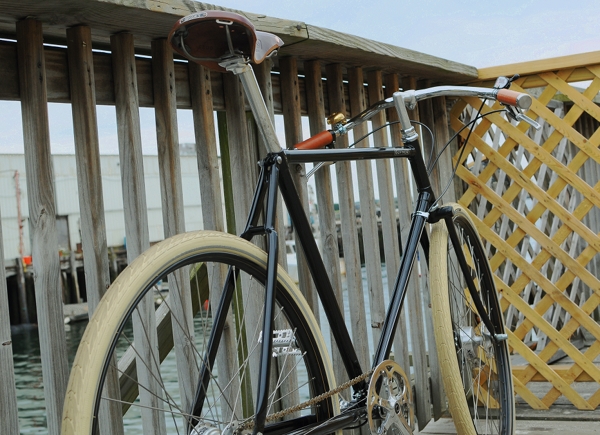
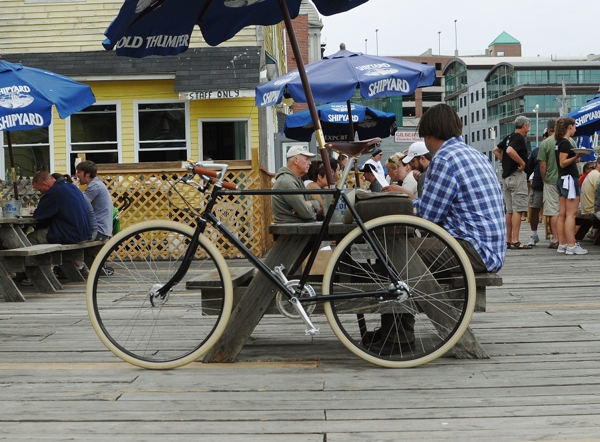
When borrowing bikes from Portland Velocipede, I had thought the Co-Habitant might like to try something entirely new, like a Gazelle or a Brompton. But he is a die-hard Pashley fan and seized the opportunity to ride the Pashley Guv'nor. The man is not overly fond of writing, so I will do my best to communicate his impressions - though the picture above pretty much says it all.

The Pashley Guv'nor is modeled on the 1930s Path Racer, and its faithfulness to this concept is remarkable. The frame is relaxed, with the same frame geometry and 28" wheel size as the Pashley Roadster. But while the Roadster is made of high-tensile steel (heavy, utilitarian), the Guv'nor is made of Reynold's 531 tubing (super light, high-end).

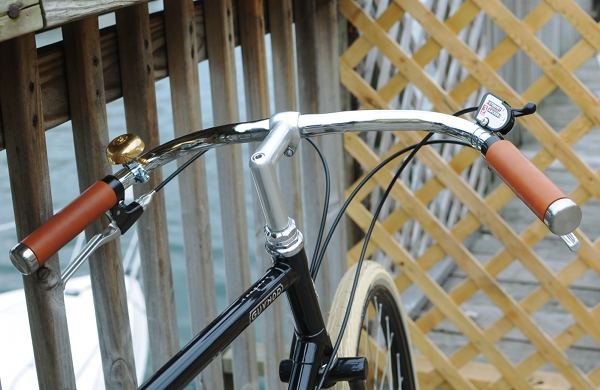
Additionally, the Guv'nor features fancier lugwork, and is equipped with sportier and more luxurious components - such as the racy upside down "North Rroad" handlebars, a Nitto stem, leather grips, and a Brooks B17 Titanium saddle. It is available as a single speed or a 3-speed, and a crazy limited edition with 4 speeds and golden lugs exists as well.

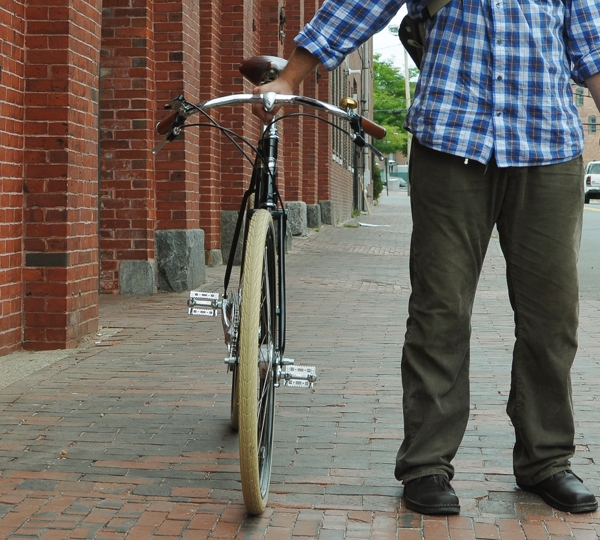
The Guv'nor is fitted with cream Schwalbe Delta Cruiser tires, and it intentionally lacks fenders. No lights or racks either. Like a traditional path racer, this bicycle has a high bottom bracket and horizontal chain stays. Because of the high bottom bracket and the slack seat tube, there is a huge amount of seat post showing, which exaggerates the aggressive appearance. Although the Co-Habitant's Roadster has the same amount of exposed seat tube, this is disguised by the huge rails and springs of the Brooks B-33 saddle that the Roadster is fitted with. The flat and unsprung B17 on the Guv'nor, on the other hand, leaves every millimeter exposed.

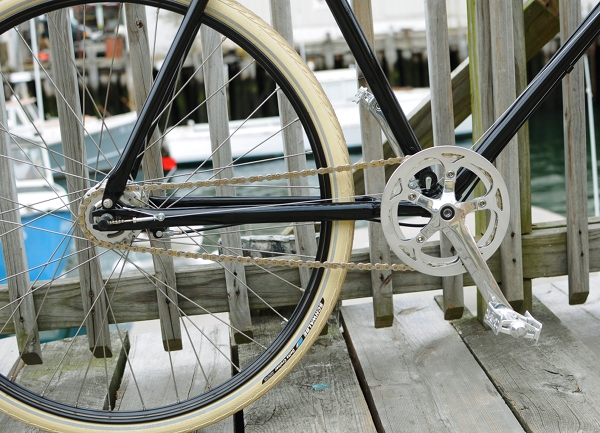
Front and rear drum brakes give the bicycle a clean appaerance.

They also allow for black rims with golden pinstriping (not really captured in the pictures, but it's there).

Drivetrain and track fork ends. The one aspect of the Guv'nor's components the Co-Habitamt dislikes are the cranks; he thinks they are "ugly" - though personally, I do not think they are bad looking.

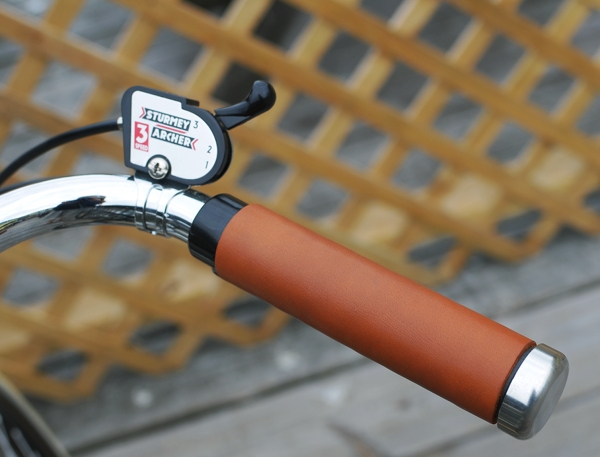
Close-up of the handlebars, with brass bell and retro-style Sturmey Archer 3-speed shifter.

The vintage-looking shifter is a nice touch.

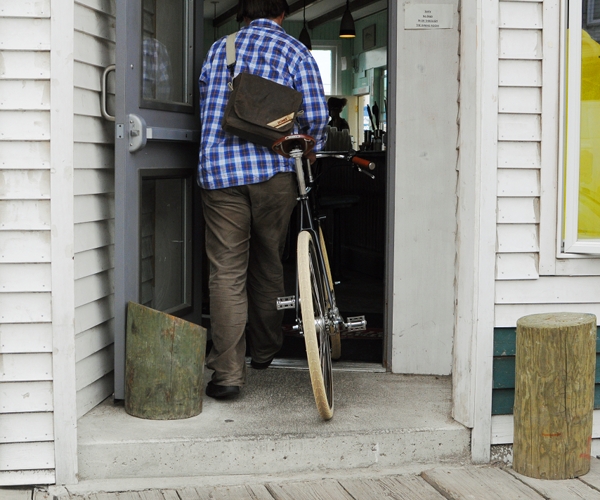
As I did on the Abici, the Co-Habitant rode around Portland, Maine on the Guv'nor - even taking it along into a dining establishment. No one seemed to mind and the bicycle received compliments.

The Pashley Guv'nor, waiting for his beer and calamari. Unlike the Pashley Roadtser, it is extremely easy to maneuver and drag around due to its light weight.

In terms of ride quality, the Guv'nor handles like a cross between a roadster and a road bike. It is very light, fast, and maneuverable - yet also stately. Some aspects of the geometry can take getting used to: Because the saddle is so far back due to the slack seat tube (plus the seat post has set-back), the handlebars are extremely far away. The Co-Habitant thinks that Pashley should have either used a shorter stem, or a seat post with no set-back; otherwise the posture feels too extreme - especially in combination with the slack seat tube and the forward position of the pedals.

Riding the bike around town was tremendous fun for the Co-Habitant, and of course he would love to own such a bike in a world unhindered by practical considerations. But the Guv'nor woud hardly be a reasonable choice for regular commuting, given its lack of fenders and lights. And while in theory, these could be installed, doing so would ruin the authentic Path Racer look - which is the very heart of the concept behind the Guv'nor. Ultimately, the Guv'nor was not designed for practicality and makes no claims to be a daily commuter. It is a trophy-bike, meant to be taken out in fair weather and enjoyed for its unique ride quality and vintage aesthetics. More than anything, it is the concept itself that is impressive: Pashley created this bicycle true to the original and made it painfully handsome in the process.

Many thanks to Portland Velocipede for loaning out this bicycle.