Showing posts with label Marianne. Show all posts

Thursday, September 2, 2010

French Experiments Continue: Belleville Handlebars and Inverse Brake Levers

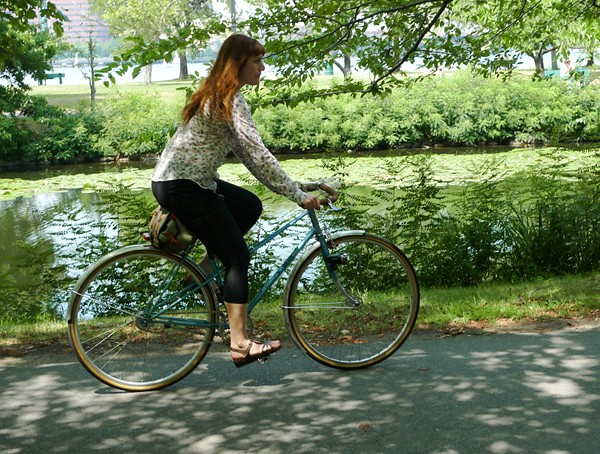
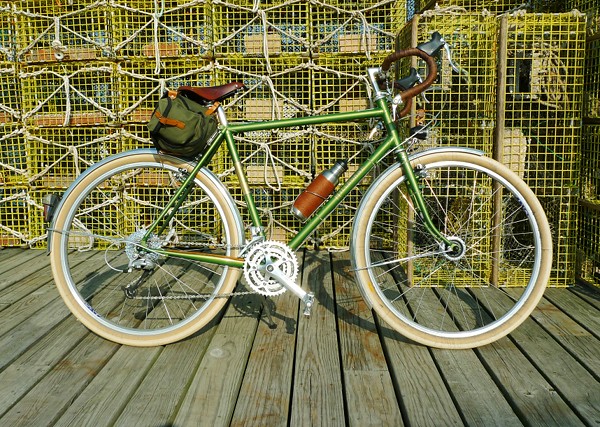
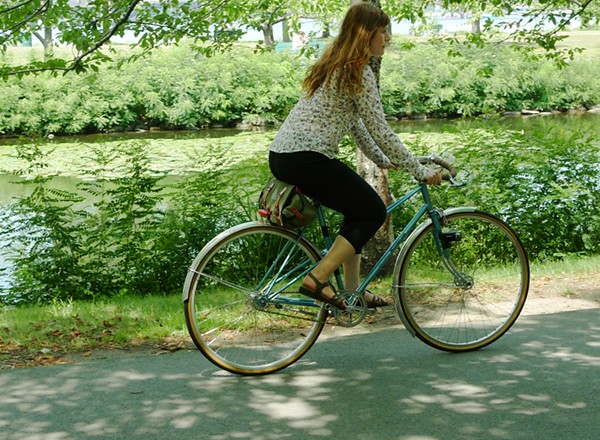
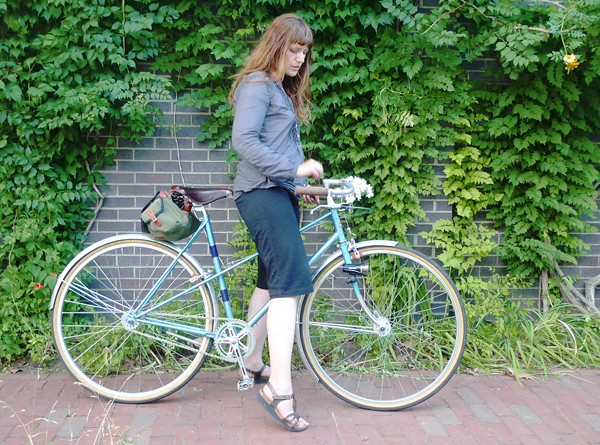
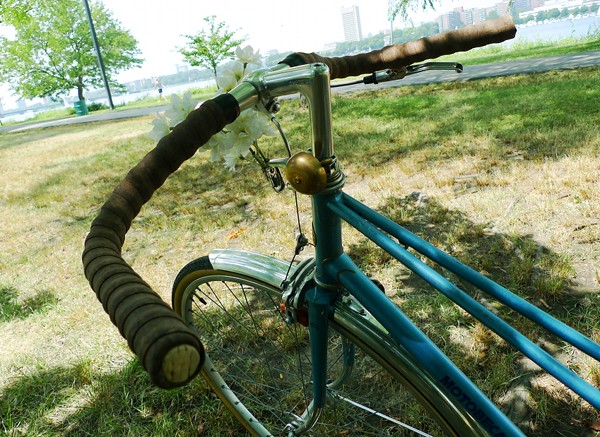
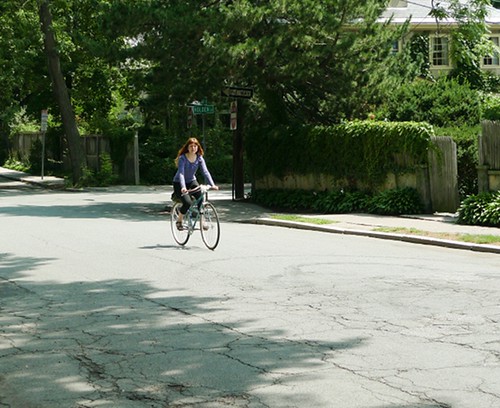
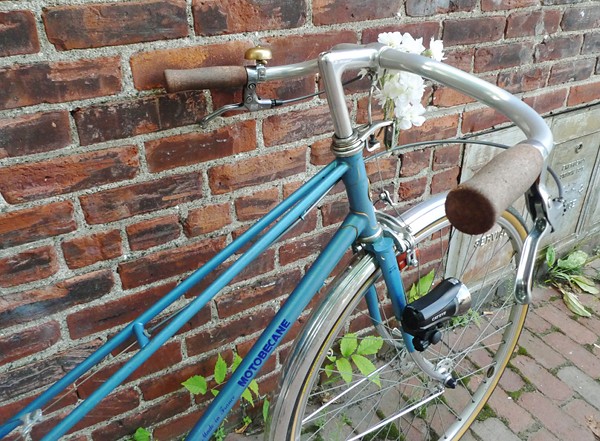
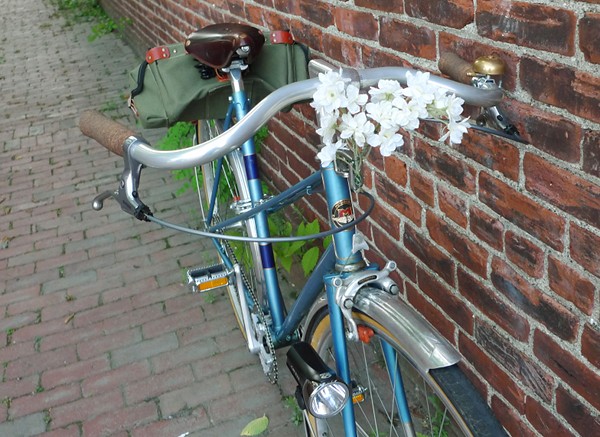
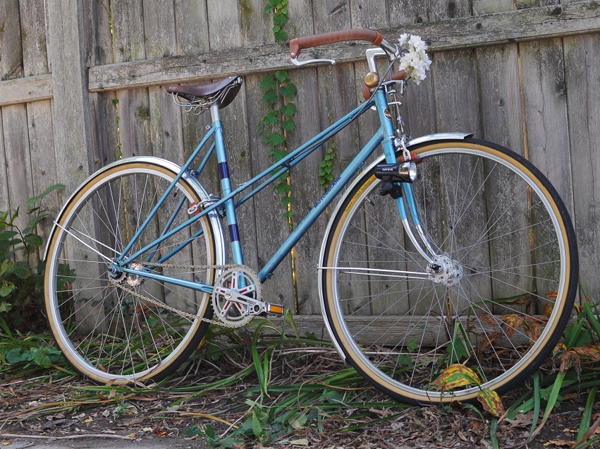
Spare bicycle parts, a restless spirit, and a willing "guinea pig" can make for a dangerous combination. In her latest reincarnation, Marianne sports VO Belleville handlebars and Dia Compe inverse brake levers - a practice run to determine how a similar set-up would feel on the Royal H. mixte.

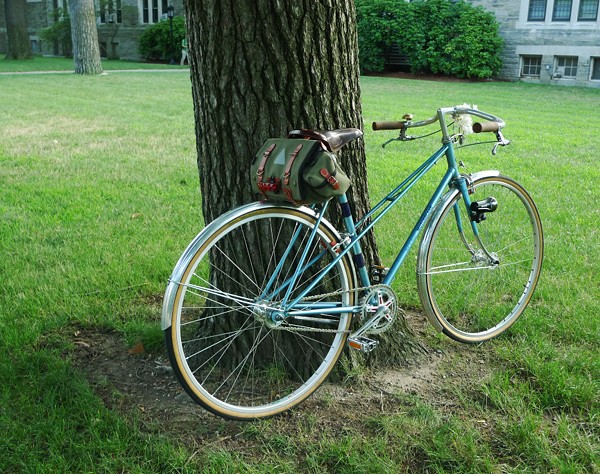
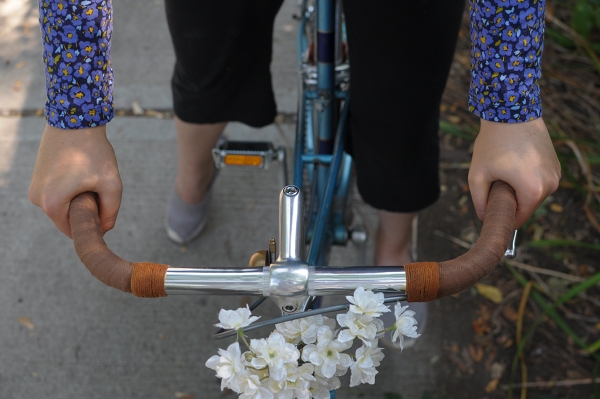
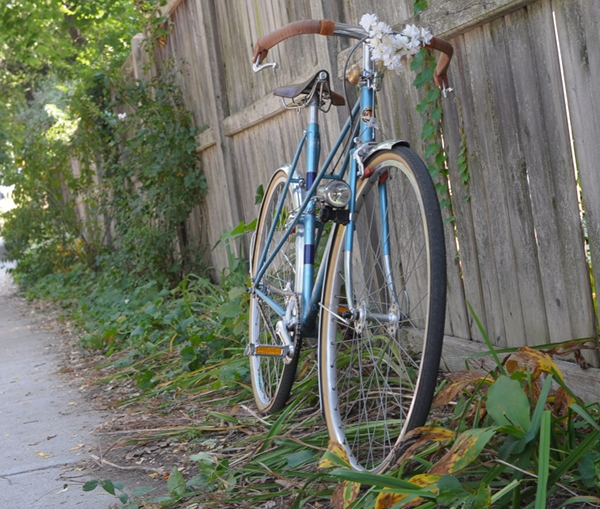
Here are the bars and levers in all of their French glory - on a Motobecane mixte with an Ideale saddle.

The Belleville handlebars are similar to the Porteur handlebars shown here. Both are a classic style of upright bars found on vintage French city bicycles. These bars are narrow, with long gripping areas that are nearly parallel to each other - placing the rider's hands in a position similar to holding a tray.  The Bellevilles are 5cm narrower than the Porteurs (43cm vs 48cm) and are completely straight across the front (whereas the Porteurs have a slight forward sweep).

It is typical to see handlebars like this fitted with inverse brake levers. My assumption is that this is done to maximise the gripping area of the bars. Because the levers are installed at the ends, there are no interruptions along the handlebar's surface and the cyclist is free to move their hands pretty much along the entire bar.

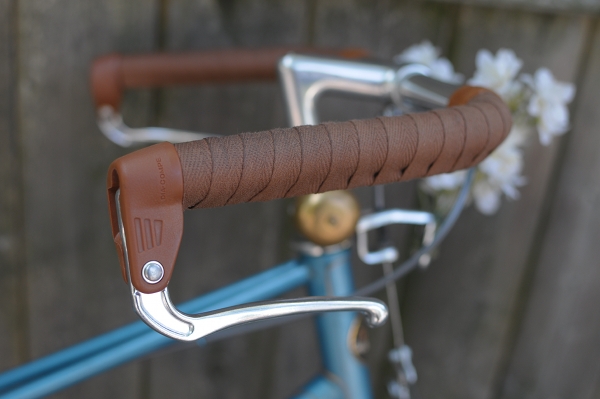
The inverse brake levers you will find today are most likely either Tektro or Dia Compe. Here I have installed the latter, and you can see that their brown rubbery tips go nicely with twined handlebars. It surprised me to learn that some dislike the Dia Compes because of the brown tips and prefer the Tektro levers instead - which are all-metal. To me, the rubbery surface felt nice, but I suppose it is a matter of personal preference. If you have used either of these levers, I'd like to hear your thoughts.

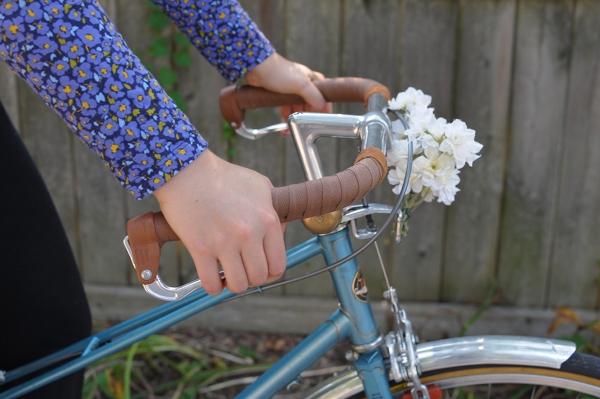
Braking with inverse levers.  I have found that I am able to get pretty good leverage almost no matter where I hold my hand along the bar, with the exception of the very front.

Can't brake from here, near the corners. But if I move my hands 1-2 inches back, it will work. This set-up is amazingly versatile in terms of the hand positions it allows.

The inverse levers are set back from the bars far enough so that they do not interfere with the grip. You can see in the pictures that they are nowhere near my knuckles. Truly a neat design.

If you are curious about this type of French set up, both the bars and the levers are surprisingly inexpensive. You will like them if you are a fan of narrow handlebars, and if you prefer to hold your hands to the sides rather than flared out or straight in front of you. I certainly fit that description, so both the Belleville and the Porteur handlebars feel as if they were made just for me. The super-wide Albatross bars were comfortable enough, but with the Bellevilles and the Porteurs I get that "spot on!" feeling. I also think that they are better match for French bicycles - especially for the Motobecane's aggressive handling.

I will pause and confess here, that this is the last change I will be making to Marianne... because she no longer belongs to me. Yes, I did sell her after all - to a lovely local woman whose acquaintance I had the pleasure of making this morning. Riding the Motobecane with the French handlebars and inverse levers yesterday, I finally felt that this bicycle was "perfect" and experienced a calm sense of satisfaction - not dissimilar to how I feel when a painting is finally "finished" or when a photograph looks just right. And after that, it finally felt appropriate to let her go. I hope the new owner enjoys her as much as I hope to enjoy my Royal H. mixte - which I will most definitely fit with a similar handlebar set-up.

Oh - and if anybody wants some Nitto Albatross bars (the alloy version) or VO Milan bars, drop me a line. Thankfully, I have no more "spare" bicycles to put them on.
Sunday, August 1, 2010

Cycling and Comfort: When Does It Hurt?

Small confession: For the past couple of days, I have been using my road bike for transportation. Not out of choice, but out of necessity - I can't spend more than 2 minutes on any of my upright or semi-upright bicycles right now without pain.

In my excitement about Marianne's conversion, I took her on her longest ride yet as a fixed gear - 28 miles. For the first 20 miles, everything was fine. The bike's geometry has never been the most comfortable, but as a fixed gear it felt better than ever and I was pedaling happily. But then, with just 8 miles to go, I suddenly became aware of a rapidly growing discomfort - not just in one area, but in several: in my shoulders, arms, back, pelvis, joints - pain seemed to be everywhere and it attacked me all at once. By the time I got home, I felt as if I had been run over by a train. I took some Ibuprofen and expected it would go away in the morning. But when I tried to ride my vintage Raleigh the next day, I felt the same pain immediately and barely managed to cycle to my destination a mere mile from home.

Mysteriously, I can still ride my roadbike with zero of the pain I experience on the upright bikes. Somehow being in the drop-bar position on the comfortable Rivendell does not activate any of the same discomfort. So, I am now in the ironic situation where I can go for 35 mile rides on a roadbike, but can't cycle for even a couple of miles on any of my city bicycles. Argh!

My working hypothesis of what happened is that while riding Marianne, my legs grew tired of the fixed gear pedaling, and without realising it I began to put more stress on my arms, hands, butt, and everything else. And because the mixte is semi-upright, this damaged some joints in a way that the pain only shows up in the upright position, but not in a leaned-over position. Does that make any sense as a possibility?

But this particular situation aside, I have been thinking a lot lately about comfort, and, more specifically, about when it is appropriate to declare that a bicycle is "comfortable".  Had I limited my rides on Marianne to 20 miles at a time or less, I would have thought she was perfectly comfortable. I could have ridden her this way for years, thinking that I had a comfortable bike - but I would have been wrong. And that is why it is so difficult to determine a bicycle's comfort based on the sort of test rides you take at the bike shop, or even short rides on your own. Bicycle A might feel better than Bicycle B after a short spin, but how will they compare after mile 20? mile 50? mile 100? You just do not know, until you actually ride the bicycle for that distance.

Sunday, July 25, 2010

50 Miles Without Coasting

I have ridden Marianne for about 50 miles now as a fixed gear, so I figure that I can offer my impressions without feeling that I am speaking too soon. I have taken her both on city rides in traffic and on trails (the Charles River Trail and the Minuteman Bikeway), both with the Co-Habitant and alone. And I think the fixed gear conversion was the best thing that could have happened to this bicycle.

Popular culture has created the unfortunate association between fixed gear and danger, brightly coloured track bikes, and "hipsters". But that is ridiculous. The only distinguishing feature of a fixed gear bike is that it does not coast.  You can turn your loop-frame or your beach cruiser into a fixed gear if you like, set the gearing low, and enjoy pedaling leisurely around town on it. It will be just like a single speed, only you can't coast. That's all.

I know that most people enjoy coasting, but I have never been crazy about it. On my regular bicycles I try to always be in a gear that will allow me to pedal. Coasting - especially at high speeds - makes me feel as if the bicycle is a wild horse galloping out of control and dragging me along, with me barely managing to hold on to the reins. This is especially frightening on winding downhills - so I try to switch into a high enough gear that will allow me to pedal, and then I feel that I have better steering control. I have no idea whether this is based on real physical principles, or whether it is all in my head. But the result is that I welcome the "no coasting" aspect of fixed gear bicycles, rather than think of it as a drawback.

For the same reason, in many ways I find fixed gear bicycles easier to ride, not more difficult. What else is easier about them? Well, remaining stable at very slow speeds - which is a useful skill in the city. You can only coast for so long before your bicycle stops, but if you push on the pedals again, your speed will increase too much. On a fixed gear, you can pedal in slow motion, and the bicycle will remain perfectly stable while going at the exact speed you want, no matter how slow. This is especially useful when you are trying to go around pedestrians, or inch your way forward to the red light at busy intersections. If you have a poor sense of balance and coordination like I do, you may find fixed gear to be helpful in situations that would otherwise leave you flustered.

As I have mentioned earlier, Marianne was a particularly good choice for a fixed gear bike, because her over-responsiveness is now an asset. As before, she turns super-quickly and easily - but now, she does it only when I want her to and the responsiveness no longer feels like "twitchiness" or "squirreliness". It feels like I now have an extremely maneuverable bike, of which I am in full control - as opposed to a bike that was more maneuverable than I could handle.

The thing that took the most getting used to, was trusting the brakes enough to speed up. I kept having to remind myself, that this is not the track bike I rode in Austria; this bike has brakes and I can come to a complete stop any time, just like on a  regular bike! After the first couple of rides though, this finally sunk in and I've stopped worrying about braking.

After a couple of days, we re-did the bars by wrapping the entire surface in cork tape, to allow multiple hand positions. We also removed the rear brake (it really was unnecessary) and placed the front brake lever on the right handlebar for easier access. The bell is now mounted on the stem.

My gearing on this bicycle is 42-tooth in the front and 19-tooth in the rear (with 170mm cranks and 27" wheels).  That is a pretty non-aggressive gearing that is good for everyday cycling in hilly areas. I may get a smaller rear cog eventually (which will allow me to go faster, but will make things more difficult on hills), but I don't feel the need for that yet.

There has been some discussion about foot retention and whether I plan to get clips for the pedals. On a fixed gear bike, there is the danger of the feet slipping off the pedals, and the pedals then smacking you in the ankles. This can happen when going over bumps at high speeds, or when flying downhill. I do recognise the risk, but let me put it this way: Given that I have brakes and I don't go very fast on this bike, I think there is more chance of my falling as a result of using clips, than there is of my getting smacked with pedals. I may try Powergrips at some point, but I've seen them in a local bikeshop and even they look scary. I did not do well with half-clips. Are Powergrips easier?

I am sure the novelty of the new Marianne will eventually wear off, but for now I can't seem to stop riding her. After a seat post adjustment (more on this later), the bicycle now feels fairly comfortable on rides under 20 miles. Taking it on a very long ride last night was overkill though, and various parts of my body are now hurting. I think I will stick with the Sam Hillborne for those, and leave Marianne for the city.

Friday, July 23, 2010

Marianne's Conversion

Poor, faithful Marianne. She has led so many lives, and has suffered through her reiterations with remarkable stoicism. Nothing she did for me was good enough. I railed against her when she was a road bike with drop bars. And though things improved with upside-down Albatross bars, the poor creature continued to be verbally abused for being "uncomfortable," "unstable" and "twitchy". Faced with the prospect of redundancy, Marianne shed bitter tears and begged me to take drastic measures: "Make me a fixed gear!" she cried, "I would rather go under the knife than be sold and make yet another owner miserable with my ridiculously steep geometry. Who could say no to a beauty in tears?

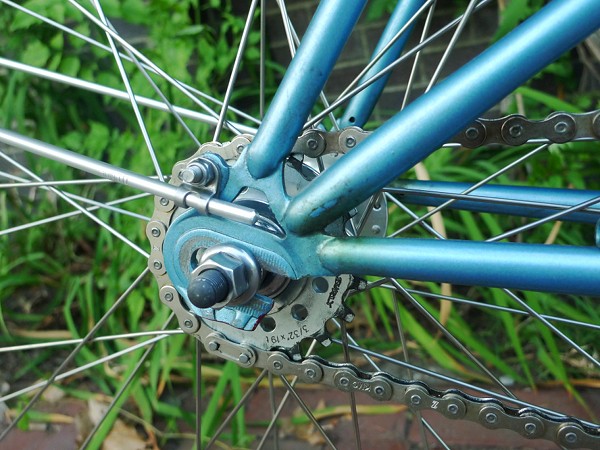
I will not bore you with too many technical details of the fixed gear conversion, except to say that with the right bike it is not difficult for the mechanically inclined. Marianne was the right bike, because she had the horizontal(ish) dropouts necessary for the conversion and not too many braze-ons.

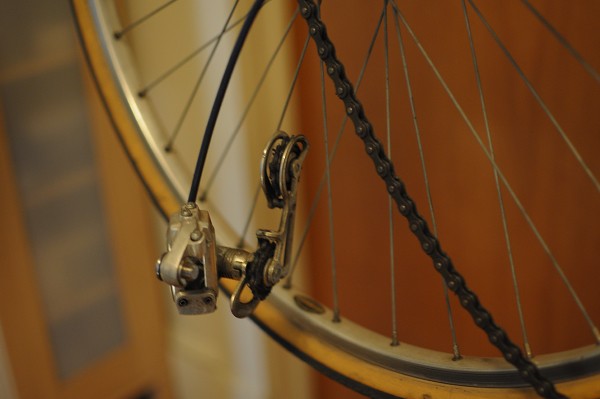
To convert this type of bicycle to fixed gear, you need to remove the rear and front derailleurs, the shifters, and all the wiring between them, and replace the rear wheel with a fixed gear wheel. In theory, you could also rebuild the original wheel with a fixed gear hub, but this is not recommended for old wheels - Given that a complete fixed gear wheel can be had for as little as $60, it is not worth the risk. You will also need a new chain, a fixed rear cog and a lock ring.

The cats were skeptical about the process, but it took the Co-Habitant just a couple of hours to turn Marianne into a ridable fixed gear.

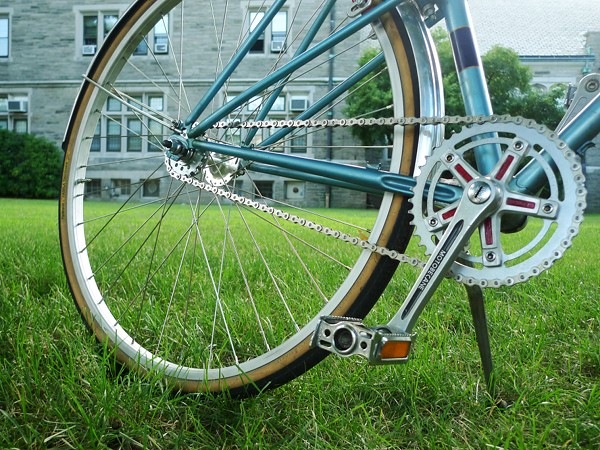
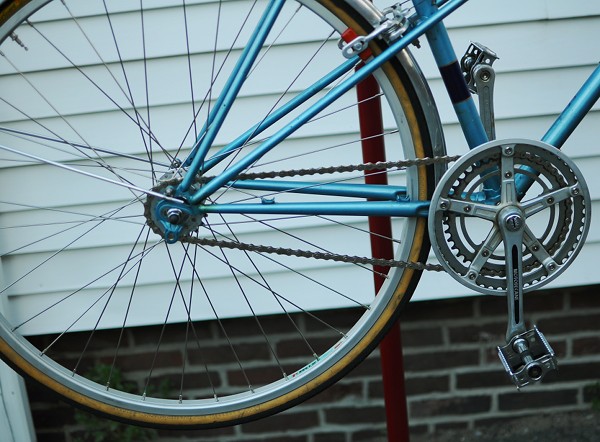
But while the bike was ridable, the aesthetics of the result were not spectacular. As you can see here, the Motobecane crankset was the kind that had both the inner and outer chainrings attached to the spider and included an integrated chainguard. There was no way to remove all that stuff and just leave one chainring and the cranks. But we did not want to get a new crankset (and the new bottom bracket that would have to go with it) - both for financial reasons, and because I really like having the original Motobecane cranks. So we decided to modify the existing set-up.

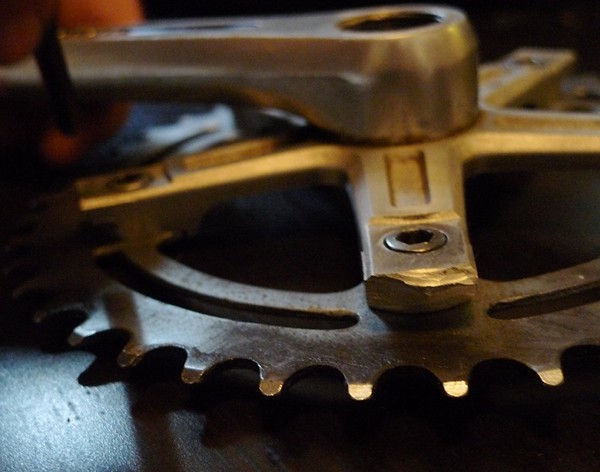
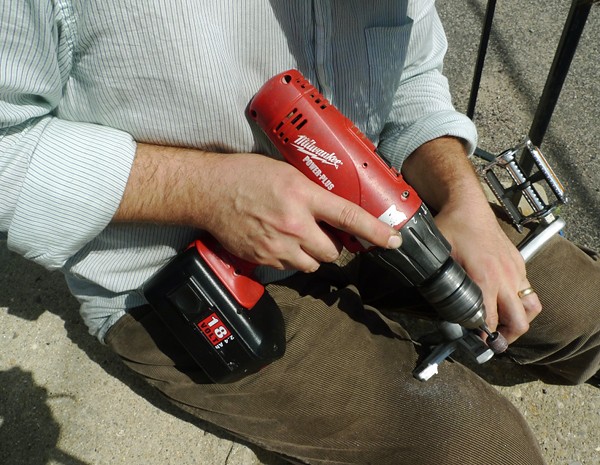
We first removed the large chainring and cut off the spider arms starting after the small chain ring. This required the Co-Habitant to spend some quality time with somervillain's dremmel.

He then polished the edges of the remaining spider arms.

All this took longer than the initial conversion, but the result was worth it.

I painted the inlays of the cranks with red nail polish.

Marianne emerged from the operating room more beautiful than ever. She even lost weight.

No more stem shifters!

I know this might invite criticism, but we did cut off the derailleur hanger from the rear dropouts and are thinking of popping off the little braze-ons for the shifter cables. I think this bicycle is better off as a fixed gear/ single speed (it has a flip-flop hub for the option of being turned into a freewheel) and will stay this way. Even if I should sell it down the line, I would rather sell it to a girl who can ride a bike like this, than to a girl who is hoping for a cute cruiser-type mixte and will be disappointed by this bike's handling. Also, this is a mass produced and very common frame that is not some fantastic piece of French bicycle history. I would not do this to a valuable or historically significant bike.

I've ridden the bike already, and I love it. I haven't the energy to discuss the riding experience in this post, so will save that for next time.  Doing the fixed gear conversion on our own was an educational experience, and the DIY crankset turned out beautifully.  Of course, all this was mainly the Co-Habitant's handiwork; I was the helper. He does not like fixed gear bikes, but did this for me anyway - which was kind of him. But maybe he will come around want a matching bike as well some day... Though personally I see him on one of these!

Monday, July 19, 2010

Rediscovering Familiar Places... and the Hills You Never Knew Were There

Yesterday was a special occasion for us, and we wanted to do something special to celebrate. We decided to visit an area of Seacoast New Hampshire and Southern Maine where we used to live a few years back - but for the first time, get around entirely on our bicycles.

We began by driving to Portsmouth, NH - which is only an hour North of Boston. We parked in a municipal lot, unfastened the bicycles, and set off. Portsmouth itself is a fantastic town and is very easy to cycle in, but our destination was Maine - which is accessible via a very cool truss lift bridge.
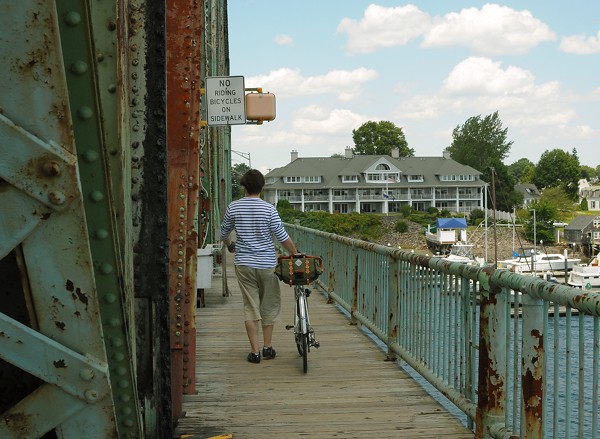
We had to wait for some ships to pass underneath, but they soon lowered the bridge and we walked our bicycles across.
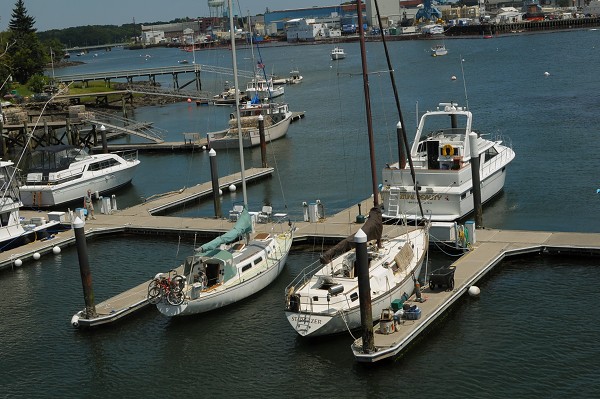
The views from this bridge are amazing, and we even spotted a boat with some bicycles strapped to it.

The Co-Habitant's Myles.

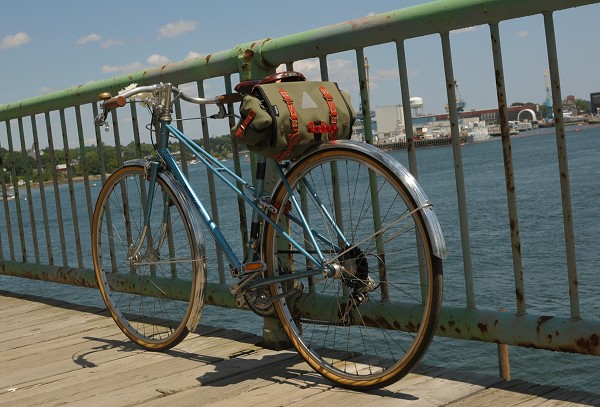
And my Marianne, enjoying the view. I took the vintage mixte, because I wanted to be more upright than on my roadbike - so as to have a better view of the scenery and to carry a camera across my back. All of that I did, but at the expense of both comfort and speed: Despite her beauty, this bicycle is just not as pleasant to ride as the Rivendell Sam Hillborne, and without drop bars it is also not as fast. In fact, now that I am finally building up my custom new mixte, we have plans for Marianne that will rescue her from redundancy - but I will save that for later.
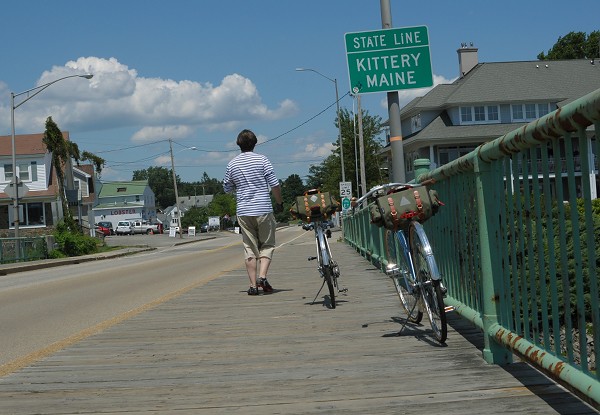
And here we are, in Kittery Maine. This was the first time we crossed a state line on bicycle.
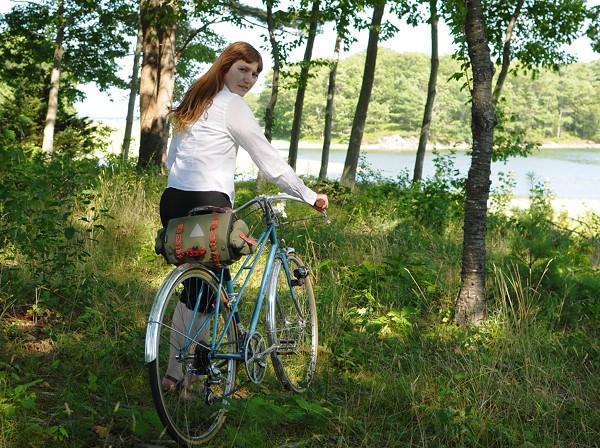
I like to think that I know coastal Southern Maine like the back of my hand. And if you were to ask me, "Is it hilly?", a few days ago I would have answered "not at all" - and I would have been so wrong! It is amazing how we are just not as aware of topography in a car as we are on a bicycle.
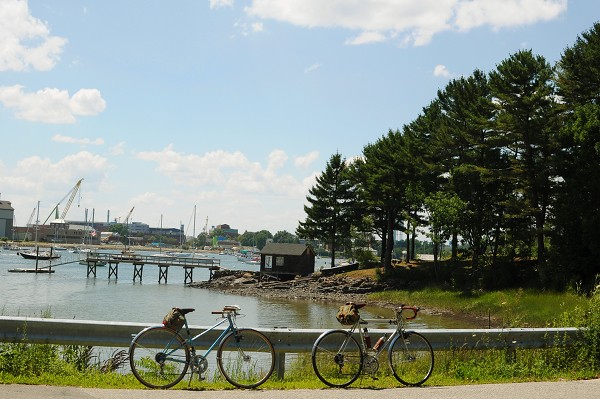
We have a favourite road in this area that is an off-shoot of Route 1A and offers spectacular views of the coastline, and I simply do not remember this road having hills. But on my 12-speed Motobecane mixte, I was soon switching gears all over the place as I tried to keep up with the frequent and considerable changes in elevation.
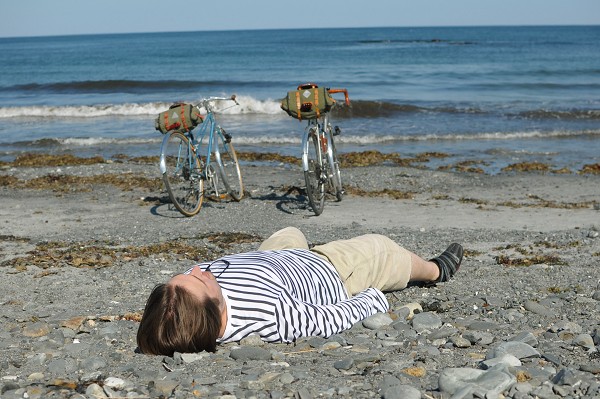
Still, it was so worth it and our trip was spectacular; I would most definitely recommend Southern Maine for touring. The traffic on the roads was much lighter than we expected, and cycling was considerably more peaceful than in the countryside around Boston. There are many non-touristy spots in the Kittery, York, and Ogunquit areas where the beaches are pristine, the restaurants are inexpensive, and the landscape is not cluttered with "motel sprawl".

Steamers, caught on the property of the restaurant that serves them. When it comes to seafood in Maine, there is so much choice that you really need to know where to go, so it helps having once been a local. Our favourite place was right along our route, and we happily stopped by after all those lovely hills.
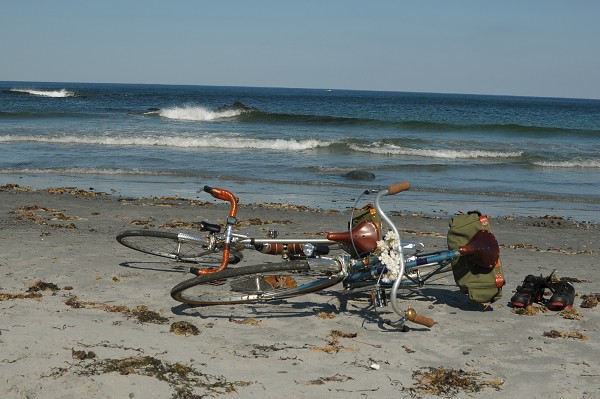
All in all, this was probably the nicest cycling trip we have taken so far. Next time we will figure out how to plan it so that we can keep going further North before turning back - maybe stay in a motel somewhere overnight. One of our favourite places on Earth has become even "favouriter", once traveled by bicycle.