Monday, December 20, 2010

The Drop Frame Bicycle - The 'Queen of Safeties' Returns

[image via Atomic Antiques]

Browsing through my favourite vintage bicycle posters, I've always noticed something unusual about the ones of the Boston-based Overman Wheel Co.: The lady's bicycle appeared to have only a single curved tube - rather than a down tube and a top tube, like the vintage loop frames we are accustomed to seeing. Could this be artistic license for the sake of making the graphics simpler, or did bicycles like this really exist? Several times I had tried to investigate, until finally I found what I was looking for:

[image via the Smithsonian Institution]

The Overman Wheel Co. "Victoria" - a "drop frame woman's safety bicycle," according to the Smithsonian. It had 28" wheels, rod-like brakes, what appears to be some sort of suspension contraption on the fork, an enormous saddle, high handlebars, and a chainguard. Finally, confirmation that the bicycle hinted at in the posters was a real model. And for a machine that was manufactured in 1889, the Victoria looks awfully familiar...


And you thought this design was funky and new, eh? Bicycles in this style have been popping up in Europe with increasing frequency over the past 5 years, and have recently made their way to the US as well: A single, oversized curved tube connecting the head tube and the seat tube - sometimes with reinforcements and sometimes without, combined with a suspension fork, suspension seat post, plush saddle and high handlebars.

[image via Tom Coghlan]

The reasoning behind the single curved tube design, is that it allows for extra low step-over height, making the bicycle especially accessible for those who wear long, loose clothing, as well as for those who have balancing problems when mounting even the standard step-through frames. And the funny thing is, that while everyone agrees that the low step-over is beneficial, many also complain about how "ugly and modern" it is. I wonder how many are aware that the "drop frame" design is in fact 120 years old!

[image via The Daily Postcard]

As I've mentioned here earlier, I think that any design that makes the bicycle more accessible to those who would otherwise be intimidated by it, is a good design. With its super-low step-over, the drop frame is inviting and safe-looking - no wonder the original was described as "the queen of safeties". Having ridden a few modern versions of these bikes in Austria a couple of years ago, I found them easy to deal with. But I wish there was a way to make them look and feel a little nicer. The suspension fork on the modern bikes is probably there because the aluminum frame makes them painful to ride over bumps. But the suspension has the side-effect of creating a "bouncy" feeling that  does not give the cyclist optimal control of the bicycle. I wonder how the original Overman bicycles were made: Were the frames lugged? Was the ride comfortable? I suppose we will never truly know how these compared to today's bikes. 

I think the modern reincarnation of the drop frame is a great idea in principle, if only it could be made more elegant. What do you think of the vintage and modern versions? - could you benefit from the low step-over, or do you find the regular step-through designs sufficient?

Sunday, December 19, 2010

D2R Boogie: a Miniature Non-Folder

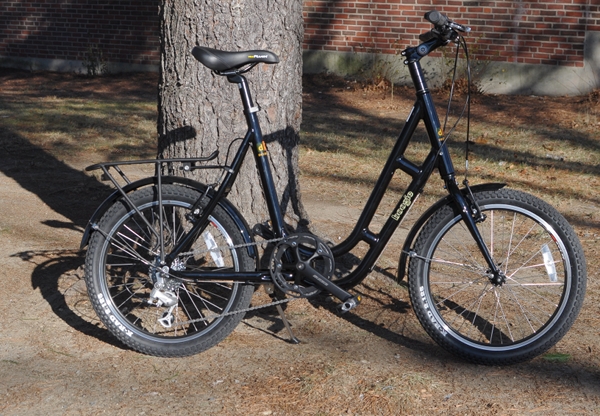
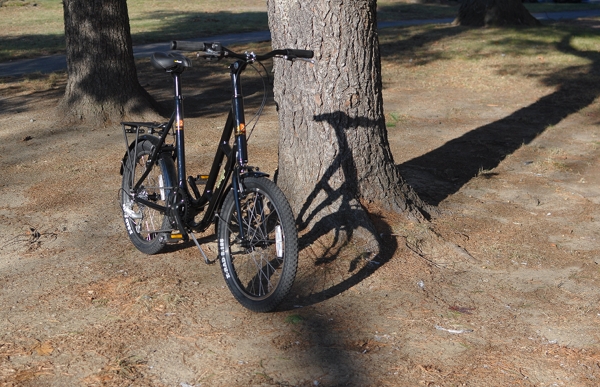
When I saw this bicycle at Harris Cyclery, it immediately caught my eye - in a "what on earth is that?..." kind of way. It appeared to be a miniature "swan frame" bike with extremely modern components, small wheels and fat tires. And for some reason, it was calling out for me to ride it. The bicycle is not yet for sale, but was apparently a sample the dealer left behind. I believe it will be available in April 2011. This creation is called "Boogie" and it is made by the company Decide 2 Ride (D2R), which has hitherto been specialising in panniers and other bicycle accessories.

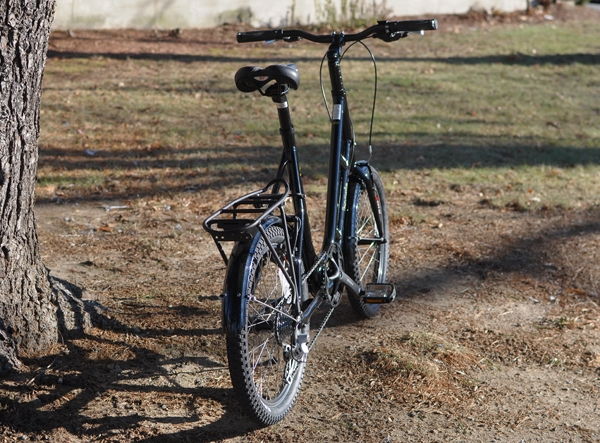
What I initially found appealing about the Boogie, was the overall elegance of its design. Despite the eye-catching swan-frame, it is an un-appologetically modern bike - with techie components, industrial-style accessories, a unicrown fork, and visible welding marks on the frame's joints. But?.. I have to say, they did a good job incorporating it all into the overall design, so that these elements actually look like they "belong" on this particular bike. Everything is in harmony; everything fits together just right. The bike does not try to look "faux vintage" - and that works in its favour. It comes across as being unique and intentional. The only other modern bicycle design I have seen thus far that achieves the same equilibrium is the KHS Green, which I also like very much. And to me, this just confirms that even if you give a good designer a small budget, and limit them to modern production techniques and components, they can still come up with something that looks visually pleasing - not only in carefully lit catalog photos, but in person, up close.

The Boogie is a miniature, small wheeled non-folder. The reasoning behind creating it, was the premise that the majority of those who buy folding bikes don't actually fold and unfold them. Rather, they choose the bikes for their small unfolded size and light weight - factors especially relevant for city dwellers who must maneuver their bike through cramped spaces and drag it up staircases. In my experience, this is true of most women (but not men) I know who own folding bikes, and I suspect the Boogie will be more appealing to women than to men.

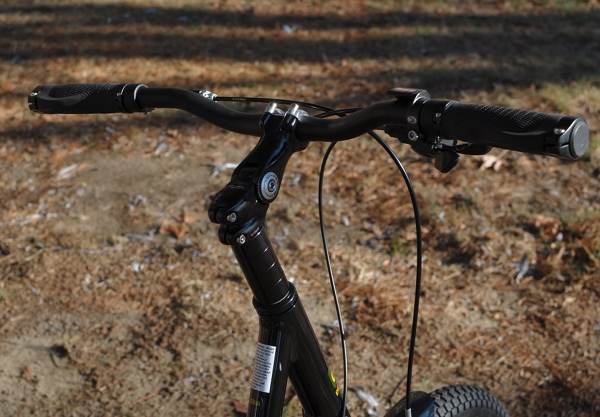
The lightweight frame of the Boogie is aluminum (I had previously received conflicting information about the frame material, but this has now been confirmed by the manufacturer). The fork is cro-moly steel either way. The bicycle is adjustable for a wide range of heights, and it comes in two sizes: for those 6 ft and below, and for those over 6 ft. The bike pictured here is the smaller size. Both saddle and handlebar height can be adjusted to fit riders of different proportions.

The wheels on the Boogie are 20", fitted with 2.125" wide tires. The model I tried comes with full fenders and a large rear rack as standard features, as well as with derailleur gearing - though single-speed and 8-speed hub versions are also available.

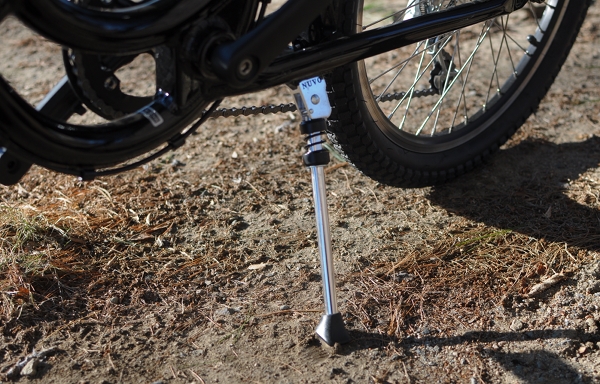
Kickstand is also standard - and it was a very sturdy one as far as kickstands go.

Of all the features on the Boogie, there are only two I don't like and would change if it were my bike: The padded synthetic saddle would have to go, and I would replace the handlebars with an inexpensive swept-back "North Roads" style version - simply because I can't comfortably use straight handlebars. Those who are more tolerant of stright bars may not care. Either way, the handlebar change can probably be made for $20 or so, so not a big deal. I would definitely keep all the components black, as to me that is part of the bike's charm.

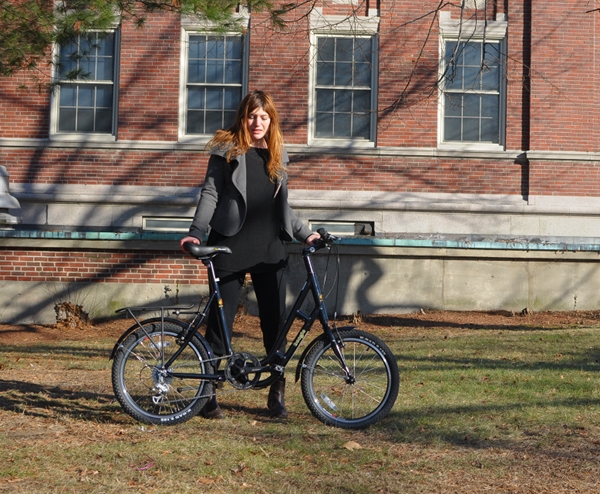
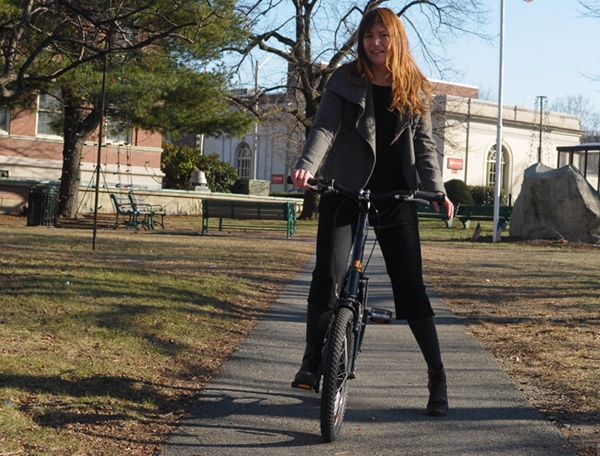
This is what the bicycle looks like next to my 5'7" frame. As you can see, the step-over area is very low - just above ankle-height, which make it easy to mount and dismount even if wearing a long skirt.

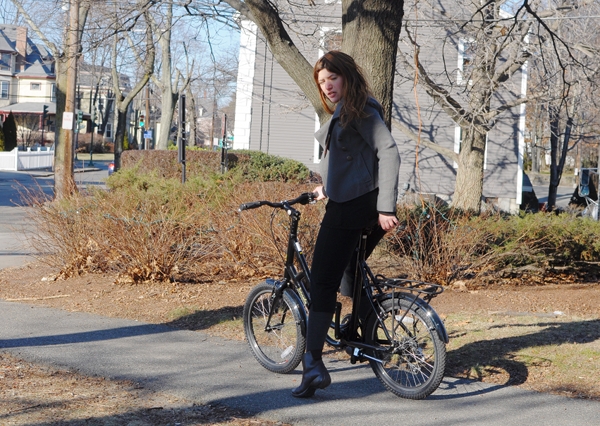
I was not sure how a bicycle like this would handle, but it felt comfortable from the get-go: Easy to get started, stable, intuitive, maneuverable.

I test rode the Boogie briefly on the roads in traffic (actual test ride not pictured), trying to determine how the small wheels and fat tires would feel over pot-holes, and also whether the bicycle would accelerate well. All was good in these respects. This is not an aggressive bicycle; it is a comfortable one. But it certainly provides enough power to be used as urban transportation. Switching gears was easy using the thumb-shifters mounted onto the handlebars. The brakes were powerful. One confession I have to make, is that I felt more comfortable with this bicycle than I did with the Brompton I test-rode earlier. I am not sure why, so cannot really elaborate. Perhaps I need to ride the Brompton again to get a better idea. And of course, the quality and the functionality of the bicycles are different: The Brompton is undoubtedly better made and it is a folder, while the Boogie is in a lower budget category and does not have the folding capacity - so in comparing how I felt on them, I am speaking solely of the test-ride experience.

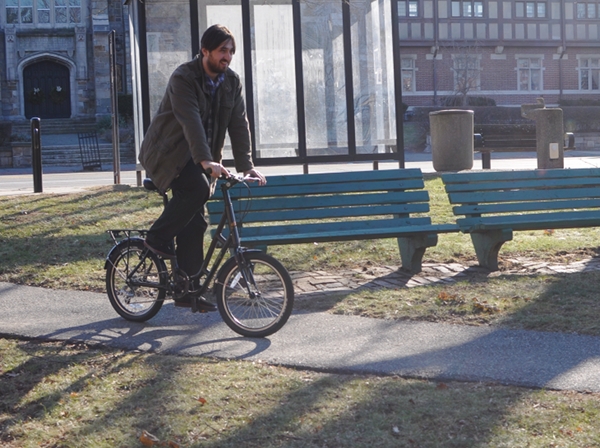
The Co-Habitant tried the Boogie as well, and found it to be "fun" - though he is baffled as to why I like it so much. He thought it was a cool bike, but not that big of a deal. So - to each their own.

The version of the Boogie I tried (derailleur, fenders, rack) is supposed to retail at around $750. I believe that the single speed version will be in the $400s and the 8-speed hub version in the $900s. Given those price points, I would probably go for either the single speed or the derailleur version - though ideally I would have liked a simple 3-speed hub. Lighting is not included, so that would be an additional expense. Although the Boogie will be available in other colours (white and sage), I think that black is the only colour that really works on this bicycle: Judging by the online pictures, the welding marks look much more prominent on the lighter-coloured bikes, detracting considerably from the elegance of the design I praised here. The striking harmony between the frame colour, component colour and accessory colour is also possible only with the black version.

If you are looking for a simple city bicycle on a budget, this is one of the few in the lower-priced category I actually like. The compact proportions are not for everyone, but I find the overall design and ride quality appealing.

Friday, December 17, 2010

Second Chances for Custom Bikes?

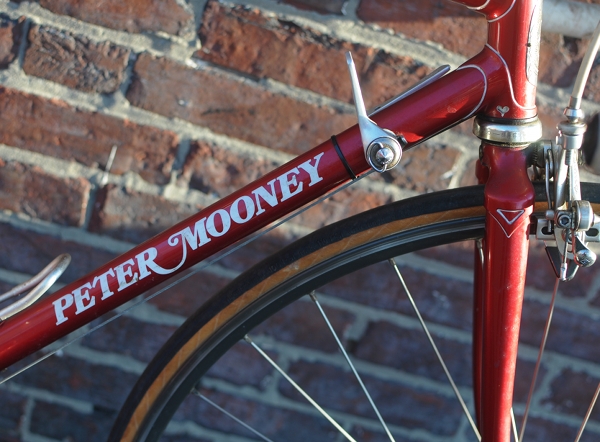
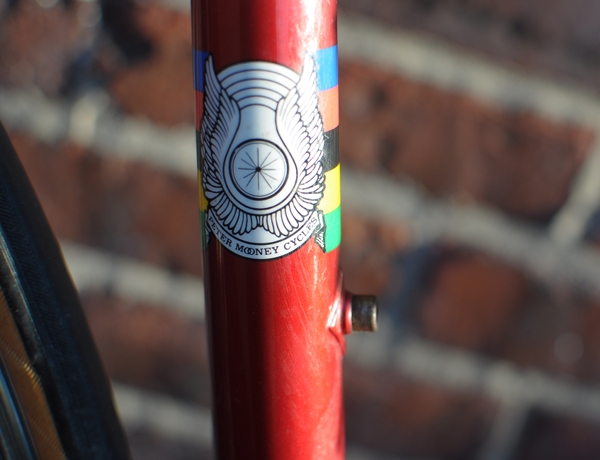
As a (somewhat) reasonable person, I recognise that sometimes a deal is just not for me, no matter how good it is. But I can still feel disappointed, can't I?  Peter Mooney is a famed local framebuilder who has been making custom bicycles since the 1970s, including his own lugwork. I love his frames and very much hope to have one of my own some day. And for a brief, dazzling moment, it seemed that such a day might come much, much sooner than I expected.

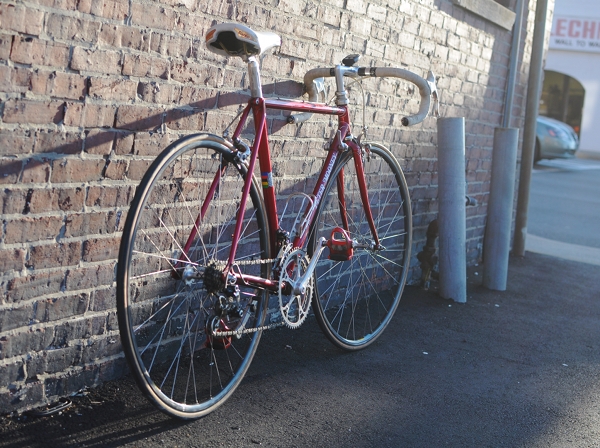
As usual, these things have a way of finding me when I am not looking, and in this case the "thing" was a second hand Peter Mooney bicycle. As soon as I learned of the bike's existence and availability, I was ready to bargain and prepared to sell or trade my other vintage roadbikes in order to get it. Going by the description, it seemed that the frame was my size - so it was only a matter of seeing it in person and test riding it.

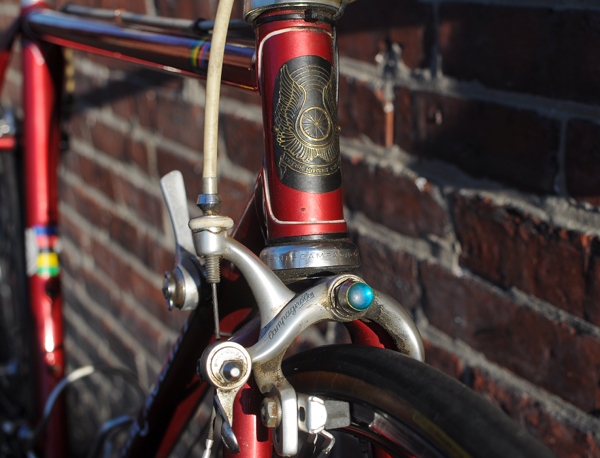
But the stars were not aligned in my favour. Although the bicycle does not look all that small in the pictures (compare it to my Moser), it felt very small once I tried to ride it. The size is 50cm (center of the bottom bracket to toptube), which is only 2cm smaller than the size I normally ride - so maybe there was something additional in the proportions that didn't feel right to me. Not sure what it could be, because the top tube actually seems long-ish, and the stem is long as well. Does anything unusual jump out at you, looking at this frame? 

And I guess that is just the thing with a custom-built frame: It was custom-built for someone else, which is bound to make second-hand purchases tricky. And the fact that it was built for someone else (judging by the components, most likely in the mid-1980s?) also makes me wonder what is the story of this bicycle - why did the previous owner give it up? 

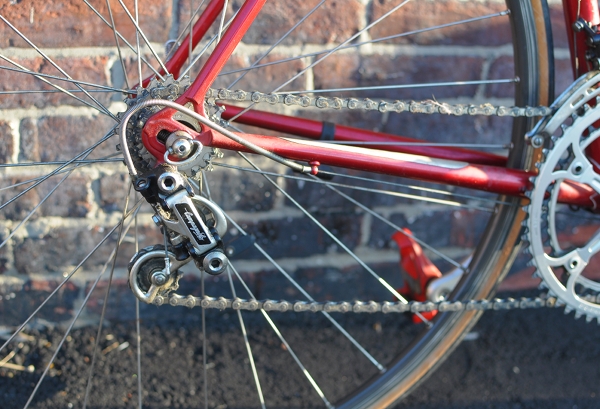
The bicycle certainly has nice components - Campagnolo everything. And though it was clearly ridden, it looks to have been well maintained.

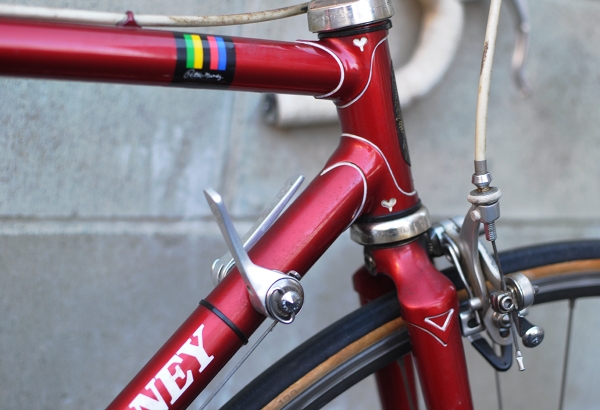
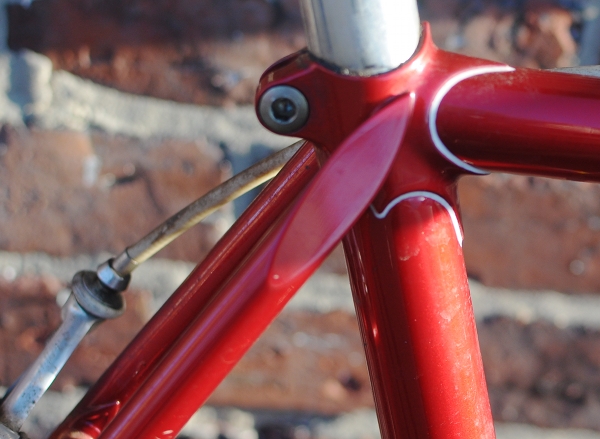
The elegant seat cluster with the white outlining is my favourite part of the lugwork. I hope the original owner appreciated it as well. 

Who knows, maybe some years from now I will have a Peter Mooney bicycle of my own - in my size, in my favourite colour, and maybe even with custom lugwork (let's just say that I already have sketches for the lugwork!). But with this particular bike, I am glad that I was able to resist. It's a bad idea to get a bicycle that doesn't fit you, no matter how good of a deal it is. 

If you are between 5'3" and 5'6" and are interested in this bicycle - it is in the custody of Vin at Old Roads, whose contact information you can find here. For the right person, it is a rare chance to own a bicycle by one of the great framebuilders. But what are your thoughts on getting a custom bike second-hand? I imagine that the more unique the original owner's anatomy, the more difficult it would be to find a new home. I wonder how many custom bikes get second chances, and what are the circumstances under which they switch owners.

The Vintage Bike Shop: a Visit to 'Old Roads' in Cambridge, MA

Used and vintage bicycle shops can be great resources on a number of levels. For the beginner cyclist, they can provide clean, tuned-up alternatives to the treacherous waters of Craigslist and ebay. For the DIY tinkerer, they can be a source for older parts and accessories. And for the seasoned collector, they can, on occasion, offer up a gem of a bicycle that one would not normally come across elsewhere. A vintage bike shop is certainly worth a visit, if one exists in your area. In Boston, we are lucky to have Old Roads - located in the Cambridge Antiques Market, just a 15 minute bike ride from my home.

Presuming that most of the bicycles offered are found locally, vintage bike shops are in a sense like museums of history: They give you an idea of what kind of bikes were popular in your area over decades past. It amazes me that no matter how many of these bikes are sold (and I've personally played matchmaker in several deals), Boston does not seem to run out of its stock of early full-chaincase Raleighs. Just imagine how many of these things must have been on the streets in the '30s-70s. The model above is an original early 1930s version.

(Cuppa tea?)

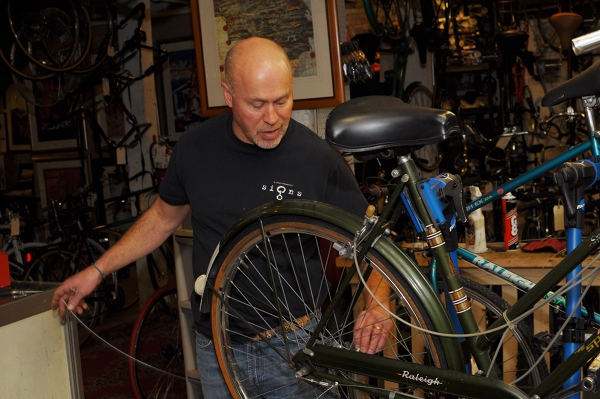
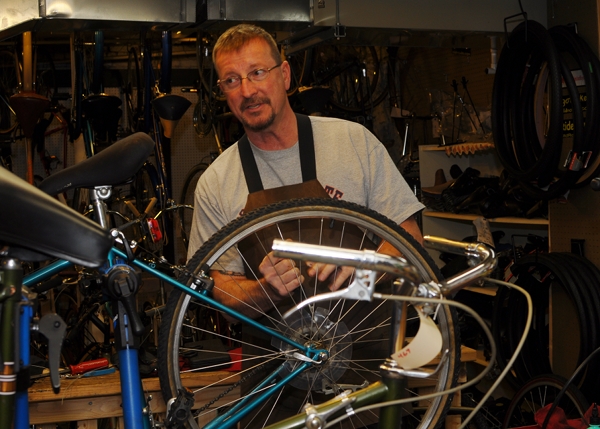
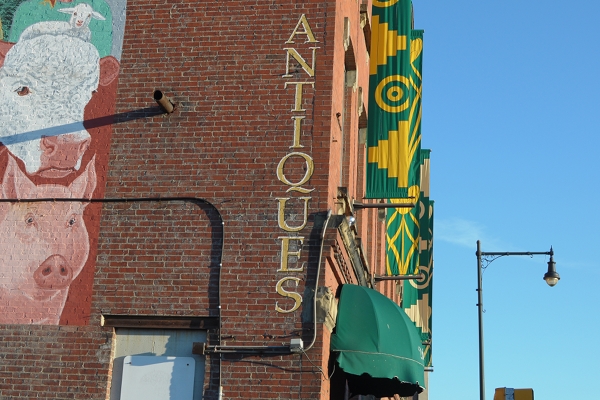
Situated in the dungeon-like basement of the Antiques Market (formerly a coffin factory!), "Old Roads" is really a joint project between two shops: Menotomy Vintage Bicycles, owned by Vinny,

and Cambridge Used Bicycles, owned by Ed. They began selling bikes out of this space in 2008, and have since become a staple of the vintage bicycle scene in the Boston area.

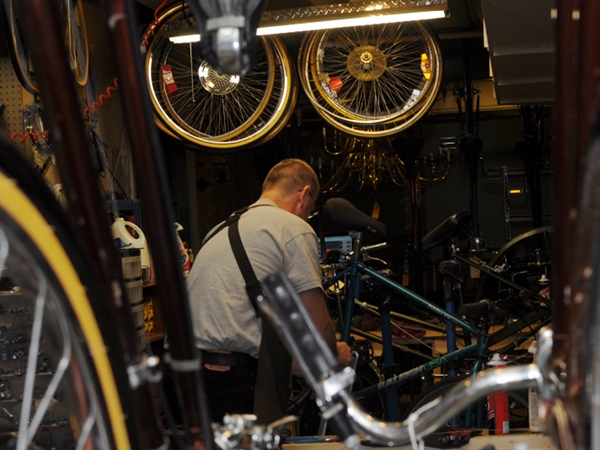
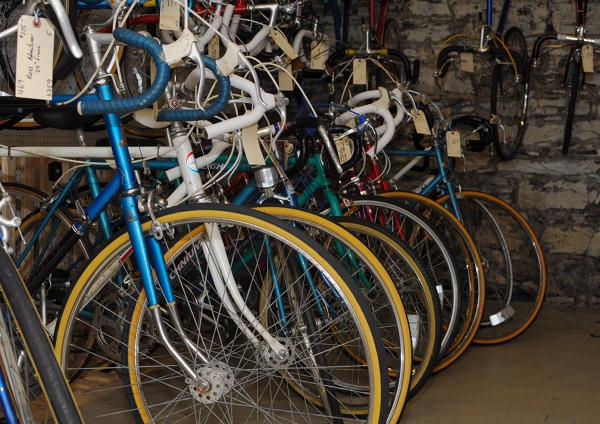
The full extend of their inventory is impossible to capture, due to the sprawling, cavernous nature of the space - which makes being there in person all the more exciting. There are rows and rows of vintage bicycles - on the floor, on the walls, on the ceiling, everywhere you look really.

Though initially, the focus of the shop was meant to be on antique bicycles, it soon became apparent that the local population was mostly interested in reliable 3-speeds and 10-speeds from the 1960s through the early 1980s, to be used as transportation. And so, increasingly, the inventory began to accommodate this. Now the shop offers a stagerring variety of bicycles, in one of five categories: vintage 3-speeds, vintage roadbikes, early vintage cruisers, antique bikes (pre-WWII), and some used newer bikes from the 1990s onward - including a couple of hand-painted "fixies".

For me, the 3-speeds are the biggest attraction. There are dozens of them, both men's and ladies'. Though Raleigh and Schwinn are the names you will see most frequently, more unusual offerings are often found as well.

Phillips, England

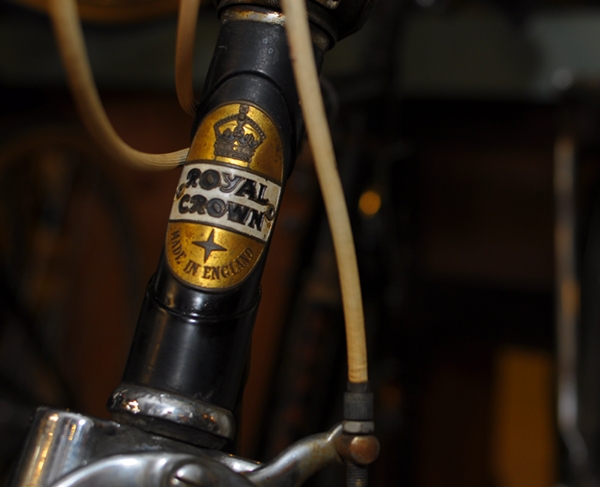
Royal Crown, England

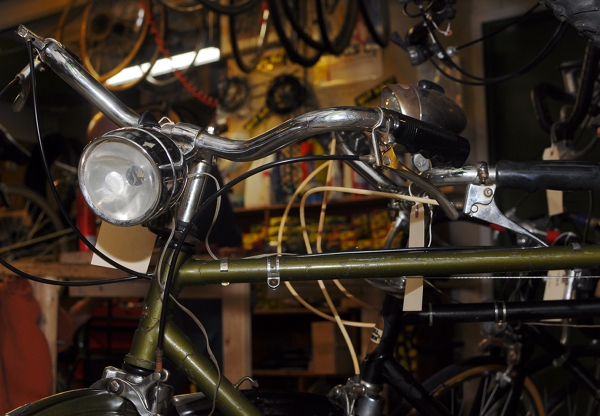
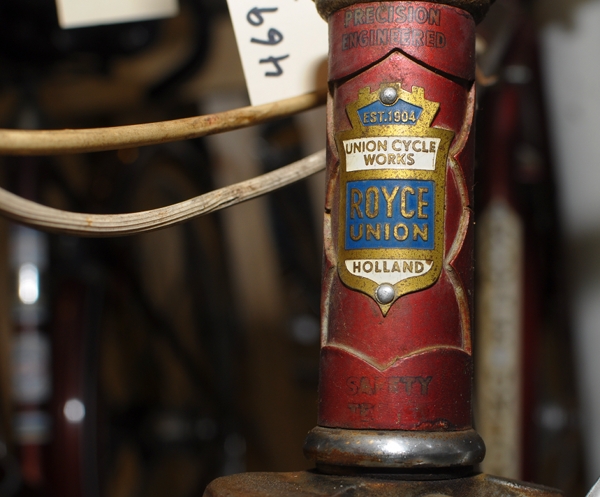
Royce Union, Holland. And there are many others. With chaincases and without, English and Dutch, step through and diamond frame, some even with the original dynamo lighting.

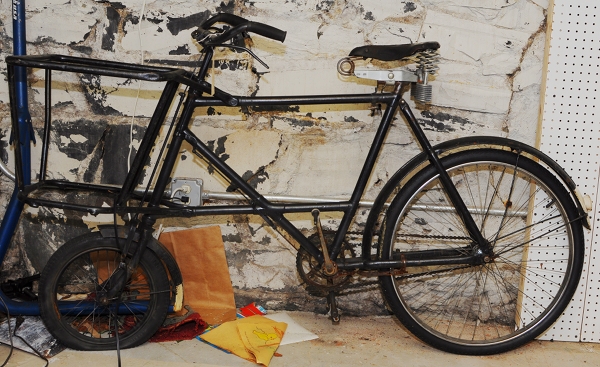
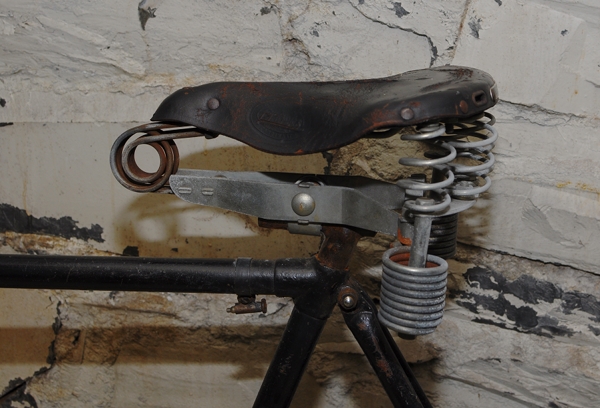
And of course the antique offerings never fail to impress. The above is a Butcher's bike, most likely from the 1920s. 

I am guessing this butcher was a heavy guy!

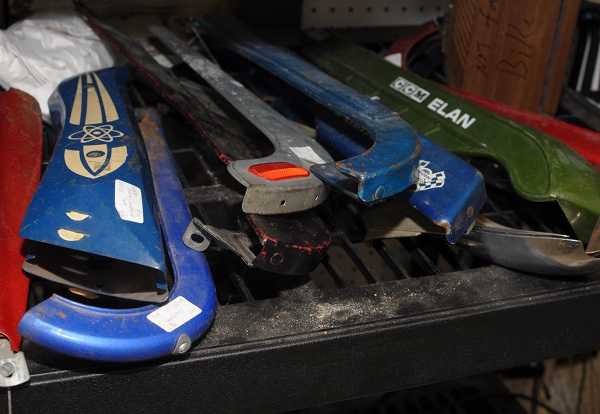
There is also a slew of accessories in stock, including chainguards, handlebars, saddles, tires and racks.

Even vintage bottle generators are available, for those who find the modern ones too high tech.

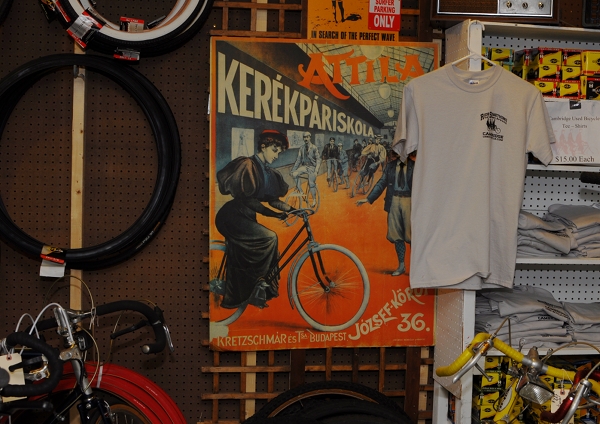
Ephemera and t-shirts, too. 

In addition to its physical presence, Old Roads offers a number of online resources for the Boston area and beyond. They host a message board where visitors can discuss a multitude of topics pertaining to vintage bikes, as well as post for sale/ wanted ads free of charge. They offer a price guide for used and vintage bicycles. And they sell some interesting hard to find parts online. While in the summer, bicycles are sold only locally, during the winter they can be shipped outside the Boston area as well. For those looking for a vintage English 3-speed in clean condition, this can be a good option if your area has a shortage. 

Like proprietors of used bookstores, vintage bike shop owners tend to be genuine enthusiasts - which means that the customer can benefit a lot more from interacting with them, than from interacting with someone who just wants to sell their old bike. Interesting stories, helpful advice, and local bicycle lore are just some of these benefits. Out of curiosity: Are there used or vintage bike shops in your area, and do you find them useful?

Wednesday, December 15, 2010

Holiday Gift Traditions - Reinterpreted for the Cyclist

Traditional gift-giving for the winter holidays is not so much about giving and receiving presents, as it is about the act of giving itself. Still, there are specific types of things that we tend to gift at this time of year, and these things tend to be symbolic: Light-hearted and sparkly gifts symbolise celebration. Warm and cozy gifts symbolise familial ties. Luxurious gifts symbolise good fortune in the year to come. Keeping these themes in mind, I have sought out the cycling-specific equivalents* of some popular winter holiday gifts. Not meant to be taken too seriously, but hopefully a fun read!

[left image via Velo Orange; right image via Lindt USA]

Traditional gift: Chocolate Truffles 
Reinterpreted for the cyclist: Classic Bicycle Bells

Holiday chocolates in festive wrappers are fun, shiny and celebratory. It is not even about the taste, but about the shiny look and the crinkling sound they make as you unwrap them. Champagne and sparkling wine is often brought into the mix to enhance this effect. How better to interpret it from a cycling perspective, than with a cheerful classic brass bell? Starting at as little as $8 (the Velo Orange version), they are a good match for the expensive holiday truffle offerings. Plus, long after the joy of the chocolates is gone and the crinkly metallic wrappers have been disposed off, the trusty bicycle bell will continue to bring good cheer to its recipient. 

[left image via Ibex; right image via GAP]

Traditional gift: Socks and Gloves
Reinterpreted for the cyclist: 100% Wool Socks and Gloves

Though there are plenty of cozy-looking, fluffy socks and gloves for sale this time of year, much of what is available tends to be made of some blend of acrylic and cotton with only a touch of wool, if at all. But it is amazing what a difference 100% wool makes in protecting your hands and feet from the cold - especially while cycling. Why not get the real deal for those you love? Surprisingly, the prices are not even that different: the Ibex "Knitty Gritty" gloves (100% wool) are $20, whereas the Gap "Knit Gloves" (100% acrylic) are $14.50. Both are available in a cheerful red colour, but the wool version will keep the cyclist happy through the winter months. 
[left image via DZ Nuts; right image via Bath & Body Works]

Traditional gift: Fragrance and Bath Products
Reinterpreted for the cyclist: Fancy Chamois Creams

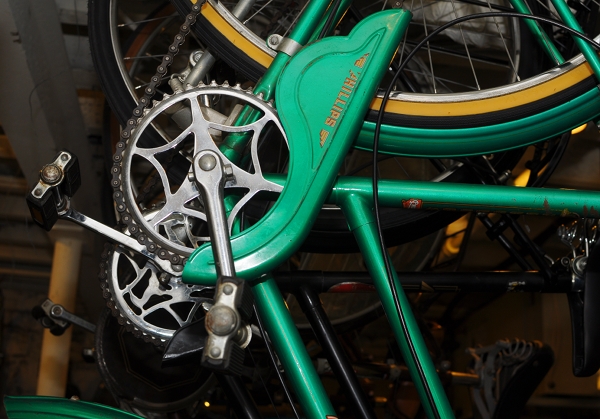
A gift of a soothing bath experience is easily translatable to a gift of a soothing cycling experience. Though many are embarrassed to discuss this, chamois creams can be extremely useful in preventing chafing and infection on some of our most cherished body parts during long rides. Many of them have herbal ingredients that smell especially festive for the holiday season, and the packaging of the new ladies' version of DZ Nuts is quite gift-appropriate as well. At $20 per tube, it's a good equivalent to most mid-range body lotions and bath products. 

[left image via Dutch Bike Seattle; right image via Harry and David]

Traditional gift: The Gourmet Food Basket
Reinterpreted for the cyclist: The Bicycle Basket

Nothing puts a smile on people's face like the traditional bicycle basket. It's adorable, it's extremely practical, and maybe, just maybe it will make motorists more kindly disposed towards the cyclist when they see it. There is something about baskets - be they for picnics, for mushroom-picking, or for cycling, that evokes images of the good life, and an innocent hope that things can be nicer, simpler, and more fun in the future. Those are pleasant thoughts to have during the winter holidays. And after all - here is no reason why the food basket and the bicycle basket gifts can't be combined. It would be fun to fill a wicker bicycle basket with the gift recipient's favourite treats. Prices vary in the $30-60 range.

[left image via Bicycle Quarterly; right image via Conde Nast]

Traditional gift: The Magazine Subscription 
Reinterpreted for the cyclist: The Bicycle Magazine Subscription 

Magazine subscriptions make good gifts for the winter holidays, because they reinforce the yearly cycle and the idea that something new and exciting will start to happen in the new year. Plus, it is not just a one-off gift: the recipient will continue to receive a little something throughout the year that will remind them of the person who gave them the gift. There are many bicycle magazines on the scene nowadays, including Momentum for those interested in transportation cycling, Bicycling for those interested in racing, and, my favourite, Bicycle Quarterly, for those interested in bicycle touring. Prices for subscriptions in the $20-30 range.
[left image via Brooks England; right image via J. Crew]

Traditional gift: The Cashmere Sweater 
Reinterpreted for the cyclist: The Leather Saddle 

Entering the territory of the more expensive gifts, one traditional one is the classic cashmere sweater. So beautiful, so luxurious, so delicate and light... and so easily destroyed by red wine spillage, or your adorably clingy cat. The leather saddle communicates the same ideas of luxury, quality, good taste and tradition - except it is infinitely more durable, particularly for the cyclist. A gift that is not only luxurious, but will last and can be used daily, is truly a gift to remember. The retail price of the Brooks saddle pictured above is $99 - just like the cashmere cardigan from J. Crew.

[left image via Mercian Cycles; right image via Tiffany &Co.]

Traditional gift: Heirloom Jewelry 
Reinterpreted for the cyclist: The Custom Handbuilt Bicycle

If expensive jewelry is to be given, the winter holidays are a traditional time for it. The idea is that jewelry is "forever" and the holidays are a good time to reaffirm that sentiment and commitment. The recipient of the jewel will wear it close to them - maybe even daily - and think of their special relationship to the gift-giver in the year to come, and hopefully all the years thereafter. A fine handbuilt bicycle frame can communicate the same sentiment to the person who is truly crazy about bicycles. Not only is it bound to be a very cherished possession, but the cyclist will likely ride it frequently and enjoy it immensely. Plus, if the bicycle is lugged, their filigreed forms are not dissimilar from actual jewels. Like the Tiffany's diamond earrings above (the .22 carat version), the stunning Mercian frame is priced at around $1,000. 

Regardless of which holidays you celebrate (for those in the "Christmas and Hannukah" camp, the holidays stretch out for an entire month this year!),  I hope you find them fun and enjoyable. And if any of these gift ideas are of interest, there is no harm in accidentally leaving your laptop open where your loved ones can see it, now is there?... They might even get the hint!

[* The products pictured here are not endorsements, paid adverts or part of any promotion]

User Friendly Interface

Now that it's winter, I find that strangers talk to me more than usual about cycling - typically when they see me locking up my bike. Over the past couple of weeks, several women have told me that they'd love to ride a bike, but find the logistics daunting: having to buy lights and figure out how to mount them; constantly getting flats (something they remember from previous cycling experiences); having to figure out how to carry their handbag, struggling to mount the bike in business attire, and other similar concerns. Their misgivings are fueled by the perception that cycling will complicate their lives - compared to walking, or taking public transportation, or driving.
What frustrates me about this, is that all of their concerns can be addressed with the right bike. As I explain about step-through frames, dynamo lighting, tires with puncture-protection, dress guards, chain cases, and panniers that attach to the bicycle's rack in seconds, I can see the ladies' faces light up as they eye these features hungrily.
One woman tried to step through my frame in her skirt-suit and squealed with delight when she was able to do it. She had never tried anything other than a mountainbike before. She said: "I knew you had a special type of bike! It's got this... user-friendly interface!" That phrase echoed in my mind for some time.

Even though I enjoy learning about bicycle design and own multiple bikes on which I constantly experiment, I am first and foremost a "transportation cyclist." My main priority is to have that one bike that is reliable, comfortable, and as low-maintenance as possible. The bicycle I use for transportation needs to make life easy for me. It needs to minimise the extent to which I think about it and tinker with it - so that I can focus on work and life itself, not on the bicycle.  Skirt suit? Heavy bag?  Dark outside? Raining like crazy? The "user friendly interface" on my machine accommodates all of these scenarios.

Many manufacturers are making what they are calling "transportation bicycles" nowadays, but not all of these bikes work for everyone. When a woman wearing a skirt suit walks into a bike store and says she would like to start cycling to work, my hope is that the salesperson will point to the section with the right kind of bicycle for her - rather than saying "Well, you won't be able to do it wearing that!" A user-friendly interface means that we should all be able to do it. Holiday wish: more elegant, practical, comfortable bicycle options for the women in skirt-suits who feel out of place in bike shops. It's getting better, but we aren't there yet.